

C1 Korean Masterclass: Discussing Urban Gentrification and Regeneration Like a Local
Phase 1: Empathy (Welcome to the Real Seoul!)
안녕하세요! (Annyeonghaseyo!) Welcome back to another edition of Daily Hangul, your premium guide to mastering authentic Korean culture and language. I’m your chief editor and local cultural navigator.
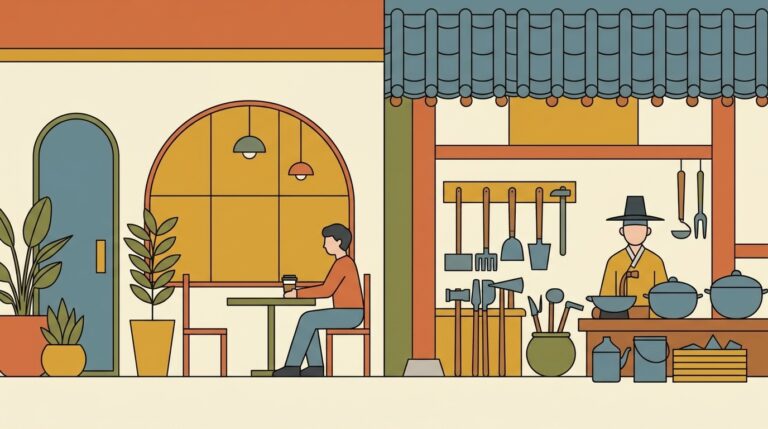
Have you ever walked through the vibrant, trendy streets of Seongsu-dong (성수동) or Euljiro (을지로)? Ten years ago, these areas were filled with dusty shoe factories and ironmonger shops. Today, they are filled with avant-garde cafes, high-fashion pop-up stores, and bustling crowds. While this transformation brings exciting energy, it also brings a complex social issue: gentrification.
If you want to discuss urban planning, culture, and social changes in Korean at a C1 level, you need more than just simple textbook vocabulary. Our advanced learners often tell us, “I want to express my sadness about my favorite local spots closing down, but I don’t know the right words!” Today, we are going to dive deep into the linguistic and cultural nuances of urban regeneration and gentrification, giving you the tools to express deep empathy and critical thoughts in fluent Korean.
Phase 2: Core Expressions Deep Dive
1. 둥지 내몰림 (Deungji Naemollim)
- Pronunciation: Deung-ji nae-mol-lim (Sounds like “dung”-“jee” followed by “nae-mol-lim” as in “impelling” out of a nest).
- Meaning: Gentrification displacement (Literally, “being pushed out of one’s nest”).
- K-Culture Moment: Often discussed in documentaries or news segments covering historic neighborhoods like Ikseon-dong or Euljiro where artists and early shop owners are forced to leave.
- Editor’s Insight: While Koreans use the loanword “젠트리피케이션” (gentrification), the native term 둥지 내몰림 carries a much deeper emotional weight. The word 둥지 (nest) evokes the cozy, safe home that local shopkeepers worked hard to build, making their displacement feel tragic and unfair.
- Situation Spectrum: Casual (⚠️) / Semi-formal (✅) / Formal (✅)
- 🤔 Think About It: How does your native language describe the phenomenon of local merchants being forced out of their neighborhoods? Does it use soft, technical words or emotional metaphors like “nest displacement”?
2. 옛 정취를 잃다 (Yet Jeongchwi-reul Ilta)
- Pronunciation: Yet jeong-chwi-reul il-ta (The word “jeong-chwi” sounds like “jung-chwee” with a crisp “ch” sound).
- Meaning: To lose its old charm, vibe, or nostalgic atmosphere.
- K-Culture Moment: You will hear this phrase in lifestyle K-Dramas when characters visit their old childhood neighborhoods only to find them replaced by cold, modern concrete high-rises.
- Editor’s Insight: 정취 (Jeongchwi) is a sophisticated word that combines “jeong” (affective attachment) and “chwi” (flavor/aroma). It refers to the unique, nostalgic atmosphere of a specific place that cannot be replicated by modern chains.
- Situation Spectrum: Casual (✅) / Semi-formal (✅) / Formal (✅)
- 🤔 Think About It: Is there a neighborhood in your city that has “lost its old charm” (옛 정취를 잃다)? How would you describe that feeling to a friend?
3. 상생 협약을 맺다 (Sangsaeng Hyeopyak-eul Maetda)
- Pronunciation: Sang-saeng hyeop-yak-eul maet-da (The word “sang-saeng” sounds like “sahng-saeng”).
- Meaning: To sign a win-win/coexistence agreement.
- K-Culture Moment: This is a common phrase in local government announcements or social campaigns trying to protect local merchants by capping rent increases.
- Editor’s Insight: 상생 (Sangsaeng) means “living together in harmony” or “mutual prosperity.” It is a core community value in Korean society, emphasizing that landlords and tenants should thrive together rather than competing selfishly.
- Situation Spectrum: Casual (🚫) / Semi-formal (✅) / Formal (✅)
- 🤔 Think About It: Does your local government promote “coexistence agreements” between property owners and small businesses? Or does the market operate purely on supply and demand?
Phase 3: Textbook Korean vs. Real Korean
Let’s compare the sterile sentences in standard textbooks with how advanced, native speakers actually express these sentiments.
Situation 1: Expressing that a neighborhood is becoming too commercialized
- 📖 Textbook Korean: 이곳은 상업화로 인해 임대료가 많이 올랐습니다.
(This place’s rent has increased significantly due to commercialization.) - 🗣️ Real Korean: 여기 요즘 뜨더니 결국 젠트리피케이션 피하지를 못했네요. 골목 상권 다 죽었어요.
(This place got popular lately, and in the end, it couldn’t escape gentrification. The alleyway business district is completely dead.) - 💡 Why the difference? Native speakers use “뜨다” (to rise/become popular) and “골목 상권” (alleyway business district) to describe the phenomenon organically, reflecting a shared social sadness.
Situation 2: Expressing sadness about a favorite old diner closing down
- 📖 Textbook Korean: 임대료 상승으로 단골 식당이 폐업했습니다.
(The regular restaurant closed down due to a rent increase.) - 🗣️ Real Korean: 월세가 미쳐서 단골집이 밀려나듯 문을 닫았어요. 너무 씁쓸하네요.
(Rent went crazy, and my favorite local spot got pushed out and closed down. I feel so bitter.) - 💡 Why the difference? C1 speakers use terms like “미치다” (to go crazy – describing rents) and “밀려나다” (to get pushed out) to show strong emotional alignment with the affected business owners.
Phase 4: K-Culture Deep Dive & Non-verbal Manners
4-1. Nunchi & Gestures
When discussing heavy topics like gentrification in Korea, your body language should convey deep empathy (공감).
* The Bitter Smile & Sigh: When talking about a favorite old shop closing, Koreans often let out a soft, muted sigh (한숨) while shaking their head slightly.
* Hand-Waving: When emphasizing how a neighborhood has changed too much, avoid aggressive pointing. Instead, gently wave your hand side-to-side horizontally to express a sense of loss or negation.
4-2. The “Newtro” (뉴트로) Culture Code
Korea has experienced rapid modernization, leading to a massive wave of nostalgia. This gave rise to the Newtro (New + Retro) trend. While young Koreans love finding “hidden gems” inside old factories, this very trend accelerates gentrification. Understanding this double-edged sword—where appreciation for the old accidentally destroys it—is key to participating in intellectual discussions with Korean friends.
Phase 5: Real-Life Roleplay Scenario
The Setting
You are visiting a newly revitalized alleyway in Euljiro with your Korean friend, Ji-won (지원), a local neighborhood activist who is passionate about preserving community identity.
지원: 여기 예전에 진짜 멋진 대장간이랑 오래된 노포들이 많았는데... 이제 다 카페로 바뀌었네요.
(Yeogi ye-jeon-e jin-jja meot-jin dae-jang-gan-i-rang o-rae-doen no-po-deul-i man-at-neun-de... i-je da ka-pe-ro ba-kqui-eot-ne-yo.)
[Ji-won sighs softly while looking at a newly opened trendy dessert cafe.]

유저: 아, 정말요? 인테리어는 예쁘지만, 왠지 원래 있던 골목의 옛 정취를 잃어버린 것 같아 아쉬워요.
(A, jeong-mal-yo? In-te-ri-eo-neun ye-ppeu-ji-man, waen-ji won-rae it-deon gol-mok-ui yet jeong-chwi-reul il-eo-beo-rin geot gat-a a-swi-wo-yo.)
[You nod slowly, scanning the modern steel facade with a bitter smile.]

지원: 맞아요. 가파르게 오른 임대료 때문에 평생 일하시던 분들이 결국 둥지 내몰림을 당하신 거죠.
(Maj-a-yo. Ga-par-eu-ge o-reun im-dae-ryo ttae-mun-e pyeong-saeng il-ha-si-deon bun-deul-i gyeol-guk deung-ji nae-mol-lim-eul dang-ha-sin geo-jyo.)
[Ji-won folds her arms, looking deeply concerned.]

유저: 이런 현상을 막기 위해서 지자체나 건물주들이 상생 협약을 맺는 사례는 없나요?
(I-reon hyeon-sang-eul mak-gi wi-hae-seo ji-ja-che-na geon-mul-ju-deul-i sang-saeng hyeop-yak-eul maet-neun sa-rye-neun eop-na-yo?)
[You lean in slightly, showing active intellectual interest.]

지원: 다행히 성수동 같은 곳에서는 그런 상생 노력이 꽤 성과를 거두고 있다고 들었어요.
(Da-haeng-hi seong-su-dong gat-un got-e-seo-neun geu-ron sang-saeng no-ryeok-i kkwae seong-gwa-reul geo-du-go it-da-go deul-eot-eo-yo.)
[Ji-won's face brightens slightly with a glimmer of hope.]
🔀 Choose Your Next Turn!
- Option A: “자본주의 사회에서 어쩔 수 없는 일 아닌가요?”
- Option B: “상생 협약이 법적으로 강제성이 없어서 한계가 있을 것 같아요. 더 실효성 있는 대책이 필요해 보입니다.”
- Option C: “그럼 다음 주에 성수동 같이 가서 구경해요! 거긴 예쁜 카페 많죠?”
💬 Feedback on Your Choice:
- Option A (Risk): While economically realistic, stating this so bluntly can come across as cold or unsympathetic in a community-oriented culture. Use with caution.
- Option B (Best C1 Choice): Outstanding! This showcases deep critical thinking, utilizing high-level terms like “법적 강제성” (legal binding power) and “실효성 있는 대책” (effective measures).
- Option C (Bad): Changing the subject to “pretty cafes” right after discussing displaced merchants shows a lack of empathy and derails a deep conversation.
Phase 6: 10-Second Shadowing Drill
Practice saying this sentence with native emotional cadence. Pay attention to the pauses (/) and the emotional cue.
[🥺 Sighing with deep, bitter empathy]
“결국 / 임대료가 오르니까 / 오랫동안 자리를 지키던 / 단골집들이 / 다 밀려나네요.”
(Gyeol-guk / im-dae-ryo-ga o-reu-ni-kka / o-raet-dong-an ja-ri-reul ji-ki-deon / dan-gol-jip-deul-i / da mil-ryeo-na-ne-yo.)
Translation: In the end, as rents rise, the old local shops that kept this place alive for so long are all getting pushed out.
Phase 7: K-Culture Mini Dictionary
- 노포 (Nopo | 老鋪): An old, historic, family-run shop or restaurant that has survived for decades. Highly respected in Korea.
- 둥지 내몰림 (Deungji Naemollim): Nest displacement / Gentrification displacement. Represents social displacement of the vulnerable.
- 상권 활성화 (Sang-gwon Hwal-seong-hwa): Commercial revitalization. The process of bringing economic life back to a neighborhood.
- 원주민 (Won-ju-min): Original residents/native merchants of a developing or gentrifying area.
Phase 8: Traveler’s Survival Kit
Survival Phrases for Neighborhood Explorers
| Phrase (Korean) | Romanization | English Meaning | Pro-Tip |
|---|---|---|---|
| 여기 옛날 모습이랑 많이 달라졌나요? | Yeogi yennal moseub-irang mani dallajyeonnayo? | Has this place changed a lot from how it used to look? | Ask an old local shop owner this to hear their fascinating stories. |
| 예전 정취가 남아있는 곳을 추천해 주실래요? | Yejeon jeongchwi-ga nama-itneun goseul chucheonhae jusillaeyo? | Can you recommend a spot that still keeps its old nostalgic vibe? | Perfect for finding authentic, non-gentrified local hidden gems. |
| 여기가 요즘 가장 뜨는 골목이에요. | Yeogiga yojeum gajang tteuneun golmokieyo. | This is the most popular/trendy alleyway these days. | Great for introducing a cool spot to friends traveling with you. |
🗺️ Editor’s Travel Note
Before heading to Seoul’s historical alleys, make sure you download the Naver Map app. Unlike foreign maps, Naver Map lists tiny, historic 노포 (Nopo) that are hidden deep inside old manufacturing alleys. To learn more about Seoul’s efforts to balance growth and preservation, search the Seoul Urban Regeneration Portal for walking tours led by local residents.
Phase 9: “Going Deeper” (Sociocultural Essay)
At the heart of the gentrification debate in Korea lies the concept of 정 (Jeong)—the invisible, emotional bond shared within a community. In traditional Korean neighborhoods, a restaurant owner isn’t just a business owner; they are the “neighborhood auntie” (이모) who knows your family. When rapid capitalistic development drives these people away, Koreans feel they are losing not just a shop, but a piece of their social fabric. This is why urban regeneration in Korea focuses so heavily on community-led preservation projects.
💬 Your Turn
Have you seen similar changes in your hometown? What is your favorite historic neighborhood, and how is it dealing with modernization? Leave a comment below—let’s discuss in Korean!
Phase 10: FAQ & Avoiding Misunderstandings
Q: Can I use the English word “gentrification” in Korean?
A: Yes! Saying 젠트리피케이션 is widely understood by university students, professionals, and news media. However, if you are talking to elderly shop owners, using native terms like 둥지 내몰림 or 골목 상권이 바뀌다 (the alleyway commercial landscape is changing) sounds much more natural and empathetic.
Q: Is “도시 재생” (Urban Regeneration) the same as “재개발” (Redevelopment)?
A: Absolutely not! 재개발 (Jaegaebal) means tearing everything down to build shiny new apartment blocks. 도시 재생 (Dosi Jaesaeng) focuses on preserving the old structures while modernizing their functions. Make sure not to mix these up in critical discussions!
Q: How can I sound polite yet critical about rent increases?
A: Instead of saying “Landlords are greedy” (건물주들이 탐욕스러워요), use passive, sophisticated phrasing like: “임대료 상승 속도가 너무 가팔라서 상인들이 감당하기 어려운 수준입니다.” (The pace of rent increases is so steep that it is difficult for merchants to bear.)
🚨 Common Mistakes Warning Sign!
- Mistake 1: Calling an old neighborhood “더러워요” (Dirty).
- Correct Action: Use “허름하다” (Heoreum-hada) which means worn-down but full of character and humble charm.
- Mistake 2: Saying “원주민들이 버려졌어요” (Original residents were abandoned).
- Correct Action: Use “둥지 내몰림을 당했다” (Suffered nest displacement) to sound like a sophisticated C1 speaker.
- Mistake 3: Confusing “상생” (Win-win/Coexistence) with “상생물” (Living creatures).
- Correct Action: Remember that “상생” (Mutual prosperity) is written as 相生, denoting harmony between different parties.
Phase 11: Action Mission & Engagement
- 🥉 Bronze Level: Write down one sentence using “옛 정취” in the comments below.
- 🥈 Silver Level: Share a picture of a retro spot in your city on Instagram and tag us with the caption: “여기는 옛 정취가 가득한 곳이에요.”
- 🥇 Gold Level: Find a K-Drama scene (like in Itaewon Class or My Mister) where characters discuss their local neighborhood, and identify if they are talking about urban changes.
Phase 12: Interactive Quiz Challenge
Test your knowledge of advanced Korean urban terms!
1. Which term best describes the phenomenon of old merchants being forced out due to rising rent?
- A) 도시 재생
- B) 둥지 내몰림
- C) 상생 협약
🔍 Show Answer
Correct Answer: B) 둥지 내몰림
Explanation: “둥지 내몰림” literally translates to “being pushed out of one’s nest,” which is the beautiful native Korean term for gentrification displacement.
2. Fill in the blank: “이 골목은 옛 ( )를 잃어버려서 너무 아쉽네요.”
- A) 정취
- B) 둥지
- C) 협약
🔍 Show Answer
Correct Answer: A) 정취 (Jeongchwi)
Explanation: “옛 정취를 잃어버리다” is the set phrase meaning “to lose its old, nostalgic atmosphere.”
3. True or False: “상생 협약” is a legally binding contract that sends landlords to jail if they raise rent.
- A) True
- B) False
🔍 Show Answer
Correct Answer: B) False
Explanation: A “상생 협약” (Win-win agreement) is usually a voluntary/cooperative pact pushed by local governments to encourage harmony, though it often lacks strict, hard legal penalties unless backed by specific municipal ordinances.






