

Phase 1: 안녕하세요! Welcome to Your Korean Neighborhood Survival Guide!
안녕하세요! (An-nyeong-ha-se-yo!) I’m your Daily Hangul Chief Editor and your personal Korean culture guide.
Picture this: You’ve just moved into your cozy new studio apartment (원룸 – won-rum) in Seoul. You’ve unpacked, ordered some delicious fried chicken, and now you’re left with a pile of trash. You gather it all up in a regular grocery plastic bag, walk down to the designated trash area, and… stop in your tracks.
Every single bag out there is color-coded, labeled with official government stamps, and sorted meticulously. You realize you can’t just throw away trash in any random bag. In Korea, you must use official volume-rate garbage bags called 종량제 봉투 (jong-ryang-je bong-tu).
Don’t panic! It is one of the most common “initiation rites” for foreigners living in Korea. Today, we are going to learn how to walk into any convenience store like a local and confidently buy the exact trash bags you need. By the end of this guide, you’ll master this essential chore with absolute ease.
Phase 2: Master the 3 Key Expressions
Let’s break down the three most important sentences you need at the convenience store counter.
1. 일반 쓰레기 봉투 있어요? (Il-ban sseu-re-gi bong-tu is-seo-yo?)
- Pronunciation Analogy: il-bahn s’eu-reh-gee bong-too eet-suh-yo? (The “sseu” sound is like the sharp ‘s’ in “spit” combined with “uh”.)
- Meaning: “Do you have general trash bags?”
- K-Culture Moment: You walk into a local CU, GS25, or 7-Eleven. You approach the counter and ask the clerk this question.
- Editor’s Insight: “일반 쓰레기” (il-ban sseu-re-gi) means “general waste” (non-recyclables like tissues, wrappers, etc.). This distinguishes it from food waste (음식물 쓰레기) or recyclables (분리수거).
- Situation Spectrum: Casual (⚠️ 일반 쓰레기 봉투 있어?) | Semi-formal (✅ 일반 쓰레기 봉투 있어요?) | Formal (🚫 일반 쓰레기 봉투 있습니까? – too stiff for daily life!)
- 🤔 Think About It: How does your home country manage waste? Paying for garbage disposal per bag helps Koreans think twice before throwing things away!
2. 이십 리터짜리 세 장 주세요. (I-sip ri-teo-jja-ri se jang ju-se-yo.)
- Pronunciation Analogy: ee-ship lee-tuh-jjah-ree seh jahng joo-seh-yo.
- Meaning: “Please give me three 20-liter ones.”
- K-Culture Moment: The clerk will ask you what size you want. You reply with the volume (in liters) and the number of bags you need.
- Editor’s Insight: “짜리” (jja-ri) means “worth” or “of the size/value of.” “장” (jang) is the counting unit for flat paper or plastic sheets. Notice we use Sino-Korean numbers for liters (이십 – 20) but Native Korean numbers for the counter “장” (세 장 – 3 sheets).
- Situation Spectrum: Casual (⚠️ 이십 리터짜리 세 장 줘) | Semi-formal (✅ 이십 리터짜리 세 장 주세요) | Formal (🚫 이십 리터짜리 세 장을 요청합니다)
- 🤔 Think About It: Standard sizes for single households are usually 10 liters (십 리터) or 20 liters (이십 리터). What size fits your daily lifestyle best?
3. 봉투 카드 결제 돼요? (Bong-tu ka-deu gyeol-je dwae-yo?)
- Pronunciation Analogy: bong-too kah-deh gyuhl-jeh dweh-yo?
- Meaning: “Can I pay for the bags with a card?”
- K-Culture Moment: Some small neighborhood mom-and-pop marts (슈퍼마켓) historically preferred cash for official trash bags because they are government-regulated goods with almost zero profit margin. Today, convenience stores accept cards easily, but it’s always polite to ask!
- Editor’s Insight: “결제” (gyeol-je) means payment, and “돼요?” (dwae-yo) means “is it okay/possible?”.
- Situation Spectrum: Casual (⚠️ 봉투 카드 돼?) | Semi-formal (✅ 봉투 카드 결제 돼요?) | Formal (🚫 봉투 카드 결제가 가능합니까?)
Phase 3: Classroom Korean vs. Real-World Korean
Let’s compare what textbooks teach versus what actual locals say.
Scenario 1: Asking for the bags
- 📖 Textbook style: “종량제 봉투를 판매하십니까?” (Jong-ryang-je bong-tu-reul pan-mae-ha-sip-ni-kka?)
- “Do you sell volume-rate garbage bags?” -> This sounds like you are writing an official business email!
- 🗣️ Real-World Korean: “쓰레기 봉투 있어요?” (Sseu-re-gi bong-tu is-seo-yo?)
- “Do you have trash bags?” -> Simple, natural, and instantly understood by every clerk.
- 💡 Why the difference? Locals shorten “종량제 봉투” to just “쓰레기 봉투” (trash bag) in daily conversations because the context makes it obvious.
Scenario 2: Specifying the size
- 📖 Textbook style: “이십 리터 용량의 봉투로 세 개를 주십시오.” (I-sip ri-teo yong-ryang-ui bong-tu-ro se gae-reul ju-sip-si-o.)
- “Please give me three bags of 20-liter capacity.” -> Super robotic.
- 🗣️ Real-World Korean: “이십 리터짜리 세 장 주세요.” (I-sip ri-teo-jja-ri se jang ju-se-yo.)
- “Give me three 20-liter ones, please.”
- 💡 Why the difference? Using “짜리” (value/size marker) and the correct counter “장” (for sheets) makes you sound incredibly natural.
Phase 4: K-Culture Deep Dive & Non-verbal Manners
4-1. Nunchi & Gestures
- Two-Handed Respect: When handing over your credit card or cash, always use both hands (or place your left hand gently under your right forearm/elbow). It shows immense respect to the convenience store worker.
- Visualizing the Size: If you forget the Korean word for “liter,” you can use your hands to show a medium-sized box shape. Koreans are quick to catch on (눈치 – Nunchi)!
4-2. The Culture Code: Our Shared Environment
In Korea, waste management is a serious community effort. Under the “종량제” (Jong-ryang-je) system, you pay for the exact volume of waste you produce by purchasing these special bags. Different districts (구 – gu) have different colored bags! For example, a bag bought in Mapo-gu cannot be used if you move to Gangnam-gu. Always buy them from a store in your own neighborhood.
Phase 5: Real-Life Roleplay Scenario
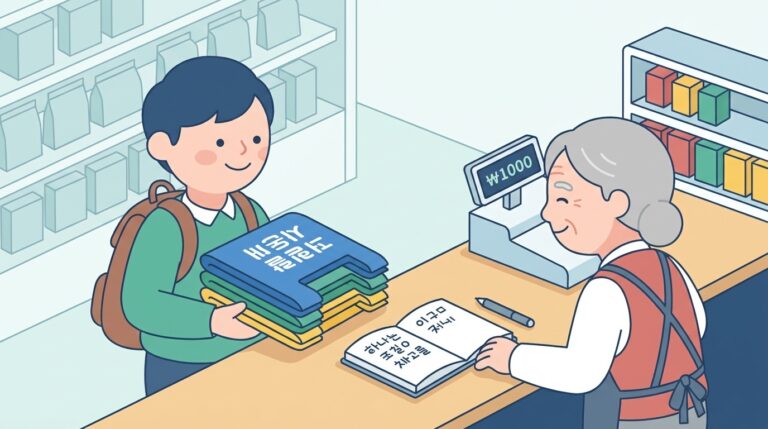
Setting: A cozy GS25 convenience store in Hongdae. An elderly neighborhood owner (사장님 – sa-jang-nim) is at the cash register. You walk in to buy trash bags.
- 사장님 (Clerk): 어서 오세요! 뭐 찾으시는 거 있으세요?
(Eo-seo o-se-yo! Mwo chat-eu-si-neun geo is-seo-se-yo?)- “Welcome! Are you looking for something?”
- 나 (You): (Smiling politely) 저… 일반 쓰레기 봉투 있어요?
(Jeo… il-ban sseu-re-gi bong-tu is-seo-yo?)- “Uh… do you have general trash bags?”
- 사장님 (Clerk): 네, 있어요. 몇 리터짜리 필요하세요?
(Ne, is-seo-yo. Myeot ri-teo-jja-ri pil-yo-ha-se-yo?)- “Yes, we do. What size do you need?”
- 나 (You): 이십 리터짜리 세 장 주세요.
(I-sip ri-teo-jja-ri se jang ju-se-yo.)- “Give me three 20-liter ones, please.”
- 사장님 (Clerk): 이십 리터 세 장이요. 여기 있습니다. 더 필요한 건 없으세요?
(I-sip ri-teo se jang-i-yo. Yeo-gi is-seup-ni-da. Deo pil-yo-han geon eop-seu-se-yo?)- “Three 20-liter bags. Here they are. Anything else you need?”
- 나 (You): 아니요, 괜찮아요. 혹시 카드 결제 돼요?
(A-ni-yo, gwaen-chan-a-yo. Hok-si ka-deu gyeol-je dwae-yo?)- “No, I’m fine. By the way, can I pay by card?”
- 사장님 (Clerk): 네, 물론이죠! 카드 단말기에 꽂아주세요.
(Ne, mul-ron-i-jyo! Ka-deu dan-mal-gi-e kkoj-a-ju-se-yo.)- “Yes, of course! Please insert your card in the terminal.”
- 나 (You): (Handing over card with two hands) 감사합니다! 수고하세요!
(Gam-sa-hap-ni-da! Su-go-ha-se-yo!)- “Thank you! Have a nice day!”
🔀 Choose Your Adventure!
What if the clerk asks you: “우리 구 봉투가 맞나요?” (Is this for our district?)
* A) “네, 마포구 맞아요!” (Yes, Mapo-gu is correct!) -> [Best Choice] You show you understand how the regional garbage system works!
* B) “잘 모르겠어요…” (I’m not sure…) -> [Risk Choice] The clerk will kindly explain that you must buy the bag matching your current living district.
* C) “그냥 아무거나 주세요!” (Just give me any!) -> [Bad Choice] If you use the wrong district’s bag, your trash won’t be collected and you might get fined!
Phase 6: 10-Second Shadowing Drill
Practice speaking with real Korean rhythm and emotion! Follow the pauses (/) and matching vibes.
[😊 Asking politely and hesitantly]- 쓰레기 봉투 / 있어요?
- Sseu-re-gi bong-tu / is-seo-yo?
[😎 Confidently ordering]- 이십 리터짜리 / 세 장 / 주세요.
- I-sip ri-teo-jja-ri / se jang / ju-se-yo.
[👋 Saying a friendly goodbye]- 감사합니다! / 수고하세요!
- Gam-sa-hap-ni-da! / Su-go-ha-se-yo!
Phase 7: K-Culture Mini Dictionary
- 종량제 봉투 (Jong-ryang-je bong-tu) | Official volume-rate trash bags sold at supermarkets and convenience stores.
- 일반 쓰레기 (Il-ban sseu-re-gi) | General waste. Non-recyclable items that go into your purchased official trash bags.
- 음식물 쓰레기 (Eum-sik-mul sseu-re-gi) | Food waste. This must be separated entirely from general waste and thrown in special food waste bags (usually yellow or pink).
- 재활용 / 분리수거 (Jae-hwal-yong / Bun-ri-su-geo) | Recycling / Waste separation (sorting plastics, papers, cans, glasses separately).
Phase 8: Survival Kit for Travelers & Expats
Top 3 Survival Phrases
- 이거 봉투에 담아주세요. (I-geo bong-tu-e dam-a-ju-se-yo.)
- “Please put this in a shopping plastic bag.” (Used when buying general groceries).
- 쓰레기 어디에 버려요? (Sseu-re-gi eo-di-e beo-ryeo-yo?)
- “Where do I throw away the trash?”
- 영수증 버려주세요. (Yeong-su-jeung beo-ryeo-ju-se-yo.)
- “Please throw away the receipt for me.”
💡 Editor’s Travel Note
Before throwing out any major electronic appliance or furniture, you must buy a special sticker (스티커) at your local community center (주민센터) or download a local district office app to report it. To check your local district waste schedule and rules, you can search on Seoul Metropolitan Government’s Official Webpage or use Naver Maps to locate your nearest Community Center (주민센터).
Phase 9: “One Step Deeper” (Reflecting on Korean Life)
In Korea, waste separation is not just a policy—it is a collective social responsibility. You will often see elderly citizens sweeping neighborhood streets, and neighbors politely correcting someone who put plastic in the general waste bin. This collective effort is called 공동체 의식 (gong-dong-che ui-sik – community consciousness). It reflects the Korean value of maintaining harmony and cleanliness in shared public spaces.
💬 Your Turn: Have you ever experienced a strict recycling system like Korea’s? Leave a comment below with your thoughts!
Phase 10: FAQ & Common Mistakes
Q: Can I buy trash bags at any supermarket?
A: Yes! You can buy them at major convenience store chains (CU, GS25, 7-Eleven, Emart24) and neighborhood local marts. They are usually kept behind the counter, so you need to ask the clerk directly.
Q: What happens if I use a regular plastic grocery bag for general trash?
A: The sanitation workers will not collect it, and you can be fined up to 300,000 KRW for illegal dumping (무단투기).
Q: Are food waste bags the same as general waste bags?
A: No! Food waste bags (음식물 쓰레기 봉투) are completely separate, usually smaller, and colored differently (commonly orange or yellow depending on the district).
🚨 Common Mistakes Alert!
- Mistake 1: Buying the wrong district’s bag.
- Correct Action: Ensure the bag says your district’s name (e.g., “마포구” for Mapo, “강남구” for Gangnam).
- Mistake 2: Putting chicken bones in the food waste bag.
- Correct Action: Bones, shells, and hard seeds are classified as 일반 쓰레기 (general waste) because animals cannot digest them!
Phase 11: Action Mission & Engagement
- 🥉 Bronze Mission: Practice the shadowing drill (Phase 6) out loud three times in your room!
- 🥈 Silver Mission: Take a photo of a Korean trash bag or a recycling station, upload it to your Instagram story, and tag us at @DailyHangul!
- 🥇 Gold Mission: Walk into a local Korean market or convenience store and successfully buy a 10L or 20L bag using only Korean!
Phase 12: Interactive Quiz
1. Which phrase should you say to ask for three 10-liter trash bags?
- A) 이십 리터짜리 세 장 주세요.
- B) 십 리터짜리 세 장 주세요.
- C) 일반 쓰레기 카드 결제 돼요?
2. (True or False) Chicken bones go into the food waste bag.
- True / False
🎉 Click here to see the answers and explanations!
- Question 1 Answer: B) 십 리터짜리 세 장 주세요. (십 리터 is 10 liters, 세 장 is three sheets).
- Question 2 Answer: False! Hard bones are classified as general waste (일반 쓰레기) because they cannot be processed into animal feed.







