

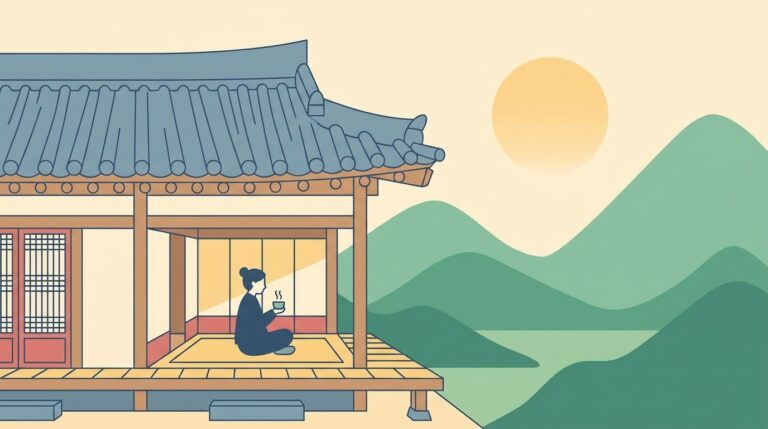
Finding Peace of Mind: How to Express Mindfulness and Spiritual Healing in Korean (B1)
안녕하세요! Hello, it’s your favorite Korean best friend and senior editor from Daily Hangul! 👋 Have you ever watched a healing K-Drama—like Hometown Cha-Cha-Cha or Our Blues—where characters escape the suffocating hustle of Seoul, sit by the quiet sea or inside a serene mountain temple, and just take a deep, long breath?
You can almost feel the stress leaving their shoulders, right?
Many of our global learners tell us: “I know how to say ‘I am happy’ (행복해요) or ‘I am busy’ (바빠요), but how do I express that deep, soulful feeling of finding inner peace and clearing my head in Korean?” Today, we are going to dive deep into the beautiful vocabulary of mindfulness, mental healing, and spiritual peace. By the end of this guide, you won’t just learn words; you will learn how Koreans actively protect their mental well-being in a fast-paced society. Let’s find our inner peace together! 🧘♂️✨
Phase 2: Deep Dive into 3 Key Expressions
Let’s look at three deeply nuanced expressions that Koreans use to describe finding mental and spiritual peace.
1. 마음이 편안해지다 (ma-eu-mi pyeon-an-hae-ji-da)
- Pronunciation: Ma-eu-mi pyeon-an-hae-ji-da (Sounds like “mah-um-ee pyun-ahn-hae-jee-da”)
- Meaning: For one’s heart/mind to become comfortable and peaceful.
- K-Culture Moment: This is the exact phrase a character whispers when they finally sit down with a warm cup of herbal tea in a traditional Hanok cafe, away from their noisy office.
- Editor’s Insight: Be careful! Physical comfort (like sitting on a soft sofa) is 편하다 (pyeon-hada). But deep emotional, mental, or spiritual peace is always 편안하다 (pyeon-anhada). Adding -해지다 means “to become,” showing a transition from stress to peace.
- Situation Spectrum: Casual (✅) / Semi-formal (✅) / Formal (✅)
- 🤔 Think About It: Does your native language have different words for physical comfort vs. spiritual peace, or do you use the same word?
2. 머리를 비우다 (meo-ri-reul bi-u-da)
- Pronunciation: Meo-ri-reul bi-u-da (Sounds like “muh-ree-reul bee-oo-dah”)
- Meaning: To empty one’s head; to clear one’s mind.
- K-Culture Moment: Often used when a character goes on a solo night walk along the Han River or takes up a repetitive, meditative hobby like knitting or puzzle-making.
- Editor’s Insight: This is a highly active expression! It implies that you are consciously choosing to sweep away all cluttered thoughts, worries, and anxieties.
- Situation Spectrum: Casual (✅) / Semi-formal (✅) / Formal (⚠️ – slightly colloquial, but polite enough)
- 🤔 Think About It: In Korean, we “empty our head” (머리) to find peace. What part of the body do you “empty” in your culture to destress?
3. 마음을 다스리다 (ma-eu-meul da-seu-ri-da)
- Pronunciation: Ma-eu-meul da-seu-ree-da (Sounds like “mah-um-eul dah-seu-ree-dah”)
- Meaning: To govern, control, or calm one’s mind/emotions.
- K-Culture Moment: In historical K-dramas (사극), you will see kings practicing calligraphy or drinking hot tea to control their anger or anxiety. They are “governing” their minds.
- Editor’s Insight: The word 다스리다 originally means “to rule over a country.” Using this for your mind implies that you are the sovereign ruler of your own emotions. It’s a very elegant, mindful phrase.
- Situation Spectrum: Casual (⚠️ – sounds a bit dramatic in casual chit-chat) / Semi-formal (✅) / Formal (✅)
- 🤔 Think About It: Treating your mind like a kingdom to be ruled is a classic Eastern philosophical concept. How do you view mind control in your culture?
Phase 3: Textbook Korean vs. Real Korean
Let’s look at how to sound like a natural local instead of a translation machine!
Scenario A: Describing why you want to visit a quiet place
- 📖 Textbook Korean: “저는 종교가 있어서 절에 가고 싶습니다.” (I want to go to a temple because I have a religion.)
- 🗣️ 진짜 (Real) Korean: “요즘 생각이 너무 많아서 마음 좀 비우러 절에 가고 싶어요.” (Lately I have too many thoughts, so I want to go to a temple to empty my mind.)
- 💡 Why it’s different: In Korea, visiting quiet temples or doing a “Temple Stay” isn’t strictly religious. Even non-religious or Christian Koreans visit temples simply to find quietude and nature. Real Koreans express the emotional motive rather than just stating their religion.
Scenario B: Reacting to a quiet, peaceful view
- 📖 Textbook Korean: “이곳은 평화롭습니다.” (This place is peaceful.)
- 🗣️ 진짜 (Real) Korean: “와, 여기 진짜 힐링되네요.” (Wow, I’m getting some serious ‘healing’ here.)
- 💡 Why it’s different: While “평화롭다” is grammatically perfect, it sounds like a line from a documentary. Modern Koreans love the English loanword 힐링 (healing). Whenever a place, a meal, or a view makes them feel peaceful, they say “힐링돼요” (It’s healing/I feel healed).
Phase 4: K-Culture 딥다이브 (Deep-Dive) & Non-verbal Manners
4-1. Temple & Tea House Etiquette: The Quiet Gesture
When searching for peace at a traditional Korean temple (절) or a quiet tea house (찻집), your non-verbal cues speak louder than words.
* 합장 (Hapjang): If you meet a Buddhist monk, bring your palms together in front of your chest and bow slightly. It’s a beautiful sign of mutual respect.
* Step Lightly: Walk softly, keeping your hands clasped politely in front of your stomach. This posture is called 차수 (Chasu) and shows that you are in a state of calm reflection.
4-2. The “Meong” (멍) Culture: The Art of Staring into Nothingness
Did you know Koreans have a dedicated word for zoning out to find peace? It’s called 멍때리기 (meong-ttae-ri-gi)! In our busy, hyper-connected society, actively doing nothing is a form of spiritual therapy. We even categorize it:
* 불멍 (bul-meong): Staring blankly at a campfire.
* 물멍 (mul-meong): Staring blankly at a river, ocean, or rain.
* 숲멍 (sup-meong): Staring blankly at green trees and mountains.
Many Koreans escape to mountain cabins or Hanok stays just to do some sup-meong and clear their overloaded brains.
Phase 5: 실전 롤플레이 (Real Roleplay Scenario)
Let’s head to a cozy Hanok tea house in Insadong, Seoul. You are sitting with your close Korean friend, Ji-woo (지우), who looks incredibly stressed from her office job.
- Characters:
- Ji-woo (지우): Your busy, tired Korean office worker friend.
- You (민지/Min-ji): The supportive friend helping her find peace.
Ji-woo: 아, 진짜 요즘 회사 때문에 미치겠어. 머리가 터질 것 같아.
(Ah, seriously, work is driving me crazy lately. I feel like my head is going to explode.)
You: 🎭 [Gently pushing a warm cup of lotus tea toward her]
지우야, 일단 이 따뜻한 차 좀 마셔 봐. 머리 좀 식히자.
(Ji-woo, first try drinking some of this warm tea. Let’s cool down your head.)
Ji-woo: (Takes a sip, closes her eyes, and exhales deeply)
음… 차 향이 진짜 좋다. 여기 오니까 좀 살 것 같네.
(Mmm… the tea scent is really nice. Coming here makes me feel like I can finally breathe.)
You: 🎭 [Smiling warmly]
그치? 여기 오면 마음이 편안해져서 나도 자주 와.
(Right? Coming here makes my mind so peaceful, so I come here often too.)
Ji-woo: 너는 스트레스 많이 받을 때 어떻게 해?
(What do you do when you get super stressed?)
You: 🎭 [Leaning in with a friendly wink]
나는 그냥 조용한 산에 가서 멍때리기 해. 그러면 머리가 비워지거든.
(I just go to a quiet mountain and zone out. Because then, my head gets cleared.)
Ji-woo: 멍때리기? 나도 해보고 싶다. 이번 주말에 나랑 같이 갈래?
(Zoning out? I want to try that too. Do you want to go with me this weekend?)
You: 🎭 [Clapping hands happily]
좋아! 이번 주말에 같이 힐링하러 가자!
(Awesome! Let’s go get some healing together this weekend!)
🔀 Interactive Choice Point
How would you respond if Ji-woo suddenly asks: “But what if I can’t stop thinking about my boss even when zoning out?”
- Option A: “그냥 다 잊어버려요!” (Just forget everything!)
- Feedback (Bad): Too aggressive! It doesn’t offer practical empathy or flow with the peaceful mood.
- Option B: “그럴 때는 호흡에 집중하면서 마음을 다스려 봐요.” (In that case, try to control your mind while focusing on your breath.)
- Feedback (Best – B1 Superstar!): Incredible! You used the deep verb “마음을 다스리다” in a practical, comforting way.
- Option C: “그럼 술 마시러 가요!” (Then let’s go drink alcohol!)
- Feedback (Risk): Fun, but it defeats the purpose of finding spiritual peace and quietude! Save the Soju for another night.
Phase 6: 10-Second Emotion Shadowing Drill
Let’s practice speaking with real Korean emotions. Pay attention to the pause markers / and the emotional cues!
- [😊 With a deep sigh of relief, feeling the tension melt away]
- “아… / 이제야 / 마음이 좀 / 편안해지네요.”
- Pronunciation: Ah… / ee-jae-yah / mah-um-ee jom / pyun-ahn-hae-jee-nae-yo.
- Meaning: Ah… my mind finally feels at ease now.
- [😌 Wisely, offering warm advice to a stressed friend]
- “생각이 너무 많을 때는 / 머리를 비우는 게 / 최고예요.”
- Pronunciation: Saeng-gak-ee nuh-mu mahn-eul ttae-neun / muh-ree-reul bee-oo-neun gae / chae-go-yae-yo.
- Meaning: When you have too many thoughts, clearing your head is the absolute best.
Phase 7: K-Culture Mini Dictionary
- 템플스테이 (Temple Stay): A cultural program allowing visitors to experience Buddhist monastic life. Extremely popular for digital detoxes.
- 힐링 (Healing): A massive lifestyle keyword in Korea. It refers to any activity that restores mental peace (e.g., healing trip, healing food).
- 마음공부 (Ma-eum-gong-bu): Literally “mind study.” It refers to self-reflection, reading philosophy, or practicing mindfulness to mature emotionally.
- 이너피스 (Inner Peace): Borrowed from English, often used both seriously and humorously (e.g., “I am repeating ‘inner peace’ to not yell at my computer right now”).
Phase 8: Survival Kit for Travelers
Survival Expressions TOP 3
- “여기 조용한 자리 있어요?” (Yeo-gi jo-yong-han ja-ri iss-eo-yo?)
- Meaning: Is there a quiet seat here?
- Pro Tip: Use this in traditional tea houses to get tucked-away cozy corners.
- “이 근처에 가볼 만한 조용한 사찰(절)이 있어요?” (Ee geun-cheo-ae ga-bol mahn-han jo-yong-han sa-chal-ee iss-eo-yo?)
- Meaning: Is there a quiet Buddhist temple worth visiting nearby?
- “템플스테이 예약하고 싶어요.” (Temple-stay yae-yak-ha-go sip-eo-yo.)
- Meaning: I would like to book a temple stay.
📌 Editor’s Travel Note:
To find peace in the middle of Seoul, download the Naver Map App and search for 길상사 (Gilsangsa Temple) or 봉은사 (Bongeunsa Temple). These are quiet, beautiful temples easily accessible by subway where you can experience instant peace amidst the skyscrapers. (Note: Temple program availability and hours may vary, so check their official websites beforehand.)
Phase 9: “한 발 더 깊이” (Go Deeper)
In Western cultures, finding peace is often seen as an individual journey—going to therapy, meditating alone in a room, or doing yoga. In Korea, while individual meditation is valued, peace is also heavily linked to 자연과의 조화 (harmony with nature) and 정 (Jeong – collective affection).
Koreans often find peace by sharing a quiet moment with others, silently watching the rain fall under the eaves of a Hanok house, or drinking tea made by a monk. It is a shared, quiet connection with the surrounding world rather than just an isolated internal state.
💬 Your Turn: How do you find peace when you feel overwhelmed? Do you prefer being completely alone, or do you find peace in quiet nature with close friends? Tell us in the comments below! (Feel free to try writing in Korean!)
Phase 10: FAQ & Common Mistakes
Q: Can I use “편안하다” to describe a comfortable bed?
A: It is better to use 편하다 for physical objects. For example, “이 침대 진짜 편해요” (This bed is really comfortable). Use 편안하다 for emotional states, atmospheres, or soft lighting that makes your soul feel relaxed: “분위기가 참 편안하네요” (The atmosphere is indeed very peaceful/relaxing).
Q: What is the difference between “사찰” and “절”?
A: Both mean Buddhist temple! 절 is the native, more common everyday Korean word, while 사찰 is a Sino-Korean, formal term. In everyday speech, just say 절.
Q: Is “힐링” considered slang? Can I use it in formal settings?
A: It started as a trendy buzzword, but it is now so widely accepted that you will see it in news headlines, books, and corporate wellness programs. You can use it safely with your boss or elders!
🚨 Common Mistakes Alert!
| Incorrect Usage | Correct Action | Why? |
|---|---|---|
| “마음이 편해요.” | “마음이 편안해요.” | 편하다 sounds like you are being lazy or avoiding work. 편안하다 correctly expresses emotional peace. |
| “머리를 청소해요.” | “머리를 비워요.” | You “clean” (청소) a room, but you “empty” (비우다) your brain of stressful thoughts. |
| “평화를 찾아요.” | “이너피스를 찾아요.” or “힐링해요.” | 평화 (Peace) sounds like you are a diplomat negotiating world peace. For personal peace, use 이너피스 or 힐링. |
Phase 11: Action Mission & K-Culture Challenge
- 🥉 Bronze Mission: Write “오늘 제 마음은 편안해요” (My mind is peaceful today) in your journal or phone notes.
- 🥈 Silver Mission: Go to a quiet park or cafe, do some 멍때리기 (zoning out) for 5 minutes, and take a photo. Post it on Instagram with the hashtag #DailyHangul_Healing!
- 🥇 Gold Mission: Use the phrase “머리 좀 비우고 싶어요” (I want to clear my head) next time you talk with a Korean speaker or write to a penpal.
🎮 K-Culture Mission
Watch a slow-paced K-Drama like Summer Strike or Little Forest. Listen closely for when the characters say “편안하다” or mention “힐링”. Write down the context in which they used it!
Phase 12: Interactive Quiz Challenge
Test your mindfulness vocabulary with this quick quiz!
1. Situation Judgment
You are standing in front of a majestic, quiet green mountain forest in Korea. You want to express how peaceful your soul feels. What do you say?
* A) 머리가 터질 것 같아요! (My head is going to explode!)
* B) 여기 진짜 숲멍하기 좋네요. 마음이 편안해져요. (This place is great for forest-zoning. My mind becomes so peaceful.)
* C) 이 침대 정말 편하네요. (This bed is really comfortable.)
Reveal Answer & Explanation
- Correct Answer: B
- Explanation: 숲멍 (forest-zoning) and 마음이 편안해지다 perfectly capture the peaceful, spiritual nature-gazing vibe. A expresses stress, and C is about a bed!
2. Fill in the Blanks
Fill in the missing verb to complete the phrase: “I need to empty my head of thoughts.”
* “생각이 많을 때는 머리를 ( )야 해요.”
Reveal Answer & Explanation
- Correct Answer: 비워 (bi-gweo) / 비워야 (from 비우다 – to empty)
- Explanation: The full sentence is: “생각이 많을 때는 머리를 비워야 해요.” (When there are many thoughts, you must empty your head.)
3. True or False
Q: Koreans only do “Temple Stays” if they are deeply religious Buddhists. (T / F)
Reveal Answer & Explanation
- Correct Answer: False
- Explanation: Temple stays are highly popular cultural healing programs open to everyone, regardless of religion. Many people go simply for a digital detox, fresh mountain air, and a chance to 머리를 비우다 (clear their heads).







