

Finding Your Cozy Nest in Korea: How to Say ‘I’m Looking for a Room’ Like a Local!
Phase 1: Empathy (Welcome Home!)
안녕하세요! (An-nyeong-ha-se-yo!) Welcome back, my dear friend! It is your favorite Korean study buddy and Senior Editor from Daily Hangul here!
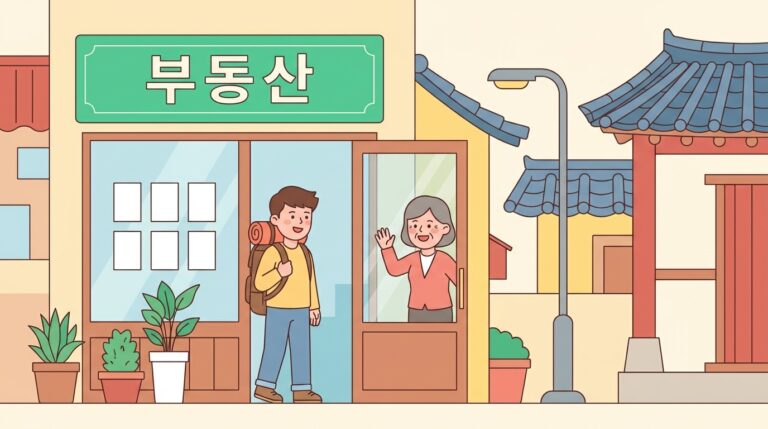
Imagine this: You have just arrived in Seoul. The neon lights are sparkling, the smell of delicious street food is in the air, and you are ready to start your dream life. But there is one major hurdle—you need a place to live! You walk down a charming street and spot a window covered in colorful paper slips with numbers like “500/45” or “1000/60” written on them. Above the door, a bright green sign reads 부동산 (Bu-dong-san).
Your heart does a little nervous flip. “How do I even start this conversation in Korean? What if I say the wrong thing?”
Don’t worry! Every expat and K-Drama protagonist (remember Dong-man and Ae-ra in Fight for My Way?) has stood exactly where you are standing right now. Today, we are going to master the exact, natural phrases you need to walk into any Korean real estate agency and confidently say, “I am looking for a room!” Let’s unlock your new home together!
Phase 2: 3 Core Expressions Deep Dive
1. 방 구하러 왔어요. (Bang gu-ha-reo wass-eo-yo.)
- Pronunciation: Bahng goo-hah-ruh wah-suh-yo (Sounds like: “Bahng” + “goo-hah-ruh” + “wah-suh-yo”)
- Meaning: “I came here to look for a room.” (Literal: “To seek room, I came.”)
- K-Culture Moment: This is the ultimate magic phrase. The moment you push open the sliding door of a neighborhood budongsan, you say this with a bright smile, and the real estate agent (usually a warm, chatty auntie or uncle) will immediately pull up a chair for you.
- Editor’s Insight: Why “방” (room) and not “집” (house)? In Korea, young people and singles renting small studio apartments typically ask for a “방” (room), which implies a cozy, manageable studio space. Asking for a “집” might make them think you want to buy a whole family house!
- Situation Spectrum: Casual (⚠️ 방 구하러 왔어) | Semi-formal (✅ 방 구하러 왔어요) | Formal (✅ 방 구하러 왔습니다)
- 🤔 Think About It: In your home country, do you use different words when looking for a small room versus a whole house? How does that change the vibe of your search?
2. 원룸 있어요? (Won-rum iss-eo-yo?)
- Pronunciation: One-room ee-suh-yo? (Sounds like: “One” + “room” + “ee-suh-yo”)
- Meaning: “Do you have any studio apartments?”
- K-Culture Moment: “원룸” (One-room) is a classic example of Konglish (Korean-style English). It refers to a studio apartment where the kitchen, bedroom, and living space are all in one single room.
- Editor’s Insight: If you want a slightly bigger place with a separate kitchen door to block cooking smells, you can ask for a 1.5룸 (일점오룸 – il-jeom-o-rum). Yes, a “one-and-a-half room” is a real thing in Korea!
- Situation Spectrum: Casual (⚠️ 원룸 있어?) | Semi-formal (✅ 원룸 있어요?) | Formal (✅ 원룸 있습니까?)
- 🤔 Think About It: How does the term “Konglish” help you feel more comfortable learning Korean? It’s already halfway in English!
3. 보증금이랑 월세가 어떻게 돼요? (Bo-jeung-geum-i-rang wol-se-ga eo-tteo-ke dwae-yo?)
- Pronunciation: Boh-jeung-geum-ee-rahng wuhl-seh-gah uh-ttuh-keh dweh-yo?
- Meaning: “How much is the deposit and monthly rent?”
- K-Culture Moment: Korea has a unique rental system. Most places require a high security deposit (보증금 – Bo-jeung-geum) and a monthly rent (월세 – Wol-se).
- Editor’s Insight: This phrase is incredibly polite and natural. Instead of bluntly asking “얼마예요?” (How much is it?), asking “어떻게 돼요?” (How does it become/work?) sounds much more sophisticated and respectful.
- Situation Spectrum: Casual (🚫 보증금이랑 월세 어떻게 돼? – too rude for business) | Semi-formal (✅ 보증금이랑 월세가 어떻게 돼요?) | Formal (✅ 보증금과 월세가 어떻게 됩니까?)
- 🤔 Think About It: Korean culture values indirectness in financial matters. Why do you think asking “How does it work?” is preferred over “How much is it?”
Phase 3: Textbook Korean vs. Real Korean
Let’s compare what dusty old textbooks teach you versus how real Koreans actually talk!
Situation 1: Asking if there are available places
- 📖 Textbook Korean: “임대 가능한 주택이 있습니까?” (Im-dae ga-neung-han ju-taek-i iss-seup-ni-ka? – “Are there any residential buildings available for lease?”)
- 🗣️ 진짜 한국어 (Real Korean): “혹시 남는 방 있어요?” (Hok-si nam-neun bang iss-eo-yo? – “By any chance, are there any rooms left?”)
- 💡 Why the difference? The textbook version sounds like a formal court document! “남는 방” (remaining/leftover room) sounds warm, casual, and perfectly natural for a friendly conversation.
Situation 2: Explaining your budget
- 📖 Textbook Korean: “제 예산은 한 달에 오십만 원입니다.” (Je ye-san-eun han dal-e o-sip-man won-im-ni-da. – “My budget is 500,000 KRW per month.”)
- 🗣️ 진짜 한국어 (Real Korean): “월세 한 50(오십)만 원 정도로 찾고 있어요.” (Wol-se han o-sip-man won jeong-do-ro chat-go iss-eo-yo. – “I’m looking for a monthly rent of around 500,000 won.”)
- 💡 Why the difference? Using “한” (around/approximately) and “정도로” (to the extent of) softens your statement. It shows you are flexible and open to negotiations, which realtors love!
Phase 4: K-Culture Deepdive & Non-verbal Manners
4-1. The Art of “Nunchi” (눈치) in a Korean Real Estate Agency
When you step into a budongsan, non-verbal communication is everything.
1. The Entrance Bow: Give a light, 15-degree bow as you enter. It instantly shows respect and warmth.
2. The “Mix Coffee” Acceptance: Real estate offices are famous for offering instant yellow packet coffee (맥심 믹스커피). Even if you aren’t a coffee fan, accepting it with two hands (두 손) and taking a polite sip builds instant rapport. It shows you accept their hospitality!
3. Nodding while inspecting: When looking at a room, nod gently while checking the water pressure (수압 – su-ap) and window light. It shows you are serious and respectful of the property.
4-2. The Korean Housing Culture Code
In Korea, housing is divided into Jeonse (전세) (a massive deposit with zero monthly rent) and Wolse (월세) (monthly rent with a smaller deposit). As an international student or traveler, you will almost certainly look for Wolse. Knowing these terms beforehand protects you from confusion and helps you sound like an experienced resident!
Phase 5: Real-Life Roleplay Scenario
Let’s practice! You are walking into “Sunshine Real Estate” (햇살 부동산). You meet Mr. Kim, a super friendly local realtor in his 50s who loves wearing hiking vests.
- Character:
- You (민우 / Min-woo): A friendly foreigner looking for a cozy studio.
- Mr. Kim (김 사장님 / Kim Sa-jang-nim): The enthusiastic, smiling neighborhood realtor.
- Mr. Kim: 어서 오세요! 어떻게 오셨어요?
(Eo-seo o-se-yo! Eo-tteo-ke o-syeot-eo-yo?)
🎭 [Welcomes you with a big smile, gesturing to a plastic chair]
“Welcome! How can I help you today?” -
You: 안녕하세요! 저… 방 구하러 왔어요.
(An-nyeong-ha-se-yo! Jeo… bang gu-ha-reo wass-eo-yo.)
🎭 [Bows politely and sits down carefully]
“Hello! I… came here to look for a room.” -
Mr. Kim: 아, 방이요? 학생이에요, 직장인이에요?
(A, bang-i-yo? Hak-saeng-i-e-yo, jik-jang-in-i-e-yo?)
🎭 [Leans in warmly, adjusting his glasses]
“Ah, a room? Are you a student or a working professional?” -
You: 대학생이에요. 혹시 학교 근처에 원룸 있어요?
(Dae-hak-saeng-i-e-yo. Hok-si hak-gyo geun-cheo-e won-rum iss-eo-yo?)
🎭 [Nods and points in the direction of the local university]
“I’m a university student. By any chance, are there studio apartments near the university?” -
Mr. Kim: 있지! 좋은 방 많아요. 혹시 예산이 어떻게 돼요?
(Iss-ji! Jo-eun bang man-a-yo. Hok-si ye-san-i eo-tteo-ke dwae-yo?)
🎭 [Nods enthusiastically and opens a listing program on his computer]
“Of course! There are many good rooms. What is your budget?” -
You: 보증금 500(오백)만 원에 월세 50(오십)만 원 정도 생각하고 있어요.
(Bo-jeung-geum o-baek-man won-e wol-se o-sip-man won jeong-do saeng-gak-ha-go iss-eo-yo.)
🎭 [Smiles gently, showing a polite attitude]
“I’m thinking of a 5 million won deposit and around 500,000 won monthly rent.” -
Mr. Kim: 딱 좋은 방 하나 있네! 지금 바로 보러 갈래요?
(Ttak jo-eun bang ha-na in-ne! Ji-geum ba-ro bo-reo gal-rae-yo?)
🎭 [Jumps up excitedly, grabbing his car keys]
“I have just the perfect room! Want to go see it right now?” -
You: 네! 지금 보러 가요! 감사합니다.
(Ne! Ji-geum bo-reo ga-yo! Gam-sa-ham-ni-da.)
🎭 [Stands up happily and bows in appreciation]
“Yes! Let’s go see it now! Thank you.”
🔀 Choose Your Path! (Interactive Branch)
What if Mr. Kim shows you a room but it is too small or smells like old cigarettes? How do you react?
- Choice A: “너무 좁고 냄새나요. 다른 거 주세요.” (Neomu jopgo naemsae-nayo. Dareun geo juseyo. – “It’s too small and smelly. Give me something else.”)
- Feedback (Bad 🚫): Ouch! This is way too blunt and might hurt Mr. Kim’s feelings. Realtors might lose enthusiasm to help you find a better place.
- Choice B: “방은 좋은데… 혹시 조금 더 넓은 방도 있을까요?” (Bang-eun jo-eun-de… hok-si jo-geum deo neol-beun bang-do iss-eul-ka-yo? – “The room is nice, but… by any chance, is there also a slightly wider room?”)
- Feedback (Best ✅): Perfect! You complimented the room first (“방은 좋은데…”) and then politely asked for a larger option. This is peak Korean nunchi!
- Choice C: “그냥 계약할게요.” (Geunyang gyeyak-halgeyo. – “I’ll just sign the contract.”)
- Feedback (Risk ⚠️): Wait! Never rush into a contract if you aren’t happy with the space. Always express your preferences politely first.
Phase 6: 10-Second Emotion Shadowing Drill
Speak like an actor! Read these lines aloud with the correct emotion and pauses (/):
- “저… / 혹시 / 원룸 있어요?”
[🥺 Shy and polite, like you're entering a cozy shop for the first time]
(Jeo… / hok-si / won-rum iss-eo-yo?) -
“월세가 / 조금 / 비싸요…”
[😢 Slightly disappointed but gentle, trying to negotiate]
(Wol-se-ga / jo-geum / bi-ssa-yo…) -
“우와! / 방이 / 정말 깨끗해요!”
[😊 Bright and excited, appreciating a beautiful room]
(U-wa! / bang-i / jeong-mal kkae-kkeut-hae-yo!)
Phase 7: K-Culture Mini-Dictionary
| Word (Korean) | Romanization | English Translation | Real-Life Usage Hint |
|---|---|---|---|
| 부동산 | Bu-dong-san | Real Estate Agency | Look for bright green or yellow signs on the street with this word! |
| 원룸 | Won-rum | Studio Apartment | The most popular and affordable housing option for single expats. |
| 보증금 | Bo-jeung-geum | Security Deposit | Money you pay upfront that you get back when your contract ends. |
| 월세 | Wol-se | Monthly Rent | Paid every month on a set date. Usually doesn’t include utilities (관리비). |
Phase 8: Survival Kit for Travelers & Expats
Survival Phrases TOP 3
- 수압이 괜찮아요? (Su-ab-i gwaen-chan-a-yo?)
- Pro Tip: “Is the water pressure okay?” In Korea, always turn on the bathroom sink and flush the toilet together to check the water pressure before signing!
- 관리비는 얼마예요? (Gwan-ri-bi-neun eol-ma-ye-yo?)
- Pro Tip: “How much is the maintenance fee?” Sometimes the rent is cheap, but the building maintenance fee (utility/cleaning fee) is surprisingly high!
- 남향이에요? (Nam-hyang-i-e-yo?)
- Pro Tip: “Is it south-facing?” South-facing rooms get beautiful sunlight all day, keeping you warm in cold Korean winters!
Editor’s Travel Note 🗺️
Before walking into a physical office, download the top Korean apartment search apps like 다방 (Dabang App) or 직방 (Zigbang App) to check price trends in your preferred neighborhood. Disclaimer: Actual listings can change quickly, so use apps for price checks and visit real estate offices in person for real-time safety!
Phase 9: ” 한 발 더 깊이 ” (One Step Deeper)
In many Western cultures, renting an apartment is a purely transactional corporate process handled by email. In Korea, housing is still deeply personal. Neighborhood realtors function like local community guardians. They know which landlord is kind, which building has noise issues, and where the safest paths home are at night. When you build a good relationship with a Korean realtor, you aren’t just getting an apartment; you are finding an uncle or auntie who will look out for you throughout your stay in Korea.
💬 Your Turn: If you could move to Seoul tomorrow, which neighborhood would you want to find a room in? Hongdae, Gangnam, or maybe quiet Han River side? Let me know in the comments below!
Phase 10: FAQ & Common Mistakes
Q: Can foreigners sign a rental contract in Korea?
A: Yes! Absolutely. However, you will need a valid passport, visa, and eventually an Alien Registration Card (ARC) to secure your deposit legally through a government stamp called 확정일자 (Hwak-jeong-il-ja).
Q: What is the average deposit for a studio (원룸) in Seoul?
A: Usually, it ranges from 5,000,000 KRW to 10,000,000 KRW (approx. $3,800 to $7,500 USD). If you have a higher deposit, you can often negotiate a lower monthly rent!
Q: Can I negotiate the rent?
A: Yes, sometimes! Real estate agents are great negotiators. If you say “보증금을 더 내고 월세를 줄일 수 있나요?” (Can I pay more deposit and reduce monthly rent?), they will happily ask the landlord for you.
🚨 Common Mistakes Billboard
- Mistake 1: Calling every rental place a “아파트” (Ah-pa-teu).
- Correct Action: In Korea, “아파트” means large multi-building luxury complexes. For a studio, always ask for a “원룸” or “오피스텔” (officetel).
- Mistake 2: Forgetting about “관리비” (Gwan-ri-bi).
- Correct Action: Always ask if the maintenance fee is included in the rent to avoid surprise bills at the end of the month.
- Mistake 3: Saying “집이 너무 더러워요” (The house is too dirty) during visits.
- Correct Action: Soften your feedback by saying “조금 정리가 필요할 것 같아요” (I think it needs a little tidying up).
Phase 11: Action Mission & K-Culture Hunt
- Bronze Medal 🥉: Stand in front of a mirror and read the 3 core expressions aloud 5 times.
- Silver Medal 🥈: Take a screenshot of our 10-second shadowing drill, practice it, and share your favorite line with a friend!
- Gold Medal 🥇: Search for a “부동산” sign in any modern K-Drama you are currently watching. Take a picture when you see it and cheer yourself on!
Phase 12: Interactive Quiz Challenge
Test your new real estate Korean skills!
Q1. What is the most natural way to say “Do you have studio apartments?”
- A) 아파트 있어요? (Ah-pa-teu iss-eo-yo?)
- B) 원룸 있어요? (Won-rum iss-eo-yo?)
- C) 빌딩 있어요? (Bil-ding iss-eo-yo?)
Q2. True or False: “보증금” refers to the monthly rent you pay to the landlord.
👀 Click here to reveal the answers!
- Answer 1: B) 원룸 있어요? (A is for luxury high-rise family complexes, and C means a whole commercial building!)
- Answer 2: False! “보증금” is the security deposit. The monthly rent is called “월세” (Wol-se).
How did you do? Tell me your score in the comments! 🎉






