

Navigating Family Rites and Beliefs: The Delicate Dance of Korean Jesa and Religious Conflict
안녕하세요! 매일한글 에디터입니다. (Hello! I’m your Daily Hangul editor.)
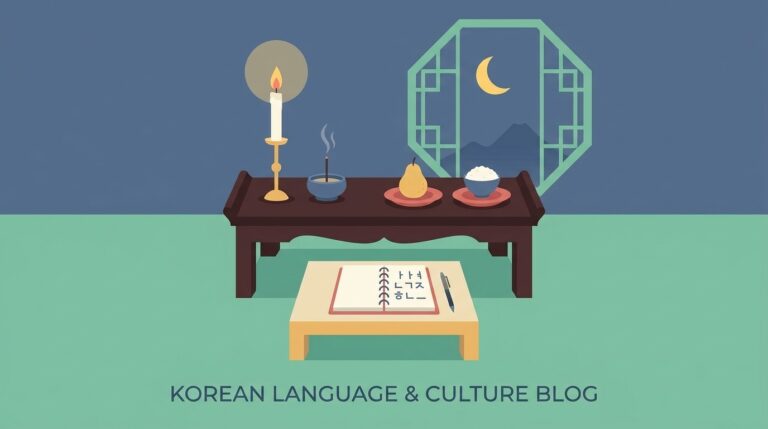
Have you ever sat in a Korean living room during a major holiday like Chuseok (추석) or Seollal (설날), only to feel a sudden, heavy silence drape over the room? Perhaps one family member is standing quietly in the corner with their hands folded in prayer, while others are kneeling deeply, pressing their foreheads to the floor before a table stacked high with fruits, fish, and burning incense.
This is the reality of Jesa (제사)—Korean ancestral memorial services—and the complex, deeply emotional religious conflicts that often surround them. Today, we aren’t just learning textbook grammar. We are diving into the heart of modern Korean family dynamics, exploring how centuries-old Confucian duties clash with modern Christian, Buddhist, or secular beliefs. As a B2 intermediate learner, mastering this topic will elevate your Korean from simple everyday chit-chat to deep, empathetic cultural fluency. Let’s explore this together like real Korean best friends!
Phase 2: Deep Dive into 3 Core Expressions
1. 제사를 지내다 (jesa-reul jinaeda)
- Pronunciation: [je-sa-reul ji-nae-da] (Think of “je” as in “gem”, “sa” as in “soccer”, and “ji-nae-da” sounding like “gee-nae-da”)
- Meaning: To perform/hold ancestral memorial rites.
- K-Culture Moment: In family-centered K-dramas, you’ll often see daughters-in-law sweating in the kitchen preparing dozens of dishes, while the grandfather sternly says, “제사는 정성이다” (Jesa requires utmost sincerity).
- Editor’s Insight: The verb 지내다 usually means “to spend time” or “to get along,” but when paired with traditional rituals like jesa (제사) or gosa (고사 – a ritual to ward off bad luck), it means “to perform” or “to observe.” It carries a weight of duty and continuous tradition.
- Situation Spectrum: Casual (⚠️ – too heavy for casual chit-chat unless discussing family stress), Semi-formal (✅), Formal (✅)
- 🤔 Think About It: How does your culture honor ancestors or deceased family members? Is it a private, quiet moment, or a structured family ritual like Korea’s Jesa?
2. 절을 하다 (jeol-eul hada)
- Pronunciation: [jeol-eul ha-da] (Pronounce jeol like “jolt” without the ‘t’)
- Meaning: To perform a formal, deep bow (kneeling on the floor).
- K-Culture Moment: This is the ultimate tipping point of religious tension. In movies, a Christian family member might stand still while others bow, causing an awkward cough from the family patriarch.
- Editor’s Insight: In Korean culture, a deep bow (jeol) is the highest form of respect. However, in monotheistic religions like Christianity, bowing to ancestral tablets or portraits is often viewed as bowing to other gods (idol worship). Thus, “절을 하느냐 마느냐” (whether to bow or not) is a major source of family friction.
- Situation Spectrum: Casual (✅), Semi-formal (✅), Formal (✅)
- 🤔 Think About It: Can physical gestures of respect in your culture sometimes carry unintended religious meanings?
3. 갈등을 빚다 (galdeung-eul bitda)
- Pronunciation: [gal-deung-eul bit-da] (gal like “gull”, deung like “dung”, and bit-da like “beat-dah”)
- Meaning: To experience/cause conflict or friction (literally: “to brew/shape conflict”).
- K-Culture Moment: News anchors often report: “명절을 앞두고 종교 문제로 갈등을 빚는 가족들이 많습니다.” (With the holidays ahead, many families are experiencing conflict over religious issues.)
- Editor’s Insight: The word 갈등 (葛藤) is beautiful yet painful. The Hanja characters mean ‘arrowroot’ (갈) and ‘wisteria’ (등). Both are climbing vines that twist in opposite directions. When they meet, they tangle so tightly that they cannot be unraveled. The verb 빚다 means to knead clay or brew alcohol, implying that this conflict was slowly created over time.
- Situation Spectrum: Casual (🚫 – sounds too formal/journalistic), Semi-formal (✅), Formal (✅)
- 🤔 Think About It: Why do you think family conflicts are described as “tangled vines” in Korean? Does your native language have a similar metaphor?
Phase 3: Textbook Korean vs. Real Korean
Scenario 1: Discussing holiday stress due to family rituals
- 📖 Textbook Korean: “제사 준비가 매우 힘듭니다.” (Preparing for ancestral rites is very difficult.)
- 🗣️ 진짜 한국어: “명절만 되면 제사 때문에 집안 분위기가 장난 아니에요.” (Whenever the holidays come, the family atmosphere because of Jesa is no joke.)
- 💡 왜 다를까? Koreans rarely say “매우 힘듭니다” in casual conversation. Instead, they use “장난 아니다” (is no joke/incredible) and “집안 분위기” (family atmosphere) to express the tense domestic energy during these seasons.
Scenario 2: Explaining religious differences in the family
- 📖 Textbook Korean: “가족의 종교가 서로 다릅니다.” (Our family’s religions are different from each other.)
- 🗣️ 진짜 한국어: “저희 집은 종교가 갈려서 명절 때 좀 눈치 보여요.” (Our family is split on religion, so holidays are a bit awkward/tense.)
- 💡 왜 다를까? “갈리다” means to be split or divided. Using “눈치 보인다” (having to watch others’ reactions / feeling awkward) perfectly captures the unspoken tension of trying not to step on anyone’s toes.
Phase 4: K-Culture Deep Dive & Non-verbal Manners
4-1. 눈치 (Nunchi) & Gestures during Jesa
If you find yourself attending a Jesa, your Nunchi (tact/situational awareness) is your shield.
* The Prayer Compromise: If your personal beliefs prevent you from bowing (jeol), do not make a big scene. Instead, when others bow, bow your head slightly and stand in silent prayer (묵념, muknyeom). This shows respect to both your beliefs and the family’s ritual without causing a scene.
* Hand Placement (Gongsu – 공수): When standing during a ceremony, place your hands together at the front of your waist. For men, the left hand goes over the right; for women, the right hand goes over the left. (Note: This is reversed at funerals, so be mindful!).
4-2. Culture Code: The “Jesa Dilemma” in K-Dramas
In family weekend dramas, the kitchen during Chuseok is a battlefield. Preparing the traditional 제사상 (Jesa table) involves strict rules like “홍동백서” (red fruits to the east, white fruits to the west). Modern young Koreans are increasingly opting for “simple Jesa” or bypassing it entirely to travel. This shift represents a massive cultural transition from rigid Confucian duty to individual mental well-being, often leading to generational clashes between traditional grandparents and modern, overworked parents.
Phase 5: Real-Life Roleplay Scenario
The Setting
Min-jun (a traditional Korean husband) and Sophie (his foreign partner) are staying at Min-jun’s parents’ house the day before Chuseok. Min-jun’s mother wants everyone to participate in the Jesa bowing, but Min-jun’s Christian aunt has refused, causing a cold war in the living room.
Characters
- Min-jun (민준): Caught in the middle, trying to keep the peace.
- Sophie (소피): Observing the situation and trying to support Min-jun without overstepping.
Dialogue
- 소피: (🎭 걱정스러운 눈빛으로 민준의 팔을 잡으며) 민준 씨, 거실 분위기가 갑자기 왜 이렇게 조용해졌어요? 어머님 표정이 안 좋으신 것 같아요.
(Min-jun, why did the living room suddenly get so quiet? Your mother’s expression doesn’t look good.) - 민준: (🎭 한숨을 내쉬며 머리를 긁적이고) 아… 고모가 이번 제사 때 절 안 하겠다고 하셔서 그래요. 종교적인 이유 때문에요.
(Ah… it’s because my aunt said she won’t bow during this Jesa. Because of religious reasons.) - 소피: (🎭 고개를 끄덕이며) 아, 그렇구나. 고모님은 교회에 다니시니까 절하는 게 조금 부담스러우실 수 있겠어요.
(Ah, I see. Since your aunt goes to church, bowing might feel a bit burdensome for her.) - 민준: (🎭 조심스럽게 속삭이며) 맞아요. 근데 아버지는 제사가 조상님께 드리는 최소한의 예의라고 생각하시니까, 서운해하시는 거죠. 갈등이 깊어질까 봐 걱정이에요.
(Exactly. But my father thinks Jesa is the bare minimum of respect for our ancestors, so his feelings are hurt. I’m worried the conflict will deepen.) - 소피: (🎭 위로하듯이 민준의 어깨를 토닥이며) 양쪽 다 입장이 이해가 가요. 저희가 중간에서 도와드릴 수 있는 방법은 없을까요?
(I understand both sides. Is there any way we can help mediate in the middle?) - 민준: (🎭 고마운 표정으로) 소피가 그렇게 말해줘서 고마워요. 그냥 우리는 묵묵히 제사상 차리는 거 돕고, 고모 오셨을 때 편안하게 해드리는 게 최선일 것 같아요.
(Thank you for saying that, Sophie. I think the best we can do is just silently help set the Jesa table and make my aunt feel comfortable when she arrives.) - 소피: (🎭 미소를 지으며 단호하게) 네, 좋아요. 전 전 부치는 거 도울게요! 너무 걱정하지 마세요, 민준 씨.
(Yes, sounds good. I’ll help fry the Jeon (Korean pancakes)! Don’t worry too much, Min-jun.) - 민준: (🎭 안도하며 미소 짓고) 고마워요, 소피. 우리 부모님도 소피의 이런 배려에 감동하실 거예요.
(Thank you, Sophie. My parents will definitely be touched by your consideration.)
🔀 Interactive Branching Points
If the aunt asks Sophie: “소피 양은 우리 집안 제사 문화에 대해 어떻게 생각해요?” (What do you think of our family’s Jesa culture, Sophie?), how should you respond?
- Choice A: “저는 기독교라서 절하는 것은 우상숭배라고 생각해요.” (Since I’m Christian, I think bowing is idol worship.)
- Feedback (Bad): 🚫 This is too direct and confrontational! It invalidates the family’s decades of tradition and will immediately escalate the tension in the room.
- Choice B: “한국 전통문화니까 무조건 절을 다 같이 해야 한다고 생각해요.” (Since it’s traditional Korean culture, I think everyone must bow together unconditionally.)
- Feedback (Risk): ⚠️ This disregards the aunt’s religious freedom and might alienate her. It sounds like you are taking sides blindly without empathy.
- Choice C (Best): “형식보다는 조상님을 기억하고 가족들이 모이는 마음이 가장 중요한 것 같아요.” (Rather than the strict format, I think the heart of remembering ancestors and gathering as a family is what matters most.)
- Feedback (Best): ✅ Perfect! This beautiful B2-level response focuses on the core value of family unity and respect, validating both traditional reverence and modern personal choices.
Phase 6: 10-Second Emotion Shadowing Drill
Let’s practice speaking with real Korean emotion. Use the pauses (/) and emotional cues to sound like a native.
- [🥺 걱정스럽고 조심스럽게 – Worried and cautious]
- “종교 때문에 / 가족끼리 갈등을 빚는 건 / 너무 마음 아픈 일이에요.”
- (jong-gyo ttae-mun-e / ga-jok-kki-ri gal-deung-eul bit-neun geon / neo-mu ma-eum a-peun il-i-e-yo.)
- Insight: Pause slightly after “때문에” and “빚는 건” to emphasize the tragic nature of family tension.
- [😊 따뜻하고 배려 넘치게 – Warm and considerate]
- “절을 하지 않더라도 / 조상님을 생각하는 / 마음은 똑같을 거예요.”
- (jeol-eul ha-ji an-theu-ra-do / jo-sang-nim-eul saeng-gak-ha-neun / ma-eum-eun ttok-ga-teul geo-ye-yo.)
- Insight: Lift your tone slightly at “생각하는” to bring comfort and reassurance.
Phase 7: K-Culture Mini Dictionary
- 제사상 (jesasang) | Ancestral Table
- Usage: The elaborately arranged food table offered to spirits. There is an immense amount of labor involved in preparing this, leading to the phrase “제사상 차리다 등골이 휜다” (My spine is bending from setting up the Jesa table).
- 묵념 (muknyeom) | Silent Prayer / Moment of Silence
- Usage: Used widely in both religious and secular contexts. When you want to show respect but cannot bow due to religious reasons, saying “저는 묵념을 하겠습니다” (I will perform a silent prayer) is the polite alternative.
- 갈등 (galdeung) | Conflict / Friction
- Usage: Derived from “arrowroot” and “wisteria.” It’s used in essays, news, and daily life to describe deep-rooted emotional or systemic issues: “고부 갈등” (conflict between mother-in-law and daughter-in-law) is a classic phrase.
- 명절 증후군 (myeongjeol jeunghugun) | Holiday Syndrome
- Usage: A modern psychological term referring to the physical and mental stress experienced by family members (especially women preparing food, or young singles facing invasive questions) before and after major traditional holidays.
Phase 8: Traveler’s Survival Kit
Survival Expressions TOP 3
- “제가 도울 일은 없나요?” (je-ga do-ul il-eun eop-na-yo?)
- Pro Tip: Use this when entering a Korean household during holiday preparations. It shows respect and willingness to integrate, even if they politely tell you to rest!
- “종교적인 예법을 잘 몰라서 실수할까 봐 걱정돼요.” (jong-gyo-jeok-in ye-beop-eul jal mol-la-seo sil-su-hal-kka bwa geok-jeong-dwae-yo.)
- Pro Tip: A humble way to preemptively apologize if you’re unsure of what gestures to make during a traditional ritual.
- “가족분들 모두 편안한 명절 보내세요.” (ga-jok-bun-deul mo-du pyeon-an-han myeong-jeol bo-nae-se-yo.)
- Pro Tip: A perfect, polite holiday greeting that doesn’t assume any specific religious ritual but wishes peace to all.
Editor’s Travel Note
If you’re traveling in Korea during Chuseok or Seollal, remember that the country practically shuts down for three days. Trains and express buses are booked out months in advance (called the “migration of the nation”). Download the 네이버 지도 앱 (Naver Map App) and check holiday operating hours for cafes and restaurants before heading out, as many family-owned businesses close down to perform their own family rites. Disclaimer: Holiday operating hours are subject to change yearly; always double-check directly on the app.
Phase 9: “한 발 더 깊이” (Going One Step Deeper)
To truly understand Korea’s religious conflict, we must understand Hyo (효 – Filial Piety). In traditional Confucianism, your body and soul are directly connected to your ancestors. Failing to perform Jesa is not just skipping a party; it is considered a severe act of ingratitude, as if you are denying your own root. On the flip side, Korea is also home to a very passionate and robust Christian community (accounting for nearly 27% of the population). This creates a unique pressure cooker of cultural obligation versus theological purity. In recent years, a beautiful middle ground has emerged: 추도 예배 (chudo yebae)—a Christian memorial service where family members gather to pray, share memories, and eat together, but without the physical bowing and food offerings. This shows the incredible adaptability of modern Korean society.
💬 Your Turn: Has your family ever experienced a clash of traditions or beliefs during major family gatherings? How did you resolve it? Let me know in the comments below!
Phase 10: FAQ & Avoiding Misunderstandings
Q: Do all Korean families still perform Jesa?
A: No. With urbanization, the rise of nuclear families, and changing religious landscapes, many families have transitioned to simplified memorial meals or decided to stop Jesa altogether. However, the eldest son’s family (큰집, keunjip) often still feels a strong duty to maintain the tradition.
Q: As a foreigner, am I expected to bow (절) at a Jesa?
A: Most Koreans do not expect foreign guests to know or perform the complex bowing rituals. Standing quietly with a respectful posture is more than enough. However, asking “절을 해도 괜찮을까요?” (Would it be okay if I bowed?) shows an extraordinary level of cultural respect that will deeply touch your host family.
Q: Is Jesa a Buddhist ritual?
A: Actually, Jesa is primarily a Confucian (유교) ritual, not Buddhist. While many Koreans blend Buddhist and Confucian traditions, the structured etiquette of Jesa comes directly from Neo-Confucian ancestral worship.
🚨 흔한 실수 (Common Mistakes) 경고판
- Bowing the wrong number of times:
- Mistake: Bowing once or three times.
- Correct Action: In Jesa, you bow twice (and a slight deep nod to finish). Bowing once is for living people (like Sebae on New Year’s), and bowing three times is for certain Buddhist temple rituals.
- Laquhing or talking loudly near the Jesa table:
- Mistake: Treating the preparation room like a casual party.
- Correct Action: Keep your voice low and respectful. The room is considered a sacred space where the spirits of ancestors are visiting.
- Using your left hand to pour or receive drinks:
- Mistake: Passing the ritual cup with one hand or using the left hand.
- Correct Action: Always hold the cup or pitcher with your right hand, supported gently by your left hand at the wrist or forearm.
Phase 11: Action Mission & Participation
Ready to take action? Try this three-step mission:
- 🥉 Bronze Mission: Pronounce
제사를 지내다out loud 3 times using the sound analogy. - 🥈 Silver Mission: Share this post on your social media with the hashtag
#DailyHanguland write one thing you learned about Korean family culture. - 🥇 Gold Mission: Watch a family K-Drama scene involving a holiday (like Reply 1988 or My Mister) and try to spot the Jesa table or notice who is preparing the food.
Phase 12: Interactive Quiz Challenge
Test your cultural and linguistic IQ!
1. Which of the following is the most polite option if you cannot bow during Jesa due to your religion?
- A) Politely refuse and go to another room.
- B) Stand respectfully and perform a silent prayer (묵념).
- C) Loudly explain why bowing is against your religion.
👀 Click to reveal the answer!
Correct Answer: B
Explanation: Performing 묵념 (muknyeom – silent prayer) shows deep respect for the occasion and your family while maintaining your personal faith without creating domestic conflict.
2. What does the word ‘갈등’ (galdeung) literally mean?
- A) Broken porcelain and clay.
- B) Tangled arrowroot and wisteria vines.
- C) High waves and strong winds.
👀 Click to reveal the answer!
Correct Answer: B
Explanation: ‘갈’ (gal) is arrowroot and ‘등’ (deung) is wisteria. Since their vines twist in opposite directions, they represent complex, tangled human conflict!
See you in the next lesson! 다음에 또 만나요! 🍁







