

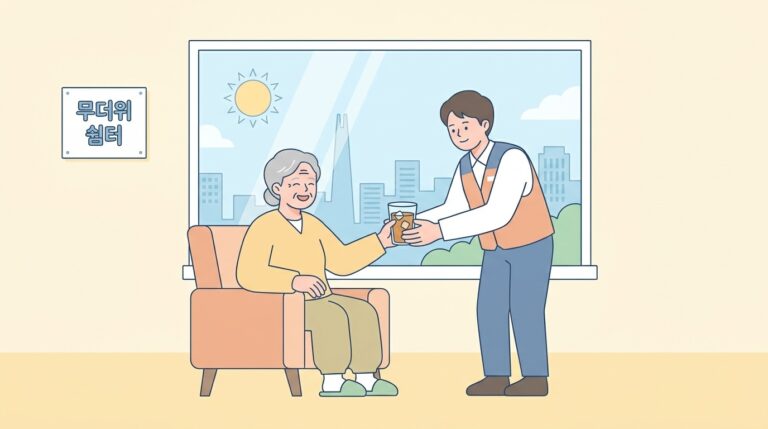
The Warmth Behind the Cool: Mastering C2 Korean for Heatwave Rescue and Community Support
Phase 1: 공감 (Empathy – Connection & Storytelling)
안녕하세요! Your premium Korean culture navigator and editor from Daily Hangul is back.
Imagine walking through the narrow alleyways of Seoul’s Jjokbangchon (쪽방촌 – historic tiny-room neighborhoods) in mid-August. The air is so thick and humid you can almost chew it. The concrete radiates relentless heat, reaching a sweltering 39°C (102°F). For vulnerable populations—such as low-income seniors living alone without air conditioning—this isn’t just uncomfortable; it is life-threatening.
Enter the Cooling Centers (무더위 쉼터). These are local libraries, senior centers, and ward offices transformed into air-conditioned sanctuaries of survival. But operating these shelters and rescuing those in need requires more than just high-performance HVAC systems. It requires a profound level of linguistic sensitivity, empathy, and social grace.
Today, we are diving deep into the C2 (Mastery) Level of Korean Disaster Safety Communication, focusing specifically on supporting heat-vulnerable demographics. If you’ve ever wanted to speak Korean with the deep, structural empathy of a social welfare director or a high-ranking crisis coordinator, this guide is crafted specifically for you. Let’s master the language of modern Korean solidarity.
Phase 2: 핵심 표현 3선 심층 분석 (3 Core Expressions Deep Dive)
1. 취약 계층을 밀착 마크하다 (chwy-ak gye-cheung-eul mil-chak ma-keu-hada)
- Pronunciation: [chwi-yak gye-cheung-eul mil-chak ma-keu-hada] (Sounds like: chwee-yak gyeh-cheung-eul meel-chak mah-keu-hah-dah)
- Meaning: To provide highly customized, zero-distance intensive support and monitoring for marginalized demographics during a crisis (Literally: “To closely man-mark vulnerable classes”).
- K-Culture Moment: You will hear this phrase used by passionate district governors or social workers in humanitarian documentaries and realistic K-dramas (like Our Blues or Live) when municipal teams go door-to-door to check on marginalized individuals.
- Editor’s Insight: “밀착 마크하다” is a brilliant sport metaphor (from soccer’s tight man-to-man marking) imported into administrative Korean. It signifies that the government or volunteer groups aren’t just sending generic texts; they are physically visiting and constantly monitoring every single individual in high-risk zones.
- Situation Spectrum: Casual (⚠️) / Semi-formal (✅) / Formal (✅)
- 🤔 Think About It: How does your home country’s public safety system describe direct, individual-level check-ins during extreme weather events? Is it as hands-on as “밀착 마크”?
2. 온열질환 예방 수칙을 전파하다 (on-yeol-jil-hwan ye-bang su-chik-eul jeon-pa-hada)
- Pronunciation: [on-yeol-jil-hwan ye-bang su-chik-eul jeon-pa-hada] (Sounds like: ohn-yuhl-jeel-hwan yeh-bang soo-cheek-eul juhn-pah-hah-dah)
- Meaning: To actively disseminate guidelines and preventative protocols for heat-related illnesses.
- K-Culture Moment: This is the precise phrasing broadcasted over rural village speakers (마을 방송) and municipal disaster alerts (재난 문자) during peak heatwave hours (2 PM to 5 PM).
- Editor’s Insight: C2 speakers must distinguish between standard illness (“아프다”) and clinical disaster terms like “온열질환” (heat-related illnesses, covering heat stroke, exhaustion, and cramps). Using “전파하다” (to propagate/disseminate) instead of “말하다” highlights your professional and authoritative mastery over public welfare topics.
- Situation Spectrum: Casual (🚫) / Semi-formal (✅) / Formal (✅)
- 🤔 Think About It: In Korea, public safety warnings are incredibly localized. Why do you think community-level voice broadcasts still remain vital alongside smartphone emergency alerts?
3. 쉼터를 상시 개방하여 온기를 나누다 (swim-teo-reul sang-si gae-bang-ha-yeo on-gi-reul na-nu-da)
- Pronunciation: [swim-teo-reul sang-si gae-bang-ha-yeo ohn-gi-reul na-nu-da] (Sounds like: shweem-tuh-reul sang-shee geh-bang-hah-yuh ohn-gee-reul nah-noo-dah)
- Meaning: To operate cooling shelters 24/7 as an expression of community compassion and human connection.
- K-Culture Moment: Found in local newspaper editorials praising neighborhood initiatives where citizens pool resources to provide ice water and air-conditioned rooms for their elderly neighbors.
- Editor’s Insight: Notice the beautiful paradox here! Even though they are keeping cooling shelters open to fight the scorching heat, they describe it as sharing “온기” (warmth/affection). In Korean culture, true safety isn’t just physical temperature regulation; it’s the social warmth of looking out for one another.
- Situation Spectrum: Casual (⚠️) / Semi-formal (✅) / Formal (✅)
- 🤔 Think About It: How does the linguistic use of “온기” (warmth) to describe a cooling initiative reveal the deep-seated cultural value of Jeong (정) in Korean society?
Phase 3: 교과서 한국어 vs 진짜 한국어 (Textbook vs. Real-World)
Situation 1: Describing the suffocating summer heatwave
- 📖 Textbook Korean: “오늘 날씨가 매우 뜨겁고 습합니다.” (The weather is very hot and humid today.)
- 🗣️ 진짜 한국어 (C2 Master level): “오늘 날씨가 그야말로 가마솥더위네요. 밖은 완전히 찜통이나 다름없어요.” (Today’s weather is literally a cauldron-like heat. The outdoors is no different from a food steamer.)
- 💡 Why the difference? Textbooks teach dry, meteorological descriptors. True native speakers use rich culinary metaphors. Comparing the environment to a traditional Korean iron cauldron (gamasot) or a bamboo food steamer (jjimtong) instantly paints a vivid picture of high-temperature humidity.
Situation 2: Persuading a stubborn senior to leave their hot room for a cooling shelter
- 📖 Textbook Korean: “위험하니까 시원한 장소로 가십시오.” (Since it is dangerous, please go to a cool location.)
- 🗣️ 진짜 한국어 (C2 Master level): “어르신, 실내 온도가 너무 높아서 더위 드실까 봐 염려돼서 그래요. 저희 센터 에어컨 바람 쐬시면서 시원한 보리차 한잔하고 가셔요.” (Ma’am/Sir, I’m genuinely worried you might suffer from heat exhaustion because the indoor temperature is too high. Please come over to our center to enjoy the AC and have a cold cup of barley tea.)
- 💡 Why the difference? Simply telling a senior what to do can sound rude or bossy. Using terms like “더위를 먹다” (to eat the heat / suffer heat stroke) and framing the invitation around shared hospitality (“보리차 한잔하고 가셔요”) honors their dignity while ensuring their safety.
Phase 4: K-Culture 딥다이브 & 비언어적 매너 (Culture Deep Dive)
4-1. 눈치 (Nunchi) & Non-verbal Manners when visiting Cooling Centers
When volunteering at or operating a cooling center, your body language is just as important as your spoken Korean:
* The Soft Approach: Never stand tall over an elderly resident sitting on the floor or a low chair. Squat down (쪼그려 앉기) to match their eye level. This shows humility and removes any sense of administrative intimidation.
* Two-Handed Respect: When handing over chilled damp towels or bottles of water, always use both hands (두 손으로 전달하기), with a slight bow of the head.
* Sensory Consideration: Many elderly citizens struggle with hearing loss. Speak slowly, pitch your voice slightly lower (higher pitches can be harder to hear), and finish your sentences with gentle, comforting endings like “~셔요” or “~시지요” rather than stiff bureaucratic endings like “~하십시오”.
4-2. K-Drama Context: The Social Realism of the Jjokbangchon
If you have watched critically acclaimed K-Dramas like My Mister (나의 아저씨) or welfare-focused episodes of daily documentaries, you’ll recognize that Korean local governments run a highly systemic yet deeply emotional network of public safety. Social workers don’t just sit in offices; they perform “야간 순찰” (night patrols) to rescue vulnerable residents during “열대야” (tropical nights). Understanding this socio-cultural fabric is key to using safety-related vocabulary naturally.
Phase 5: 실전 롤플레이 시나리오 (Interactive Roleplay Scenario)
Setting: A local community center turned Cooling Shelter (무더위 쉼터) in Seoul during an extreme heatwave warning (폭염 경보).
Characters:
* 지민 (Jimin): A passionate and empathetic community welfare officer.
* 김창식 어르신 (Mr. Kim): A proud, independent 82-year-old resident who refuses to turn on his fan at home to save on electricity.
[Scene Start: Jimin enters Mr. Kim's cramped, humid apartment holding an insulated cooler box.]

1. 지민: (공손하게 머리를 숙이며) 어르신, 저 주민센터 지민이에요. 문 좀 열어봐 주셔요!
   [Jimin: (Bowing politely) Mr. Kim, it's Jimin from the community center. Please open up!]

2. 어르신: (선풍기도 틀지 않은 채, 땀을 뻘뻘 흘리며) 아이고, 이 더운데 여긴 뭐 하러 왔어? 나 괜찮아, 안 더워.
   [Mr. Kim: (Sweating profusely without even running his fan) Oh dear, what brought you here in this heat? I'm fine, I'm not hot.]

3. 지민: (방안의 훅 끼치는 열기에 놀라며) 아니, 어르신! 방안이 완전히 가마솥더위예요. 왜 선풍기도 안 틀고 계셔요?
   [Jimin: (Surprised by the sudden blast of heat inside the room) Oh my, sir! It is literally a cauldron in here. Why don't you have the fan on?]

4. 어르신: (손사래를 치며) 전기세가 무서워서 그렇지. 그리고 노인네가 바람 쐬면 뼈마디만 시려.
   [Mr. Kim: (Waving his hand dismissively) It's because I'm terrified of the electricity bill. Besides, cold air just makes an old man's bones ache.]

5. 지민: (어르신의 어깨를 부드럽게 짚으며) 어르신, 이 온도에서 계속 버티시면 진짜 더위 드셔요. 큰일 나요.
   [Jimin: (Gently touching his shoulder) Sir, if you keep enduring this temperature, you will genuinely get heat stroke. It is dangerous.]

6. 어르신: (한숨을 쉬며) 에휴, 이웃들한테 번거롭게 폐 끼치고 싶지 않아. 그냥 참을 만해.
   [Mr. Kim: (Sighing) Sigh, I don't want to cause trouble or be a burden to my neighbors. It's tolerable.]

7. 지민: (어르신의 눈을 따뜻하게 맞추며) 폐라뇨! 저희가 어르신 밀착 마크하라고 특별히 설치한 쉼터인걸요. 거기 시원한 보리차도 가득 준비해 놨어요.
   [Jimin: (Making warm eye contact) A burden? Not at all! We set up this shelter specifically to look after you closely. We've got plenty of cold barley tea ready there too.]

8. 어르신: (고마운 듯 옅은 미소를 지으며) 허허, 매번 이렇게 챙겨주니 미안해서 어쩌나. 그럼 딱 한 시간만 쉬다 올까?
   [Mr. Kim: (Smiling faintly with gratitude) Haha, you take care of me like this every single time, I feel so apologetic. Should I go rest there for just an hour then?]
🔀 Choose Your Response (Interactive Branch Point)
As Jimin, how do you respond to ensure Mr. Kim safely makes it to the cooling center and stays there comfortably?
- Option A: “네, 어르신. 딱 한 시간만 계시다가 방이 좀 식으면 다시 돌아오세요!”
- Option B: “한 시간은 너무 짧아요! 요새 열대야라 위험하니까 오늘 밤은 아예 거기서 주무시고 가셔요. 제가 다 준비해 드릴게요.”
- Option C: “그럼요! 일단 한 시간만 시원하게 계셔보셔요. 가시는 길에 제가 양산도 씌워 드리고 부축해 드릴게요.”
💡 Action Analysis & Feedback:
- Option A (Bad): Allowing him to return to a scorching room after just an hour puts him back in immediate danger. The room will not cool down on its own without AC.
- Option B (Risk): While highly safe, pushing him to sleep there overnight immediately might feel too overwhelming or invasive for a proud senior, causing him to retract his agreement.
- Option C (Best – 100% Experience Point!): Perfect! You lowered the entry barrier by agreeing to “just an hour” but gently secured his safety for the journey by offering physical assistance and shade (양산). Once he feels the comfort of the cooling center, he will likely stay longer voluntarily.
Phase 6: 10초 감정 섀도잉 드릴 (10-Second Emotional Shadowing)
To speak like a native, you must master the cadence of empathy. Practice these lines with emotional focus, paying attention to the pauses (/):
- [🥺 Deeply concerned & Urgent]
“어르신, / 실내 온도가 너무 높아서 / 더위 드실까 봐 / 정말 걱정돼서 그래요.”
(eoh-reu-sin, / sil-nae on-do-ga neo-mu nop-ah-seo / deo-wi deu-sil-kka bwa / jeong-mal geok-jeong-dae-seo geu-rae-yo.) -
[😊 Reassuring & Warmly inviting]
“부담 갖지 마시고, / 저희 무더위 쉼터 오셔서 / 시원한 물 한잔하시고 / 쉬다 가셔요.”
(bu-dam gat-ji ma-si-go, / jeo-hwi mu-deo-wi swim-teo oh-seo-seo / si-won-han mul han-jan-ha-si-go / swi-da ga-syeo-yo.)
Phase 7: K-Culture 미니 사전 (Mini Dictionary)
- 열대야 (Yeol-dae-ya) | Tropical Night
- Meteorological term used when the lowest temperature remains above 25°C (77°F) overnight. It is the primary cause of heat exhaustion for those without domestic AC.
- 무더위 쉼터 (Mu-deo-wi Swim-teo) | Extreme Heat Shelter
- Designated air-conditioned public spaces opened by the government during summers to prevent casualties among vulnerable citizens.
- 양산 쓰기 캠페인 (Yang-san Sseu-gi Kaem-pe-in) | Parasol Wearing Campaign
- A highly unique East Asian public safety campaign encouraging people of all genders and ages to use parasols to block direct sunlight, reducing body temperatures by up to 7°C.
- 사각지대 발굴 (Sa-gak-ji-dae Bal-gul) | Uncovering Social Blind Spots
- The administrative act of finding marginalized individuals who are slipped through the cracks of standard welfare databases.
Phase 8: 여행자를 위한 생존 키트 (Survivor Kit for Travelers)
Survival Phrases TOP 3
- “근처에 무더위 쉼터가 어디에 있나요?”
- Pronunciation: [geun-cheo-ye mu-deo-wi swim-teo-ga eo-di-ye in-na-yo?]
- Pro Tip: Use this if you or someone you are with shows signs of dizziness or heat exhaustion while walking around Seoul during summer.
- “시원한 얼음물 한 잔만 얻을 수 있을까요?”
- Pronunciation: [si-won-han eo-reum-mul han jan-man eo-deul su is-seul-kka-yo?]
- Pro Tip: A polite, lifesaving way to ask for cold water at community hubs or local offices.
- “열사병 증상이 있는 것 같아요. 도와주세요.”
- Pronunciation: [yeol-sa-byeong jeung-sang-i in-neun geot gat-ah-yo. do-wa-ju-se-yo.]
- Pro Tip: “I think I have heatstroke symptoms. Please help me.”
📝 Editor’s Travel Note
During hot summer days, don’t walk unprepared. We highly recommend downloading the official Korean emergency app. You can search and locate emergency shelters near your current location instantly. For real-time updates on local heatwave alerts and cooling locations, utilize the Kakao Map Emergency Features or download the government-operated Emergency Ready App (안전디딤돌) before exploring historical districts under the summer sun.
Phase 9: 한 발 더 깊이 – 생각 질문 (Deep Social Reflection)
Modern Korean public safety infrastructure relies heavily on “상부상조” (Sang-bu-sang-jo – Mutual communal aid). Historically, Korean agricultural communities operated through shared labor (Dure) and collective responsibility. Today, when a natural disaster hits—be it a flood or an extreme heatwave—this communal DNA manifests as localized civil servant networks and neighborhood volunteers physically marching into tight alleyways to check on their neighbors. It is a striking contrast to highly digitized, hands-off bureaucratic systems seen in other parts of the world.
💬 Your Turn: How does your culture handle disaster relief for vulnerable groups? Is it primarily institutionalized through official government structures, or do you rely on informal, localized neighbor-to-neighbor check-ins?
Phase 10: FAQ & 오해 방지 (FAQ & Common Mistakes)
Q: Can anyone use a “무더위 쉼터” (Cooling Center), or are they strictly reserved for registered vulnerable citizens?
A: Anyone can use them! While they are specifically prioritized and actively operated to support vulnerable groups like the elderly, low-income families, and outdoor laborers, anyone experiencing heat fatigue—including foreign travelers—is welcome to step in, rest, and hydrate.
Q: Is the water and tea provided at these centers free of charge?
A: Yes, all basic cooling supplies, water, and resting facilities are provided entirely free as part of government disaster safety programs.
Q: Are all cooling centers open 24 hours a day?
A: Not all of them. Standard centers operate during normal business hours (9 AM to 6 PM). However, during peak “폭염 경보” (Severe Heatwave Warning periods) and prolonged “열대야” (Tropical Nights), designated night shelters (야간 쉼터) extend their operations overnight.
🚨 흔한 실수 (Common Mistakes) Warning Board!
- Mistake 1: Addressing a senior as “너” or using banmal (“쉬어라” – Rest) in a cooling center.
- Correct Action: Always use respectful high-level honorifics: “어르신, 여기 앉아서 좀 쉬셔요.” (Please sit here and rest, sir/ma’am.)
- Mistake 2: Translating “heat exhaustion” directly as “더운 병” (hot sickness).
- Correct Action: Use the proper idiomatic phrase “더위 먹다” or the clinical term “온열질환”.
- Mistake 3: Thinking “에어컨” is the only solution.
- Correct Action: Understand that many seniors avoid air conditioning due to cost anxiety. Frame the help as a collective social resource, not a personal luxury.
Phase 11: 액션 미션 (Action Missions)
- Bronze Mission 🥉 (Solo Practice): Read the 10-Second Emotional Shadowing Drill out loud twice. Pay attention to the smooth transition of “~셔요” to sound inviting yet professional.
- Silver Mission 🥈 (Social Share): Share your favorite Korean summer term (like 가마솥더위 or 찜통더위) on your social feed or with your language partner, explaining its culinary origin!
- Gold Mission 🥇 (Real Life Application): The next time you visit Korea in July or August, look out for the banner saying “무더위 쉼터” on community centers and libraries. Note down how community officers interact with the neighborhood elders.
Phase 12: 인터랙티브 퀴즈 챌린지 (Quiz Challenge)
Test your mastery of C2-level disaster safety and cultural terms!
1. What does the sports-derived metaphor “밀착 마크하다” mean in the context of community social safety?
🔍 Click to see the answer and explanation
Answer: It means to provide intensive, close-contact monitoring and targeted care to highly vulnerable individuals during a crisis (e.g., social workers checking on isolated seniors daily during a heatwave).
2. Fill in the blank: If a senior is showing signs of heatstroke, you say they have “_____ 먹었다”.
🔍 Click to see the answer and explanation
Answer: 더위 (더위를 먹었다 / suffered heat exhaustion).
3. True or False: “온기” (warmth) is never used when talking about summer cooling operations because it refers to hot air.
🔍 Click to see the answer and explanation
Answer: False! While literal warmth is avoided in summer, the word “온기” is frequently used metaphorically in Korean media to describe the “warmth of human connection and compassion” shared through these cool public initiatives.







