

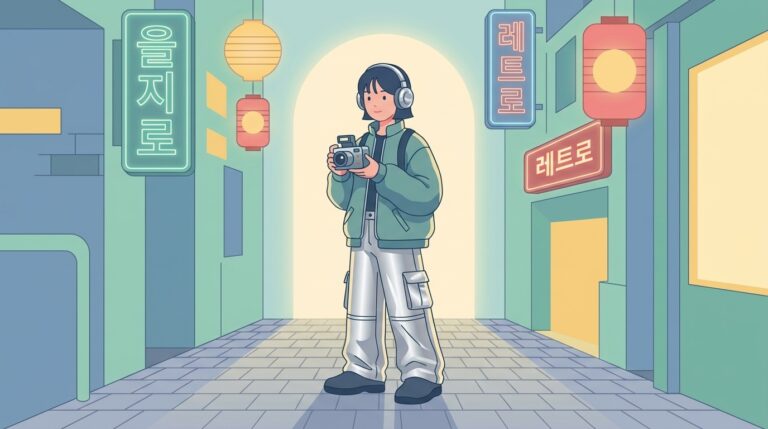
Phase 1: Nostalgic Seoul—Why Y2K is Stealing Hearts in Seongsu-dong
안녕하세요! Welcome back to another edition of Daily Hangul, your premium compass to the soul of Korean language and culture. I’m your lead editor, and today we are hopping into a time machine back to the turn of the millennium.
Picture this: You are walking down the industrial-chic alleys of Seongsu-dong (성수동). Among the concrete cafes, you spot Gen-Z Koreans sporting oversized metallic cargo pants, chunky silver headphones draped around their necks, and beaded phone straps clinking against vintage flip phones. It’s not a glitch in the matrix—it is the triumphant, sparkly return of Y2K fashion and “Newtro” (뉴트로) culture.
But here is the catch for advanced learners: when you discuss this aesthetic with your Korean friends, simply saying “이 옷은 옛날 패션이에요” (This clothing is old fashion) sounds incredibly flat and detached. It completely misses the rich emotional texture of nostalgia that Koreans associate with this era. To truly connect at a C2 level, you need to master the highly specific, emotionally charged vocabulary that local trendsetters use to describe this revival.
Today, we will dive deep into the linguistic nuances of Korea’s retro renaissance, helping you navigate conversations about fashion, media, and the psychological comfort of the past with absolute fluency. Let’s get retro!
Phase 2: Key Expressions Deep Dive
1. 세기말 감성 (Segi-mal Gam-seong)
- Pronunciation: [Se-gi-mal Gam-seong] (Think “Say-gee-mahl gahm-suhng”)
- Meaning: Turn-of-the-century vibe / Late 90s–Early 2000s aesthetic.
- K-Culture Moment: This expression perfectly encapsulates the visual style of early K-pop legends like S.E.S, Fin.K.L, or Lee Hyori’s iconic 2003 “10 Minutes” era. It is also the ultimate descriptor for the retro, low-fi music videos of modern groups like NewJeans.
- Editor’s Insight: Segi-mal literally means ‘the end of the century’ (세기말), and Gam-seong means ‘sensibility’ or ‘vibe’. Unlike the generic word ‘retro’ (레트로), Segi-mal Gam-seong specifically triggers a feeling of futuristic optimism mixed with analog warmth—the unique cultural cocktail of the years 1998 to 2002.
- Situation Spectrum: Casual ✅ | Semi-formal ✅ | Formal ⚠️
- 🤔 Think About It: In English, we often use ‘Y2K’ as a dry design category. In Korean, adding ‘Gam-seong’ (감성) shifts the focus entirely onto the emotion and mood the fashion evokes. How does your native culture linguistically package the emotions of past eras?
2. 그때 그 시절 (Geu-ttae Geu Sijeol)
- Pronunciation: [Geut-tae Geu See-jeol] (Rhymes with “Good-tae Geu See-juhl”)
- Meaning: “Those days, that era” (A poignant, nostalgic reference to a shared past).
- K-Culture Moment: Used constantly in variety shows when an old song plays, or when friends look at old photos of Cyworld (싸이월드), Korea’s premier early-2000s social media platform.
- Editor’s Insight: This phrase carries a heavy dose of shared nostalgia. When you say “그때 그 시절,” you aren’t just pointing to a calendar year; you are inviting the listener to join you in a warm, collective memory. It has a deeply bonding effect.
- Situation Spectrum: Casual ✅ | Semi-formal ✅ | Formal ✅
- 🤔 Think About It: Why does referring to a specific timeframe with such emotional weight create instant intimacy in Korean conversations?
3. 촌스러운데 힙하다 (Chon-seu-reoun-de Hip-ha-da)
- Pronunciation: [Chon-seu-ruh-oon-deh Hip-hah-dah]
- Meaning: Tacky/old-fashioned, yet somehow incredibly cool and hip.
- K-Culture Moment: Perfect for describing a vintage windbreaker found at the Dongmyo Flea Market, or an extremely saturated, low-resolution digital camera photo that would have been deleted 15 years ago but is now uploaded to Instagram.
- Editor’s Insight: This is a brilliant linguistic paradox. Chon-seureopda (촌스럽다) historically means ‘rural’ or ‘tacky’. Combining it with Hiphada (힙하다 – to be hip) reflects the modern Korean youth’s ability to repurpose outdated, unpolished elements into cutting-edge self-expression.
- Situation Spectrum: Casual ✅ | Semi-formal ⚠️ | Formal 🚫
- 🤔 Think About It: How does the linguistic coupling of opposites (tacky + hip) redefine what is considered high-status or fashionable in modern society?
Phase 3: Textbook Korean vs. Real Korean
Situation 1: Reacting to a friend’s full-on Y2K outfit
- 📖 Textbook Korean: “당신의 옷은 매우 복고풍이군요.” (Your clothes are very retro-style.)
- 🗣️ Real Korean: “와, 오늘 착장 완전 세기말 감성 제대로다!” (Wow, today’s outfit is absolute turn-of-the-century vibes!)
- 💡 Why the difference? Textbook Korean relies on the formal, Chinese-character-based word Bokgo-pung (복고풍), which sounds like an academic categorization. Real Koreans use Chak-jang (착장 – outfit/fit) and Segi-mal Gam-seong to show genuine admiration for the aesthetic execution.
Situation 2: Explaining why you bought a low-res vintage digital camera
- 📖 Textbook Korean: “오래된 카메라는 사진의 품질이 낮지만 인기가 많습니다.” (Old cameras have low photo quality but are popular.)
- 🗣️ Real Korean: “화질이 좀 깨지는 게 오히려 촌스러운데 힙하잖아.” (The pixels breaking up a bit actually makes it tacky yet super hip.)
- 💡 Why the difference? Instead of using formal technical terms like ‘photo quality’ (사진의 품질), native speakers focus on the physical aesthetic of Hwa-jil-i kkae-ji-da (화질이 깨지다 – pixels breaking/glitching) as a desirable, stylistic feature.
Phase 4: K-Culture Deep Dive & Non-Verbal Manners
4-1. The Retro Photo Poses & Attitude
To truly pull off the Y2K vibe in Korea, your language must match your body language. When taking a photo in a retro booth (인생네컷) or holding a vintage digicam, Koreans rarely do the standard smile.
* The Gyaru Peace (갸루피스): An upside-down V-sign held out in front of your face. It originally crossed over from Japanese street fashion in the early 2000s and was repopularized by K-Pop idols.
* The Deadpan Chic (무심한 표정): Staring into the camera with a completely blank, slightly bored expression. It conveys that you are ‘too cool to care’—a core tenet of the original Y2K attitude.
4-2. The Rise of ‘Newtro’ (뉴트로) Culture
Korea’s obsession with the past isn’t just passive nostalgia; it is an active industry called Newtro (New + Retro). While ‘Retro’ is simply copying the past, ‘Newtro’ is Gen-Z taking things they never actually experienced (like 90s cassette tapes or early-2000s cyber aesthetics) and interpreting them through a sleek, modern digital lens. This is why cafes in Euljiro (을지로) serve traditional Korean tea alongside high-end espresso in rusted, 1980s metal-stamping factories. It is historical collision at its finest.
Phase 5: Real-Life Roleplay Scenario
Setting: A hidden vintage curation shop in Euljiro (popularly known as ‘Hip-jiro’), filled with cassette players, metallic sunglasses, and vintage leather jackets.
Characters:
* 지영 (Ji-young): The effortlessly cool vintage shop owner who curated the entire space (NPC).
* 민우 (Min-woo): An advanced Korean learner looking for the perfect retro accessory.
지영: 어서 오세요! 저희 매장은 처음이신가요? 편하게 둘러보세요.
      (Welcome! Is this your first time at our shop? Please look around comfortably.)

민우: 🎭 (Casually picking up a pair of metallic, wrap-around sunglasses)
      우와, 사장님! 이거 진짜 대박이네요. 완전 세기말 감성 제대로인데요?
      (Wow, boss! This is incredible. This is absolute turn-of-the-century vibes!)

지영: 🎭 (Smiling warmly, leaning against the counter)
      어머, 뭘 좀 아시네요! 그거 2000년대 초반에 진짜 잘 나가던 스타일이에요.
      요즘 친구들은 이걸로 사진 찍어서 인스타에 올리더라고요.
      (Oh, you know your stuff! That style was huge back in the early 2000s.
      Kids these days take photos with it and post them on Insta.)

민우: 안 그래도 저도 그때 그 시절 음악이나 패션에 완전 꽂혀 있거든요.
      이 안경은 약간 촌스러운데 묘하게 힙한 느낌이 있어요.
      (Actually, I'm completely obsessed with the music and fashion of those days.
      These glasses are a bit tacky, but they have a weirdly hip vibe.)

지영: 맞아 맞아! 요즘 나오는 매끈한 디자인들보다 이런 투박한 게 훨씬 멋스럽죠.
      그 안경 끼고 저희 매장 구석에 있는 옛날 브라운관 TV 앞에서 사진 한번 찍어봐요.
      인생샷 건질 걸요?
      (Exactly! These clunky designs look way cooler than the sleek ones coming out now.
      Put those glasses on and take a photo in front of the old CRT TV in the corner.
      You'll get the shot of your life!)
🔀 Interactive Choice Point
How should Min-woo respond to Ji-young’s photo suggestion to keep the advanced conversational flow going?
- Choice A: “사진은 괜찮습니다. 그냥 이것만 계산해 주세요.”
- Choice B: “오, 진짜요? 그럼 사장님이 요새 유행하는 갸루피스 포즈로 한 장 찍어주실 수 있어요?”
- Choice C: “브라운관 TV라니, 진짜 추억 돋네요. 혹시 사진 필터는 어떤 게 어울릴까요?”
💡 Feedback on Your Choice:
- Choice A (Bad): Too cold and transactional. It shuts down the friendly relationship-building (정) that is highly valued in local Korean shops.
- Choice B (Best): Fantastic! It shows high cultural fluency by referencing the “Gyaru Peace” (갸루피스) and playfully invites the local owner to engage in a shared cultural moment.
- Choice C (Risk): Decent and polite, but slightly repetitive. Asking for a filter is a safe conversational route but lacks the punchy, playful energy of Choice B.
Phase 6: 10-Second Emotion Shadowing Drill
To master C2-level speaking, you must nail the natural pauses and emotional delivery. Practice saying these sentences aloud, respecting the pauses (/) and capturing the specified emotions.
- [😊 Filled with nostalgic excitement]
“이 노래 들으니까 / 진짜 그때 그 시절 생각나서 / 가슴이 몽글몽글해져요.”
(Hearing this song / really makes me think of those days / and makes my heart feel all fluffy.) -
[😎 Playful and effortlessly cool]
“이 구닥다리 디카로 찍으면 / 대충 찍어도 / 세기말 감성 제대로 살죠?”
(If you shoot with this ancient digicam / even a sloppy shot / captures that turn-of-the-century vibe perfectly, right?)
Phase 7: K-Culture Mini-Dictionary
- 뉴트로 (New-tro) | Newtro
- A portmanteau of ‘New’ and ‘Retro’. It refers to the trend of reinterpreting retro culture with modern technology and sensibilities, heavily embraced by Korean Gen-Z.
- 폰스트랩 (Pon-seut-raep) | Phone Strap
- Beaded or woven wrist straps attached to phone cases, mimicking the heavily decorated flip phones of the late 90s.
- 디카 감성 (Di-ka Gam-seong) | Digicam Aesthetic
- The low-resolution, slightly blurry, and flash-heavy photo aesthetic produced by early-2000s digital cameras.
- 꾸안꾸 (Kku-An-Kku) | Effortlessly Chic
- Abbreviation of “꾸민 듯 안 꾸민 듯” (Dressed up, but looking like you didn’t). Crucial for mastering the relaxed, baggy silhouette of modern Y2K streetwear.
Phase 8: The Traveler’s Survival Kit
Survival Expressions for Vintage Lovers
- “이거 빈티지 제품이라 / 수량은 이거 하나뿐인가요?”
- Is this a vintage item, so this is the only one in stock?
- Pro Tip: Vintage shops in Seoul often have single items, so ask this to confirm if you need to grab it immediately before someone else does!
- “혹시 작동 여부 / 확인할 수 있을까요?”
- Could I check if this actually works?
- Pro Tip: Crucial when buying retro electronics like cassette players or film cameras at flea markets.
- “택 붙어 있는 거 보니까 / 데드스탁 맞죠?”
- Since the tag is still on, this is deadstock (unworn vintage), right?
- Pro Tip: Shows extreme insider knowledge to the shop owner, often preventing them from overcharging you.
🗺️ Editor’s Travel Note
When hunting for Y2K fashion in Seoul, skip the high-end department stores. Instead, open your Naver Map App and search for “동묘 구제시장” (Dongmyo Flea Market) or “을지로 빈티지샵” (Euljiro Vintage Shops). Dongmyo is a chaotic, thrilling outdoor market where you can literally dig through mountains of clothes for $3 finds, while Euljiro houses curated, high-concept vintage boutiques hidden on the third and fourth floors of industrial printing alleys.
(Note: Street market vendors often prefer cash or bank transfers, so keep some cash handy!)
Phase 9: Go One Step Deeper—The Sociology of Nostalgia
Why is South Korea—one of the most technologically advanced, hyper-futuristic countries in the world—so deeply obsessed with looking backward?
Sociologists suggest that because Korea underwent such rapid economic development (the “Miracle on the Han River”) and digitized faster than almost any other nation, the psychological toll of this constant acceleration is immense. The turn of the millennium was a unique cultural window: the internet was brand new, mobile phones were physical toys with buttons, and human connection still felt highly tactile.
For older millennials, Y2K fashion is a return to a simpler, warmer past. For Gen-Z, it is a form of escapism from the exhausting perfection of high-definition smartphone cameras and social media algorithms. They find solace in the flawed, blurry, and analog charm of “그때 그 시절.”
💬 Your Turn: Does your country have a similar obsession with a specific past decade? Which era’s aesthetic do you wish would make a comeback? Let us know in the comments below!
Phase 10: FAQ & Avoiding Misconceptions
Q: Is there a difference between ‘복고’ (Bokgo) and ‘레트로’ (Retro)?
A: Yes, there is a subtle stylistic difference. Bokgo (복고) is a native Korean word that often evokes older, domestic historical eras (like the 70s and 80s Korean countryside, old school uniforms, or trot music). Retro (레트로) is a loanword that usually points to global fashion trends, pop art, and Western-influenced aesthetics of the late 20th century.
Q: Can I use the word ‘촌스럽다’ (tacky) as a compliment to a stranger?
A: Absolutely not! Calling someone’s outfit Chonseureopda directly can be highly offensive. Only use it when paired with Hiphada (“촌스러운데 힙하다”) or when speaking with close friends in a clearly playful, appreciative context.
Q: Why do Koreans call vintage clothing ‘구제’ (Guje) instead of ‘빈티지’ (Vintage)?
A: Guje (구제) literally means ‘relief’ or ‘salvage’ clothing—originally referring to second-hand clothes donated after the war. Today, Guje generally implies cheaper, uncurated second-hand piles (like at Dongmyo), while Vintage (빈티지) implies highly curated, premium, and branded retro wear.
🚨 Common Mistakes Dashboard
| What You Might Say | Why It’s Awkward | The Correct Action |
|---|---|---|
| “이 옷은 아주 오래되었습니다.” | Sounds like you are complaining that the garment is dusty and ruined. | Use “빈티지 감성이 제대로 살아있네요” (The vintage vibe is perfectly alive). |
| “저는 옛날 음악을 정말 좋아해요.” | A bit too simple and childlike for an advanced learner. | Use “저는 그때 그 시절 레트로 음악에 꽂혀 있어요” (I’m obsessed with retro music from back in the day). |
| “이 카메라는 나쁜 화질을 가졌어요.” | Translating “bad image quality” literally sounds highly unnatural. | Use “화질이 자글자글해서 예뻐요” (The image quality is wonderfully grainy/noisy). |
Phase 11: Action Mission
- 🥉 Bronze Medal Mission: Identify one song by NewJeans, TripleS, or EXID that utilizes a Y2K concept. Write a single sentence in the comments using the term “세기말 감성”.
- 🥈 Silver Medal Mission: Take a photo of your outfit today. Post it on Instagram, tag
@DailyHangul, and use the caption: “촌스러운데 묘하게 힙한 오늘의 착장! 😎” - 🥇 Gold Medal Mission: Visit a local vintage shop or cafe. Initiate a 3-turn conversation with the owner or staff using the phrase “그때 그 시절” or “뉴트로”, and share your experience with us!
Phase 12: Interactive Quiz Challenge
Test your mastery of advanced Korean retro culture with these quick brain teasers!
1. Scenario Judgment
Your Korean colleague comes to work wearing a neon windbreaker and chunky white Fila sneakers. Which reaction is the most culturally fluent and complimentary?
* A) “오늘 아주 시골 사람처럼 입으셨네요!”
* B) “오늘 착장 완전 세기말 감성 제대로인데요? 힙해요!”
* C) “복고풍 의류를 착용하시는 이유가 무엇입니까?”
Reveal Answer & Explanation
Correct Answer: B
* A translates to “You dressed like a villager today!” which is highly offensive.
* C sounds like a formal interrogation.
* B uses the perfect colloquial terms (Chak-jang, Segi-mal Gam-seong, Hip-haeda) to compliment their style naturally.
2. Fill-in-the-Blank
Complete the natural Korean sentence expressing nostalgia:
“이 구형 미니홈피 스킨을 보니까 진짜 ( ) 생각나서 눈물 날 것 같아.”
(Looking at this old Mini-hompy skin really makes me think of ( ), I think I might cry.)
Reveal Answer & Explanation
Correct Answer: 그때 그 시절
This phrase perfectly fills the blank to evoke the shared, nostalgic era of early-2000s Korean internet culture.
3. True or False?
In Korean cultural contexts, “뉴트로” (Newtro) is strictly limited to old people wanting to recreate their youth.
Reveal Answer & Explanation
Correct Answer: False
Newtro is primarily driven by Gen-Z and Millennials who never actually experienced the original eras but find the analog aesthetic fresh, novel, and highly fashionable.







