

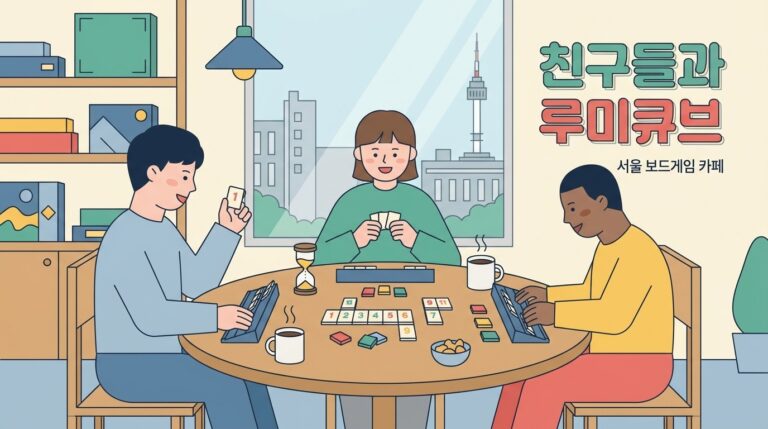
Master Rummikub Like a Pro: The Ultimate Guide to Korean Board Game Cafe Strategy and Slang
Phase 1: Empathy (안녕하세요! Welcome to the Mind Games)
안녕하세요! (Annyeonghaseyo!) It’s your favorite Korean best friend and senior editor at Daily Hangul.
Picture this: You are sitting in a vibrant, neon-lit board game cafe in Hongdae on a Friday night. The air is thick with the aroma of freshly fried tteokbokki and butter-garlic French fries. Across the table, your Korean friends are staring intensely at their Rummikub (루미큐브) racks. One of them slides a tile, giving you a smirk. Your heart races. You want to restructure the board, but your mind goes blank. You know the rules, but how do you express your strategic genius in Korean without sounding like a textbook robot?
Today, we are bridging that gap. This guide is built on real-life case studies of advanced learners who struggled to blend in during game nights. By the end of this post, you will not only master Rummikub vocabulary but also the high-level psychological slangs that make playing board games in Korea so addictive.
Phase 2: Key Expressions Deep Dive (핵심 표현 3선)
Let’s analyze three high-yield strategic expressions that will instantly elevate your game-table presence.
1. 머리를 쓰다 (meo-ri-reul sseu-da)
- Pronunciation: Muh-ri-reul sseu-da (Rhymes with “worry”)
- Meaning: Lit. “To use one’s head”; Fig. “To strategize / To think critically”
- K-Culture Moment: Often heard in competitive Korean variety shows like The Devil’s Plan or The Genius when a player pulls off a complex mathematical move.
- Editor’s Insight: While “생각하다” (to think) is neutral, “머리를 쓰다” implies a deliberate, cunning mental effort to outsmart someone.
- Situation Spectrum: Casual ✅ | Semi-formal ⚠️ | Formal 🚫
- 🤔 Think About It: How does your native language describe the physical act of deep thinking? Is it head-related, heart-related, or completely different?
2. 신의 한 수 (sin-ui han su)
- Pronunciation: Sin-ui han su (Sounds like “Seen-we han soo”)
- Meaning: Lit. “God’s move”; Fig. “A stroke of genius / A game-changing move”
- K-Culture Moment: This term originated from the game of Go (바둑) but is used everywhere now—from dramatic K-drama plot twists to putting down that perfect Joker tile in Rummikub.
- Editor’s Insight: Use this when an opponent (or you!) makes an unexpected move that completely reorganizes the tiles and clears the rack.
- Situation Spectrum: Casual ✅ | Semi-formal ✅ | Formal ⚠️
- 🤔 Think About It: Koreans love Go-related metaphors in daily life. What sport or game dominates the metaphors in your culture?
3. 밑장빼기 (mit-jang-ppae-gi)
- Pronunciation: Meet-jang-ppae-gee (Strong ‘p’ sound)
- Meaning: Lit. “Pulling from the bottom of the deck”; Fig. “Sleight of hand / Subtle cheating”
- K-Culture Moment: A legendary slang immortalized by the Korean cult-classic film Tazza: The High Rollers.
- Editor’s Insight: Do not use this in formal settings! In Rummikub, use it playfully when a friend secretly hoards a Joker behind their rack or tries to adjust tiles on the table when no one is looking.
- Situation Spectrum: Casual ✅ (Use only with close friends!) | Semi-formal 🚫 | Formal 🚫
- 🤔 Think About It: Why does playful accusations of cheating actually build trust and closeness (정 – Jeong) in Korean social circles?
Phase 3: Textbook vs. Real Korean (교과서 vs. 진짜 한국어)
Let’s compare how a standard textbook teaches game terms versus how native Koreans actually banter.
Situation 1: Declaring your turn is ending
- 📖 Textbook: “제 차례를 마치겠습니다.” (I shall finish my turn.)
- 🗣️ 진짜 한국어: “자, 이제 패 넘긴다!” (Alright, passing the turn over to you!)
- 💡 Why the difference? The textbook expression is grammatically perfect but feels incredibly cold and robotic. Real game talk uses words like “패” (hand/tiles) and “넘기다” (to pass over) to keep the flow fast and lively.
Situation 2: Praising someone’s clever move
- 📖 Textbook: “당신의 전략은 매우 훌륭합니다.” (Your strategy is very excellent.)
- 🗣️ 진짜 한국어: “와, 잔머리 장난 아니다!” (Wow, your quick wits are no joke!)
- 💡 Why the difference? “전략” (strategy) sounds like a military briefing. “잔머리” (petty brains/quick wits) is a friendly, slightly cheeky way to praise someone’s sneaky but smart moves.
Phase 4: K-Culture Deep-Dive & Non-verbal Manners
4-1. The Art of “Nunchi” (눈치) and Table Etiquette
In Korean board game cafes, Nunchi (tact/situational awareness) is your ultimate weapon.
* The Poker Face (포커페이스): When you finally get a Joker (조커), never smile. In fact, a common Korean tactic is to sigh softly (“아, 이번 판은 망했다…”) to deceive your opponents.
* Slamming the Tile: When making a definitive move, Koreans sometimes place the final tile with a satisfying, sharp clack on the table. It’s a non-verbal way of saying, “Checkmate.”
4-2. The Rise of Korean Board Game Cafes (보드게임 카페)
Unlike Western board game meetups that often happen in private homes, Koreans flock to dedicated multi-room board game cafes like Red Button or Asmodee. These are premium entertainment spots where you order food via iPad, sit in private booths, and can play hundreds of games. It is a staple of Korean youth dating and hangout culture.
Phase 5: Real-Life Roleplay Scenario
Setting: A private room at a board game cafe in Sinchon. You are playing Rummikub with Min-jun (민준), a passionate board gamer.
- 민준: (staring intensely at the table) 아… 머리 터지겠네. 숫자가 왜 이렇게 안 맞지?
(Ah… my head is about to explode. Why are the numbers not matching up?) - You: (grinning)
🎭 여유로운 표정으로민준아, 1분 다 되어 간다. 모래시계 다 떨어졌어!
(Min-jun, almost a minute is up. The hourglass is empty!) - 민준: 아, 잠깐만! 타임! 이거 하나만 맞추면 돼. 진짜 다 왔어.
(Ah, wait! Time out! I just need to match this one. I’m almost there.) - You:
🎭 놀리듯이설마 또 장고 끝에 악수 두는 거 아니지?
(You aren’t going to make a bad move after agonizing over it for so long, are you?) - 민준: (slamming a tile down) 됐다! 이거 여기 끼워 넣고, 조커 빼서… 등록 완료!
(Done! Slide this in here, take the Joker… Meld complete!) - You: 와… 진짜 신의 한 수 인정한다. 그걸 그렇게 푸네.
(Wow… I admit, that was a stroke of genius. You solved it like that.)
🔀 Interactive Branching Decision
It is now your turn. You notice Min-jun left a gap where you can play your tiles, but doing so might help him on his next turn. What do you say?
- Option A: “안전하게 가자. 그냥 패 한 장 가져올게.”
- Option B: “여기 틈새 공략한다! 이거 받고 더블로 가!”
- Option C: “민준아, 우리 동맹 맺을까?”
💡 Feedback on Your Choice:
- Best Choice (Option B): Excellent! “틈새 공략” (targeting the niche/gap) and the famous movie reference “이거 받고 더블로 가” (Double down!) shows incredible cultural integration. Min-jun will love the energy!
- Risk Choice (Option A): Safe, but a bit boring for a competitive Korean game night. It keeps the game slow.
- Bad Choice (Option C): Rummikub is an individual game! Offering an alliance (“동맹”) might make you look weak or overly dependent.
Phase 6: 10-Second Emotional Shadowing Drill
Practice these sentences out loud, paying attention to the emotional guides and pauses (/).
[😏 Confidently & Teasingly]
“에이, / 그렇게 머리 써봤자 / 내 손바닥 안이지!”
(Ay, / no matter how much you use your brain, / you’re in the palm of my hand!)-
[🤯 Mind-blown & Surprised]
“헐, / 대박! / 그게 거기서 풀린다고? / 진짜 신의 한 수다.”
(Heol, / awesome! / That got resolved from there? / Truly a God’s move.)
Phase 7: K-Culture Mini Dictionary
- 보겜 (Bo-gem) | Short for 보드게임 (Board Game). Casual slang used when planning hangouts.
- 조커 (Jo-keo) | Joker. In daily life, it refers to a hidden trump card or a secret weapon you reveal at the last minute.
- 등록 (Deung-rok) | Initial Meld (specifically in Rummikub where tiles must sum to 30+). In daily life, it means registration.
- 뇌정지 (Noe-jeong-ji) | Lit. “Brain stop”; Brain freeze. Used when the board is too complex and you cannot think anymore.
Phase 8: Traveler’s Survival Kit
Survival Expressions TOP 3
- “여기 가장 인기 있는 보드게임이 뭐예요?” (What is the most popular board game here?) | Pro Tip: Use this to ask the staff for recommendations.
- “룰 설명 좀 부탁드려요!” (Could you explain the rules for us?) | Pro Tip: Korean board game cafes often have staff or tablet videos that explain rules clearly.
- “이번 판 벌칙은 뭐로 할까?” (What should be the penalty for this round?) | Pro Tip: Games are more fun with a penalty like buying the next round of drinks.
📌 Editor’s Travel Note:
To find the best spots, open your map app and search for “보드게임카페”. We highly recommend checking out localized maps. For seamless navigation, you can Download Naver Map App which has the most updated reviews and locations of trendy board game cafes in Seoul.
Phase 9: One Step Deeper (한 발 더 깊이)
In Korea, board games are more than just a hobby; they are an extension of the country’s intense, fast-paced cognitive culture. From a young age, Koreans are exposed to highly strategic games, which explains why the PC bang (LAN cafe) and board game cafe cultures are so heavily developed. Playing games is a way to display quick intellect, build social bonds (Jeong), and relieve the high stress of academic or working life. When you play Rummikub with Koreans, they aren’t just passing time—they are engaging in a passionate, friendly battle of wits.
💬 Your Turn: Have you ever played board games in Korea? What is your favorite go-to game when hanging out with friends? Let us know in the comments below!
Phase 10: FAQ & Mistake Prevention
Q: Is it rude to tease your opponent during a board game in Korea?
A: Not at all! Playful banter (티키타카 – Tiki-taka) is highly encouraged and makes the game fun. However, always read the room (Nunchi). If your opponent is genuinely stressed, tone it down.
Q: Can I use “밑장빼기” with people older than me?
A: Absolutely not, unless you are extremely close. It is a slang term heavily associated with cheating and gambling. Keep it strictly among friends of the same age or younger.
Q: How do I ask for a rematch?
A: You can say “한 판 더!” (Han pan deo!) which means “One more round!”
🚨 Common Mistakes Board
- Mistake 1: Saying “내 차례입니다” in a highly formal tone during a casual game night.
- Correct Action: Just say “이제 내 턴!” or “나 할게!”.
- Mistake 2: Keeping too quiet because you are focused on the tiles.
- Correct Action: Express your mental state! Say “아, 머리 아파!” or “뇌정지 왔다” to keep the social vibe alive.
- Mistake 3: Not knowing how to call the staff.
- Correct Action: Don’t yell across the room. Press the call button on the table or use the iPad installed in your booth.
Phase 11: Action Mission & Engagement
- Bronze Mission: Practice saying “신의 한 수” three times in front of the mirror with a dramatic hand gesture.
- Silver Mission: The next time you play any game, use “머리 아프다” or “머리를 쓰다” instead of “생각하다”.
- Gold Mission: Visit a local Korean board game cafe, order some snacks, and use “룰 설명 좀 해주세요” to the staff!
Phase 12: Interactive Quiz Challenge
Test your knowledge of Korean gaming slang!
1. Which expression means a “stroke of genius” or “game-changing move”?
- A) 잔머리
- B) 신의 한 수
- C) 밑장빼기
2. True or False: It is completely fine to use the term “밑장빼기” during a business board game meeting with your boss.
- A) True
- B) False
🔍 Click here to see the Answers & Explanations!
- Answer: B (신의 한 수). It represents the perfect move that turns the tide of the game. (잔머리 means petty tricks, and 밑장빼기 means cheating by pulling from the bottom).
- Answer: B (False). “밑장빼기” is a slang term associated with cheating and gambling movies. Using it with a boss or superior is highly inappropriate!







