

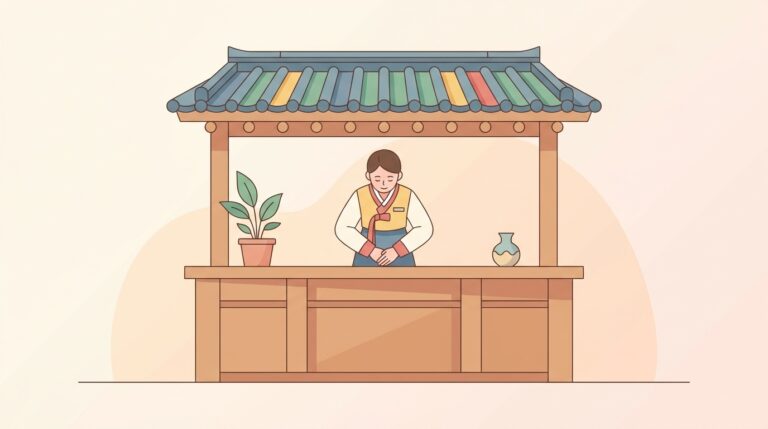
Mastering the Art of Korean Customer Service: How to Turn Mistakes into Magical Moments
Phase 1: Empathy (Your Gateway to Warm Korean Service)
안녕하세요! (Annyeonghaseyo!) Welcome back to Daily Hangul, your trusted local guide to mastering Korean culture and language.
Imagine this: You are working at a beautiful Hanok boutique hotel in Gyeongju or managing a trendy cafe in Hongdae. Suddenly, a customer approaches you with a troubled expression. Their room’s heating isn’t working, or perhaps their order was mixed up. In many cultures, resolving an issue is purely transactional. But in Korea, customer service is deeply rooted in Jeong (정 – warm attachment) and Chinjeol (친절 – kindness).
Handling complaints in a second language can feel incredibly nerve-wracking. You might worry about sounding too blunt or accidentally using the wrong level of politeness (존댓말 – Jondaetmal). Don’t worry! This guide is built based on real-world experiences of global hospitality professionals in Seoul. By the end of this post, you will know exactly how to apologize gracefully, offer clear solutions, and present compensation like a natural-born Korean service pro.
Phase 2: Deep Dive into 3 Core Expressions
To confidently handle issues, you need high-frequency, polite phrases in your linguistic toolkit. Let’s break down three essential B2-level customer service expressions.
1. 불편을 드려 정말 죄송합니다. 조속히 처리해 드리겠습니다. (Bul-pyeon-eul deu-ryeo jeong-mal joe-song-ham-ni-da. Jo-sok-hi cheo-ri-hae deu-ri-get-seom-ni-da.)
- Pronunciation: “Bool-pyeon-eul deu-ryeo jung-mal jway-song-ham-nee-da. Jo-sok-hee chuh-ree-hae deu-ree-get-soom-nee-da.”
- Meaning: “I am truly sorry for the inconvenience. We will process and resolve this as quickly as possible.”
- K-Culture Moment: You will hear this exact phrase in K-dramas like King the Land or Hotel Del Luna whenever a high-end concierge handles a VIP client’s request with utmost professionalism.
- Editor’s Insight: The word 조속히 (Jo-sok-hi) is a sophisticated, formal way of saying “quickly/promptly.” It sounds much more reassuring and professional to a customer than just saying “빨리 (ppalli – fast).”
- Situation Spectrum: Casual: 🚫 | Semi-formal: ⚠️ | Formal: ✅
- 🤔 Think About It: In your native language, is it more important to explain why the mistake happened first, or to promise a fast resolution immediately? In Korea, emphasizing speed (조속히) shows respect for the customer’s time.
2. 죄송한 마음을 담아 작은 보상을 준비했습니다. (Joe-song-han ma-eum-eul da-ma ja-geun bo-sang-eul jun-bi-haet-seom-ni-da.)
- Pronunciation: “Jway-song-han ma-eum-eul da-ma jah-goon bo-sang-eul joon-bee-haet-soom-nee-da.”
- Meaning: “We have prepared a small compensation to express our sincere apologies.”
- K-Culture Moment: If you are ever at a high-end Korean restaurant and the kitchen delays your food, the server might bring out a free dish (often called “서비스” – Service) using this phrase.
- Editor’s Insight: 작은 보상 (Ja-geun bo-sang) literally means “small compensation.” In Korea, framing compensation as “small” is a humble cultural practice (겸손 – Gyeom-son) that lowers your stance and elevates the customer’s comfort.
- Situation Spectrum: Casual: 🚫 | Semi-formal: ✅ | Formal: ✅
- 🤔 Think About It: How does your culture view “freebies” during an issue? In Korea, “서비스” is not just free stuff; it is a bridge to restore trust.
3. 이번 건에 한해 전액 환불이나 교환을 도와드려도 괜찮으실까요? (I-beon geon-e han-hae jeon-aek hwan-bul-i-na gyo-hwan-eul do-wa-deu-ryeo-do gwaen-chan-eu-sil-kka-yo?)
- Pronunciation: “Ee-buhn guhn-ay han-hae juhn-aek hwan-bool-ee-na gyoh-hwan-eul doh-wah-deu-ryuh-doh gwaen-chan-oo-sheel-kkah-yoh?”
- Meaning: “Would it be alright if we assist you with a full refund or an exchange for this instance?”
- K-Culture Moment: Frequently used by customer support agents on major Korean e-commerce platforms like Coupang or Naver Shopping.
- Editor’s Insight: 이번 건에 한해 (I-beon geon-e han-hae) means “limited to this specific case.” This is a brilliant business phrase because it solves the current issue while politely setting a boundary so that it doesn’t set a permanent precedent.
- Situation Spectrum: Casual: 🚫 | Semi-formal: ✅ | Formal: ✅
- 🤔 Think About It: Notice the soft ending ~도 괜찮으실까요? (Would it be okay?). Instead of telling the customer what you will do, asking for permission makes them feel respected and in control.
Phase 3: Textbook Korean vs. Real Korean
Let’s compare the stiff expressions found in standard textbooks with the natural, empathetic language used by native speakers.
Scenario 1: Apologizing for a Delayed Order
- 📖 Textbook Korean: 늦어서 미안합니다. 곧 나옵니다. (Nujeoseo mianhamnida. Got naomnida.)
- Why it feels off: It sounds too casual, abrupt, and slightly defensive—almost like saying “Sorry it’s late. It’s coming.”
- 🗣️ 진짜 (Real) Korean: 오래 기다리게 해 드려 정말 죄송합니다. 바로 준비해 드리겠습니다. (Orae gidarige hae deuryeo jeongmal joesonghamnida. Baro junbihae deurigetseumnida.)
- 💡 Why it works: It acknowledges the customer’s effort (“waiting for a long time”) and uses highly polite honorifics to show genuine concern.
Scenario 2: Offering a Complimentary Item (“On the House”)
- 📖 Textbook Korean: 이것은 무료 서비스입니다. 받으세요. (Igeoseun muryo seobiseu-imnida. Badeuseyo.)
- Why it feels off: “This is a free service. Take it.” sounds transactional and slightly demanding.
- 🗣️ 진짜 (Real) Korean: 많이 불편하셨을 텐데, 죄송한 마음에 드리는 작은 서비스입니다. (Mani bulpyeonhasyeosseul tende, joesonghan maeume deuringean jageun seobiseu-imnida.)
- 💡 Why it works: It starts with deep empathy (“You must have been very uncomfortable…”) and frames the complimentary item as a token of sincerity rather than a mere transactional hand-out.
Phase 4: K-Culture Deep Dive & Non-verbal Manners
4-1. Nunchi (눈치) & Bowing Etiquette
In Korean customer service, Nunchi (눈치 – situational quickness/tact) is your superpower. When a customer is upset, your body language speaks louder than your words.
* The Gongsu (공수) Pose: When apologizing or offering a solution, stand with your feet together and place your hands gently clasped over your lower stomach.
* The Eye Contact & Bow: Make brief, respectful eye contact to show you are listening, and then bow your head/upper body slightly (about 15 to 30 degrees) as you say “죄송합니다” (Joesonghamnida). Avoid staring directly into their eyes continuously while they complain, as this can be perceived as confrontational in traditional Korean culture.
4-2. The “Service” (서비스) Culture Code
In Western countries, “service” refers to the act of serving. In Korea, 서비스 (Seo-bi-seu) is a noun that means “free of charge as a gesture of goodwill.” If a business makes a mistake, offering a “서비스” (such as a free drink, a room upgrade, or an extra side dish) is culturally expected. It acts as an emotional band-aid that completely dissolves the customer’s frustration.
Phase 5: Practical Roleplay Scenario
Setting: The lobby of “Sura Hanok Stay” in Gyeongju. A chilly autumn evening.
Characters:
* Ji-hoon (지훈): The polite, professional Hanok manager (NPC).
* Sarah (세라): A tired foreign guest whose room floor heating (Ondol) is not working.
[Sarah approaches the front desk, looking cold and tired.]

Sarah: 저기요, 방이 너무 추워요. 보일러가 안 되는 것 같아요.
(Jeogiyo, bang-i neomu chuwoyo. Bo-il-leo-ga an doeneun geot gat-ayo.)
"Excuse me, the room is too cold. I think the heater isn't working."

Ji-hoon: [🎭 Surprised and deeply apologetic, placing hands in the Gongsu pose]
아, 그러셨군요! 감기 걸리실까 봐 걱정되네요. 불편을 드려 정말 죄송합니다.
(Ah, geureosyeotgunyo! Gamgi geolliseilkka bwa geokjeongdoeneyo. Bulpyeoneul deuryeo jeongmal joesonghamnida.)
"Oh, is that so! I am worried you might catch a cold. I am truly sorry for the inconvenience."

Sarah: 오늘 밤에 여기서 자야 하는데 어떻게 하죠?
(Oneul bame yeogiseo jaya haneunde eotteoke hajyo?)
"I have to sleep here tonight, what should I do?"

Ji-hoon: [🎭 Warmly offering a solution]
네, 저희가 조속히 처리해 드리겠습니다. 마침 바로 옆에 따뜻한 온돌방이 비어 있는데, 그쪽으로 방을 변경해 드려도 괜찮으실까요?
(Ne, jeohui-ga jo-sok-hi cheo-ri-hae deu-ri-get-seom-ni-da. Machim baro yeope ttatteut-han ondol-bang-i bieo inneunde, geujjogeuro bang-eul byeon-gyeong-hae deu-ryeo-do gwaen-chan-eu-sil-kka-yo?)
"Yes, we will resolve this promptly. Coincidentally, there is a warm Ondol room vacant right next door. Would it be alright if we move you to that room?"

Sarah: 네, 옮기는 건 괜찮아요. 귀찮게 해 드려 죄송해요.
(Ne, omgineun geon gwaenchanayo. Gwichanke hae deuryeo joesonghaeyo.)
"Yes, moving is fine. Sorry for the trouble."

Ji-hoon: [🎭 Waving hands slightly in reassurance, smiling warmly]
아닙니다! 저희가 먼저 꼼꼼히 체크했어야 했는데 죄송합니다. 저희가 짐도 다 옮겨 드리겠습니다.
(Animnida! Jeohuiga meonjeo kkomkkomhi chekeuhaesseoya haenneunde joesonghamnida. Jeohuiga jimdo da omgyeo deurigetseumnida.)
"Not at all! We should have checked it thoroughly beforehand, we apologize. We will move all your luggage for you as well."

Sarah: 정말 감사합니다. 친절하시네요.
(Jeongmal gamsahamnida. Chinjeolhasineyo.)
"Thank you so much. You are very kind."

Ji-hoon: [🎭 Bowing politely]
그리고 죄송한 마음을 담아 저희 한옥 카페 무료 음료 쿠폰을 준비했습니다. 편하실 때 꼭 이용해 주세요.
(Geurigo joesonghan maeumeul dama jeohui Hanok kape muryo eumnyo kuponeul junbihaetseumnida. Pyeonhasil ttae kkok iyonghae juseyo.)
"Also, to express our sincere apologies, we have prepared a free drink coupon for our Hanok Cafe. Please feel free to use it anytime."
🔀 Interactive Choice Point
How would you respond to a customer complaining about a delayed delivery? Choose your path:
- Path A: “택배 회사에 연락해 보세요. 저희 잘못이 아닙니다.” (Contact the delivery courier. It’s not our fault.)
- Path B: “배송이 지연되어 정말 죄송합니다. 저희가 확인 후 오늘 안으로 연락을 드려도 될까요?” (We are truly sorry for the delayed delivery. May we contact you by today after we check?)
- Path C: “무조건 내일까지 가니까 걱정 마세요.” (It will unconditionally arrive by tomorrow, so don’t worry.)
Feedback:
- Path A (Bad): 🚫 Directing the blame to a third party ruins trust. Even if it is the courier’s fault, in Korea, the selling business must show empathy and assist.
- Path B (Best): ✅ Perfect! You took responsibility, apologized politely, and proposed a concrete timeline (“today”) to follow up.
- Path C (Risk): ⚠️ Dangerous! Over-promising without checking the facts can lead to a bigger complaint if the delivery fails to arrive tomorrow.
Phase 6: 10-Second Emotion Shadowing Drill
Let’s practice the rhythm of polite apologies. The / marks indicate where you should pause briefly to sound natural.
- 불편을 드려 / 정말 죄송합니다. / 조속히 / 처리해 드리겠습니다.
[🥺 Earnest and deeply apologetic]- (Bul-pyeon-eul deu-ryeo / jeong-mal joe-song-ham-ni-da / jo-sok-hi / cheo-ri-hae deu-ri-get-seom-ni-da)
- 죄송한 마음을 담아 / 작은 보상을 / 준비했습니다.
[😊 Warm, soft, and comforting]- (Joe-song-han ma-eum-eul da-ma / ja-geun bo-sang-eul / jun-bi-haet-seom-ni-da)
Phase 7: K-Culture Mini Dictionary
| Word (한글/Romanization) | English Translation | Real-Life Usage & Context |
|---|---|---|
| 환불 (Hwan-bul) | Refund | Used when returning money. (e.g., “환불을 도와드릴까요?” – Shall I help you with a refund? ) |
| 보상 (Bo-sang) | Compensation | Tangible items or vouchers given to resolve a service failure. |
| 불편 (Bul-pyeon) | Inconvenience / Discomfort | Always used in polite customer service apologies to acknowledge customer’s negative experience. |
| 조속히 (Jo-sok-hi) | Promptly / Speedily | High-level formal word to promise immediate action. |
Phase 8: Traveler’s Survival Kit
Survival Phrases TOP 3
- 잠시만 기다려 주시면 바로 확인해 드리겠습니다. (Jam-si-man gi-da-ryeo ju-si-myeon ba-ro hwa-gin-hae deu-ri-get-seom-ni-da.)
- Pro Tip: Perfect when you need to check something on your system or consult your manager.
- 혹시 어떤 점이 불편하셨는지 말씀해 주시겠어요? (Hok-si eo-tteon jeom-i bul-pyeon-ha-syeot-neun-ji mal-sseum-hae ju-si-get-eo-yo?)
- Pro Tip: A gentle, non-aggressive way to ask for the details of a complaint.
- 다음부터는 이런 일이 없도록 각별히 신경 쓰겠습니다. (Dae-eum-bu-teo-neun i-reon il-i eop-do-rok gak-byeol-hi sin-gyeong sseu-get-seom-ni-da.)
- Pro Tip: Reassures the customer that you will prevent future occurrences. Great for long-term clients.
Editor’s Travel Note
If you run into issues while traveling in Korea, don’t worry! Major services offer seamless digital solutions. For taxi-related issues, use the Kakao T Application to contact customer support instantly. If you have an issue with food delivery, the 24/7 customer service chat on the Baemin Delivery App is highly responsive and often provides immediate coupon refunds!
Note: App interface layouts and specific policy guidelines are subject to change over time.
Phase 9: “One Step Deeper” (Cultural Insight)
In many Western cultures, an apology can be seen as a legal admission of guilt, which makes businesses sometimes hesitate to apologize directly. However, in Korea, an apology is seen as an emotional realignment. When a Korean business owner says “불편을 드려 죄송합니다”, they are not just admitting a mistake; they are restoring the harmonious relationship between host and guest (Jeong). Showing empathy first actually de-escalates conflicts instantly, paving the way for a smooth resolution.
💬 Your Turn
Have you ever experienced “서비스” (freebies) in a Korean shop or restaurant when something went wrong? How did it make you feel? Share your warm K-service stories in the comments below!
Phase 10: FAQ & Avoiding Misunderstandings (FAQ Schema)
Q: Can I use “미안합니다” (Mianhamnida) to a customer?
A: It is highly recommended not to use “미안해요” or “미안합니다” to a customer. While polite in casual settings, in customer service, you must use “죄송합니다” (Joesonghamnida). “죄송” (Joesong) contains a much deeper level of respect and humility than “미안” (Mian).
Q: What if a customer demands a refund but it is against company policy?
A: Instead of saying “그건 안 됩니다” (You can’t do that), use the soft buffer phrase: “규정상 어렵습니다만, 대신 ~은 어떠신가요?” (According to our policy it is difficult, but instead, how about ~?).
Q: How do I offer compensation without making the business look bad?
A: Frame it as a gesture of care. Use the phrase “저희가 감사하고 죄송한 마음을 담아 준비했습니다” (We prepared this to express our gratitude and apologies). This shows warmth rather than admitting defeat.
🚨 Common Mistakes Warning Board
- Mistake 1: Say “알았어요” (Arasseoyo – I got it) to an upset customer.
- Correct Action: Say “네, 잘 알겠습니다.” (Yes, I understand completely.) which sounds highly professional.
- Mistake 2: Bowing with your hands in your pockets or behind your back.
- Correct Action: Clasp your hands in front of your stomach in the Gongsu position before bowing.
- Mistake 3: Saying “고객님이 오해하신 것 같습니다” (I think you misunderstood, Customer).
- Correct Action: Say “설명이 부족했던 것 같습니다.” (It seems our explanation was insufficient.) to avoid blaming the client.
Phase 11: Action Mission & Engagement
🏅 The 3-Step Action Mission
- Bronze Mission: Write down today’s Core Expression #1 in your notebook and record yourself saying it with a warm, apologetic tone.
- Silver Mission: Share a post on Instagram or Threads tagging #DailyHangul explaining the unique Korean concept of “서비스” (service) in your own words!
- Gold Mission: Next time you go to a Korean business or interact with a Korean speaker, try using “잠시만 기다려 주시면 바로 확인해 드리겠습니다” if you need a moment to think!
🎮 K-Culture Mission
Watch a food or travel-themed K-variety show (like Seojin’s Korean Street Food or Youn’s Stay). Pay close attention to how the cast members apologize and offer extra food (“서비스”) to guests who wait too long for their orders! Write down one phrase they use.
Phase 12: Interactive Quiz Challenge
Test your intermediate customer service Korean skills!
Q1. Which of the following is the most professional way to tell a customer you will fix an issue quickly?
1) 빨리 할게요. (Ppalli halgeyo.)
2) 조속히 처리해 드리겠습니다. (Jo-sok-hi cheo-ri-hae deu-ri-get-seom-ni-da.)
3) 조금만 기다려 봐요. (Jogeumman gidaryeo bwayo.)
Q2. Fill in the blank: “불편을 드려 정말
______. 죄송한 마음을 담아 작은 서비스를 준비했습니다.”
1) 축하합니다 (Chukhahamnida)
2) 죄송합니다 (Joesonghamnida)
3) 감사합니다 (Gamsahamnida)
Q3. [True or False] It is culturally appropriate in Korea to tell an upset customer “It is not our company’s fault” directly to solve the issue.
- True / False
🔍 Click here to reveal the Answers and Explanations!
- A1: Correct Answer is 2. “조속히 처리해 드리겠습니다” is the gold standard for polite, prompt customer service. Option 1 is too casual; Option 3 sounds slightly impatient.
- A2: Correct Answer is 2. “죄송합니다” (I apologize) fits perfectly. (1 means congratulations; 3 means thank you).
- A3: Correct Answer is False. Even if a third party made the error, a professional business in Korea will first apologize for the customer’s discomfort and help them resolve it, rather than flatly denying responsibility.







