

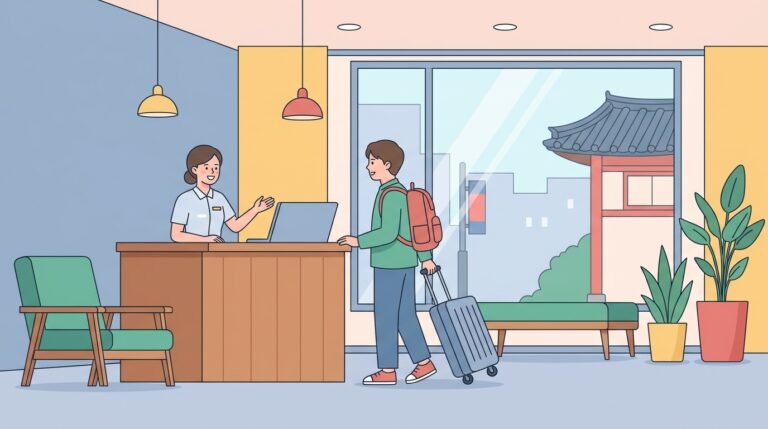
Arrived Early at Your Seoul Hotel? How to Ask to Store Your Luggage and Check In Like a Pro
Phase 1: Empathy (Your Korean Bestie’s Welcome)
안녕하세요! (An-nyeong-ha-se-yo!) I’m your Daily Hangul editor and your personal Korean culture guide.
Imagine this: You’ve just stepped off a long flight to Incheon Airport, taken the bustling Airport Railroad directly to Hongdae, and dragged your heavy suitcases through the vibrant, energetic streets of Seoul. You’re exhausted, but excited! You arrive at your chic boutique hotel, look at your watch, and gasp—it’s only 11:30 AM, but check-in isn’t until 3:00 PM.
You stand in the sleek lobby, feeling a bit self-conscious with your giant bags, wondering: ‘Should I just wait here for three hours? Can I leave my bags? How do I ask this politely without sounding demanding?’
Don’t worry, my friend! This is one of the most common ‘pain points’ our learners at Daily Hangul ask about. Today, we are going to learn how to turn this awkward moment into a smooth, warm interaction. By the end of this guide, you’ll be able to confidently negotiate your early arrival and drop off your bags like a true Seoulite, leaving you free to grab a delicious iced americano nearby! Let’s dive in!
Phase 2: Deep Dive into 3 Core Expressions
1. 혹시 체크인 전에 짐을 맡길 수 있을까요? (Hok-si che-keu-in jeon-e jim-eul mat-gil su is-seul-kka-yo?)
- Pronunciation: Hok-shee (like ‘she’ with a soft h) che-keun jeon-eh jeem-ool mat-geel soo ee-sool-kka-yo?
- Meaning: “By any chance, could I leave my luggage before check-in?”
- K-Culture Moment: You’ll hear this gentle ‘혹시’ (by any chance) used constantly in K-Dramas whenever a character wants to make a polite, non-intrusive request—like when the main lead asks a cafe owner for a small favor.
- Editor’s Insight: ‘혹시’ is your magic word in Korea. It instantly softens your request, showing the hotel receptionist that you respect their rules and aren’t demanding immediate entry.
- Situation Spectrum:
- Casual: 🚫 (Too informal for staff)
- Semi-formal: ✅ (Perfect for most modern hotels)
- Formal: ✅
- 🤔 Think About It: Why do you think Korean speakers prefer starting requests with words like ‘혹시’ (by any chance) rather than asking directly? How does this reflect the cultural value of preserving harmony and avoiding direct pressure on others?
2. 제가 체크인 시간보다 일찍 도착했는데요. (Je-ga che-keu-in si-gan-bo-da il-jjik do-chak-haet-neun-de-yo.)
- Pronunciation: Jeh-gah che-keun she-gan-bo-dah eel-jjeek do-chak-haet-noon-deh-yo.
- Meaning: “I have arrived earlier than the check-in time…”
- K-Culture Moment: The trailing ‘-는데요’ (neun-de-yo) ending is the classic ‘polite trailing-off’ sound you hear when characters in Kdramas are presenting a situation and waiting for the other person’s helpful response.
- Editor’s Insight: Notice that this sentence doesn’t end with a direct question. By saying ‘I arrived early…’, you are politely explaining your situation and leaving space for the staff to offer help (like checking if your room is ready early). It’s incredibly polite and natural.
- Situation Spectrum:
- Casual: 🚫
- Semi-formal: ✅ (Highly recommended)
- Formal: ⚠️ (Slightly conversational, but acceptable)
- 🤔 Think About It: In your native language, do you usually state your problem directly (“I am early, can I check in?”), or do you explain the situation first? How does the Korean way of trailing off feel to you?
3. 얼리 체크인이 가능한가요? 혹시 추가 비용이 있나요? (Eol-li che-keu-in-i ga-neung-han-ga-yo? Hok-si chu-ga bi-yong-i in-na-yo?)
- Pronunciation: Earl-lee che-keun-ee gah-noong-hahn-gah-yo? Hok-shee choo-gahbee-yong-ee een-nah-yo?
- Meaning: “Is early check-in possible? By any chance, is there an extra fee?”
- K-Culture Moment: Korea loves using English loanwords, and ‘얼리 체크인’ (Early Check-in) is standard terminology at hotel front desks in Seoul.
- Editor’s Insight: Checking if there’s an extra charge (‘추가 비용’) is a smart, practical question that shows you are a prepared, respectful guest. Even if they charge you, they will appreciate your clear communication.
- Situation Spectrum:
- Casual: 🚫
- Semi-formal: ✅
- Formal: ✅
- 🤔 Think About It: How does the blending of English terms like ‘Early Check-in’ into Korean grammar make learning Korean feel more accessible to you?
Phase 3: Textbook Korean vs. Real Korean
Let’s look at how textbooks often teach these situations versus how real, warm, and natural conversations actually sound in Seoul.
Scenario 1: Asking to leave your luggage
- 📖 Textbook Korean: “제 짐을 보관해 주세요.” (Je ji-meul bo-gwan-hae ju-se-yo.)
- Why it feels off: It translates to “Please store my luggage.” While grammatically correct, it can sound a bit like a demanding command to a hotel receptionist.
- 🗣️ 진짜 (Real) Korean: “혹시 체크인 전에 짐 좀 맡겨도 될까요?” (Hok-si che-keu-in jeon-e jim jom mat-gyeo-do doel-kka-yo?)
- 💡 Why it’s better: The addition of ‘좀’ (jom – a little/just) and asking ‘맡겨도 될까요?’ (could I leave it?) makes it sound friendly, modest, and incredibly natural.
Scenario 2: Finding out if you can go up to your room early
- 📖 Textbook Korean: “일찍 체크인할 수 있습니까?” (Il-jjik che-keu-in-hal su it-seum-ni-ka?)
- Why it feels off: This is very stiff, formal textbook military-style Korean. It sounds like you are interviewing the receptionist.
- 🗣️ 진짜 (Real) Korean: “혹시 지금 체크인 바로 할 수 있을까요?” (Hok-si ji-geum che-keu-in ba-ro hal su is-seul-kka-yo?)
- 💡 Why it’s better: “By any chance, could I check in right now?” It flows naturally, sounds polite, and fits the relaxed but professional vibe of modern Korean service industries.
Phase 4: K-Culture Deep Dive & Non-Verbal Etiquette
4-1. Nunchi (눈치) & The Art of the Polite Bow
In Korea, communication is only 50% verbal. The other 50% relies on 눈치 (Nunchi)—the art of reading the room and non-verbal cues. When you arrive early at a hotel:
* The Two-Hand Pass: When handing over your passport or booking confirmation, always use two hands (or support your right forearm with your left hand). This is a vital sign of respect in Korean culture!
* The Head Bow (목례 – Mong-nye): When you approach the desk, give a slight, gentle nod/bow of your head. You don’t need a deep 90-degree bow, just a polite inclination of your upper body to show warm appreciation.
4-2. The Korean Guest Experience: ‘Jeong’ (정)
Korean hospitality is deeply rooted in 정 (Jeong)—a feeling of warm attachment, empathy, and sharing. Even though Seoul is a hyper-modern metropolis with high-tech self-check-in kiosks, the hotel staff will genuinely want to help you. If you show polite manners (using two hands and a soft smile), they will often go out of their way to find an available room for you early or recommend the best local spots while you wait!
Phase 5: Real-Life Roleplay Scenario
Setting: You are standing at the beautiful, warm lobby of Namsan Forest Hotel in Seoul. The receptionist, a friendly young man named Min-ho (민호), smiles warmly as you approach the counter.
👤 Min-ho: 어서 오세요! 남산 포레스트 호텔입니다. 예약하셨나요?
           (Eo-seo o-se-yo! Nam-san po-re-seu-teu ho-tel-im-ni-da. Ye-yak-ha-syeot-na-yo?)
           "Welcome! This is Namsan Forest Hotel. Do you have a reservation?"

🎭 You: (Smile politely and hand over your passport with both hands)
       네, 예약했어요. 그런데 제가 체크인 시간보다 일찍 도착했는데요.
       (Ne, ye-yak-hae-sseo-yo. Geon-de-de jega che-keu-in si-gan-bo-da il-jjik do-chak-haet-neun-de-yo.)
       "Yes, I have a reservation. But... I arrived a bit earlier than the check-in time."

👤 Min-ho: 아, 그러시군요! 아직 방이 준비 중이라서 바로 체크인은 어려우세요.
           (Ah, geu-reo-si-gun-yo! A-jik bang-i jun-bi jung-i-ra-seo ba-ro che-keu-in-eun eo-ryeo-u-seo-yo.)
           "Ah, I see! Since the room is still being prepared, immediate check-in is not possible."

🎭 You: (Nodding understandingly)
       아, 네! 괜찮습니다. 혹시 체크인 전에 짐을 맡길 수 있을까요?
       (Ah, ne! Gwaen-chan-seum-ni-da. Hok-si che-keu-in jeon-e jim-eul mat-gil su is-seul-kka-yo?)
       "Ah, yes! That's alright. By any chance, could I leave my luggage before check-in?"

👤 Min-ho: 네, 물론이죠! 짐은 저희가 보관해 드릴게요. 여기 보관증 받으세요.
           (Ne, mul-lon-i-jyo! Jim-eun jeo-hui-ga bo-gwan-hae deu-ril-ge-yo. Yeo-gi bo-gwan-jeung ba-deu-se-yo.)
           "Yes, of course! We will store your luggage for you. Here is your luggage tag."

🎭 You: (Taking the tag with two hands)
       감사합니다! 주변에 맛있는 카페 추천해 주실 수 있나요?
       (Gam-sa-ham-ni-da! Ju-byeon-e ma-sin-neun ka-pe chu-cheon-hae ju-sil su in-na-yo?)
       "Thank you! Could you recommend a nice cafe nearby?"
🔀 Choose Your Adventure!
Min-ho tells you the room will take about 2 hours. What do you do?
- Option A: “그럼 혹시 얼리 체크인 비용을 내면 바로 들어갈 수 있나요?” (Then, if I pay an early check-in fee, can I enter right now?)
- Feedback (Best/Smart Option): Great! It shows you value your comfort and are willing to pay if they have another clean room ready. Min-ho will gladly check his system for you.
- Option B: “왜 지금 안 돼요? 바로 들어가고 싶어요.” (Why not now? I want to go in immediately.)
- Feedback (Bad Option – High Risk): Oh no! This sounds extremely demanding and completely breaks the ‘Nunchi’ harmony. You might make the staff feel uncomfortable.
- Option C: “네, 그럼 짐 맡기고 한 시간 뒤에 다시 올게요!” (Okay, then I will leave my bags and come back in an hour!)
- Feedback (Good Option – Friendly): Perfect! This gives you a chance to explore the neighborhood bag-free. Min-ho will love your flexible attitude.
Phase 6: 10-Second Emotional Shadowing Drill
Let’s practice saying our core phrase with natural rhythm and the perfect emotional tone. Pause briefly at the / marks!
- [🥺 Polite and Hoping for Help]
“혹시 / 체크인 전에 / 짐을 맡길 수 있을까요?”
(Hok-si / che-keu-in jeon-e / jim-eul mat-gil su is-seul-kka-yo?) -
[😊 Soft, Warm, and Explanatory]
“제가 / 체크인 시간보다 / 일찍 도착했는데요.”
(Je-ga / che-keu-in si-gan-bo-da / il-jjik do-chak-haet-neun-de-yo.)
Phase 7: K-Culture Mini-Dictionary
| Word (Hangul) | Romanization | Meaning & Practical Travel Context |
|---|---|---|
| 짐 | Jim | Luggage/Bags. Use this for suitcases, backpacks, or shopping bags. |
| 대기 | Dae-gi | Waiting / Queue. You will hear this if you have to wait for your room to be ready. |
| 로비 | Lo-bi | Lobby. “로비에서 기다릴게요” (I’ll wait in the lobby). |
| 보관 | Bo-gwan | Storage/Safekeeping. Hotels use this formal term for holding your items securely. |
Phase 8: Traveler’s Survival Kit
Survival Expressions TOP 3
- 화장실이 어디예요? (Hwa-jang-sil-i eo-di-yeo-yo?)
- Pro Tip: “Where is the restroom?” Perfect to ask in the lobby before you head out.
- 근처에 맛집 있어요? (Geun-cheo-e mat-jib is-seo-yo?)
- Pro Tip: “Are there any delicious restaurants nearby?” Staff love sharing their local secret spots!
- 택시 좀 불러주실 수 있나요? (Taek-si jom bul-leo-ju-sil su in-na-yo?)
- Pro Tip: “Could you call a taxi for me?” Super helpful if you have heavy bags.
📝 Editor’s Travel Note
When traveling in Korea, don’t rely solely on Google Maps, as it doesn’t always update walking routes perfectly in Seoul. For the ultimate smooth trip, make sure to download the Naver Map App or KakaoMap. These local apps will guide you flawlessly to the nearest cafes and restaurants while you wait for your room!
Phase 9: “One Step Deeper” (Thinking Corner)
Have you noticed how Korean sentences often end in soft, slightly open-ended ways like “-인데요” (-eun-de-yo)? In Western cultures, communication is often direct: “I am early. Can I check in?” In Korea, however, stating a fact and leaving it open (“I arrived early…”) allows the other person to offer help willingly without feeling cornered. It’s a beautiful reflection of Korea’s relationship-oriented society where empathy and mutual respect guide every daily interaction.
💬 Your Turn: Have you ever felt hesitant to ask for a favor in a foreign country? How do you think using polite softeners like “혹시” (by any chance) might change your travel experiences? Let me know in the comments below!
Phase 10: FAQ & Common Mistakes
Q: What should I do if the hotel doesn’t offer luggage storage?
A: Don’t worry! Major subway stations in Seoul (like Hongdae, Myeongdong, and Seoul Station) have safe, digital luggage lockers called T-Locker. You can easily store your bags there for a small hourly fee.
Q: Can I use informal Korean (반말) if the hotel staff looks younger than me?
A: Absolutely not! In Korea’s service culture, always use high-polite language (존댓말) like “-요” or “-습니다” with staff, regardless of age. It ensures mutual respect.
Q: Is early check-in usually free in Korea?
A: It depends. If you arrive 1-2 hours early and the room is already clean, many hotels will let you in for free. However, arriving very early (e.g., morning) usually requires an extra fee or booking the night before.
🚨 Common Mistakes Warning Board
- Mistake 1: Grabbing your luggage back without showing your luggage tag.
- Correct Action: Show your 보관증 (bo-gwan-jeung – luggage receipt) to the staff first!
- Mistake 2: Demanding an early room in a loud voice.
- Correct Action: Use 혹시 (by any chance) and keep a calm, polite tone.
- Mistake 3: Handing over documents with one hand.
- Correct Action: Always use two hands as a sign of respect.
Phase 11: Action Mission & Engagement
Are you ready to try this out? Let’s take it step-by-step!
- 🥉 Bronze Mission: Read our core phrase “혹시 체크인 전에 짐을 맡길 수 있을까요?” out loud 3 times in front of your mirror with your best warm smile.
- 🥈 Silver Mission: Write down this phrase on a sticky note and place it inside your passport holder so you’re ready to use it the moment you land in Korea!
- 🥇 Gold Mission: Use this exact phrase with the receptionist at your next Korean hotel check-in and share your success story on Instagram tagging
@DailyHangul!
🎮 K-Culture Mission: Next time you watch a travel-themed K-Drama (like Hotel Del Luna or Run On), look closely at how characters interact at the front desk. Can you spot them using two hands to pass items?
Phase 12: Interactive Quiz Challenge
Test your skills before you pack your bags!
1. Which word should you add to the start of your request to make it sound incredibly polite and soft?
- A) 빨리 (Bbal-li)
- B) 혹시 (Hok-si)
- C) 진짜 (Jin-jja)
See Answer & Explanation
Correct Answer: B) 혹시 (Hok-si)
Explanation: ‘혹시’ means ‘by any chance’ and is the perfect way to soften any polite request in Korean!
2. True or False: It is completely polite to hand your passport to the hotel clerk with just one hand.
- A) True
- B) False
See Answer & Explanation
Correct Answer: B) False
Explanation: In Korea, always hand over important items like passports, credit cards, or keys with both hands to show respect.







