

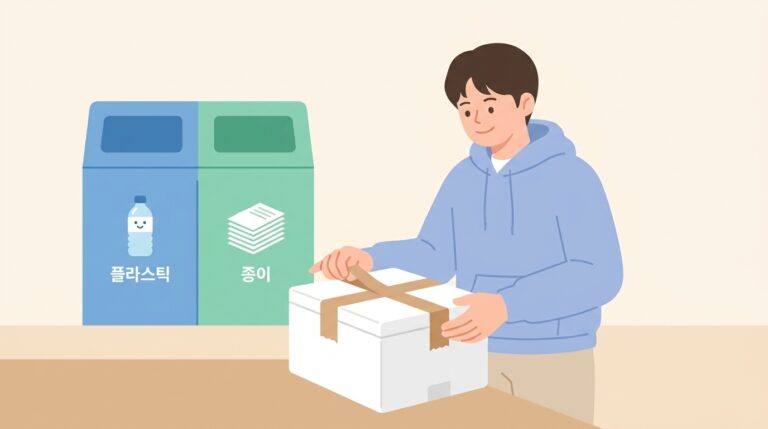
Mastering Korea’s Tricky Styrofoam Recycling: The Ultimate Friendly Guide
Phase 1: Welcome to the Styrofoam Mystery! 📦✨
안녕하세요! (An-nyeong-ha-se-yo!) Hello, my lovely language learners and Korea explorers! It’s your favorite Korean best friend and senior editor from Daily Hangul.
Imagine this: You’ve just finished a delicious late-night meal of Korean fried chicken or spicy tteokbokki (떡볶이) delivered right to your studio apartment. You’re feeling full, happy, and ready to sleep. But then, you look at your entryway and see it—a giant, white, bulky styrofoam box staring back at you.
You ask yourself: “Where do I put this? Do I throw it in the general trash bag? Will I get a heavy fine (과태료 – Gwa-tae-ryo)?”
Don’t panic! Today, we are going to conquer the scary world of Korean styrofoam recycling together. By the end of this quick guide, you will sound like a local neighbor and recycle like a pro, keeping your landlord and the neighborhood Gyeongbi-ajeossi (경비아저씨 – security guard) very happy! Let’s dive in!
Phase 2: 3 Core Expressions Every Resident Must Know 🗣️
Here are the three golden phrases you will hear or use when dealing with styrofoam. Let’s break them down easily!
1. 이거 스티로폼이에요? (I-geo seu-ti-ro-pom-i-e-yo?)
- Pronunciation Analogy: “Ee-guh soo-tee-roh-pohm-ee-yuh-yo?”
- Meaning: “Is this styrofoam?”
- K-Culture Moment: You are standing in the recycling area of your villa holding a strange white plastic tray. You see a neighbor and ask them politely to make sure you are placing it in the right spot.
- Editor’s Insight: Even though “styrofoam” is an English word, Koreans pronounce it as 스티로폼 (seu-ti-ro-pom). Saying “I-geo…” (This…) while pointing is a perfect A2-level trick!
- Situation Spectrum:
- Casual: 이거 스티로폼이야? (I-geo seu-ti-ro-pom-i-ya?) | ⚠️ (Only with close friends)
- Semi-formal: 이거 스티로폼이에요? (I-geo seu-ti-ro-pom-i-e-yo?) | ✅ (Best for neighbors/guards)
- Formal: 이것은 스티로폼입니까? (I-geot-eun seu-ti-ro-pom-im-ni-ka?) | 🚫 (Too stiff/robotic)
- 🤔 Think About It: In your home country, do you recycle styrofoam together with plastic, or is it thrown in the general waste? Korea treats it very specifically!
2. 테이프 떼고 버려야 돼요. (Te-i-peu tte-go beo-ryeo-ya dwae-yo.)
- Pronunciation Analogy: “Teh-ee-peuh tteh-goh buh-ryuh-yah dwaeh-yo.”
- Meaning: “You have to peel off the tape before throwing it away.”
- K-Culture Moment: You are carrying a delivery box, and a friendly neighborhood grandmother (Halmeoni) points at the brown packaging tape still stuck to the box.
- Editor’s Insight: 떼다 (tte-da) means “to peel off” or “to detach.” 버려야 돼요 (beo-ryeo-ya dwae-yo) means “must throw away.” This grammar structure (-야 되다) is incredibly useful for rules!
- Situation Spectrum:
- Casual: 테이프 떼고 버려. (Te-i-peu tte-go beo-ryeo.) | ⚠️
- Semi-formal: 테이프 떼고 버려야 돼요. (Te-i-peu tte-go beo-ryeo-ya dwae-yo.) | ✅
- Formal: 테이프를 제거하고 배출하셔야 합니다. (Te-i-peu-reul je-geo-ha-go bae-chul-ha-syeo-ya ham-ni-da.) | 🚫 (Too bureaucratic)
3. 깨끗이 씻어서 내놓으세요. (Kkae-kkeut-i ssi-seo-seo nae-noh-eu-se-yo.)
- Pronunciation Analogy: “Kkaeh-kkeut-ee shee-suh-suh naeh-noh-euh-seh-yo.”
- Meaning: “Please wash it clean and put it out.”
- K-Culture Moment: Your apartment guard notices red soup stains on your instant ramen cup and reminds you of the cleanliness rule.
- Editor’s Insight: 내놓다 (nae-noh-ta) means to put something outside (like bringing trash out to the curb). Adding -으세요 (-eu-se-yo) makes it a polite request.
- Situation Spectrum:
- Casual: 씻어서 내놔. (Ssi-seo-seo nae-nwa.) | ⚠️
- Semi-formal: 깨끗이 씻어서 내놓으세요. (Kkae-kkeut-i ssi-seo-seo nae-noh-eu-se-yo.) | ✅
- Formal: 세척 후 배출해 주시기 바랍니다. (Se-cheok hu bae-chul-hae ju-si-gi ba-ram-ni-da.) | 🚫
Phase 3: Textbook Korean vs. Real-Life Korean 📖 ➡️ 🗣️
Let’s compare the overly formal sentences in textbooks with the practical, warm language Koreans actually use!
Situation 1: Telling someone a stained cup-noodle bowl cannot be recycled
- 📖 Textbook style: “음식물로 오염된 스티로폼은 재활용품이 아닙니다.” (Styrofoam contaminated with food is not a recyclable item.)
- 🗣️ Real-life style: “빨간 국물 묻은 건 안 돼요!” (The ones with red soup stains are a no-go!)
- 💡 Why the difference? Real Koreans use simple, visual descriptions like “빨간 국물” (red soup) to explain recycling rules quickly and warmly.
Situation 2: Asking where to leave the styrofoam boxes
- 📖 Textbook style: “스티로폼 배출 장소는 어디입니까?” (Where is the discharge location for styrofoam?)
- 🗣️ Real-life style: “스티로폼 어디에 둬요?” (Where do I put the styrofoam?)
- 💡 Why the difference? “배출 장소” is a dry, official term. In real life, simply asking “어디에 둬요?” (Where do I place/leave it?) sounds much more natural and friendly.
Phase 4: K-Culture Deep Dive & Non-verbal Manners 🇰🇷
4-1. The “Peeling Tape” Gesture & Eye Contact
When talking to a security guard or landlord about styrofoam, always show that you respect their hard work. Before you carry your box down, dramatically scratch the corner of the tape with your fingernail while smiling. This visual cue tells the guard, “Look, I did my homework and peeled off all the tape and delivery stickers!” A polite nod of the head (called mok-insa) goes a long way!
4-2. The Korean Delivery Empire (배달 문화) & Eco-Consciousness
Korea has the fastest food and parcel delivery system in the world. Fresh groceries arrive in thick styrofoam boxes filled with dry ice. Because of this massive volume of waste, local communities are very strict about recycling. Doing your part shows you are not just a tourist, but a respectful member of the local community.
Phase 5: Real-Life Roleplay Scenario 🎭
Setting: You are standing in front of the recycling station of your apartment complex on a chilly Tuesday evening. You are holding a large white styrofoam box. Min-woo (민우), your friendly next-door neighbor, is sorting his plastics.
Min-woo: 안녕하세요! 분리수거 하러 오셨어요?
         (An-nyeong-ha-se-yo! Bun-ri-su-geo ha-reo o-sycol-seo-yo?)
         "Hello! Are you here to do some recycling?"

You:     (Nodding politely) 네! 그런데 이거 스티로폼 어떻게 버려요?
         (Ne! Geon-de i-geo seu-ti-ro-pom eo-tteok-hae beo-ryeo-yo?)
         "Yes! But, how do I throw this styrofoam away?"

Min-woo: Ah! [pointing at the paper delivery label] 테이프랑 송장은 떼고 버려야 돼요.
         (Ah! Te-i-peu-rang song-jang-eun tte-go beo-ryeo-ya dwae-yo.)
         "Ah! You have to peel off the tape and the delivery label."

You:     아, 진짜요? 몰랐어요. [peeling off the sticker quickly] 이건 그냥 일반 쓰레기에요?
         (Ah, jin-jja-yo? Mol-las-seo-yo. I-geon geu-nyang il-ban sseu-re-gi-e-yo?)
         "Oh, really? I didn’t know. Are these stickers just general trash?"

Min-woo: 네, 맞아요. 일반 쓰레기봉투에 버리세요. 그리고 스티로폼은 저기 하얀색 모아둔 곳에 두면 돼요!
         (Ne, ma-ja-yo. Il-ban sseu-re-gi-bong-tu-e beo-ri-se-yo. Geu-ri-go seu-ti-ro-pom-eun jeo-gi ha-yan-saek mo-a-dun got-e du-myeon dwae-yo!)
         "Yes, that's right. Throw them in the general trash bag. And for the styrofoam, you can leave it over there where the white ones are gathered!"

You:     아! 정말 감사합니다. 도와주셔서 다행이에요!
         (Ah! Jeong-mal gam-sa-ham-ni-da. Do-wa-ju-syeo-seo da-haeng-i-e-yo!)
         "Ah! Thank you so much. I’m so glad you helped me!"
🔀 Interactive Branching Point: What do you do with a stained red cup-ramen bowl?
- Choice A: Try to slide it quietly into the white styrofoam pile.
- Choice B: Ask Min-woo: “이건 빨간색인데 괜찮아요?” (This one is red/stained, is it okay?)
- Choice C: Wash it thoroughly under the tap first, then place it in the clean pile.
Feedback:
- Choice A (Bad): 🚫 Oops! The security guard might spot it and chase after you, or your building might get flagged. Not cool!
- Choice B (Risk): ⚠️ Not bad! Min-woo will tell you: “안 돼요! 씻거나 일반 쓰레기로 버려야 돼요.” (No! You must wash it or throw it in the general trash.)
- Choice C (Best): Perfect! Washing it clean shows you are a true recycling master. You get 100 social points!
Phase 6: 10-Second Emotion Shadowing Drill 🗣️⏱️
Let’s practice speaking with real Korean feelings! Pay attention to the pauses (/) and emotional cues.
- “테이프 / 꼭! / 떼고 / 버리세요.”
- [😊 Friendly but firm]
- “Te-i-peu / kkok! / tte-go / beo-ri-se-yo.”
- (Make sure you emphasize “꼭” [kkok] which means “definitely!”)
- “깨끗하게 / 안 씻으면 / 안 돼요!”
- [🥺 Caring and slightly worried]
- “Kkae-kkeut-ha-ge / an ssi-seu-myeon / an dwae-yo!”
- (Keep your tone soft but warned—like you’re helping a friend avoid a fine!)
Phase 7: K-Culture Mini Dictionary 📖
- 분리수거 (Bun-ri-su-geo) | Separate garbage collection / Recycling.
- 배달 (Bae-dal) | Delivery service (food or packages).
- 과태료 (Gwa-tae-ryo) | Fine / Penalty fee for violating public rules.
- 경비실 (Gyeong-bi-sil) | Security / Guard office in residential buildings.
Phase 8: Traveler’s Survival Kit 🎒
Survival Expressions TOP 3
- “이거 어디에 버려요?” (I-geo eo-di-e beo-ryeo-yo?) – “Where do I throw this away?”
- “테이프 떼야 돼요?” (Te-i-peu tte-ya dwaeh-yo?) – “Do I need to peel off the tape?”
- “이것도 재활용 돼요?” (I-geot-do jae-hwal-yong dwae-yo?) – “Can this be recycled too?”
Editor’s Travel Note:
To find out which days are recycling days in your specific neighborhood, check your building’s entrance board or search your local district office website. You can easily navigate to your nearest convenience store or district office using the Naver Map App Guide to buy standard general waste bags (종량제 봉투).
Phase 9: “One Step Deeper” (Thinking Cultural Essay) 🧠
Korea’s strict volume-rate garbage system (쓰레기 종량제) was introduced in 1995. Before this, garbage was a huge environmental headache. By forcing residents to pay for specialized trash bags and sort recyclable materials carefully, Korea became one of the top recycling nations in the world.
This system works because of community trust. If one person messes up, the whole building gets fined. It shows how deeply Korean society values collective responsibility and shared respect.
💬 Your Turn: How is recycling handled in your country? Do you find Korea’s system hard or convenient? Let me know in the comments below!
Phase 10: FAQ & Common Mistakes ❓
Q: Can I recycle colored styrofoam (like black meat trays)?
A: Generally, no. Only clean, pure white styrofoam is recyclable. Colored or printed styrofoam should go into the general waste bag (종량제 봉투).
Q: What should I do with the ice packs inside delivery boxes?
A: Do not open them! Most gel ice packs go into the general trash, but some modern ones contain only water. Cut those open, pour the water out, and recycle the plastic cover.
Q: What if I can’t wash the red ramen stain out of the white bowl?
A: If it remains stained red even after washing, it cannot be recycled. Throw it into the general trash bag.
🚨 Common Mistakes Alert!
- Leaving the paper shipping label on the box: Correct Action: Always peel off stickers completely.
- Throwing dirty cup noodles in the recycling bin: Correct Action: Sun-dry the washed bowl to remove stains, or use general waste.
- Mixing bubble wrap with styrofoam: Correct Action: Bubble wrap goes with generic plastics (비닐류).
Phase 11: Action Mission 🏆
- Bronze Medal: Check your current trash bin. Did you peel the tape off your boxes?
- Silver Medal: Snap a picture of your neat recycling pile and share it with your language-exchange partner!
- Gold Medal: Say “수고하십니다!” (Thank you for your hard work!) to your local building guard next time you drop off your styrofoam.
Phase 12: Interactive Quiz Challenge 🎮
Test your skills! (Click to see answers)
Q1. Which of the following CANNOT be recycled as styrofoam?
1) Pure white clean TV box packing
2) Cup noodle container with stubborn red stains
3) Clean white food tray
Reveal Answer
Answer: 2
Red food stains contaminate the recycling stream. Throw stained bowls into the general trash!
Q2. True or False: You can leave the packing tape on the box if it is clear tape.
Reveal Answer
Answer: False
All tape—whether brown, clear, or paper—must be completely removed before recycling!







