

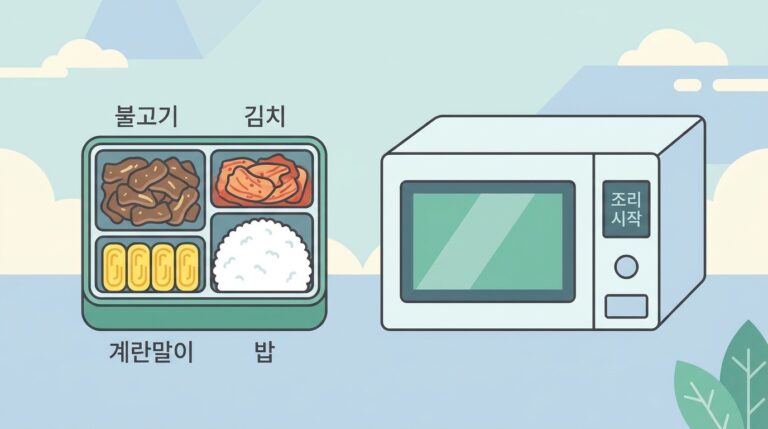
Master the Art of the Korean Convenience Store Feast: The Evolution of Dosirak (도시락)
안녕하세요! Welcome back to another edition of Daily Hangul. I’m your senior editor and local culture navigator. If you have ever stepped into a Korean convenience store (편의점 – pyeon-ui-jeom) expecting just soggy sandwiches and lukewarm instant coffee, you are in for a massive, mouth-watering surprise.
Today, we are diving deep into the fascinating world of 편의점 도시락 (Pyeon-ui-jeom Dosirak – Convenience Store Lunchboxes). For advanced (C1) learners, simply ordering food is easy. But to truly navigate the social nuances, slang, and changing cultural tides of Korea’s high-speed dining, you need to master the linguistic and behavioral codes of the modern “Honbap” (혼밥 – eating solo) revolution.
Let’s unpack how a simple plastic tray of rice and side dishes evolved into a gourmet cultural phenomenon, and learn the exact expressions you need to sound like a seasoned Seoulite.
Phase 2: Core Expressions (핵심 표현 3선)
To talk about modern convenience store cuisine like a true local, you need to go beyond standard dictionary definitions. Here are three highly nuanced terms essential for C1-level fluency.
1. 혜자스럽다 (Hye-ja-seu-reop-da)
- Pronunciation: Hye-ja-seu-reop-da (Sounds like “Hyeh-jah-seu-rup-dah”)
- Meaning: Superb value for money; incredibly generous in portion and quality.
- K-Culture Moment: This slang originated from a legendary convenience store lunchbox line branded by the beloved veteran actress Kim Hye-ja. The meals were so unexpectedly high in quality and cheap that her name literally became an adjective for “generous and high-quality.”
- Editor’s Insight: Use this when you buy a meal that feels way too good for its price. The opposite is 창렬하다 (Chang-ryeol-hada), which means overpriced and disappointing (based on another celebrity food line that went terribly wrong).
- Situation Spectrum:
- Casual: ✅ | Semi-formal: ⚠️ | Formal: 🚫
- 🤔 Think About It: Does your native language have an adjective derived from a person’s name to describe the quality of a product?
2. 한 끼 때우다 (Han kki ttae-u-da)
- Pronunciation: Han kki ttae-u-da (Sounds like “Han kkee tteh-oo-dah”)
- Meaning: To settle for a quick, cheap, or simple meal just to get by.
- K-Culture Moment: You will hear exhausted office workers in K-dramas (like Misaeng) say this as they grab a triangle kimbap or a quick dosirak between overtime shifts.
- Editor’s Insight: “때우다” literally means to patch up a hole. Thus, “한 끼 때우다” implies you aren’t having a luxurious dining experience; you are simply fueling your body to survive the day.
- Situation Spectrum:
- Casual: ✅ | Semi-formal: ✅ | Formal: ⚠️ (Can sound a bit too informal in highly professional reports)
- 🤔 Think About It: Why does Korean culture place such a high linguistic emphasis on “eating well,” to the point where skipping a proper meal is described as “patching up” a hole?
3. 골라 먹는 재미가 있다 (Gol-la meok-neun jae-mi-ga it-da)
- Pronunciation: Gol-la meok-neun jae-mi-ga it-da (Sounds like “Kol-lah mung-nun jae-mee-gah eet-tah”)
- Meaning: The joy of having a wide variety of choices.
- K-Culture Moment: Used extensively in food blogs and vlogs when reviewing the dozens of different dosirak options available at CU, GS25, and Seven-Eleven.
- Editor’s Insight: This phrase emphasizes the modern shift of convenience stores from places of “desperation” to places of “curated choice.”
- Situation Spectrum:
- Casual: ✅ | Semi-formal: ✅ | Formal: ✅
- 🤔 Think About It: How does the abundance of choices in modern urban spaces affect our daily decision-making processes?
Phase 3: Textbook Korean vs. Real Korean
Let’s compare how textbooks teach convenience store interactions versus how native speakers actually converse in these fast-paced spaces.
Situation 1: Inquiring about warming up food
- 📖 Textbook: “이 도시락을 전자레인지에 데워도 괜찮습니까?” (May I warm up this lunchbox in the microwave?)
- 🗣️ Real Korean: “이거 몇 분 돌려야 돼요?” (How many minutes should I run this for?)
- 💡 Why the difference? Locals assume that you will warm it up yourself. The active verb 돌리다 (to spin/run) is universally used instead of “데우다” (to warm up) because of the spinning plate inside a microwave.
Situation 2: Praising the quality of the meal
- 📖 Textbook: “음식의 질이 아주 우수하고 가격이 저렴합니다.” (The food quality is excellent and the price is low.)
- 🗣️ Real Korean: “와, 요즘 편의점 도시락 진짜 잘 나오네요!” (Wow, convenience store lunchboxes these days are incredibly well-made!)
- 💡 Why the difference? “잘 나오다” (to come out well) is the natural, idiomatic way to express that a product’s design, portions, and overall quality have reached a high standard.
Phase 4: K-Culture Deep Dive & Non-Verbal Manners
4-1. Nunchi (눈치) & Microwaving Etiquette
Korean convenience stores are semi-public dining rooms. To show high-level Nunchi (social intelligence):
1. The Post-Microwave Wipe: If your food splatters inside the shared microwave, it is expected that you grab a tissue from the counter and wipe it down immediately.
2. The Quick Sort: When you finish your dosirak, do not just throw the whole container in the trash. Separate the plastic cover, the main tray, and any leftover food waste (음식물 쓰레기) into their designated bins.
4-2. The “Honbap” (혼밥) Revolution
Historically, eating alone in Korea carried a social stigma of loneliness. However, the rise of the single-person household (1인 가구) has transformed “Honbap” into a trendy, self-care lifestyle. Convenience store lunchboxes have evolved from “sad, lonely meals” to “curated, luxurious single-portion feasts” featuring ingredients like beef ribs (갈비), eel (장어), and premium side dishes.
Phase 5: Real-World Roleplay Scenario
Setting: A bustling GS25 convenience store in the trendy neighborhood of Mapo, Seoul, at 9:00 PM.
Characters:
* Min-ji (민지): A friendly, experienced store clerk.
* Tyler (타일러): An advanced foreign exchange student looking for a satisfying dinner after a long study session.
민지: 어서 오세요! 찾으시는 거 있으세요?
      (Welcome! Are you looking for anything in particular?)

타일러: 요즘 하도 편의점 도시락이 잘 나온다고 해서 구경하고 있어요. 종류가 진짜 많네요!
        (I heard convenience store lunchboxes are so well-made these days, so I'm browsing. There are so many kinds!)

민지: 맞아요. 요즘은 골라 먹는 재미가 있죠. 특히 저 백종원 도시락이 요즘 제일 가성비가 좋아요.
      (True! There's definitely a joy in choosing these days. Especially that Baek Jong-won lunchbox over there—it has the best value for money right now.)

타일러: 아, 그래요? 구성이 엄청 알차네요. 완전 혜자스러워요!
        (Oh, really? The setup is incredibly solid. It's totally Hyeja-스럽다!)

민지: ㅋㅋㅋ 맞아요, 완전 혜자죠! 오늘 피곤하신데 그걸로 맛있는 한 끼 때우세요.
      (Haha, exactly! It's totally Hyeja! You look tired today; use that to have a satisfying quick meal.)

타일러: 네, 이걸로 할게요. 아, 그런데 이거 전자레인지에 몇 분 돌려야 돼요?
        (Yes, I'll take this one. Oh, by the way, how many minutes should I microwave this?)

민지: 뚜껑 덮고 한 2분만 돌리시면 돼요. 나무젓가락은 계산대 아래에 있어요!
      (Just keep the lid on and run it for about 2 minutes. Wooden chopsticks are right under the counter!)
🔀 Choose Your Path!
How would you respond if the store clerk tells you the microwave inside is temporarily out of order?
- Option A: “아, 그래요? 그럼 그냥 차갑게 먹어도 돼요?” (Oh, really? Then can I just eat it cold?)
- Feedback: [Risk] While grammatically correct, most Korean dosirak meals (especially meat-heavy ones) taste terrible cold due to solidified fats. Min-ji might look at you with deep concern!
- Option B: “앗, 진짜요? 그럼 집에 가서 데워 먹어야겠네요. 감사합니다!” (Ah, really? Then I’ll have to warm it up and eat it at home. Thank you!)
- Feedback: [Best] Highly natural, polite, and shows that you understand the cultural norm of eating dosirak hot.
- Option C: “전자레인지 고장 났어요? 고쳐 주세요.” (Is the microwave broken? Please fix it.)
- Feedback: [Bad] Extremely rude and demanding. Convenience store part-timers do not have the tools or authority to fix hardware on the spot.
Phase 6: 10-Second Emotion Shadowing Drill
Practice these sentences out loud, paying attention to the pauses (/) and emotional cues.
[😊 Excited & Impressed]
“우와, / 요즘 편의점 도시락 / 진짜 혜자스러운데요?”
(Woah, convenience store lunchboxes these days are incredibly generous!)-
[🥺 Tired & Self-pitying]
“오늘도 / 그냥 편의점 도시락으로 / 대충 한 끼 때워야겠다…”
(I guess I’ll just scrape by another meal with a convenience store lunchbox today…)
Phase 7: K-Culture Mini Dictionary
- 편맛평 (Pyeon-mat-pyeong): Short for “편의점 맛 평가” (Convenience store taste review). A highly popular hashtag used by food bloggers reviewing new snacks and meals.
- 편밀레 (Pyeon-mil-le): A portmanteau of “편의점” (Convenience store) and “밀레” (Millet’s painting The Angelus, depicting workers praying over potatoes). Refers to young people or students gathered around convenience store tables eating budget meals.
- 혼술족 (Hon-sul-jok): People who enjoy drinking alcohol alone at home, often buying premium convenience store dosirak or side snacks to pair with beer.
- 폐기 (Pye-gi): Food items pulled from shelves due to expiration. Often eaten by part-time workers or shared among cash-strapped college students.
Phase 8: Traveler’s Survival Kit
Top 3 Survival Phrases
- “젓가락 챙겨 주실 수 있나요?” (Can I get some chopsticks?)
- Pro Tip: Most self-service stores require you to grab them yourself, but asking politely helps if they are hidden.
- “이 도시락 뚜껑 덮고 데워요?” (Do I microwave this with the lid on?)
- Pro Tip: Some premium containers have steam-vent lids that can stay on, while others must be removed to prevent warping.
- “카드 결제 되나요?” (Can I pay with a card?)
- Pro Tip: Korea is virtually cashless; card payments are accepted everywhere, even for a 500-won candy bar.
Editor’s Travel Note
Before wandering around looking for a specific premium lunchbox, download the official mobile apps like the Pocket CU App on Google Play or the GS25 app to check real-time stock levels at nearby stores. This will save you from making unnecessary trips!
Phase 9: One Step Deeper
The evolution of the Korean convenience store dosirak mirrors the shifting landscape of modern Korean society. As the traditional family unit shrinks, the collective kitchen has given way to individual micro-apartments. Yet, the high quality of these meals shows that Koreans refuse to compromise on culinary pleasure, turning a fast-paced necessity into an art form. It’s a beautiful, bittersweet testament to modern efficiency and resilience.
💬 Your Turn: Have you ever tried a Korean convenience store meal? What surprised you the most about the quality? Leave a comment below!
Phase 10: FAQ & Common Mistakes
Q: Can I sit and eat inside every Korean convenience store?
A: Most urban convenience stores have small dining counters (시식대), but smaller residential branches might not. Always look for the designated seating counter before unpacking your food.
Q: Is it okay to leave my trash on the table if there are no trash cans visible?
A: Absolutely not. Keeping the space clean is a fundamental social rule in Korea. Trash bins are always located near the door or under the food prep counters.
Q: Are convenience store lunchboxes healthy?
A: While they used to be criticized for high sodium content, modern premium options focus heavily on nutrition, offering balanced macronutrients, steamed vegetables, and low-calorie grains.
🚨 Common Mistakes Board
- Mistake 1: Using the verb “요리하다” (to cook from scratch) instead of “데우다/돌리다” (to heat up) when preparing instant food.
- Correct Action: Say “이거 전자레인지에 돌려야 돼요?”
- Mistake 2: Forgetting to separate food waste from plastic recyclables.
- Correct Action: Scrape leftovers into the food waste bin (음식물 쓰레기) first, then recycle the plastic tray.
- Mistake 3: Assuming all lids must be removed before microwaving.
- Correct Action: Read the label. If it says “뚜껑을 덮고 돌려주세요” (Please microwave with the lid on), leave it on to keep the rice moist!
Phase 11: Action Mission
- Bronze Mission: Go to a Korean supermarket or local convenience store, find a lunchbox, and read the microwave instructions in Korean.
- Silver Mission: Take a photo of your favorite quick meal and post it on social media using the slang #혜자스럽다.
- Gold Mission: Go to a convenience store in Korea, order a premium dosirak, warm it up yourself, and separate the trash perfectly like a local.
Phase 12: Interactive Quiz Challenge
Test your knowledge with these three quick questions!
1. What does the slang “혜자스럽다” mean?
a) Extremely expensive and fancy
b) Poor quality and disappointing
c) Incredibly generous in portion and quality relative to price
2. Which verb is most naturally used when talking about microwaving food?
a) 요리하다
b) 돌리다
c) 끓이다
3. [True or False] You should always throw your entire lunchbox container into the general waste bin without separating food scraps.
👉 Click here for the Answer Key & Explanations!
- 1. Correct Answer: c (Named after actress Kim Hye-ja, this slang represents superb value for money!)
- 2. Correct Answer: b (“돌리다” refers to the rotating motion of the microwave tray and is the go-to verb.)
- 3. Correct Answer: False (You must separate food waste from recyclable plastic. High-level Nunchi requires perfect waste separation!)







