

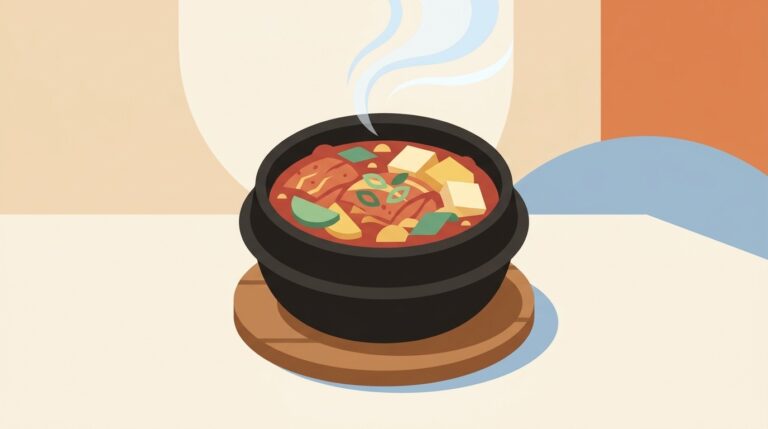
Why Korean Stews Never Get Cold: The Secret of the Ttukbaegi
Phase 1: Empathy (An Warm Welcome!)
안녕하세요! (Annyeonghaseyo!) It’s your favorite Korean bestie and Senior Editor at Daily Hangul.
Have you ever sat down at a cozy, bustling restaurant in Seoul, ordered a bubbling pot of Kimchi-jjigae (김치찌개), taken a huge, excited spoonful, and immediately regretted your life choices as your tongue went completely numb? 🥵
You are not alone! Many of my intermediate learners tell me they absolutely love the deep, rich flavors of Korean soups but dread the “lava-like” temperature that never seems to drop.
The secret behind this magical (and sometimes painful) eternal heat is the 뚝배기 (Ttukbaegi)—the traditional Korean earthenware pot. Today, we’re diving into the unique culture of Korean stews, the science of heat retention, and the essential intermediate (B2) expressions you need to sound like a local while saving the roof of your mouth from disaster!
Frequently Asked Questions (FAQ)
Q: What does "뚝배기" mean in Korean and how do you pronounce it?
A: In Korean, "뚝배기" is pronounced [Ttukbaegi] and means: —the traditional Korean earthenware pot. Today, we're diving into the unique culture of Korean stews, the science of heat retention, and the essential intermediate (B2) expressions you need to sound like a local while saving the roof of your mouth from disaster!







