

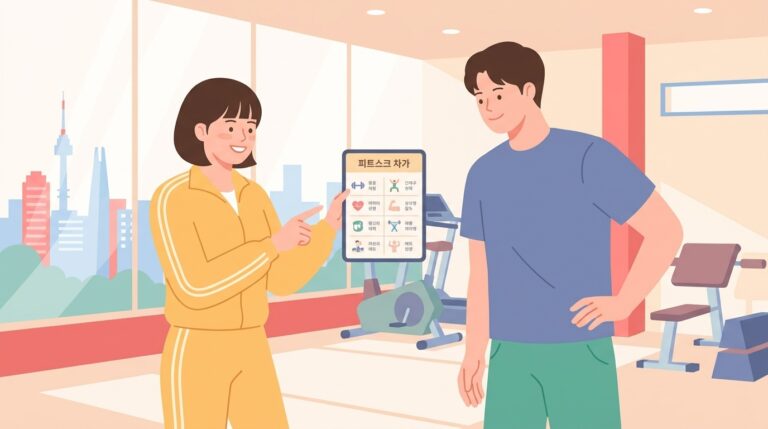
Crush Your Gym Goals in Korea: How to Sign Up and Request PT Like a Pro
안녕하세요! (Annyeonghaseyo!) It’s your favorite Korean culture navigator and Daily Hangul’s head editor. Have you ever walked past one of those sleek, neon-lit Korean fitness centers (헬스장 – hel-seu-jang) in Seoul and wished you had the courage to walk in and sign up?
Whether you’ve been motivated by your favorite K-Pop idol’s workout routine or want to experience Korea’s booming fitness culture firsthand, entering a Korean gym can feel intimidating. Between the energetic trainers and the unique fitness vocabulary, it’s easy to freeze up. But don’t worry! Today, we are going to master the exact phrases and cultural nuances you need to confidently walk into any Korean gym, ask for a Personal Training (PT) consultation, and start your journey toward “득근” (gaining muscle)!
Phase 2: Core 3 Expressions Deep Dive
1. 혹시 PT 상담 좀 받을 수 있을까요? (Hoksi PT sang-dam jom badeul su isseulkayo?)
- Pronunciation: Hok-shee PT sang-dahm jom bah-deul soo ee-seul-kah-yo?
- Meaning: “By any chance, could I get a consultation for PT (Personal Training)?”
- K-Culture Moment: You’ve probably seen this scene in K-Dramas like Weightlifting Fairy Kim Bok-joo, where characters nervously step into a fitness center to turn their lives around. This is the ultimate, polite door-opener phrase.
- Editor’s Insight: Starting with 혹시 (hok-si / by any chance) and adding 좀 (jom / a little, please) instantly softens your tone. It makes you sound incredibly polite, natural, and respectful of the trainer’s busy schedule.
- Situation Spectrum: Casual ⚠️ / Semi-formal ✅ / Formal ✅
- 🤔 Think About It: Why does Korean culture value softening words like “혹시” and “좀” even when you are a paying customer? It’s all about creating a harmonious first impression (첫인상).
2. 초보자도 따라갈 수 있는 프로그램인가요? (Chobojado ttaragal su inneun peurogureamingayo?)
- Pronunciation: Cho-bo-ja-do ttha-ra-gal soo een-neun peu-ro-gue-rim-een-ga-yo?
- Meaning: “Is this program suitable for a beginner to follow?”
- K-Culture Moment: Essential for anyone who feels overwhelmed by those complex gym machines. This phrase is the perfect way to express your concern while showing a genuine interest in learning.
- Editor’s Insight: 초보자 (cho-bo-ja) means beginner. By adding -도 (do / also/even) and 따라가다 (tta-ra-ga-da / to keep up or follow), you are asking if the trainer can customize the pace for you. Trainers love this question because it shows you want to learn the right way!
- Situation Spectrum: Casual ⚠️ / Semi-formal ✅ / Formal ✅
- 🤔 Think About It: Admitting you are a beginner in Korea is highly respected; it signals humility and a readiness to be coached.
3. 한 달에 몇 번 정도 수업을 받나요? (Han dare myeot beon jeongdo sueobeul bannyayo?)
- Pronunciation: Han dahl-eh myut bun jung-do soo-up-eul bahn-nah-yo?
- Meaning: “How many classes/sessions do I get per month?”
- Editor’s Insight: This helps you clarify the frequency of your PT sessions. 수업 (su-eob) usually means class or lesson, and 받다 (bat-da) means to receive. Combined, they mean “taking sessions.”
- Situation Spectrum: Casual 🚫 / Semi-formal ✅ / Formal ✅
- 🤔 Think About It: How does setting clear boundaries and schedules right from the start reflect the organized, fast-paced (빨리빨리) lifestyle of modern Korea?
Phase 3: Textbook Korean vs. Real Korean
Let’s look at how textbooks teach gym talk versus how actual locals speak. Notice the difference in warmth and natural flow!
Situation 1: Asking about the membership fee
- 📖 Textbook Korean: “회비가 얼마입니까?” (Hwebiga eolmaimnikka? / How much is the membership fee?)
- 🗣️ Real Korean: “혹시 한 달 회비가 어떻게 돼요?” (Hoksi han dal hwebiga eotteoke dwaeyo? / By any chance, how much is the monthly fee?)
- 💡 Why the difference? Saying “얼마입니까?” sounds like a robot reading a catalog. Using “어떻게 돼요?” (How does it go/What is it?) is much softer and naturally invites a friendly explanation.
Situation 2: Expressing your workout determination
- 📖 Textbook Korean: “열심히 운동하겠습니다.” (Yeolsimhi undonghagesseumnida? / I will exercise hard.)
- 🗣️ Real Korean: “이번엔 진짜 ‘득근’해 보려고요!” (Ibeonen jinjja ‘deuk-geun’hae boryeogoyo! / This time, I’m really trying to gain some muscle!)
- 💡 Why the difference? While the textbook version is very polite, the real version uses the beloved gym slang 득근 (deuk-geun / muscle gain), which instantly builds a fun, friendly rapport with your trainer.
Phase 4: K-Culture Deep Dive & Non-verbal Manners
4-1. Nunchi (눈치) & Gym Etiquette
When you step into a Korean gym for a consultation, trainers will appreciate your 눈치 (Nunchi – situational quick-wittedness) if you follow these simple non-verbal rules:
1. The Shoes Rule: Never wear your outdoor sneakers onto the gym floor! Always bring a separate, clean pair of indoor-only sneakers (실내용 운동화) in a bag.
2. Eye Contact & Nodding: When a trainer is explaining body composition results (InBody analysis is huge in Korea!), maintain polite eye contact and nod slightly. It shows you respect their expertise.
4-2. The “Oh-Un-Wan” (오운완) Phenomenon
If you use Instagram in Korea, you’ve definitely seen the hashtag #오운완 (Oh-Un-Wan). It stands for 오늘 운동 완료 (Today’s Workout Complete). It’s a massive cultural trend where people post a mirror selfie of their gym outfit or their sweaty face to celebrate daily consistency. Mentioning this trend during your gym consultation will show your trainer that you are fully immersed in modern Korean lifestyle trends!
Phase 5: Practical Roleplay Scenario
Meet Min-su, an enthusiastic, highly supportive personal trainer, and Sarah, an intermediate Korean learner who wants to get fit.
- 민수 (Trainer): 어서 오세요! 어떤 것 도와드릴까요? 🎭 smiling warmly with hands folded
- 사라 (Sarah): 안녕하세요! 혹시 PT 상담 좀 받을 수 있을까요? 🎭 bowing slightly
- 민수 (Trainer): 네, 물론이죠! 이쪽으로 앉으세요. 혹시 따로 원하시는 운동 목적이 있으신가요?
- 사라 (Sarah): 체력을 기르고 싶은데, 초보자도 따라갈 수 있는 프로그램인가요?
- 민수 (Trainer): 당연하죠! 기초부터 차근차근 알려드릴 거예요. 보통 한 달에 몇 번 정도 수업을 받고 싶으세요?
- 사라 (Sarah): 주 2회씩 해서, 한 달에 8번 정도 받고 싶어요.
- 민수 (Trainer): 아주 좋습니다! 그럼 인바디(InBody) 측정부터 도와드릴게요. 이쪽으로 오세요!
🔀 Interactive Choice: What should Sarah say next to keep the positive vibe going?
- Option A: “우와, 인바디 처음 해봐요! 신기해요!” (Wow, it’s my first time doing InBody! Fascinating!)
- Option B: “귀찮은데 인바디 꼭 해야 돼요?” (It’s annoying, do I really have to do InBody?)
- Option C: “인바디 결과 안 좋게 나오면 어떡하죠?” (What if my InBody results are bad?)
💡 Feedback on Your Choice:
- If you chose A (Best): Perfect! It shows high energy, enthusiasm, and willingness to participate. Your trainer will be highly motivated to help you!
- If you chose B (Bad/Risk): Oops! This sounds a bit negative and might drain the trainer’s enthusiasm.
- If you chose C (Acceptable): A very natural worry! Korean trainers are used to hearing this and will usually respond with a friendly, “걱정 마세요! (Don’t worry!)”
Phase 6: 10-Second Emotion Shadowing Drill
Let’s practice speaking like a native! Focus on the pauses (marked by /) and match the emotional tags to sound natural.
혹시 / PT 상담 좀 / 받을 수 있을까요?- [🥺 shy but polite] Hok-si… PT sang-dam jom… badeul su isseulkayo?
이번엔 / 진짜 / 득근할 거예요!- [🔥 highly motivated and energetic] Ibeonen… jinjja… deuk-geun-hal geoyeyo!
초보자도 / 쉽게 / 할 수 있겠죠?- [😊 hopeful and seeking reassurance] Chobojado… swipge… hal su itgetjyo?
Phase 7: K-Culture Mini Dictionary
| Word | Pronunciation | Meaning & Usage |
|---|---|---|
| 득근 | Deuk-geun | Literally “gaining muscle.” Used to cheer someone on who is working out hard. |
| 오운완 | O-un-wan | “Today’s workout done.” The ultimate Korean fitness hashtag. |
| 헬린이 | Hel-rin-i | “Gym beginner” (헬스장 + 어린이/child). A cute way to say you’re a newbie. |
| 회원님 | Hwe-won-nim | “Valued member.” How trainers always address you. It sounds polite and professional. |
Phase 8: Survival Kit for Travelers
If you are only visiting Korea for a short time but still want to keep up your fitness routine, here are your absolute lifesavers!
Survival Expressions TOP 3
- 일일권 있나요? (Il-il-gwon innayo?)
- Meaning: Do you have a one-day pass?
- Pro Tip: Perfect for travelers who want to drop in for a single workout session.
- 수건이랑 운동복 주시나요? (Su-geon-i-rang un-dong-bok ju-si-na-yo?)
- Meaning: Do you provide towels and workout clothes?
- Pro Tip: Many Korean gyms rent out clean t-shirts, shorts, and towels for free or a tiny fee!
- 라커룸 어디예요? (La-keo-rum eo-di-ye-yo?)
- Meaning: Where is the locker room?
🧳 Editor’s Travel Note: To find a local gym near your accommodation, don’t use global search engines. Download Naver Map and search for “헬스장 일일권” (gym day-pass) to see local reviews, operating hours, and daily entry fees! (Please note that prices and operating hours can change depending on the branch).
Phase 9: “한 발 더 깊이” (Deep Dive into Korean Body Culture)
In recent years, the concept of health in Korea has shifted dramatically. While the previous generation focused heavily on extreme dieting to get skinny, today’s young Koreans celebrate strength, discipline, and physical capability. This is heavily reflected in the 바디프로필 (Body Profile) trend, where ordinary people train intensely for months to take professional, high-concept photographs of their sculpted bodies. It’s no longer just about losing weight; it’s about claiming ownership over one’s lifestyle and celebrating self-improvement.
💬 Your Turn: Does your country have a similar trend of taking professional fitness photos? How do you feel about this focus on visual body goals? Let us know in the comments below!
Phase 10: FAQ & Common Mistakes
Q: Can I sign up for PT if my Korean is very basic?
A: Absolutely! Korean trainers are highly energetic and excellent at using non-verbal cues, body language, and physical demonstrations. Knowing the core phrases in this guide is more than enough to show your polite attitude and willingness to learn.
Q: Do Korean gyms allow outside shoes if they look clean?
A: No, absolutely not! This is a major cultural taboo. Even if you just bought the shoes and only wore them from your taxi to the gym, you must change into clean, indoor-only shoes at the entrance or inside the locker room.
Q: What is the average price for PT in Korea?
A: PT prices generally range from 50,000 KRW to 80,000 KRW per session, often with deep discounts if you buy packages of 10, 20, or 30 sessions. Always ask: “혹시 이벤트 할인도 있나요?” (By any chance, is there an event discount?)
🚨 Common Mistakes Alert!
- Mistake 1: Calling the trainer “선생님” (Seon-saeng-nim / Teacher) with a stiff tone.
- Correct Action: While “선생님” is okay, calling them 코치님 (Ko-chi-nim / Coach) or simply addressing them during the consultation with polite verb endings makes the atmosphere much cooler and sports-focused!
- Mistake 2: Walking into the gym area directly with your street clothes.
- Correct Action: Always consult at the front desk or designated counseling tables first.
Phase 11: Action Mission
- Bronze Mission: Practice saying “혹시 PT 상담 좀 받을 수 있을까요?” out loud 5 times in front of your mirror with a warm smile!
- Silver Mission: Write down your fitness goal in Korean in the comments section below using 초보자 (beginner) or 득근 (muscle gain)!
- Gold Mission: If you are in Korea, walk into a local gym, ask for a consultation, and post an #오운완 photo on your Instagram, tagging us!
Phase 12: Interactive Quiz Challenge
Test your knowledge with this quick quiz!
1. What does the slang “득근” (deuk-geun) mean?
- A) Finding a locker key
- B) Gaining muscle
- C) Exercising with a partner
2. Fill in the blank: “초보자도 _________ 수 있는 프로그램인가요?” (Is this a program a beginner can follow?)
- A) 먹을 (meog-eul / to eat)
- B) 따라갈 (tta-ra-gal / to follow)
- C) 갈 수 (gal su / to go)
🔍 Click here to reveal the answers and explanations!
- Answer: B) Gaining muscle.
- Explanation: “득” (gain/obtain) + “근” (muscle). It’s the ultimate motivator word used in Korean gym culture!
- Answer: B) 따라갈 (tta-ra-gal / to follow).
- Explanation: “따라가다” means to follow or keep up with. So “따라갈 수 있는” means “able to follow.”
- Explanation: “따라가다” means to follow or keep up with. So “따라갈 수 있는” means “able to follow.”







