

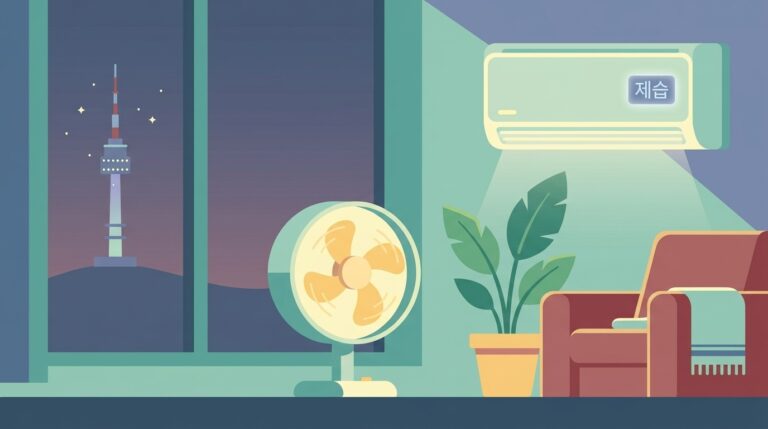
Beat the Korean Summer Heat: How to Talk About ‘Yeoldaeya’ (Tropical Nights) and AC Etiquette Like a Local
Phase 1: Empathy (Welcome to the Sticky Korean Summer! 🥵)
안녕하세요! It’s your favorite Korean bestie and Daily Hangul’s senior editor. If you are reading this from a tiny officetel in Seoul during late July or August, chances are you are currently sticking to your chair, staring at your air conditioner remote, and wondering: ‘Why is it still 30°C (86°F) at 2 AM?’
Welcome to the infamous Korean 열대야 (Yeoldaeya – Tropical Night).
In Korea, summer isn’t just hot; it’s incredibly humid. When the sun goes down, the heat doesn’t leave; it traps the moisture, turning the city into a giant sauna. Many of our intermediate (B2) students tell us they struggle to explain this unique exhaustion. Sure, you know the word ‘덥다’ (to be hot), but can you complain about your sleepless night, negotiate the AC temperature with a roommate, or avoid the dreaded 냉방병 (air-conditioning sickness) without sounding like a textbook?
Today, we’re leveling up your intermediate Korean so you can complain, negotiate, and survive the hot summer nights like a true Seoulite. Let’s dive in!
Phase 2: Deep Dive into 3 Essential Expressions
To master this sticky season, you need more than just dictionary translations. Here are three high-frequency expressions used constantly during the Korean summer heatwaves.
1. 열대야 때문에 잠을 설쳤어요 (yeol-dae-ya ttae-mun-e jam-eul seol-chyeost-eo-yo)
- Pronunciation: Yuhl-dae-yah ttae-moon-eh jahm-eul suhl-chyuh-ssuh-yo (Like “Yuhl” in ‘gull’, and “seol” like ‘soul’)
- Meaning: I tossed and turned/slept poorly because of the tropical night.
- K-Culture Moment: You will hear this expression constantly in K-Dramas when characters walk into the office looking exhausted, holding a giant iced Americano (아아) as their lifeline.
- Editor’s Insight: ‘설치다’ (seol-chi-da) means to do something incompletely or fitfully. When combined with ‘잠’ (sleep), it specifically refers to waking up repeatedly or being unable to fall into a deep sleep due to discomfort.
- Situation Spectrum:
- Casual: 열대야 때문에 잠설쳤어. ✅
- Semi-formal: 열대야 때문에 잠을 설쳤어요. ✅
- Formal: 열대야 현상으로 인해 숙면을 취하지 못했습니다. (Used in weather broadcasts) ⚠️
- 🤔 Think About It: How does your culture describe those unbearably hot nights when sleep is impossible? Is there a specific term like ‘열대야’?
2. 에어컨 제습 모드로 틀어 놔 (e-eo-keon je-seup mo-deu-ro teul-eo nwa)
- Pronunciation: Eh-uh-kun jeh-seup moh-deu-ro teul-uh nwah (The ‘j’ in ‘je-seup’ is soft, like ‘jeep’ but with an ‘eh’ sound)
- Meaning: Keep the air conditioner on dehumidifying mode.
- K-Culture Moment: This is the ultimate “mom tip” in Korean households. If you leave the AC on ‘냉방’ (cooling mode) all night, you’ll get scolded for the upcoming electricity bill. Instead, Koreans swear by ‘제습’ (dehumidifying) to keep the air crisp but energy-efficient.
- Editor’s Insight: ‘틀어 놓다’ (teul-eo noh-da) is a compound verb. ‘틀다’ means to turn on (an appliance), and ‘-어 놓다’ indicates maintaining that state. It literally means “turn it on and leave it that way.”
- Situation Spectrum:
- Casual: 에어컨 제습으로 틀어 놔. ✅
- Semi-formal: 에어컨 제습 모드로 틀어 놓으세요. ✅
- Formal: 에어컨을 제습 운전으로 설정해 주시기 바랍니다. 🚫 (Too robotic for daily life)
- 🤔 Think About It: Do you actively use the dehumidifier mode in your country, or do you just blast the cold air?
3. 냉방병 걸릴까 봐 걱정돼요 (naeng-bang-byeong geol-ril-kka bwa geok-jeong-dwae-yo)
- Pronunciation: Naeng-bahng-byuhng guhl-ril-kkah bwah guhk-jung-dwae-yo (Notice the double ‘k’ sound in ‘kka’)
- Meaning: I’m worried about getting air-conditioning sickness.
- K-Culture Moment: If you enter a Korean cafe, office, or subway train in July, it can feel like the Arctic. Because of the extreme temperature difference between the roasting outdoors and the freezing indoors, many Koreans suffer from ‘냉방병’—a cultural medical phenomenon characterized by headaches, runny noses, and fatigue.
- Editor’s Insight: ‘-을까 봐 걱정되다’ is a grammar pattern meaning “I am worried that [X] might happen.” It’s perfect for expressing mild anxiety about physical health or social faux pas.
- Situation Spectrum:
- Casual: 냉방병 걸릴까 봐 걱정돼. ✅
- Semi-formal: 냉방병 걸릴까 봐 걱정돼요. ✅
- Formal: 냉방병 발생이 우려됩니다. (Official health advisory) ⚠️
Phase 3: Textbook Korean vs. Real-World Korean
Let’s compare the stiff expressions found in standard textbooks with the vibrant, natural Korean spoken on the streets of Seoul.
Situation 1: Expressing how unbearably hot and humid it is
- 📖 Textbook Korean: 오늘 날씨가 매우 덥고 습합니다. (Today’s weather is very hot and humid.)
- 🗣️ Real-World Korean: 오늘 날씨 진짜 푹푹 찐다, 쪄! (Today the weather is literally steaming, steaming!)
- 💡 Why the difference? ‘푹푹 찌다’ (puk-puk jji-da) uses the onomatopoeia ‘푹푹’ (describing steam rising rapidly) and ‘찌다’ (to steam food). It paints a vivid picture of being a mandu (dumpling) trapped inside a hot steamer.
Situation 2: Asking someone to crank up the AC
- 📖 Textbook Korean: 에어컨 온도를 더 낮춰 주십시오. (Please lower the air conditioner temperature.)
- 🗣️ Real-World Korean: 에어컨 좀 빵빵하게 틀어 주면 안 돼? (Can’t you turn the AC on a bit more ‘ppang-ppang’-ly?)
- 💡 Why the difference? ‘빵빵하게’ (ppang-ppang-ha-ge) is an adverb meaning “full, abundant, or at maximum blast.” Whether it’s car speakers, WiFi signals, or AC air, Koreans use ‘빵빵하다’ to ask for maximum performance!
Phase 4: K-Culture Deep-Dive & Non-verbal Manners
4-1. The Silent Battle: ‘Nunchi’ and the Office Thermostat
In Korea, harmony in shared spaces is highly valued, which brings us to the concept of 눈치 (Nunchi – social intuition/reading the room).
If you are cold in a shared office or classroom, it is considered slightly impolite to abruptly turn off the AC or complain loudly. Instead, Koreans will quietly put on a thin cardigan (often called an ‘에어컨 바람막이’ or ‘AC windbreaker’) or gently ask, “혹시 저만 좀 추운가요?” (Is it just me, or is it a bit cold?). This invites others to agree without creating conflict.
4-2. Summer Night Escapes: 한강 시민공원 (Han River Park)
When the ‘열대야’ (tropical night) hits, staying inside a cramped apartment can feel suffocating. Around 9 PM, thousands of Seoulites head to the Han River Parks (한강공원).
They lay out picnic mats (돗자리), order 치맥 (Chimaek – Chicken and Beer) via delivery apps directly to designated delivery zones, and catch the cool river breeze. This night-time escape is a core part of modern Korean youth culture.
Phase 5: Real-World Roleplay Scenario
Setting: A trendy shared office space in Gangnam. It’s 2 PM, the outside temperature is 35°C (95°F), and the humidity is at 80%.
Characters:
* 민호 (Min-ho): A local designer who is sensitive to the heat.
* Sarah (새라): An expat marketing manager who caught a mild cold from the indoor AC blast.
민호: (손으로 부채질을 하며) 와, 오늘 날씨 진짜 미쳤네요. 완전 찜통더위예요.
      [wa, o-neul nal-ssi jin-jja mi-chyeost-nae-yo. wan-jeon jjim-tong-deo-wi-yeo-yo.]
      (Fanning himself with his hand) Wow, today's weather is crazy. It's a total steamer.

새라: (재채기를 하며) 에취! 맞아요, 민호 씨. 근데 사무실 에어컨 너무 세지 않아요?
      [e-chwi! maj-a-yo, min-ho ssi. geun-de sa-mu-sil e-eo-keon neo-mu se-ji anh-a-yo?]
      (Sneezing) Achoo! You're right, Min-ho. But isn't the office AC too strong?

민호: 아, 새라 씨 감기 걸렸어요? 목소리가 좀 잠겼네요.
      [a, sae-ra ssi gam-gi geol-lyeost-eo-yo? mok-so-ri-ga jom jam-gyeost-nae-yo.]
      Oh, Sarah, did you catch a cold? Your voice sounds a bit hoarse.

새라: 네, 요새 열대야 때문에 집에서도 에어컨을 계속 틀어 놨더니 냉방병에 걸린 것 같아요.
      [ne, yo-sae yeol-dae-ya ttae-mun-e jib-e-seo-do e-eo-keon-eul gye-sok teul-eo nwast-deo-ni naeng-bang-byeong-e geol-rin geot gat-a-yo.]
      Yeah, lately because of the tropical nights, I kept the AC on at home, and I think I caught AC sickness.

민호: 에고, 저런... 그럼 에어컨 제습 모드로만 틀어 놓지 그랬어요. 그게 훨씬 나은데.
      [e-go, jeo-reon... geu-reom e-eo-keon je-seup mo-deu-ro-man teul-eo noh-ji geu-raest-eo-yo. geu-gae hwol-ssin na-eun-de.]
      Oh, dear... Then you should have just run the AC on dehumidifying mode. That's much better.

새라: 아, 정말요? 오늘 밤엔 그렇게 해봐야겠어요. 오늘은 좀 살 것 같네요!
      [a, jeong-mal-yo? o-neul bam-en geu-reoh-ge hae-bwa-ya-gest-eo-yo. o-neul-eun jom sal geot gat-nae-yo!]
      Oh, really? I should try that tonight. I feel like I might survive now!
🔀 Your Turn! Interactive Choice
Sarah is still feeling cold in the office. How should she politely ask Min-ho to adjust the AC?
* Choice A: “야, 에어컨 꺼! 나 추워.” (Hey, turn off the AC! I’m cold.)
* Choice B: “민호 씨, 제가 냉방병 때문에 그런데 에어컨 온도를 조금만 올릴 수 있을까요?” (Min-ho, because of my AC sickness, would it be okay if we raise the temperature just a little bit?)
* Choice C: “에어컨을 당장 끄지 않으면 저는 퇴사하겠습니다.” (If you don’t turn off the AC right now, I will resign.)
Feedback:
- Choice A (Bad): Too direct and informal (반말). It lacks nunchi and might strain your workplace relationship.
- Choice B (Best): Polite, explains the reason (health), and uses soft questioning ending (
-을 수 있을까요?) to keep things harmonious. Highly recommended! - Choice C (Risk/Drama): Extremely dramatic. Unless you want to start a corporate war over a thermostat, avoid this! 😂
Phase 6: 10-Second Emotional Shadowing Drill
Practice speaking with the exact emotions of a tired, humid Seoul resident. Pay attention to the pauses (/) and the emotional guidance.
- [🥺 Exhausted and sleepy, sighing at the heat]
어제 / 열대야 때문에 / 잠을 / 완전히 설쳤어.
(Eo-je / yeol-dae-ya ttae-mun-e / jam-eul / wan-jeon-hi seol-chyeost-eo.) -
[😊 Relieved and cozy, giving a friendly tip]
에어컨을 / 제습 모드로 틀면 / 훨씬 쾌적해!
(E-eo-keon-eul / je-seup mo-deu-ro teul-myeon / hwol-ssin kwae-jeok-hae!)
Phase 7: K-Culture Mini Dictionary
| Word (Korean/Romanization) | English Meaning | Real-Life Application |
|---|---|---|
| 열대야 (Yeoldaeya) | Tropical Night | When overnight low temperatures stay above 25°C (77°F). |
| 냉방병 (Naengbangbyeong) | Air-conditioning Sickness | Physical ailments caused by prolonged exposure to strong AC. |
| 누진세 (Nujinse) | Progressive Tax/Bill | The progressive electricity billing system in Korea that spikes your bill if you exceed usage limits. |
| 약냉방칸 (Yak-naeng-bang-kan) | Mildly Cooled Train Car | Specifically designated subway cars (usually cars 4 and 5 on major lines) where the AC is kept slightly warmer (26°C instead of 24°C) for sensitive passengers. |
Phase 8: Travel Survivor Kit
Survival Expressions TOP 3
- 실내 온도 조절기 어디 있어요?
- Sil-nae on-do jo-jeol-gi eo-di is-seo-yo? | Where is the indoor thermostat?
- 에어컨 송풍으로 예약해 주세요.
- E-eo-keon song-pung-eu-ro ye-yak-hae ju-se-yo. | Please set the AC on fan mode with a timer.
- 에어컨 리모컨 배터리가 나간 것 같아요.
- E-eo-keon ri-mo-keon bae-teo-ri-ga na-gan geot gat-a-yo. | I think the AC remote battery is dead.
Editor’s Travel Note ✈️
If you find yourself roasting during a Seoul tropical night, download the Kakao T App to call a cool taxi instead of walking. If you want to head to the Han River, use Baedal Minjok App to order food directly to the park. Please note: App layouts and localized delivery zone rules are subject to updates by providers.
Phase 9: “Going Deeper” (Cultural Essay)
The Wisdom of Keeping the Belly Warm
Even in the dead of summer, if you sleep in a Korean household, your Korean mother or grandmother will likely pull a thin blanket over your belly. There is a deep-rooted belief in Korea: “아무리 더워도 배는 따뜻하게 해야 한다” (No matter how hot it is, you must keep your stomach warm).
This stems from traditional medicine, which warns that a cold abdomen slows down digestion and lowers immunity—a concept highly relevant when sleeping under an active AC unit all night! This is why many Koreans still use a ‘죽부인’ (Jukbujin – bamboo wife, a hollow bamboo bolster) to hug while sleeping, keeping the body cool while keeping their core covered.
💬 Your Turn!
Have you ever experienced “냉방병” (AC sickness) or survived a “열대야” (tropical night) in Korea? Tell us your survival tips in the comments below!
Phase 10: FAQ & Common Mistakes
Q: Why is my Korean landlord warning me about ‘누진세’ (Nujinse)?
A: Unlike some countries with flat-rate electricity, Korea uses a progressive billing system (누진세) during the summer. If your power usage crosses certain thresholds, the rate per kilowatt-hour multiplies significantly. Blasting the AC at 18°C (64°F) 24/7 can result in a shocking bill at the end of August!
Q: What is the difference between ‘제습’ and ‘송풍’?
A: ‘제습’ (Je-seup) is dehumidifying mode, which removes moisture from the air (essential for Korean summers). ‘송풍’ (Song-pung) is fan-only mode, which circulates the air without cooling, perfect for saving energy when the room is already comfortable.
Q: Is ‘냉방병’ an officially recognized disease?
A: It is not a clinical disease classification, but rather a widely recognized medical condition in Korea referring to the physical adaptation issues (headache, digestive issues, chills) caused by extreme temperature fluctuations.
🚨 Common Mistakes Alert!
- Wrong: 에어컨을 열어 주세요. ❌
- Correct: 에어컨을 켜 주세요. 또는 에어컨을 틀어 주세요. ⭕
- Why? You ‘열다’ (open) doors or boxes. For electrical appliances, you must use ‘켜다’ (turn on) or ‘틀다’ (run/stream).
Phase 11: Action Missions
- 🥉 Bronze Mission: Open your KakaoTalk or diary and write: “어제 열대야 때문에 잠을 설쳤어.”
- 🥈 Silver Mission: Go to a Korean cafe, locate the AC unit, and identify if the mode is set to 냉방 (cooling) or 제습 (dehumidifying).
- 🥇 Gold Mission (Real-World): The next time you are on Line 1, 3, or 4 of the Seoul subway and feel freezing, locate the 약냉방칸 (Mildly Cooled Car, usually cars 4 & 5) and move there, using your knowledge of Korean transit systems!
Phase 12: Interactive Quiz Challenge
1. Vocabulary Match
Which word matches the definition: “Physical symptoms like headaches and fatigue caused by excessive indoor cooling”?
* A) 열대야
* B) 냉방병
* C) 누진세
2. Fill in the Blank
오늘 날씨 진짜 푹푹
* A) 끓는다
* B) 굽는다
* C) 찐다
🎉 Click to Reveal Answers & Explanations!
- Correct Answer: B) 냉방병 (Naengbangbyeong)
- Explanation: ‘냉방’ means cooling, and ‘병’ means sickness.
- Correct Answer: C) 찐다 (jjinda)
- Explanation: The idiomatic expression for extremely hot, steaming weather is ‘푹푹 찌다’ (steaming like a dumpling).







