

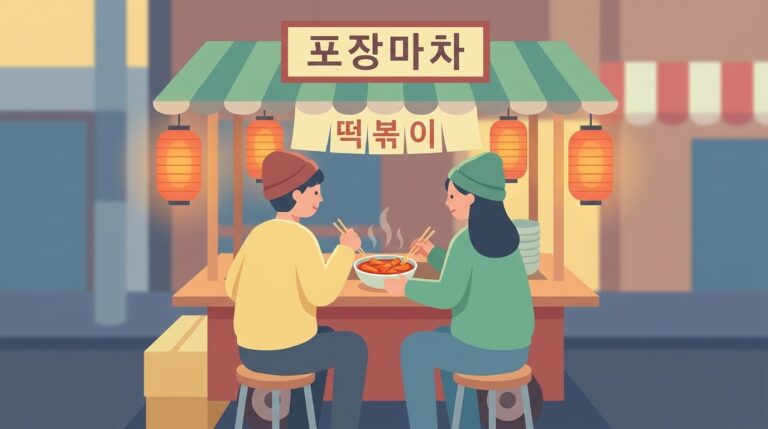
The Invisible Threads of Korean Hearts: Decoding the Secrets of Jeong (情) and Han (恨)
안녕하세요! I’m your Chief Editor at Daily Hangul. If you have ever watched a K-Drama and wondered why characters share a deep, silent understanding over a simple bowl of hot soup, or why they carry a profound, quiet sorrow that seems to stretch across generations, you have already brushed past the two most defining emotional pillars of Korean culture: Jeong (情 – 정) and Han (恨 – 한).
As intermediate (B2) learners, you already know the basic vocabulary for ‘love’ (사랑) and ‘sadness’ (슬픔). But to truly speak and feel like a local, you must step into this nuanced emotional landscape. Today, we are going inside the Korean psyche to master these untranslatable emotions and learn how to express them in real-life conversations.
Phase 2: Deep Dive into 3 Core Expressions
1. 정이 들다 (Jeong-i deulda)
- Pronunciation: Jeong-i deul-da (sounds like jung-ee deul-dah)
- Meaning: To grow fond of someone or something over time; to slowly develop a deep bond.
- K-Culture Moment: In the slice-of-life drama Reply 1988, neighbors constantly exchange side dishes. They aren’t doing it for favors; they have simply grown so close that sharing food is second nature because “정이 들어서” (because they have developed Jeong).
- Editor’s Insight: ‘Jeong’ isn’t instant passion. It’s the sticky, warm affection that develops through shared time, routine, and even shared hardships. You can even grow ‘Jeong’ with an old, squeaky office chair!
- Situation Spectrum: Casual ✅ / Semi-formal ✅ / Formal ✅
- 🤔 Think About It: Is there an object or a mildly annoying classmate you ended up loving just because you spent so much time together? That is exactly what ‘Jeong’ is.
2. 한이 맺히다 (Han-i maethida)
- Pronunciation: Han-i maet-hi-da (sounds like hahn-ee maet-hee-dah)
- Meaning: To have deep-seated resentment, sorrow, or unfulfilled dreams build up in one’s heart.
- K-Culture Moment: You often hear this in historical dramas (사극) when characters face systemic injustice, or in modern shows when parents talk about their youth when they couldn’t afford an education.
- Editor’s Insight: ‘Han’ is a unique blend of collective grief, unresolved injustice, and passive suffering—but with a tiny spark of hope for resolution. It’s a pain so deep that it practically crystallizes (맺히다) in the soul.
- Situation Spectrum: Casual ✅ / Semi-formal ✅ / Formal ✅
- 🤔 Think About It: How does your native culture describe a sorrow that is inherited from ancestors or shaped by historical struggles?
3. 정 때문에 (Jeong ttaemune)
- Pronunciation: Jeong ttae-mu-ne (sounds like jung ttae-moo-neh)
- Meaning: Because of ‘Jeong’ (out of attachment, history, or social obligation).
- K-Culture Moment: When a character in a drama stays in a toxic relationship or keeps helping a troublesome friend, they sigh and say, “정 때문에 어쩔 수 없어” (I can’t help it, because of our shared history/Jeong).
- Editor’s Insight: This phrase explains the ‘sticky’ side of Korean relationships. It is the reason why people choose loyalty and history over cold logic.
- Situation Spectrum: Casual ✅ / Semi-formal ✅ / Formal ⚠️
- 🤔 Think About It: Have you ever done a favor for someone you don’t even like that much, simply because you’ve known them for ten years? That is ‘Jeong’ pulling your strings!
Phase 3: Textbook Korean vs. Real Korean
Let’s compare the sterile expressions found in standard textbooks with the vivid, emotional language actually spoken by native Koreans.
Situation 1: Explaining why you can’t throw away a worn-out souvenir.
- 📖 Textbook Korean: 추억이 있어서 못 버려요. (I can’t throw it away because it has memories.)
- 🗣️ Real Korean: 오래 써서 정이 듬뿍 들었거든요. 못 버려요. (I’ve used it so long that it’s packed with Jeong. I just can’t throw it away.)
- 💡 Why? ‘정이 들다’ combined with the adverb ‘듬뿍’ (generously/heavily) sounds incredibly warm and natural to native ears.
Situation 2: Expressing a deep, lifelong regret.
- 📖 Textbook Korean: 대학에 못 간 것이 너무 슬픕니다. (I am very sad that I couldn’t go to college.)
- 🗣️ Real Korean: 대학에 못 간 게 평생 한으로 남았어요. (Not going to college has remained a lifelong Han in my heart.)
- 💡 Why? Using ‘한으로 남다’ upgrades your Korean to a B2 level, showing you understand that some sadnesses are not temporary, but lifelong weights.
Phase 4: K-Culture Deep-Dive & Non-verbal Manners
4-1. Eyes, Hands, and ‘Jeong’
To show ‘Jeong’, you don’t need a lot of words. It is expressed through non-verbal warmth:
* The ‘Deom’ (덤) Gesture: When shopping at a traditional market, if a vendor throws in an extra apple or potato for free, they are giving you ‘Deom’ out of ‘Jeong’. Receive it with both hands, bow slightly, and say “감사합니다!”.
* The Comforting Touch: If someone is sharing their ‘Han’ (deep sorrows), do not offer quick, logical solutions. Listen silently, nod slowly, and gently touch their arm or hand. Silence is often the warmest form of ‘Jeong’.
4-2. The Masterpieces of ‘Han’ and ‘Jeong’: My Mister
If you want to witness these emotions in their absolute raw form, watch the K-Drama My Mister (나의 아저씨). The characters are weighed down by life’s heavy burdens (Han), yet they survive and heal through the unspoken, quiet support of their community (Jeong). It is a perfect cultural blueprint for intermediate learners.
Phase 5: Real Roleplay Scenario
Setting: A cozy, retro Makgeolli (Korean rice wine) house in Euljiro, Seoul.
Characters:
* You (A foreign professional living in Korea for 2 years)
* Min-jun (Your close Korean colleague who has had a rough, exhausting week)
Min-jun: 🎭 [Sighs heavily, pouring Makgeolli into your brass cup]
“진짜 요즘 회사 생활 너무 지치네요. 그만두고 싶을 때가 한두 번이 아니에요.”
(Work is so exhausting lately. There are so many times I just want to quit.)
You: 🎭 [Nodding with empathy, holding your cup with both hands]
“민준 씨가 고생이 많아요. 마음고생 하시는 게 눈에 보여요.”
(You are going through so much, Min-jun. I can see you are suffering inside.)
Min-jun: 🎭 [Smiles weakly, looking at the table]
“그래도 동료들한테 정이 많이 들어서 쉽게 그만두지도 못하겠어요.”
(But I’ve grown so fond of my colleagues that I can’t bring myself to quit easily.)
You: 🎭 [Leaning in slightly with a warm expression]
(Choose your response below!)
🔀 Your Move: What would you say next?
- Option A: “맞아요. 정 때문에 일하는 거죠. 한 잔 마시고 다 잊어버려요!”
- Option B: “그러면 그냥 이직하세요. 회사 동료는 친구가 아니잖아요.”
- Option C: “민준 씨의 따뜻한 정이 결국 빛을 발할 거예요. 한풀이하듯 마셔요!”
💡 Selection Feedback:
- Option A (Best): Perfect! Acknowledging that we work “정 때문에” (because of Jeong) shows deep cultural empathy, and inviting them to drink it away is classic Korean bonding.
- Option B (Bad): Too cold. While logical, dismissing colleagues as ‘not friends’ breaks the flow of ‘Jeong’ and might make Min-jun feel lonely.
- Option C (Risk): A bit dramatic. While “한풀이” (releasing Han) fits, using it here for everyday corporate stress feels slightly exaggerated.
Phase 6: 10-Second Shadowing Drill
Practice saying these with the exact emotional pitch of a native speaker. The slash / indicates a micro-pause.
- “정 때문에 / 쉽게 버릴 수가 없어요.”
- Emotion: 🥺 [Sad and attached]
- Translation: Because of Jeong, / I can’t easily throw it away.
- “그때 대학을 포기한 게 / 한이 맺혔어요.”
- Emotion: 😢 [Quietly regretful]
- Translation: Giving up college back then / became a deep-seated regret in my heart.
Phase 7: K-Culture Mini Dictionary
- 미운 정 (Mi-un Jeong) | The Love-Hate Bond
- The affection you develop for someone you constantly bicker or fight with.
- 고운 정 (Go-un Jeong) | The Sweet Affection
- The smooth, pure, and pleasant affection built on happy moments.
- 한풀이 (Han-pul-i) | Catharsis / Releasing the Han
- The act of releasing built-up sorrow or resentment through singing, crying, or speaking out.
- 덤 (Deom) | The Generosity Gift
- The extra, free portions of food or goods given purely out of ‘Jeong’.
Phase 8: Traveler’s Survival Kit
Survival Expressions for the Soul
- “사장님, 정이 정말 많으시네요!”
- Pronunciation: Sa-jang-nim, jeong-i jeong-mal ma-neu-si-ne-yo!
- Pro Tip: Say this to a guesthouse owner or an elderly market vendor when they treat you with warm kindness. It will make their day!
- “정이 듬뿍 담겨서 더 맛있어요.”
- Pronunciation: Jeong-i deum-ppuk dam-gyeo-seo deo ma-si-sseo-yo.
- Pro Tip: Use this when eating homemade food cooked by a local host.
Editor’s Travel Note
To experience true ‘Jeong’, step away from fancy automated department stores. Instead, download the KakaoMap App and navigate to traditional markets like Mangwon Market (망원시장) or Gyeongdong Market (경동시장). Interacting with the vendors over physical transactions reveals a side of Korea that algorithms can never replicate.
Phase 9: “한 발 더 깊이” (Go Deeper)
Western cultures often view individuals as independent islands. However, Korean society is built on the concept of 우리 (Uri – We/Us).
Because of this collective identity, your sorrow is my sorrow (creating collective Han), and my time with you makes us inseparable parts of each other (creating Jeong). Understanding these words is not just a language milestone; it is a gateway to understanding why community matters so deeply in Korea.
💬 Your Turn: Have you ever experienced ‘Jeong’ or ‘Han’ while interacting with Koreans or watching K-Dramas? Tell us your story in the comments below!
Phase 10: FAQ & Mistake Prevention
Q: Can ‘Jeong’ (정) be used interchangeably with ‘Love’ (사랑)?
A: Not quite! ‘사랑’ (love) can be passionate, romantic, and sudden. ‘정’ (Jeong) is quieter, built slowly over time, and can exist even between enemies (미운 정). You can love someone without having Jeong yet, and you can have deep Jeong for someone you no longer romantically love.
Q: Is ‘Han’ (한) just a fancy word for sadness (슬픔)?
A: No. Sadness (슬픔) is a temporary reaction to a sad event. ‘Han’ (한) is a long-term, deep-seated emotional state resulting from unresolved trauma, injustice, or unfulfilled desires over a lifetime or generations.
Q: Can I say “I have Han” if I lost my wallet?
A: That is too light for ‘Han’. If you lose your wallet, you are just ‘슬프다’ (sad) or ‘짜증 나다’ (annoyed). Keep ‘한’ for major life regrets or historical tragedies.
🚨 Common Mistakes Board
- Mistake 1: Saying “저는 그 사람을 정해요” to mean “I feel Jeong for them.”
- Correct Action: ‘정’ is a noun, not a verb. Use “그 사람에게 정이 들었어요” (I grew fond of them).
- Mistake 2: Using ‘한’ for petty daily inconveniences.
- Correct Action: Use ‘한이 맺히다’ only for profound, heavy life regrets.
Phase 11: Action Mission
- 🥉 Bronze Mission: Write a sentence in the comments using “정이 들다” about your favorite Korean study book or hobby.
- 🥈 Silver Mission: Share this post on social media and tag a friend who you have developed “미운 정 고운 정” (love-hate bond) with!
- 🥇 Gold Mission: Next time you visit a local Korean restaurant, warmly tell the owner, “이모님, 너무 친절하셔서 정들 것 같아요!” (I think I’ll grow fond of you because you’re so kind!).
Phase 12: Interactive Quiz Challenge
Test your emotional intelligence of Korean nuances!
Q1. True or False?
“You can feel ‘Jeong’ (정) toward someone you fight with constantly.”
Q2. Fill in the blank:
“오래 키우던 반려견이 떠나서 마음에 큰
( )이/가 남았어요.”
(My long-time pet passed away, leaving a deep, historical ache/regret in my heart.)
👉 Click to reveal Answers & Explanations!
- A1: True! This is called 미운 정 (Mi-un Jeong). The shared history of conflict actually builds a strong bond over time.
- A2: 한 (Han). Because a pet is a lifelong companion, their loss can transcend simple sadness and remain as a permanent ‘한’ (Han) or deep emotional scar in your heart.







