

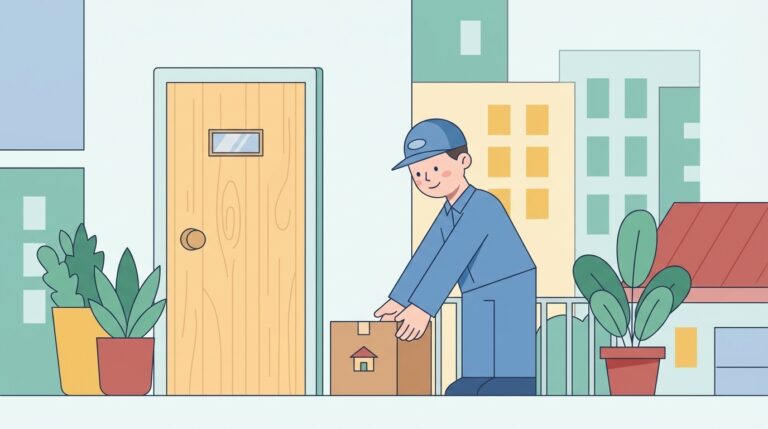
Master Korean Delivery: How to Receive Your Parcels Like a Local
Phase 1: Welcome to the Land of Fast Delivery! 📦
안녕하세요! (Annyeonghaseyo!) Your friendly Daily Hangul editor is back! If you are living in Korea or planning to move here, there is one absolute superpower you will experience on day one: 택배 (Taekbae – Parcel Delivery).
Imagine this: You ordered a gorgeous Korean skincare set last night, and by 7:00 AM, you get a text on your phone saying it has already arrived! It feels like magic, right? But suddenly, your phone buzzes with a message from the delivery driver (택배기사님 – Taekbae-gisahnim) asking where to leave it. Oh no! Your heart rate spikes. What do I reply? How do I say ‘leave it at my door’ in polite Korean?
Don’t worry! This is a classic “foreigner panic” moment that almost all of our students experience. Today, we are going to unlock the exact phrases you need so you can confidently receive your parcels without any awkward phone calls. Let’s dive in!
Phase 2: Three Key Expressions to Save Your Day
Here are the three most powerful phrases you will use over and over again when ordering things in Korea. Let’s analyze them step-by-step.
1. 문 앞에 두고 가세요. (Please leave it at the door.)
- Pronunciation: Mun appe dugoh gaseyo (Sounds like: “Moon” + “ah-peh” + “do-go” + “gah-say-yo”)
- Meaning: Literal: “Leave it in front of the door and go.” / Natural: “Please leave it at my door.”
- K-Culture Moment: If you watch slice-of-life K-Dramas, you’ve probably seen characters opening their front door to find towers of cardboard boxes stacked neatly outside.
- Editor’s Insight: This is the most common instruction in Korea. Because Korea has a highly safe environment with security cameras everywhere, leaving packages at the door is the default standard.
- Situation Spectrum: Casual: ⚠️ | Semi-formal: ✅ | Formal: ✅
- 🤔 Think About It: In many countries, leaving a package at the front door is an invitation for theft. Why do you think this practice is so naturally accepted in modern Korean apartment culture?
2. 경비실에 맡겨 주세요. (Please leave it at the security office.)
- Pronunciation: Gyeong-bi-shil-eh mat-gyeo ju-se-yo (Sounds like: “Gyung-bee-sheel-eh” + “maht-gyuh” + “joo-seh-yo”)
- Meaning: Please leave it with the security guard / building office.
- K-Culture Moment: You might recognize the friendly apartment guard (경비아저씨 – Gyeongbi-ajeossi) from dramas like Reply 1988. They do so much more than security—they are the heart of the building!
- Editor’s Insight: Use this if you live in an apartment complex with a guard and want extra security, or if you are going to be away for a few days.
- Situation Spectrum: Casual: ⚠️ | Semi-formal: ✅ | Formal: ✅
- 🤔 Think About It: How does having a designated neighborhood figure like a “Gyeongbi-ajeossi” make a residential area feel more like a community?
3. 택배함에 넣어 주세요. (Please put it in the delivery locker.)
- Pronunciation: Taek-bae-ham-e neoeo ju-se-yo (Sounds like: “Tek-beh-hahm-eh” + “nuh-uh” + “joo-seh-yo”)
- Meaning: Please place it in the unmanned delivery locker.
- K-Culture Moment: Many modern Korean studio apartments (officetels) have a wall of electronic lockers in the lobby for secure, contactless delivery.
- Editor’s Insight: If your building has a “택배함” (Taekbae-ham), this is the safest option. The driver will lock it and text you the password!
- Situation Spectrum: Casual: 🚫 | Semi-formal: ✅ | Formal: ✅
- 🤔 Think About It: How does the integration of smart tech like electronic lockers change how we interact with service workers?
Phase 3: Textbook Korean vs. Real-Life Korean
When you open a traditional textbook, the phrases can sound a bit like a robot wrote them. Let’s look at how native Koreans actually speak!
Situation 1: Asking where your package is
- 📖 Textbook Korean: “택배가 어디에 있습니까?” (Where is the parcel?)
- 🗣️ Real-Life Korean: “택배 어디에 두셨어요?” (Where did you leave the parcel?)
- 💡 Why the difference? The textbook version is too formal and stiff. Real Koreans use the polite past tense ending “-셨어요?” to sound natural and friendly when asking the driver.
Situation 2: Expressing gratitude to the delivery driver
- 📖 Textbook Korean: “배달해 주셔서 감사합니다.” (Thank you for delivering.)
- 🗣️ Real-Life Korean: “기사님, 감사합니다! 수고하세요!” (Thank you, driver! Keep up the great work!)
- 💡 Why the difference? Referring to the driver as “기사님” (Gisahnim) is a sign of high respect. Adding “수고하세요” (literally, “keep working hard,” but used as “have a nice day”) is the ultimate way to show warm manners.
Phase 4: K-Culture Deep Dive & Non-verbal Etiquette
4-1. The “Nunchi” (눈치) of Delivery Etiquette
Korean culture values speed and efficiency, but it also deeply values mutual respect. If you happen to meet your delivery driver in the hallway or elevator:
1. The Gentle Bow: You don’t need a full 90-degree bow! A light nod of the head with a smile is perfect.
2. The Intercom Quick-Reply: If they ring your doorbell, simply press the button and say, “문 앞에 두고 가세요!” so they don’t have to wait for you to open the door. It saves their precious time!
4-2. The Fast-Paced “Ppalli-Ppalli” (빨리빨리) Lifestyle
Korea’s delivery system is a direct reflection of its famous “Ppalli-Ppalli” (hurry, hurry) culture. Because of this, drivers have incredibly tight schedules. Sending a quick, clear text message instead of calling them on the phone is considered highly polite because it allows them to keep moving without interruption.
Phase 5: Real-World Roleplay Scenario
Let’s practice! You are at work, and you receive a message from a friendly delivery driver, Mr. Choi (최기사님).
🎭 The Cast
- Ji-woo (You): An expat living in Seoul.
- Mr. Choi (NPC): The hardworking delivery driver.
Mr. Choi: 여보세요? 택배 기사입니다. 지금 집에 계세요?
          (Yeoboseyo? Taekbae gisa-imnida. Jigeum jibe gyeseyo?)
          "Hello? This is the delivery driver. Are you home right now?"

Ji-woo:   아, 지금 밖에 있어요.
          (Ah, jigeum bakke isseyo.)
          "Ah, I am outside right now."

Mr. Choi: 아, 그렇군요. 택배 어디에 둘까요?
          (Ah, geureokunyo. Taekbae eodie dulkkayo?)
          "Ah, I see. Where should I leave the parcel?"
🔀 Choose Your Adventure!
How will you respond to Mr. Choi? Select your option below to see how he reacts!
- Option A: “문 앞에 두고 가세요.” (Mun appe dugoh gaseyo.)
- Driver’s Reaction (Best): “네, 문 앞에 두고 사진 문자 보낼게요!” (Sure, I’ll leave it at the door and text you a photo!)
- Editor’s Feedback: Perfect choice! This is the most efficient and standard answer. The driver can quickly move to the next apartment.
- Option B: “그냥 가세요.” (Geunyang gaseyo.)
- Driver’s Reaction (Bad): “네? 택배를 그냥 들고 가요…?” (What? I should just take the package back with me…?)
- Editor’s Feedback: Oh no! “그냥 가세요” means “Just leave/go away.” This sounds cold and will confuse the driver. They won’t know what to do with your precious box!
- Option C: “내 방에 들어오세요.” (Nae bange deureo-oseyo.)
- Driver’s Reaction (Risk/Awkward): “어… 그건 좀 어렵습니다…” (Uh… that’s a bit difficult/uncomfortable…)
- Editor’s Feedback: Yikes! Asking a driver to come inside your private room when you aren’t home is culturally highly awkward and creates a safety boundary issue. Stick to Option A!
Phase 6: 10-Second Emotion Shadowing Drill
To sound like a natural Korean, you need to match the rhythm and emotion of native speakers. Try speaking these out loud with the emotional cues!
- “문 앞에 / 두고 가세요!”
- Emotion: [😊 Polite and cheerful]
- Rhythm Guide: Say “Mun appe” / short pause / “dugo gaseyo!” with a rising tone at the end.
- “기사님, / 정말 / 감사합니다!”
- Emotion: [🥺 Deeply grateful and warm]
- Rhythm Guide: Say “Gisahnim” / pause / “jeongmal” / pause / “gamsahamnida!”
Phase 7: K-Culture Mini Dictionary
- 택배기사님 (Taekbae-gisahnim) | Delivery Driver | The respectful way to refer to delivery personnel. Always use this instead of just “택배원” or “배달원.”
- 공동현관 (Gongdong-hyeongwan) | Lobby Entrance | The main locked glass door of an apartment complex. You often need to share this password so the driver can enter your building.
- 문 앞 (Mun-ap) | In front of the door | Your actual apartment doorstep.
- 착불 (Chakbul) | Cash on Delivery | A shipping method where you pay the delivery fee upon receiving the item. Rare nowadays, as most are prepaid (선불 – Seonbul).
Phase 8: The Traveler’s Survival Kit
Survival Phrases TOP 3
- 공동현관 번호는 #1234입니다. (Lobby door code is #1234.)
- Pronunciation: Gongdong-hyeongwan beonhoneun #1234-imnida.
- Pro Tip: If you live in an apartment, the driver must know this code to reach your door.
- 벨 누르지 말고 문자 주세요. (Please don’t ring the bell, just send a text.)
- Pronunciation: Bel nureuji malgo munja juseyo.
- Pro Tip: Perfect if you have a sleeping baby, a barking dog, or are working from home.
- 택배가 아직 안 왔어요. (The delivery hasn’t arrived yet.)
- Pronunciation: Taekbaega ajik an wasseyo.
- Pro Tip: Use this when contacting customer service if your package is delayed.
📝 Editor’s Travel Note
When living in Korea, download the CJ Logistics delivery tracking app or the Coupang shopping app to track your packages in real-time. Note: App layouts and delivery policies are subject to change by providers, so always check their official websites for the most updated guides.
Phase 9: One Step Deeper
One of the most shocking things for expats moving to Korea is seeing packages—including expensive laptops, iPad boxes, and organic groceries—left untouched outside apartment doors for hours. This high-trust society is built on a strong sense of community and strict surveillance systems. In Korea, taking someone else’s “택배” is considered a serious crime, but more importantly, it breaks a social contract of respect.
💬 Your Turn: Have you ever experienced a delivery system like Korea’s? What would happen if a package was left outside your door in your home country? Let us know in the comments below!
Phase 10: FAQ & Avoiding Common Mistakes
Q: Do I need to tip the delivery driver in Korea?
A: No! Tipping is not a part of Korean culture. In fact, offering a tip might confuse the driver or make them feel uncomfortable. Instead, offering a cold can of coffee or a bottle of water on a hot summer day is highly appreciated!
Q: What if my lobby door has a passcode? How do I share it?
A: When ordering online, there is always a box called “배송 요청사항” (Delivery Requests). You should write your lobby code there (e.g., “공동현관 번호: #1234”).
Q: What should I do if my package is marked “delivered” but I can’t find it?
A: Check your text messages first! The driver usually sends a photo of where they left it. If it’s still missing, check the “경비실” (security office) or the “택배함” (delivery locker) before calling customer service.
🚨 Common Mistakes Scoreboard
| What you might do (Incorrect) | Why it’s wrong | What to do instead (Correct) |
|---|---|---|
| Replying “응” (Eung) to the driver. | “응” is highly casual (banmal). It sounds rude to a stranger. | Always reply politely with “네” (Ne) or “네, 감사합니다.” |
| Forgetting to write the lobby passcode. | The driver cannot enter your building, causing delays. | Always add your “공동현관 비밀번호” in the delivery notes. |
| Calling the driver repeatedly. | Drivers are extremely busy. | Send a polite text message instead of calling. |
Phase 11: Action Mission & K-Culture Challenge
🏆 Your Action Plan
- Bronze Medal: Write down “문 앞에 두고 가세요” on a post-it note and practice reading it aloud three times.
- Silver Medal: The next time you order something in Korea, use the text request “벨 누르지 말고 문자 주세요” (Don’t ring bell, just text).
- Gold Medal: When you receive a delivery text from a driver, reply within 5 minutes with: “네, 문 앞에 두고 가세요! 감사합니다! 🙇♂️”
🎮 K-Culture Mission
Watch a slice-of-life K-Drama (like Because This Is My First Life or Hospital Playlist) and keep an ear out for the door intercom ringing. See if you can spot a character saying “택배요!” (Taekbae-yo! – It’s delivery!) or “문 앞에 두세요!”
Phase 12: Interactive Quiz Challenge
Test your knowledge to see if you are ready to receive deliveries like a native!
1. Situational Quiz
You are taking a shower and hear the doorbell ring. The driver shouts “택배입니다!”. Which response is polite and appropriate?
* A) 너 가라. (Neo gara.)
* B) 문 앞에 두고 가세요. (Mun appe dugoh gaseyo.)
* C) 문을 열어 주세요. (Muneul yeoreoh juseyo.)
Reveal Answer
Correct Answer: B
Explanation: Option B is the polite and standard way to ask the driver to leave the package at your door. Option A is rude (informal), and Option C asks them to open your door, which is awkward and confusing!
2. Fill-in-the-Blank
“Please leave my parcel at the security office.”
-> “___________에 맡겨 주세요.”
Reveal Answer
Correct Answer: 경비실 (Gyeongbi-shil)
Explanation: 경비실 means the security/guard office of a building complex.
3. True or False
In Korea, it is polite to tip your delivery driver 1,000 KRW for fast delivery.
* True
* False
Reveal Answer
Correct Answer: False
Explanation: Korea is a non-tipping culture. To show gratitude, a warm text message or a small bottled drink is the best way to go!







