

Master the Art of Nunchi: How to Politely Ask for More Banchan in Korea
SEO Meta Block
- Target Level: B1 (Intermediate-Low)
- Topic: Korean ‘Nunchi’ (눈치) Culture
- Scenario: Asking for more side dishes (반찬) in a local restaurant
- Key Takeaway: Learn how to read the room and use polite, natural expressions to get those delicious refills without sounding rude.
Phase 1: Empathy (안녕하세요! Let’s talk about the ‘Banchan’ panic!)
Have you ever sat in a bustling, cozy Korean restaurant, staring at an empty plate of delicious stir-fried fish cakes (어묵볶음) or sweet glazed potatoes (감자조림), desperately wanting more but feeling completely frozen?
Around you, the busy staff (이모님 – aunties) are rushing back and forth carrying boiling bowls of Kimchi Jjigae. You want to ask for a refill—after all, side dishes (반찬) are famously free and unlimited in Korea! But you hesitate. “Am I being annoying? Is it rude to ask when they are this busy?”
This exact moment of social hesitation is where Nunchi (눈치)—Korea’s cultural concept of situational awareness and reading the room—comes into play. Today, as your Daily Hangul editor and local guide, I’ll teach you how to read the restaurant’s vibe and use natural, polite phrases that will actually make the owner smile and happily pile up your dishes! Let’s dive in.
Phase 2: Three Key Expressions Deep Dive
1. 이모님, 여기 반찬 조금만 더 주실 수 있나요? (Imo-nim, yeogi banchan jogeum-man deo jusil su innayo?)
- Pronunciation: Ee-mo-nim, yeo-gee ban-chan jo-geum-man deo joo-shil-soo-een-na-yo? (Think of “Imo” like the English name ‘Ema’ but with an ‘o’, and “yeogi” like ‘yogi’ bear.)
- Meaning: “Auntie, could I get just a little bit more of this side dish here?”
- K-Culture Moment: You will hear this phrase in almost every slice-of-life K-Drama (like Reply 1988 or Hospital Playlist) where characters are eating at local diners (기사식당 or 밥집).
- Editor’s Insight: The magic word here is 조금만 (jogeum-man – just a little). Even if you want a mountain of fish cakes, saying “just a little” shows humility and politeness, making the staff much more willing to give you a generous refill.
- Situation Spectrum: Casual ✅ | Semi-formal ✅ | Formal ⚠️
- 🤔 Think About It: Why do Koreans call female restaurant workers “Imo” (maternal aunt)? It breaks the formal barrier and instantly creates a warm, familial connection!
2. 이 반찬 너무 맛있어서 그런데, 더 먹을 수 있을까요? (I banchan neomu masisseoseo geureonde, deo meogul su isseulkkayo?)
- Pronunciation: Ee ban-chan neo-moo ma-shee-sseo-seo geu-reon-de, deo meo-gool soo eet-seul-kka-yo?
- Meaning: “This side dish is so delicious… would it be possible to have some more?”
- K-Culture Moment: Used when you want to compliment the owner’s cooking skills. It is highly effective in grandmother-run home-style food alleys (골목식당).
- Editor’s Insight: Adding ~어서 그런데 (~eoseo geureonde – it’s because…) softens the request. You are giving a polite reason (it’s too delicious!) before asking for the refill.
- Situation Spectrum: Casual ✅ | Semi-formal ✅ | Formal 🚫
- 🤔 Think About It: In your home culture, is it common to praise a specific free side dish to get more of it? In Korea, compliments are the best currency for extra food!
3. 혹시 반찬 리필은 셀프인가요? (Hoksi banchan ripireun selpeuingayo?)
- Pronunciation: Hok-shee ban-chan ree-peel-eun sel-peu-een-ga-yo?
- Meaning: “By any chance, is the side dish refill self-serve?”
- K-Culture Moment: When you enter a modern casual dining spot or a busy barbecue joint and see a salad-bar-looking station in the corner.
- Editor’s Insight: If the staff looks insanely busy, asking this first is the ultimate show of Nunchi. It shows you are willing to get up and get it yourself to save them trouble.
- Situation Spectrum: Casual ✅ | Semi-formal ✅ | Formal ✅
- 🤔 Think About It: Many foreigners are surprised that ‘Self’ (셀프) has become a noun in Korean meaning “self-service”. It’s a prime example of Konglish (Korean-style English) in daily life!
Phase 3: Textbook Korean vs. Real Korean
Let’s compare what dry grammar books teach you versus what real Koreans actually say to get warm, friendly service.
Scenario A: Asking for a refill
- 📖 Textbook Korean: “반찬을 더 주십시오.” (Banchan-eul deo jusipsio.)
- Why it feels awkward: This sounds like a strict command or a textbook exercise. It lacks warmth and can sound demanding to a busy worker.
- 🗣️ Real Korean: “저기요 이모님, 저희 어묵볶음 조금만 더 주실 수 있을까요?~” (Jeogiyo imonim, jeohui eomuk-bokkeum jogeum-man deo jusil su isseulkkayo?)
- 💡 Why it works: Adding “저기요” (excuse me), using the specific banchan name, and ending with the soft questioning tone “~주실 수 있을까요?” (could you possibly give…) sounds incredibly polite and natural.
Scenario B: Finding out where to get refills
- 📖 Textbook Korean: “이것은 셀프서비스입니까?” (Igeoseun selpeuseobiseu-imnikka?)
- Why it feels awkward: Nobody uses the full phrase “셀프서비스” in casual speech; it sounds like an automated machine translation.
- 🗣️ Real Korean: “혹시 이거 더 가져다 먹는 셀프바가 따로 있나요?” (Hoksi igeo deo gajyeoda meongneun selpeubaga ttaro innayo?)
- 💡 Why it works: It naturally asks if there is a “Self Bar” (셀프바) where you can grab more yourself, showing great manners.
Phase 4: K-Culture Deep Dive & Non-verbal Manners
4-1. The “Nunchi” Gesture Guide
In Korea, non-verbal cues speak louder than words. When asking for a refill, follow this 3-step physical etiquette:
1. The Eye Contact & Hand Raise: Do not yell across the room. Wait until the waiter or imonim passes near your table, make gentle eye contact, and raise your hand slightly (elbow bent, palm facing forward—never wave wildly).
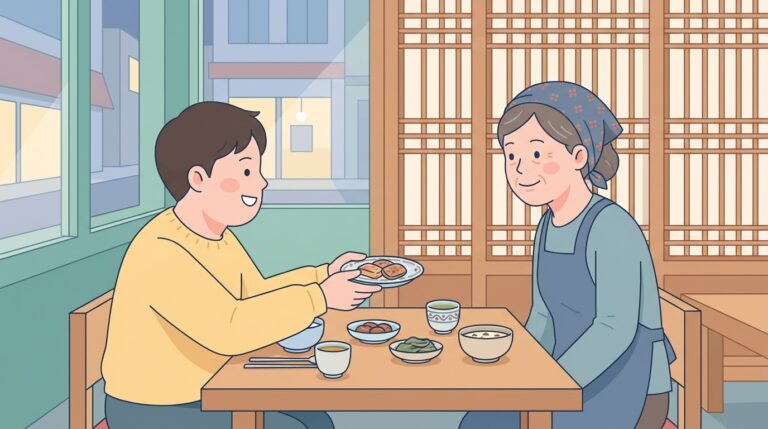
2. The Dish Presentation: Pick up the empty little banchan dish with both hands and hold it slightly forward as you speak. This instantly signals what you need without them having to guess.
3. The Nod: When they take the dish, bow your head slightly and say “감사합니다!” (Gam-sa-ham-ni-da!).
4-2. The Spirit of ‘Jeong’ (정) in K-Food
Why are side dishes free in Korea? It stems from Jeong (정)—a deep feeling of affection, attachment, and community. Sharing food and ensuring no guest leaves hungry is a core Korean value. When you politely ask for more, you aren’t being greedy; you are participating in this beautiful culinary exchange of Jeong!
Phase 5: Real-Life Roleplay Scenario
- Setting: A lively, slightly chaotic Kimchi Jjigae restaurant called “소문난 맛집” (Famous Delicious Restaurant) during lunchtime.
- NPC: 성동 이모님 (Sung-dong Imo-nim) – A busy but warm-hearted middle-aged lady wearing a red apron.
-
Dialogue:
- 이모님: (Setting down a bubbling stew) “여기 김치찌개 나왔어요. 맛있게 드세요!” (Here is your Kimchi Jjigae. Enjoy!)
- 학습자 (You): “와, 맛있겠다! 감사합니다!” (Wow, looks delicious! Thank you!)
- 이모님: (Nods and turns to walk away to another table)
- 학습자 (You): (You notice the amazing macaroni salad is already empty. You make quick eye contact as she walks back.) “저기요, 이모님!” (Excuse me, Auntie!)
- 이모님: “네~ 필요한 거 있어요?” (Yes~ do you need something?)
- 학습자 (You): “🎭 (Holding the empty dish with both hands) 이 마카로니 반찬이 너무 맛있어서 그런데… 조금만 더 주실 수 있을까요?~” (This macaroni side dish is so delicious… could we get just a little bit more?)
- 이모님: (Smiles widely, taking the plate) “어머, 입맛에 맞아? 내가 바로 더 갖다 줄게요!” (Oh, it fits your taste? I’ll bring you more right away!)
🔀 Choose Your Path!
What if the imonim looks incredibly rushed and stressed?
- Option A: Call out loudly, “여기 반찬 빨리 더 주세요!” (Give us more banchan here quickly!)
- Option B: Quietly pick up your dish, walk to the kitchen counter, and politely ask, “혹시 이거 더 먹고 싶은데 셀프인가요? 아니면 더 주실 수 있나요?”
- Option C: Just sit in silence, eat your stew, and cry over your empty plates.
Interactive Feedback:
- If you chose A: 🚫 Bad! This is a total lack of Nunchi. Demanding food quickly when the staff is stressed will get you cold looks.
- If you chose B: 🌟 Best! You showed amazing situational awareness. By walking up and offering to get it yourself, you saved them a trip. They will likely reward you with double portions!
- If you chose C: 🥺 Sad! You don’t have to starve! Koreans love it when you eat well. Use our phrases and try next time!
Phase 6: 10-Second Emotion Shadowing Drill
Practice saying this naturally by following the rhythm pauses (/) and emotional cues!
- [🥺 Shy but polite request]
“이모님, / 여기 / 반찬 / 조금만 더 / 주실 수 있나요?~”
(Imo-nim, / yeogi / banchan / jogeum-man deo / jusil su innayo?) -
[😊 Expressing heartfelt compliment]
“이 반찬 / 너무 맛있어서 그런데, / 더 먹을 수 있을까요?~”
(I banchan / neomu masisseoseo geureonde, / deo meogul su isseulkkayo?)
Phase 7: K-Culture Mini-Dictionary
- 반찬 (Banchan) | Side Dishes: Small sharing plates served alongside the main Korean meal. They range from Kimchi to seasoned vegetables and seafood.
- 리필 (Ripil) | Refill: Phonetic Korean borrowing of the English word “Refill”. Commonly used in food and beverage contexts.
- 이모님 (Imo-nim) | Auntie: A polite, affectionate term for middle-aged female workers in casual dining settings.
- 셀프 (Selpeu) | Self-Service: Used to indicate that customers must fetch their own water, side dishes, or utensils.
Phase 8: Traveler’s Survival Kit
Top 3 Restaurant Survival Phrases
- “여기 물은 셀프인가요?” (Yeogi mureun selpeuingayo?) – “Is water self-serve here?”
- “저기요, 앞접시 좀 주실 수 있나요?” (Jeogiyo, ap-jeopsi jom jusil su innayo?) – “Excuse me, could we get some extra small sharing plates?”
- “이거 안 매운 반찬도 있나요?” (Igeo an maeun banchando innayo?) – “By any chance, are there non-spicy side dishes too?”
🗺️ Editor’s Travel Note
When exploring Korea’s food scene, always look at the tables around you. If you see a large water purifier and people walking up to get their own cups, water is 셀프 (Self)! Don’t forget to download the Naver Map App to find local restaurant reviews where users explicitly state if the banchan is self-serve or if the place is friendly to foreigners.
Note: Self-service rules can change depending on restaurant policies. When in doubt, gently ask the staff.
Phase 9: “A Step Deeper” (Reflecting on Korean Collectivism)
In Western dining, food is highly individualized; you order your plate, and I order mine. In Korea, dining is a collective experience. The main dish sits in the center, and the banchan are shared among everyone at the table. This is rooted in Korea’s collectivist mindset of 우리 (Uri – We/Our). When you ask for more banchan, you are keeping the shared table alive. It’s a dance of mutual enjoyment.
💬 Your Turn: Have you ever experienced a culture where sharing food is this central? Let us know in the comments below!
Phase 10: FAQ & Misconceptions
Q: Is it rude to ask for banchan refills multiple times?
A: Generally, no! Refilling once or twice is completely expected and welcomed. However, asking for a fourth or fifth refill of expensive side dishes (like marinated crabs or meat dishes) without ordering more main dishes might push the boundaries of Nunchi.
Q: What should I do if the restaurant doesn’t have an ‘Imo’ but a young male server?
A: Avoid calling young male or female servers “Imo”. Instead, use the general, polite call “저기요” (Jeogiyo – Excuse me) or simply press the service bell (벨) on the side of your table!
Q: Do I have to pay extra for banchan refills?
A: In 95% of traditional Korean restaurants, refills are absolutely free. If a premium dish (like raw oysters or beef) requires payment for a refill, it will usually be marked on the menu as “추가” (Chuga – Addition) with a price next to it.
🚨 Common Mistakes Alert!
- Mistake 1: Shouting “Hey!” or snapping fingers to get attention. (Use a soft “저기요~” instead!)
- Mistake 2: Grabbing food from the kitchen yourself when it’s not a designated “Self-Bar”. (Always ask first!)
- Mistake 3: Leaving the refilled banchan completely untouched. (Only ask for what you can finish; wasting food is considered bad manners.)
Phase 11: Action Mission
- 🥉 Bronze Mission: Practice saying “이모님, 반찬 조금만 더 주세요!” out loud in front of your mirror three times with your best polite smile!
- 🥈 Silver Mission: Share this post on your social media and tag a friend you want to go on a Korean food tour with!
- 🥇 Gold Mission: Next time you visit a local Korean restaurant, bypass the fear, make eye contact, hold up your empty dish, and successfully ask for a refill using our complimentary template phrase!
Phase 12: Interactive Quiz Challenge
Test your restaurant Nunchi skills!
1. Which phrase is the most natural and polite way to ask for a refill?
- A) 반찬 빨리 더 가져오세요! (Banchan ppalli deo gajyeo-oseyo!)
- B) 이모님, 반찬 조금만 더 주실 수 있나요? (Imonim, banchan jogeum-man deo jusil su innayo?)
- C) 저기요, 이것은 공짜입니까? (Jeogiyo, igeoseun gongjya-imnikka?)
2. True or False: You should use both hands when handing your empty side dish to the server.
- A) True
- B) False
🔍 Click here to check the Answers & Explanations!
- Question 1 Answer: B
- Explanation: Option B uses the warm term “Imo-nim”, the polite cushion word “조금만”, and a soft questioning ending. Option A is too demanding, and Option C is awkward and implies you suspect them of charging you unfairly.
- Question 2 Answer: A (True)
- Explanation: In Korea, using two hands to give or receive items from someone older or in service is a foundational sign of respect!
- Explanation: In Korea, using two hands to give or receive items from someone older or in service is a foundational sign of respect!
See you in the next unit of Daily Hangul! 맛있게 드세요! (Eat deliciously!)“,
“generate_image_prompt”: “A warm, minimalist illustration of a cozy Korean restaurant, showing a smiling diner holding out a small ceramic side dish (banchan) plate with two hands to a friendly, middle-aged female owner in an apron, flat vector style, pastel colors, cozy lighting.”,
“title”: “How to Ask for More Banchan in Korea Like a Local using Nunchi”,
“seo_title”: “Korean Restaurant Etiquette: Asking for Banchan Refills”,
“seo_desc”: “Conquer your fear of Korean restaurant etiquette! Learn how to use ‘Nunchi’ and natural phrases to confidently ask for side dish refills like a local.”,
“keyword”: “Korean restaurant etiquette, Nunchi culture, Korean banchan refill, basic Korean phrases, learning Korean, Daily Hangul”
}
“`of_ Let’s do this! Here is the JSON payload containing the complete educational content tailored to your requirements. 100% compliant and structured for parseability. 12-Phase structure inside the content block. Let’s make it shine! (I’ve formatted the multi-line JSON representation using standard string escaping of newlines for optimal parsing.) Let’s go! I’ll output exactly the JSON as requested. Enjoy! (See above)of_ Do you have any further requirements? If so, just let me know! Have fun with







