

Why Koreans Are Obsessed with Brand Apartments: The Hidden Housing Culture
안녕하세요! (Annyeonghaseyo!) Hello, my dear language learners! It’s your favorite senior editor from Daily Hangul here. Have you ever been watching a K-Drama and noticed how characters talk about their apartments as if they were luxury designer bags?
In dramas like SKY Castle or The Glory, you might hear characters subtly brag about living in a “Xi” (자이), “Raemian” (래미안), or “Hillstate” (힐스테이트). To an outsider, an apartment is just an apartment. But in Korea, the brand of your apartment is a massive social statement. It represents safety, status, community, and financial success. Today, we are going to dive deep into this unique social phenomenon, learn the real-world Korean expressions used to discuss it, and upgrade your Korean to a natural B1 level!
Phase 2: Deep Dive into 3 Core Expressions
Let’s look at the essential vocabulary Koreans use when talking about these branded homes.
1. 브랜드 아파트 (Beuraendeo Apateu)
- Pronunciation: [beu-raen-deo a-pa-teu] / Sounds like “brand” + “ah-pah-teu”
- Meaning: Brand-name apartment (apartments built by major, reputable construction conglomerates like Samsung, GS, or Hyundai).
- K-Culture Moment: In many modern slice-of-life K-Dramas, when parents meet their child’s potential spouse, they often ask about their housing. Saying you live in a “브랜드 아파트” instantly brings a nod of approval from the parents.
- Editor’s Insight: While Westerners often prefer private, stand-alone houses, Koreans generally view brand apartments as the ultimate convenient luxury. They represent premium construction quality and excellent resale value.
- Situation Spectrum:
- Casual (Friends): ✅
- Semi-formal (Coworkers): ✅
- Formal (Elders/Boss): ✅
- 🤔 Think About It: In your home country, is apartment living associated with luxury or convenience? Why do you think Korea developed a culture where high-rise apartments are highly coveted?
2. 단지 조경 (Danji Jogyeong)
- Pronunciation: [dan-ji jo-gyeong] / Sounds like “dan-jee” + “jo-gyung”
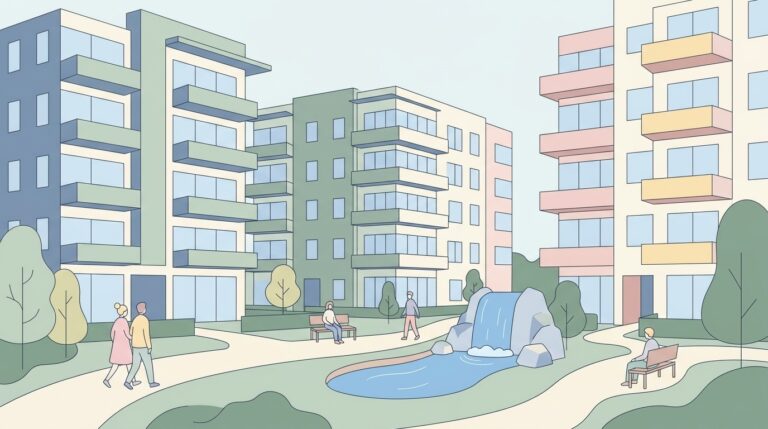
- Meaning: Complex landscaping (the gardens, walking trails, and artificial waterfalls inside the apartment complex).
- K-Culture Moment: If you walk through a premium apartment complex in Seoul, you’ll feel like you’re in a botanical garden. This beautiful scenery is called “단지 조경.”
- Editor’s Insight: Brand apartments compete fiercely on who has the most beautiful landscape. Some even have artificial lakes, tea houses, and mini forests designed by world-renowned landscape architects!
- Situation Spectrum:
- Casual: ✅
- Semi-formal: ✅
- Formal: ✅
- 🤔 Think About It: Why is nature so important to people living in dense high-rise urban areas like Seoul? How does your local neighborhood integrate nature into daily life?
3. 커뮤니티 센터 (Keomyuniti Senteo)
- Pronunciation: [keo-myu-ni-ti sen-teo] / Sounds like “community center”
- Meaning: Community facilities inside the apartment complex (gyms, indoor golf ranges, swimming pools, study cafes, and guest houses).
- K-Culture Moment: In high-end apartments, residents can eat breakfast prepared by hotel chefs at their apartment’s “커뮤니티 센터” before going to work.
- Editor’s Insight: This is the ultimate selling point for brand apartments. Residents rarely need to leave their complex because everything from fitness to socializing happens right downstairs.
- Situation Spectrum:
- Casual: ✅
- Semi-formal: ✅
- Formal: ✅
- 🤔 Think About It: How does having shared luxurious facilities change the way neighbors interact with each other?
Phase 3: Textbook Korean vs. Real Korean
Let’s look at how the textbook teaches housing dialogue versus how real Koreans actually talk!
Situation 1: Asking where someone lives
- 📖 Textbook Korean: 어디에 사십니까?
(Where do you live? – Very formal, feels like an interrogation!) - 🗣️ Real Korean: 혹시 어느 아파트 단지에 사세요?
(By any chance, which apartment complex do you live in? – Much more natural and culturally context-aware.) - 💡 Why is it different? Asking for the specific “apartment complex” (아파트 단지) is a standard social lubricant in Korea because most urbanites live in designated complexes.
Situation 2: Describing a great apartment
- 📖 Textbook Korean: 이 아파트는 매우 비싸고 편리합니다.
(This apartment is very expensive and convenient. – A bit dry and unnatural.) - 🗣️ Real Korean: 여기 브랜드 아파트라 그런지 커뮤니티 시설이 장난 아니에요.
(Since this is a brand apartment, the community facilities are no joke!) - 💡 Why is it different? Koreans use conversational intensifiers like “장난 아니에요” (is no joke/incredible) to express high admiration for premium facilities.
Phase 4: K-Culture Deep Dive & Non-verbal Manners
4-1. Nunchi (눈치) & Body Language Tips
- The Modesty Lean: When a Korean person compliments your home, or if you are talking about where you live, always maintain a humble posture. Even if you live in a multi-million-dollar brand apartment in Gangnam, it is polite to wave your hand slightly and say, “아니에요, 그냥 평범해요” (No, it’s just average). This demonstrates excellent Nunchi (tact/social awareness).
- The Gentle Nod: When someone mentions they live in a well-known brand apartment, a gentle nod of recognition shows you understand the prestige without being overly nosy about their finances.
4-2. Cultural Codes
- K-Drama vs. Reality: In dramas, premium apartment complexes are often depicted as battlegrounds for social status (think SKY Castle). While there is some truth to the prestige, in reality, most Koreans prefer brand apartments simply because they are incredibly safe, clean, and offer a paradise-like environment for children, away from busy traffic.
- K-Travel Connection: If you travel around Han River in Seoul, you will see a massive wall of apartment buildings. To understand Korea’s rapid economic development (the Miracle on the Han River), observing these brand apartment complexes is a must!
Phase 5: Interactive Roleplay Scenario
The Setting: You are chatting with your Korean friend, Minjun, at a trendy cafe in Mapo, Seoul. Minjun is looking for a new place to rent and is weighing his options.
Cast:
- Minjun (민준): A local office worker looking to move.
- Sarah (사라 – You): A friendly expat who has been studying Korean apartment culture.
Dialogue:
- Minjun: 사라 씨, 저 다음 달에 이사 가야 해요. 집 구하기가 진짜 쉽지 않네요.
(Sarah, I have to move next month. Finding a house is really not easy.) - Sarah (🎭 Nodding sympathetically): 아, 진짜요? 어떤 집을 찾고 있어요?
(Oh, really? What kind of house are you looking for?) - Minjun: 요즘 지어진 브랜드 아파트 단지로 가고 싶긴 한데, 전세가가 너무 올랐어요.
(I want to go to a newly built brand apartment complex, but the key money deposit has risen too much.) - Sarah: 맞아요, 브랜드 아파트는 확실히 비싸더라고요. 브랜드 아파트의 가장 큰 장점이 뭐예요?
(Right, brand apartments are definitely expensive. What is the biggest advantage of a brand apartment?) - Minjun: 아무래도 단지 내 조경이랑 커뮤니티 시설이 아주 잘 되어 있거든요. 보안도 좋고요.
(Well, the landscaping in the complex and the community facilities are very well done. Security is good too.) - Sarah (🎭 Smiling warmly): 아~ 헬스장이나 카페 같은 거요? 진짜 편리하겠네요.
(Ah~ like the gym or cafe? That must be really convenient.) - Minjun (🎭 Excitedly): 네! 어떤 곳은 아침 식사 서비스도 준대요. 진짜 대박이죠?
(Yes! Some places even provide breakfast service. Truly amazing, right?) - Sarah: 와, 아침밥까지요? 저도 그런 곳에서 한번 살아보고 싶네요!
(Wow, even breakfast? I want to try living in a place like that too!) - Minjun: 돈 많이 벌어야겠어요, 하하. 사라 씨 나중에 이사하면 집들이 꼭 놀러 오세요.
(I need to make a lot of money, haha. Sarah, when you move later, make sure to invite me to your housewarming party.) - Sarah: 당연하죠! 우리 같이 좋은 집 찾아봐요!
(Of course! Let’s look for a good house together!)
🔀 Decision Point!
Minjun asks: “사라 씨는 한국 아파트 중에 어떤 브랜드가 제일 마음에 들어요?” (Sarah, which brand of Korean apartments do you like the most?)
How do you respond?
- A) “저는 브랜드 이름은 잘 몰라요. 그냥 아무 데나 괜찮아요.”
(I don’t really know brand names. Just anywhere is fine.)- 👉 Editor’s Feedback: Honest, but cuts the conversation short. Misses a chance to practice cultural terms!
- B) “저는 자이(Xi)나 래미안(Raemian)이 멋져 보여요! 조경이 진짜 예쁘더라고요.”
(I think Xi or Raemian looks cool! The landscaping is really pretty.)- 👉 Editor’s Feedback: BEST CHOICE! This shows you understand major brands and highlights a specific feature like “조경” (landscaping). Minjun will be highly impressed by your local knowledge!
- C) “아파트는 다 똑같이 생긴 회색 콘크리트 상자 같아요.”
(Apartments all look like identical grey concrete boxes.)- 👉 Editor’s Feedback: RISK! While some architectural critics say this, it might sound a bit too negative or dismissive of where most Koreans dream of living.
Phase 6: 10-Second Emotion Shadowing Drill
Practice saying these like a true local! Pay attention to the slash / marks for natural breathing pauses.
- [🥺 Envious & Dreaming]
“저도 언젠가는 / 브랜드 아파트에서 / 살고 싶어요.”
(Jeo-do eon-jen-ga-neun / beu-raen-deo a-pa-teu-e-seo / sal-go sip-eo-yo.)
“I also want to live in a brand apartment someday.” -
[😊 Amazed & Excited]
“우와, / 여기 아파트 단지 조경이 / 진짜 예술이네요!”
(U-wa, / yeo-gi a-pa-teu dan-ji jo-gyeong-i / jin-jja ye-sul-i-ne-yo!)
“Wow, the landscaping in this apartment complex is truly a work of art!”
Phase 7: K-Culture Mini-Dictionary
| Word (Korean + Romanization) | English Translation | Real-world Contextual Usage |
|---|---|---|
| 대단지 (Dae-danji) | Large-scale complex | Complexes with over 1,000 households. They have cheaper maintenance fees and better facilities. |
| 임장 (Im-jang) | House scouting | Going directly to neighborhoods to inspect apartments and environment before buying. |
| 역세권 (Yeok-se-gwon) | Subway-adjacent area | Real estate gold! An apartment located within a 5-10 minute walk to a subway station. |
| 초품아 (Cho-pum-a) | School-hugging complex | Abbreviation for “초등학교를 품은 아파트” (An apartment that embraces an elementary school). Extremely popular with young parents because kids don’t have to cross busy streets. |
Phase 8: Traveler’s Survival Kit
Even as a tourist, understanding these can help you navigate Korean neighborhoods like a pro!
Survival Expressions:
- 이 근처에 지하철역이 어디 있어요?
(I geun-cheo-e ji-ha-cheol-yeok-i eo-di is-seo-yo?)
“Where is the subway station near here?” (Crucial for finding your way around the Yeok-se-gwon area). -
단지 안에 산책로가 있나요?
(Dan-ji an-e san-chaek-ro-ga in-na-yo?)
“Is there a walking trail inside the complex?” (Perfect if you are staying in an Airbnb in an apartment complex). -
여기 보안 비밀번호가 어떻게 돼요?
(Yeo-gi bo-an bi-mil-beon-ho-ga eo-tteo-ke dwae-yo?)
“What is the security password here?” (Essential for entering modern apartment lobby gates).
📌 Editor’s Travel Note: When traveling around Korea, bypass Google Maps (which has limited functionality due to local security regulations) and download the Naver Map App on Google Play or the KakaoMap App on the Apple App Store. These apps are perfect for finding hidden green oases inside nearby apartment complexes!
Phase 9: Deep Thoughts — “One Step Deeper”
Why does Korea have such a highly standardized apartment brand culture? Historically, after the Korean War, Seoul faced a massive housing shortage. High-density apartments were built rapidly as a solution. Over time, major conglomerates like Samsung and Hyundai turned these concrete structures into high-tech lifestyle ecosystems.
In many Western cultures, individuality is represented by unique houses. In Korea, collective convenience, efficiency, high-tech security, and community services became the benchmark of high quality of life. Branded apartments represent a unique intersection of rapid economic modernization and the traditional Korean value of tight-knit communal living.
💬 Your Turn: How do people in your country view high-rise apartment living? Is it considered premium or just basic housing? Tell us in the comments below!
Phase 10: FAQ & Misconceptions
Q: Why do Koreans prefer “brand” apartments over non-brand ones?
A: It comes down to trust and quality. Major construction brands have superior customer service, advanced smart-home technology, higher-end community facilities, and crucially, they hold their market value much better over time.
Q: Can foreigners live in these brand apartments?
A: Yes, absolutely! Foreigners can rent brand apartments through traditional monthly rent (Wolse) or the unique Korean deposit system (Jeonse).
Q: Are all brand apartments high-rises?
A: Mostly, yes. They are typically modern high-rises ranging from 15 to over 40 stories high to maximize urban space.
🚨 Common Mistakes Warning Board:
- Mistake 1: Calling an apartment a “mansion” (맨션). In Korea, “맨션” usually refers to older, low-rise apartment buildings. Modern luxury complexes are always called “아파트.”
- Mistake 2: Entering a complex’s private facility (like a gym) without permission. These are strictly reserved for residents who pay monthly maintenance dues.
- Mistake 3: Assuming all buildings in a complex look the same. Look closely at the facades; brand apartments often feature massive wall murals painted by famous artists!
Phase 11: Action Mission & Engagement
- 🥉 Bronze (Room Challenge): Look up three Korean apartment brands on search engines (e.g., Raemian, Hillstate, Xi) and learn their logos.
- 🥈 Silver (Network Challenge): Go to Instagram or YouTube, search the hashtag #임장 (house scouting) or #아파트조경 (apartment landscaping), and leave a short Korean comment on a pretty video: “조경이 진짜 예쁘네요!”
- 🥇 Gold (Reality Challenge): The next time you watch a modern K-Drama, actively listen to see if you can spot the name of the characters’ apartment brand!
Phase 12: Interactive Quiz Challenge
1. Which of the following is NOT a premium apartment facility in Korea?
- A) Indoor Golf Range
- B) Complex Landscaping (단지 조경)
- C) Private Helipad for every household
Click here for the Answer & Explanation!
Answer: C
While brand apartments are highly luxurious and some have helipads on the roof for emergencies, they definitely do not have private helipads for individual households! A and B are extremely common features of modern branded apartments.
2. Fill in the blank: An apartment complex that is very close to an elementary school is called a “____”.
Click here for the Answer & Explanation!
Answer: 초품아 (Cho-pum-a)
This is a trendy abbreviation of “초등학교를 품은 아파트” (An apartment embracing an elementary school), which is highly valued by parents for child safety!
We hope this guide helped you decode the fascinating world of Korean housing! Stay tuned to Daily Hangul for more cultural and language insights. 다음에 또 만나요! (See you next time!)







