

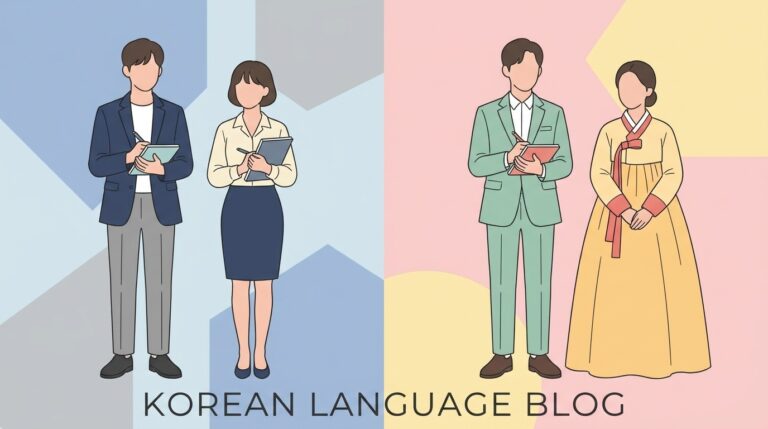
Master the Unspoken Rules of Korean Fashion: How to Style the Perfect ‘Hagaek-ruk’ and ‘Myeonjeob-ruk’
안녕하세요! (Annyeonghaseyo!) It is your trusted Korean culture navigator and chief editor at Daily Hangul. Grab a cup of warm tea because today, we are diving deep into the fascinating, subtle, and incredibly stylish world of Korean dress codes!
Imagine this: You have just landed a dream interview at a trendy creative agency in Seoul’s Mapo district, or perhaps you have been invited to the beautiful wedding of your Korean coworker in Gangnam. You open your wardrobe and pull out your favorite outfit. But a sudden wave of anxiety hits: “Is this too bright? Is this too casual? Will I look like I didn’t care, or worse, am I going to commit a major cultural faux pas?”
Take a deep breath. You are not alone. In my ten years of teaching Korean language and mentoring expats in Seoul, I have seen so many brilliant minds freeze up not because of grammar, but because they didn’t know the unspoken fashion rules. I remember my student Sarah, a brilliant marketer from London. She was invited to her team lead’s wedding and wore a stunning, crisp white lace dress. In her hometown, it was a celebratory, chic summer look. In Korea, she accidentally became a 민폐하객 (minpye-hagaek)—a nuisance wedding guest—by clashing with the bride’s white gown. We laughed about it later, but she told me, “I wish someone had taught me the cultural context behind the clothes!”
Today, we are going to do exactly that. By the end of this guide, you won’t just know what to wear; you will master the exact intermediate-level Korean vocabulary and nuances to discuss fashion like a true Seoulite. Let’s dive in!
Phase 2: Deep Dive into 3 Core Styling Expressions
To talk about fashion in Korea, you need to go beyond words like “nice” or “pretty.” Here are three essential B2-level terms that will elevate your conversational game instantly.
1. 하객 룩 (Hagaek-ruk)
- Pronunciation: [ha-gaek-ruk] / Sounds like: ha-get-rook
- Meaning: Wedding Guest Look (하객 = guest/visitor, 룩 = look/outfit)
- K-Culture Moment: You will see this term trending on search engines like Naver every spring and autumn (Korea’s peak wedding seasons). In K-Dramas, whenever a main character attends a rival’s wedding, the camera pans slowly from their shoes to their hair to showcase their impeccable Hagaek-ruk.
- Editor’s Insight: The golden rule of Hagaek-ruk is subtle elegance. You must look neat and put-together without stealing the spotlight from the bride and groom. For women, this typically means pastel tones, navy, or beige dresses (never solid white). For men, it means a clean blazer paired with slacks.
- Situation Spectrum:
- Friends & Casual Gatherings: 🚫 (Too formal for a casual chicken-and-beer hangout)
- Work Colleagues & Formal Events: ✅
- Job Interviews: ⚠️ (Slightly too soft/festive; interviews require sharper lines)
- 🤔 Think About It: Why does Korean society emphasize minimizing your own visual impact to let the bride stand out? What does this tell us about the Korean value of 배려 (baeryeo – consideration for others) and harmony within a group?
2. TPO에 맞추다 (TPO-e matchuda)
- Pronunciation: [TPO-e mat-chu-da] / Sounds like: T-P-O-eh maht-choo-dah
- Meaning: To dress/behave according to Time, Place, and Occasion (TPO).
- K-Culture Moment: In corporate offices or fashion-conscious neighborhoods like Cheongdam-dong, you will hear stylists and HR managers say this constantly. It is the ultimate metric of a person’s social intelligence (눈치 – nunchi).
- Editor’s Insight: While “TPO” is an English acronym, it is used as a highly active verb phrase in Korean (
맞추다means “to match” or “to adjust”). If someone tells you “오늘 TPO에 딱 맞추셨네요!” (You matched today’s TPO perfectly!), it is a premium compliment on your social savvy. - Situation Spectrum:
- Friends & Casual: ✅
- Semi-formal business: ✅
- Executive boardrooms: ✅
- 🤔 Think About It: In many Western cultures, personal style and self-expression are valued highly even in formal settings. In Korea, matching the “TPO” is seen as a sign of respect toward the host or organization. How does your native culture balance personal expression with social expectations?
3. 단정하다 (Danjeong-hada)
- Pronunciation: [dan-jeong-ha-da] / Sounds like: dahn-jung-hah-dah
- Meaning: To be neat, tidy, and presentable.
- K-Culture Moment: This is the most crucial keyword for 면접 룩 (myeonjeob-ruk – interview look). Whether you are applying to a tech giant in Pangyo or a cozy school in Busan, the feedback on a successful candidate’s appearance is almost always: “첫인상이 아주 단정했다” (The first impression was very neat/respectable).
- Editor’s Insight:
단정하다is more than just clean; it implies a state of mental discipline and readiness. It means your clothes are ironed, your hair is styled cleanly away from your face, and your shoes are polished. - Situation Spectrum:
- Friends & Casual: ⚠️ (Might make you look a bit stiff, like a student council president)
- Business/Interviews: ✅
- Family gatherings (meeting partner’s parents): ✅ (Highly recommended!)
- 🤔 Think About It: Unlike
예쁘다(pretty) or멋지다(cool) which focus on superficial beauty,단정하다focuses on order and respect. How does the structure of a language change when its highest praise for formal wear is rooted in neatness rather than individuality?
Phase 3: Textbook Korean vs. Real Korean
When we study textbooks, the sentences are often grammatically flawless but socially robotic. Let’s look at how Koreans actually talk about formal wear to help you sound natural and culturally fluent.
Situation 1: Describing a neat, professional outfit
- 📖 Textbook Korean: “이 옷은 참 깔끔하고 단정합니다.” (This clothing is very clean and neat.)
- 🗣️ Real Korean: “와, 오늘 스타일 진짜 핏이 깔끔하고 예쁜데요?” (Wow, the fit of your style today is really clean and pretty!)
- 💡 Why the difference? Modern Koreans use the English loanword “핏” (fit) to describe how clothes drape on the body. Using “단정합니다” to a coworker face-to-face sounds like an official report. “핏이 깔끔하다” strikes the perfect balance of professional praise and modern warmth.
Situation 2: Asking if an outfit is too revealing or inappropriate for a wedding
- 📖 Textbook Korean: “이 의복을 결혼식에 입으면 안 됩니까?” (Am I not allowed to wear this clothing to a wedding?)
- 🗣️ Real Korean: “이거 하객 룩으로 선 넘는 거 아니겠죠?” (This isn’t crossing the line for a wedding guest look, right?)
- 💡 Why the difference? The phrase “선 넘다” (to cross the line) is highly popular in modern Korean social discourse. It is the perfect B2-level idiom to express concern about breaking unspoken social rules without sounding overly academic.
Phase 4: K-Culture Deep Dive & Non-verbal Manners
4-1. The Unspoken Etiquette of the Group Photo (눈치 – Nunchi)
In a Korean wedding, the ultimate test of your Nunchi (societal sense) happens during the group photo at the end of the ceremony. The photographer will call up friends and colleagues.
* The Non-verbal Rule: If you are wearing a light beige or off-white outfit, do not stand next to the bride. Move to the back row or the far sides. In Korean culture, this visual courtesy ensures that the bride remains the absolute focal point of her special day.
4-2. The Evolution of the Interview Outfit (면접 룩)
Historically, a Korean interview outfit was synonymous with 칼정장 (kal-jeongjang – razor-sharp, ultra-traditional formal black suits), often joked about as the 모나미 룩 (Monami-look: white shirt, black pants, looking like a Monami pen).
However, with the rise of global tech giants, startup culture in Pangyo, and K-Content powerhouses, the trend has shifted toward 비즈니스 캐주얼 (business casual). But make no mistake: “casual” in Seoul still demands a high level of sleekness. A structured blazer, well-tailored slacks, and clean loafers are your safest bet. It says: “I am creative, but I respect your company’s space.”
Phase 5: Gamer-style Interactive Roleplay
Put yourself in the shoes of a fashion-conscious expat in Seoul. You are sitting at a trendy cafe in Garosu-gil with your stylish Korean friend, Minji (민지). You are trying to finalize your outfit for an interview at a famous design agency tomorrow, followed by a mutual friend’s wedding this weekend.
Cast:
- You (주인공 – The Protagonist): An ambitious foreign professional preparing for major career and social events in Seoul.
- Minji (민지): Your incredibly chic, brutally honest, yet warm-hearted Korean fashion mentor.
The Dialogue:
- Minji: 🎭 (Taking a sip of her iced Americano, looking at your outfit sketches)
“내일 면접이랑 주말 결혼식 코디 다 정했어? 엄청 신경 쓰이겠다.”
(Naeil myeonjeob-irang jumal gyeolhonsik kodi da jeonghaesseo? Eomcheong singyeong sseuigetda.)
“Did you decide on your interview and weekend wedding outfits? You must be so stressed about it.” -
You: 🎭 (Nervously scrolling through photos on your phone)
“네, 너무 고민돼요. 특히 면접 룩은 어디까지 캐주얼해도 되는지 모르겠어요.”
(Ne, neomu gomindaeyo. Teukhi myeonjeob-rugeun eodi-kkaji kaejueol-haedo doeneunji moreugesseoyo.)
“Yes, I’m so worried. Especially for the interview look, I don’t know how casual I can go.” -
Minji: 🎭 (Nodding understandingly)
“요즘 디자인 회사는 칼정장 안 입어. 그래도 첫인상이니까 단정하게 가야지. 재킷은 필수야!”
(Yojeom dijain hoesaneun kal-jeongjang an ibeo. Geuraedo cheot-insang-inikka danjeong-hage gayaji. Jaekiseun pilsuya!)
“Design companies these days don’t wear stiff formal suits. But since it’s a first impression, you must look neat (danjeong). A jacket is a must!” -
You: 🎭 (Showing a photo of a beige oversized blazer)
“이 베이지색 재킷은 어때요? 바지는 슬랙스로 입고요.”
(I beige-saek jaekiseun eottaeyo? Bajineun seullaekseuro ipgoyo.)
“How about this beige oversized blazer? And wearing slacks for pants.” -
Minji: 🎭 (Clapping her hands with approval)
“오, 대박! 핏이 되게 깔끔하다. 딱 세련된 비즈니스 캐주얼이네. 면접관들이 좋아하겠어!”
(O, daebak! Pisi doege kkal-kkeumhada. Ttak seryeondaen bijeoniseu kaejueorine. Myeonjeobgwan-deuri joahagesseo!)
“Oh, awesome! The fit is really clean. It’s the perfect stylish business casual. The interviewers will love it!” -
You: 🎭 (Sighing with relief, then showing another picture)
“다행이네요! 그럼 결혼식 하객 룩은요? 이 레이스 원피스 어때요? 약간 연한 아이보리 색인데…”
(Dahaeng-ineyo! Geureom gyeolhonsik hagaek-rugeunyo? I lace wonpiseu eottaeyo? Yaggan yeonhan ivory saeginde…)
“What a relief! Then what about the wedding guest look? How about this lace dress? It’s a slightly light ivory color…” -
Minji: 🎭 (Gasping, playfully waving her hands in a ‘No’ gesture)
“헉, 아이보리? 절대 안 돼! 그건 진짜 민폐하객 지름길이야. 신부보다 튀면 안 되잖아.”
(Heok, ivory? Jeoldae an dwae! Geugeon jinjja minpye-hagaek jireumgiriya. Sinbuboda twiyeon an doejana.)
“Oh my god, ivory? Absolutely not! That is a shortcut to becoming a nuisance guest. You shouldn’t stand out more than the bride.” -
You: 🎭 (Blushing, quickly swiping to a navy blue wrap dress)
“아, 진짜요? 깜짝이야. 그럼 이 차분한 네이비 원피스는요?”
(A, jinjja-yo? Kkamjjak-iya. Geureom i chabun-han navy wonpiseu-neunyo?)
“Oh, really? You startled me. Then how about this calm navy dress?” -
Minji: 🎭 (Smiling warmly, giving you a thumbs-up)
“그거지! 아주 TPO에 딱 맞춘 코디야. 우아하고 깔끔해 보여!”
(Geugeoji! Aju TPO-e ttak matchun kodiya. Uahago kkal-kkeumhae boyeo!)
“That’s the one! An outfit perfectly matched to the TPO. You look elegant and neat!” -
You: 🎭 (Smiling happily)
“민지 씨 덕분에 살았어요! 한국 패션 문화를 이제 좀 알 것 같아요.”
(Minji-ssi deokbune sarasseoyo! Hanguk paesyeon munhwareul ije jom al geot gatayo.)
“You saved my life, Minji! I think I finally understand Korean fashion culture a bit now.”
🔀 Decision Point: Choose Your Style Path!
If you were in this situation, which style choice would you make to impress your Korean peers?
- Option A: Stick to your own cultural preference and wear the ivory lace dress to the wedding because it is a very expensive designer brand.
- Option B: Wear the calm navy dress to the wedding, but choose a bright red power-suit for the design interview to make a bold creative statement.
- Option C: Wear the clean beige blazer with tailored slacks for the interview, and the elegant navy dress for the wedding.
🏆 Best Choice Analysis:
- Option C is the absolute best! It shows that you have superb 눈치 (nunchi) and deeply understand how to balance modern professional trends with respectful traditional etiquette in Korea. You will easily win the hearts of both your interview board and the newlyweds!
🚨 Risk/Bad Choice Analysis:
- Option A will make you the talk of the wedding—for all the wrong reasons. Even if you don’t mean to, wearing white or ivory to a Korean wedding is widely considered disrespectful.
- Option B is risky for an interview. While creativity is appreciated, a bright red suit might cross the line from “stylish” to “distracting” in a Korean corporate setting.
Phase 6: 10-Second Emotion Shadowing Drill
Let’s practice speaking with real Korean emotion. Pay attention to the pauses (/) and the emotional guidance inside the brackets to sound completely natural!
- [🥺 Realizing a mistake & feeling apologetic]
“헉, / 제가 / 민폐하객이 / 될 뻔했네요!”
Heok, / jega / min-pye-ha-gaek-i / doel ppeon-haet-ne-yo!
“Oh my, / I / almost became / a nuisance guest!” -
[😊 Relieved and highly satisfied]
“이 옷이 / TPO에 / 아주 / 딱 맞네요!”
I ot-i / TPO-e / aju / ttak mat-ne-yo!
“This outfit / fits the TPO / so / perfectly!” -
[😤 Confident and determined]
“내일 면접은 / 아주 / 단정하게 / 입고 갈게요!”
Naeil myeon-jeob-eun / aju / dan-jeong-ha-ge / ip-go gal-ge-yo!
“For tomorrow’s interview, / I will go / looking / extremely neat!”
Phase 7: K-Culture Mini Dictionary
Let’s enrich your vocabulary with these four trendy lifestyle keywords that every fashion-savvy Korean uses daily!
+---------------------------------------------------------------------------------------+
| 1. 꾸안꾸 (Gku-an-gku)                                                                 |
| - English: Effortless chic / "Dressed up but looks casual."                           |
| - Context: A contraction of "꾸민 듯 안 꾸민 듯" (looks like I decorated, but looks   |
|   like I didn't). It represents the holy grail of modern K-beauty and street style.   |
+---------------------------------------------------------------------------------------+
| 2. 하객 크리 (Hagaek-keuri)                                                           |
| - English: Wedding guest etiquette disaster / faux pas.                               |
| - Context: Combining "하객" (guest) with the gaming term "크리티컬" (critical hit).   |
|   It refers to a guest who commits a social disaster at a wedding (like wearing white).|
+---------------------------------------------------------------------------------------+
| 3. 모나미 룩 (Monami-ruk)                                                             |
| - English: The black-and-white standard look.                                         |
| - Context: Named after Korea's classic black-and-white Monami pen. It gently pokes    |
|   fun at the ultra-standard combination of a crisp white shirt and black slacks.     |
+---------------------------------------------------------------------------------------+
| 4. 칼정장 (Kal-jeongjang)                                                             |
| - English: Razor-sharp formal suit.                                                   |
| - Context: "칼" (knife) signifies precision. It refers to a flawless, perfectly       |
|   pressed, traditional three-piece business suit worn for conservative interviews.    |
+---------------------------------------------------------------------------------------+
Phase 8: Traveler’s Survival Kit
If you find yourself in Seoul and need to upgrade your wardrobe immediately, keep these three survival phrases in your pocket!
Survival Expressions
- “이 근처에 단정한 옷 파는 곳 어디예요?”
I geun-cheo-e dan-jeong-han ot pa-neun got eo-di-yeo-yo?- “Where is a place that sells neat/respectable clothes around here?”
- Pro Tip: Perfect when you need to urgently find a blazer or slacks before an unexpected meeting.
- “하객 룩으로 입기 좋은 원피스 추천해 주세요.”
Hagaek-rugeuro ipgi joeun wonpiseu chucheonhae juseyo.- “Please recommend a dress that is good to wear as a wedding guest look.”
- Pro Tip: Use this in boutiques in areas like Sinsa-dong or Yeouido. Shop assistants will love your precise use of the term “하객 룩”!
- “이 바지, 슬랙스 핏이 너무 크지 않나요?”
I baji, seullaekseu pisi neomu keuji annayo?- “Aren’t these pants/slacks a bit too oversized in fit?”
- Pro Tip: Useful when trying on clothes in trendy, oversized Korean fashion stores.
📌 Editor’s Travel Note
- Where to Shop: For affordable, high-quality basics that fit the “단정하다” aesthetic perfectly, check out Musinsa Standard (무신사 스탠다드) in Hongdae or Gangnam.
- Digital Navigation: Never use Google Maps in Korea—it doesn’t update walking paths or local boutique locations well. Instead, download the Naver Map App to find local boutique shops, dry cleaners, and tailors instantly!
Phase 9: Deep Thoughts — “One Step Deeper”
In Western fashion discourse, style is often viewed as an extension of the self—an outward manifestation of one’s unique identity and internal spirit.
In contrast, Korean fashion—especially formal wear like Hagaek-ruk—functions heavily as an interpersonal bridge. It is an aesthetic language designed to communicate respect, maintain social harmony, and show solidarity. When you wear a quiet navy dress to a wedding, you are not suppressing your beauty; you are actively contributing to the collective beauty of the bride’s big day.
This is deeply rooted in the concept of 공동체 의식 (gongdongche uisik – community consciousness). Dressing well in Korea is less about “Look at me!” and more about “Look at how much I respect this gathering and my relationship with you.”
💬 Your Turn: How does your home country balance personal self-expression with collective social respect when it comes to formal dress codes? Let us know in the comments below!
Phase 10: FAQ & Avoiding Mistakes
Q: Can men wear a casual t-shirt to a Korean wedding?
A: Depends, but generally no. If it is a very casual, outdoor, or modern small wedding, a high-quality plain t-shirt under a structured blazer might pass. However, for traditional wedding halls, a collared dress shirt or a neat knit polo under a jacket is highly recommended to stay respectful.
Q: Is it okay to wear bright colors like pink or yellow as a guest?
A: Yes, absolutely! Pastel pink, soft mint, lavender, and gentle beige are highly encouraged. Just avoid pure, radiant white, ivory, or neon colors that draw immediate attention away from the bride and groom.
Q: What should I avoid wearing to a corporate interview in Seoul?
A: Avoid showing too much skin and overly distressed clothing. Even if the company has a very casual dress code (like gaming or IT startups), ripped jeans, sandals, or deep V-necks are considered a major breach of “TPO” during the initial interview stages.
🚨 Common Mistakes Alert! Board of Warnings
- Mistake 1: Wearing bright white lace dresses to weddings. (Correct Action: Swap for navy, pastel, or classy beige.)
- Mistake 2: Wearing sneakers to a formal conservative interview. (Correct Action: Wear neat loafers or classic dress shoes.)
- Mistake 3: Thinking “Business Casual” means your everyday gym clothes. (Correct Action: In Korea, keep it tailored, pressed, and clean.)
Phase 11: Action Missions
Ready to put your knowledge into practice? Try these three fun challenges!
- 🥉 Bronze (The Mirror Challenge): Go to your wardrobe, pick out an outfit, look in the mirror, and practice saying out loud: “오늘 제 코디, TPO에 잘 맞는 것 같아요!” (My outfit today seems to match the TPO perfectly!)
- 🥈 Silver (The Network Challenge): Take a photo of your favorite neat outfit and post it on Instagram or thread. Write a caption using the hashtag #하객룩 or #면접룩 and ask your followers: “제 스타일 어때요? 단정해 보이나요?” (How is my style? Does it look neat?)
- 🥇 Gold (The Real-world Challenge): Next time you watch a K-Drama (like What’s Wrong with Secretary Kim or Start-Up), pause during a wedding or office scene. Identify at least three outfits that match the “TPO” and try to spot a “모나미 룩”!
Phase 12: Interactive Quiz Challenge
Test your styling and cultural intelligence with this quick quiz!
1. Scenario Judgment
Your Korean coworker, Ji-hoon, is getting married. You want to look stylish, so you wear a bright, solid-white pantsuit to show your modern fashion sense. Is this a good choice?
* A) Yes, it’s chic and modern!
* B) No, wearing solid white to a Korean wedding is a major faux pas (민폐하객).
2. Fill in the Blank
Complete the sentence: “첫인상이 좋아야 하니까 내일 면접에는 아주 __________ 입고 갈 거예요.”
(Since the first impression must be good, I will go to the interview tomorrow looking very __________.)
* A) 꾸안꾸 (Effortlessly casual)
* B) 단정하게 (Neatly / Respectably)
3. True or False?
Modern creative agencies and IT startups in Seoul still strictly require all candidates to wear a traditional black “칼정장” (kal-jeongjang) for interviews.
* True / False
🔍 Tap here to reveal the answers and explanations!
-
Answer: B
Explanation: Correct! Solid white (even in pantsuit form) should be avoided to ensure the bride remains the most prominent figure in photos. -
Answer: B
Explanation:단정하게(neatly/respectably) is the perfect adverb to describe preparing for a highly professional interview. -
Answer: False
Explanation: Many modern startups prefer a clean and stylish 비즈니스 캐주얼 (business casual) over a stiff traditional suit. However, keeping it neat (단정하다) is always a must!







