

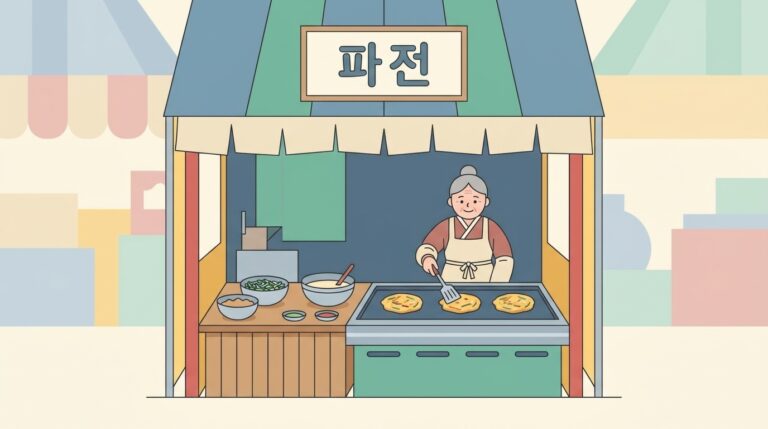
Sizzle Your Way into a Korean Grandma’s Heart: The Ultimate Beginner’s Guide to Traditional Markets and Savory ‘Jeon’
안녕하세요! (Annyeonghaseyo!) Hello! I am your Chief Editor at Daily Hangul, your friendly Korean tutoring partner. Today, we are stepping away from the textbook and stepping into the warm, lively, and delicious world of a Korean traditional market (전통 시장 – Jeontong Sijang).
The Search for the Perfect Sizzle
Have you ever watched a K-Drama where the main characters sit on plastic stools under a warm orange tent, eating crispy, golden pancakes and laughing with the shop owner? That delicious dish is 전 (Jeon – Korean savory pancake), and the best place to experience it is at a local traditional market!
For many beginners, walking into a busy market can feel scary. The loud shouting of vendors, the bustling crowds, and the lack of English menus might make you want to turn around. But don’t worry! Today, you will learn the exact phrases to order like a local and experience 정 (Jeong)—the unique Korean warmth of sharing and connection.
Phase 2: Deep Dive into 3 Core Expressions
1. 이거 얼마예요? (Igeo eolmayeyo?)
- Pronunciation: ee-geo eol-ma-ye-yo? (Sounds like: “Ee-guh uhl-mah-yeh-yo?”)
- Meaning: How much is this?
- K-Culture Moment: You are pointing at a mountain of freshly fried, golden Kimchi pancakes (김치전 – Kimchijeon). You look at the market grandmother (할머니 – Halmoni), point politely, and ask this magical question.
- Editor’s Insight: This is the most important survival phrase in Korea! It is simple, polite, and instantly shows that you are trying to speak Korean.
- Situation Spectrum:
- Friends/Casual: ⚠️ (Too formal for close friends, but okay)
- Semi-formal/Market: ✅ (Perfect!)
- Formal/Business: ✅
- 🤔 Think About It: In Korea, even when we do not know someone, we use polite language (존댓말 – Jondaetmal) like ending sentences with “요” (yo). Why do you think showing respect to strangers is so important in Korean society?
2. 따뜻할 때 드세요. (Tatteut-hal ttae deuseyo.)
- Pronunciation: tah-tteut-hal ttae deu-seh-yo. (Sounds like: “Tah-teut-hal ttae deu-seh-yo”)
- Meaning: Please eat it while it is warm.
- K-Culture Moment: The market vendor hands you a plate of piping hot pancake, steam rising in the cool market air, and says this with a warm smile.
- Editor’s Insight: Koreans show love through food. When a vendor says this, they want you to enjoy the food at its absolute best. It is a expression of pure care.
- Situation Spectrum:
- Friends/Casual: ⚠️
- Semi-formal/Market: ✅ (Commonly heard from vendors)
- Formal/Business: ✅
- 🤔 Think About It: How does your culture show care and affection through food? Do you have a similar phrase to say when serving warm dishes?
3. 하나 더 주세요. (Hana deo juseyo.)
- Pronunciation: ha-na deo joo-seh-yo. (Sounds like: “Ha-nah duh joo-seh-yo”)
- Meaning: Please give me one more.
- K-Culture Moment: You just finished a delicious plate of potato pancakes (감자전 – Gamjajeon) and realize your stomach wants another one because it is just too good!
- Editor’s Insight: Saying “one more” is the ultimate compliment to the chef in a Korean market. It shows you genuinely love their cooking!
- Situation Spectrum:
- Friends/Casual: ⚠️
- Semi-formal/Market: ✅
- Formal/Business: ✅
- 🤔 Think About It: Why is asking for “more” of the same dish often more flattering to a local vendor than simply saying “thank you”?
Phase 3: Textbook Korean vs. Real Korean
Let’s compare what rigid textbooks teach you versus how real Koreans actually speak in the market!
Situation 1: Ordering your food
- 📖 Textbook Korean: 김치전을 주문하고 싶습니다. (Kimchijeoneul jumunhago sipseumnida.) – “I would like to place an order for Kimchijeon.”
- 🗣️ Real Korean: 김치전 하나 주세요! (Kimchijeon hana juseyo!) – “Kimchijeon, one please!”
- 💡 Why is it different? The textbook version is way too formal and stiff. At a busy market, speed and friendly warmth are key. Simply naming the dish and adding “하나 주세요” (one, please) is natural and polite!
Situation 2: Saying the food is delicious
- 📖 Textbook Korean: 이 음식은 매우 맛있습니다. (I eomsigeun maeu mas-iss-eumnida.) – “This food is highly delicious.”
- 🗣️ Real Korean: 우와, 진짜 맛있어요! (Uwa, jinjja mas-iss-eoyo!) – “Wow, it’s really delicious!”
- 💡 Why is it different? The textbook sentence sounds like a robot writing a food review. Real market diners use emotional exclamations like “우와” (Wow) and “진짜” (Really) to show their true delight.
Phase 4: K-Culture Deep Dive & Mannerisms
4-1. Two Hands for Love (비언어적 매너)
When the market owner hands you your freshly cooked plate of Jeon, or when you hand over your cash/card, always use two hands. Using both hands to give and receive items is a foundational sign of respect in Korea. A slight bow of your head at the same time will instantly make you the favorite customer of the day!
4-2. The Sizzle of Rain: Jeon & Makgeolli
Did you know that in Korea, when it rains, everyone immediately craves Jeon and 막걸리 (Makgeolli – traditional rice wine)? The secret lies in sound! Koreans believe that the sound of rain falling sounds exactly like the sizzling sound of pancake batter frying on a hot, oiled griddle. If you ever visit Seoul on a rainy day, head straight to Gwangjang Market (광장시장) to witness this cultural phenomenon!
Phase 5: Gwangjang Market Roleplay
Setting: It is 7:00 PM. The lights of Gwangjang Market are glowing. You are sitting on a warm stool in front of a giant iron pan. The delicious smell of frying oil is in the air.
Cast: You (hungry traveler) and Imo (이모 – “Auntie”, a friendly female vendor).
- Imo: 🎭 (Wiping the counter, looking at you warmly) 어서 오세요! 뭐 드릴까요? (Eoseo oseyo! Mwo deurilkkayo? / Welcome! What can I get for you?)
- You: 🎭 (Pointing at the golden mung bean pancakes) 이거 얼마예요? (Igeo eolmayeyo? / How much is this?)
- Imo: 🎭 (Pointing to the menu) 녹두빈대떡은 오천 원이에요. 진짜 맛있어요! (Nokdu-bindaetteok-eun ocheon-won-ieyo. Jinjja mas-isseyo! / The mung bean pancake is 5,000 won. It’s really delicious!)
- You: 🎭 (Nodding eagerly) 네, 그거 하나 주세요! (Ne, geugeo hana juseyo! / Yes, please give me one of those!)
- Imo: 🎭 (Pouring fresh oil and placing the pancake on the sizzler) 조금만 기다려요! 금방 해 줄게요. (Jogeumman gidaryeoyo! Geumbang hae julgeyo. / Just wait a little bit! I’ll make it for you quickly.)
- You: 🎭 (Watching the steam rise) 와, 소리가 진짜 좋아요! (Wa, sori-ga jinjja joayo! / Wow, the sound is really nice!)
- Imo: 🎭 (Handing over the hot plate with both hands) 자, 따뜻할 때 드세요! (Ja, tatteut-hal ttae deuseyo! / Here, eat it while it’s warm!)
- You: 🎭 (Taking the plate with both hands) 감사합니다! (Gamsahabnida! / Thank you!)
- You: 🎭 (Taking a big, crispy bite) 우와, 진짜 맛있어요! (Uwa, jinjja mas-iss-eoyo! / Wow, it is really delicious!)
- Imo: 🎭 (Smiling happily, handing you a side dish) 많이 먹어요! (Mani meogeoyo! / Eat a lot!)
- You: 🎭 (Chewing happily) 네! 막걸리도 하나 주세요! (Ne! Makgeolli-do hana juseyo! / Yes! Please give me one Makgeolli too!)
🔀 Decision Point!
Imo brings the Makgeolli. How do you accept it?
* A) Take it with one hand while looking at your phone.
* B) Receive the cup with both hands, look Imo in the eyes, and say “감사합니다” (Gamsahabnida).
* **C) Wave your hand and say “No thank you.”
Best Choice Analysis: B is perfect! Using two hands shows respect and builds a warm connection (Jeong) with the market staff.
Bad/Risk Choice Analysis: A is considered impolite in Korea. Looking at your phone and using one hand makes you look uninterested and disrespectful to the elder.
Phase 6: 10-Second Emotion Shadowing Drill
Let’s practice saying these phrases with real feelings! Speak out loud along with the emotional guides.
- [😊 Excited and Hungry]
이거 / 얼마예요?
(Ee-geo / eol-ma-ye-yo?)
“How much / is this?” - [🤩 Amazed and Happy]
진짜 / 맛있어요!
(Jin-jja / mas-iss-eoyo!)
“Really / delicious!” - [🥺 Pleading and Friendly]
하나 더 / 주세요!
(Ha-na deo / joo-seh-yo!)
“One more / please!”
Phase 7: K-Culture Mini Dictionary
- 전 (Jeon): Korean savory pan-fried dishes made by coating ingredients in flour and egg batter.
- 정 (Jeong): A warm feeling of attachment, love, and loyalty that grows over time between people.
- 이모 (Imo): Literally means “maternal aunt,” but used widely to friendly call female restaurant or market owners.
- 막걸리 (Makgeolli): A traditional Korean milky, sweet, and fizzy rice wine served in brass bowls.
Phase 8: Traveler’s Survival Kit
Top 3 Survival Phrases
- 여기요! (Yeogiyo!): “Over here, please!” (Use this to call the market owner politely when you are ready to order.)
- 포장해 주세요. (Pojang-hae juseyo.): “Please wrap it up / Please make it to-go.”
- 카드 돼요? (Kadeu dwaeyo?): “Do you accept credit cards?” (Note: Many small market stalls prefer cash!)
📌 Editor’s Travel Note:
To find the best traditional markets like Mangwon Market or Gwangjang Market, download the Naver Map App. Google Maps is not fully functional for walking directions in Korea, so Naver Map is your ultimate survival tool!
Phase 9: Deep Thoughts — “One Step Deeper”
In many Western cultures, dining is often a private experience focused on individual plates. In Korea, especially at traditional markets, dining is a shared communal event. Food is placed in the center, and strangers sit side-by-side on long wooden benches. This physical closeness reflects the Korean value of 우리 (Uri – We/Us). Eating together makes everyone feel like family.
💬 Your Turn: How does your culture bring people together through street food or local markets? Share your thoughts in the comments below!
Phase 10: FAQ & Avoiding Misunderstandings
Q: Can I pay with a credit card at a traditional market?
A: Depends. While most established market stalls in Seoul now accept credit cards, smaller street vendors might only accept cash or bank transfers. It is always wise to keep 10,000 to 20,000 KRW in cash when visiting local markets!
Q: Do I need to tip the market vendors?
A: No! Korea is a strictly non-tipping culture. Trying to leave a tip might confuse the owner, who might run after you to return the “forgotten” money!






