

Don’t Call Your Boss Oppa! The Ultimate Guide to Korean Titles and Etiquette
안녕하세요! (An-nyeong-ha-se-yo! – Hello!) I’m your senior editor at Daily Hangul, your trusty Korean friend and local guide.
Have you ever been watching your favorite K-Drama, like Crash Landing on You or Business Proposal, and noticed how characters call each other by different names? One second it’s “Oppa,” the next it’s “Manager,” and suddenly they add a “Ssi” at the end of a name.
If you are feeling confused, don’t worry! You are not alone. Let me tell you a quick story about Emma, one of my lovely A2-level students from Chicago. On her first day at her Seoul internship, she wanted to be friendly to her male manager (who was just a few years older). Remembering her favorite dramas, she smiled brightly and said, “Oppa, good morning!”
The entire office went dead silent. Her manager turned bright red!
In K-Dramas, “Oppa” sounds sweet and casual. But in a real Korean office, using it can make things very awkward! This is why learning Korean Etiquette (한국의 예절) and Addressing People Correctly (호칭 바르게 부르기) is so important. When you master these simple titles, you won’t just avoid awkward silences—you will instantly win the hearts of locals, make real Korean friends, and show deep respect. Let’s dive in!
Phase 2: Three Essential Korean Titles You Must Know
Let’s look at the three most common and practical titles you will use daily in Korea. Ready? Let’s go!
1. ~씨 (Ssi)
- Pronunciation: [Ssi] / Sounds like “see” but with a slightly stronger, tense “s” sound.
- Meaning: Mr. / Ms. / Mrs. (Polite title added after a full name or first name)
- K-Culture Moment: In office dramas, you will hear colleagues address each other as “Ji-won-ssi” (지원 씨) or “Min-jun-ssi” (민준 씨) to keep a polite, professional distance.
- Editor’s Insight: This is your safest bet for people of a similar age or social standing. Never use it with your boss, teachers, or elderly people, as it might sound like you are looking down on them! Always attach it to the first name (Min-jun-ssi) or full name (Kim Min-jun-ssi), never just the last name (Kim-ssi is considered rude!).
- Situation Spectrum:
- Friends/Casual: ⚠️ (Can sound a bit too formal for close friends)
- Co-workers/Semi-formal: ✅ (Perfect for colleagues of similar rank)
- Boss/Elders/Formal: 🚫 (Never use this for someone higher in hierarchy!)
- 🤔 Think About It: In English, we easily call our bosses by their first names. Why do you think Korean society prefers to keep this linguistic boundary? How does your culture show respect at work?
2. 언니 / 오빠 / 누나 / 형 (Eonni / Oppa / Nuna / Hyeong)
- Pronunciation:
- 언니 (Eonni): [Uhn-nee] / Sounds like “on-knee”
- 오빠 (Oppa): [Oh-pah] / Sounds like “oh-pah”
- 누나 (Nuna): [Noo-nah] / Sounds like “noo-nah”
- 형 (Hyeong): [Hyuhng] / Sounds like “young” with a soft “h” at the start
- Meaning: Older Sister / Older Brother (Used among close friends or actual siblings)
- Eonni: Used by a female to an older female.
- Oppa: Used by a female to an older male.
- Nuna: Used by a male to an older female.
- Hyeong: Used by a male to an older male.
- K-Culture Moment: Think of K-Pop fans cheering for their favorite male idols shouting “Oppa!” or female friends sharing secrets over Korean fried chicken calling each other “Eonni!”
- Editor’s Insight: These terms carry a lot of “Jeong” (정 – warm affection). However, do not use them the very first time you meet someone! Wait until you have hung out a few times and the older person says, “You can call me Oppa/Eonni!”
- Situation Spectrum:
- Friends/Casual: ✅ (Excellent for close friends who are older than you)
- Co-workers/Semi-formal: ⚠️ (Only if you are extremely close and outside the office)
- Boss/Elders/Formal: 🚫 (Big no-no in official settings!)
- 🤔 Think About It: Why does Korean culture use family terms like “brother” and “sister” for friends? It shows how much Koreans value community and closeness!
3. 사장님 (Sajangnim)
- Pronunciation: [Sah-jang-nim] / Sounds like “sah-jahng-neem”
- Meaning: “President” or “Shop Owner”
- K-Culture Moment: When you enter a cozy local restaurant (Sikdang) or a convenience store, you will often hear locals call the owner “Sajangnim!” to get their attention.
- Editor’s Insight: In Korea, almost every small business owner is called “Sajangnim.” It is highly respectful, polite, and makes the owner feel great. If you use this, you might even get some “Service” (서비스 – free side dishes or drinks)!
- Situation Spectrum:
- Local Restaurants/Shops: ✅ (The ultimate magic word for great service!)
- Corporate Office: ✅ (Only if they are actually the company president)
- Casual Friends: 🚫 (Too formal for friends unless you are teasing them)
- 🤔 Think About It: How do you address a shop or restaurant owner in your home country? Is there a specific respectful word, or do you just say “Excuse me”?
Phase 3: Textbook Korean vs. Real-World Korean
Let’s look at how textbooks teach you to call people versus how real Koreans do it in the streets of Seoul!
Situation 1: Calling a Server in a Restaurant
- 📖 Textbook Korean: “웨이터!” (We-i-teo! – Waiter!)
- 🗣️ Real-World Korean: “저기요~” (Jeo-gi-yo~ – Excuse me~) or “이모님~” (I-mo-nim~ – Auntie~)
- 💡 Why the difference? Calling someone “Waiter” sounds very cold and mechanical in Korea. Saying “Jeogiyo” (literally, “Over there, please”) is polite and natural. If the server is a warm, middle-aged lady, calling her “Imonim” (Auntie) instantly builds a friendly, cozy bond!
Situation 2: Getting a Stranger’s Attention on the Street
- 📖 Textbook Korean: “당신!” (Dang-sin! – You!)
- 🗣️ Real-World Korean: “저기요, 실례합니다!” (Jeo-gi-yo, sil-lye-ham-ni-da! – Excuse me, pardon me!)
- 💡 Why the difference? While textbooks translate “Dangsin” as “You,” using “Dangsin” in real life can sound incredibly aggressive—almost like you are starting a fight! Instead, always use “Jeogiyo” or “Sil-lye-ham-ni-da” to be safe and polite.
Phase 4: K-Culture Deep Dive & Non-Verbal Manners
4-1. The Magic of “Nunchi” (눈치) and Bowing
In Korea, communication is only 50% words; the other 50% is body language and Nunchi (눈치)—the art of reading the room. When you address someone older or of higher status, always combine your words with a gentle bow.
* The 15-Degree Bow: A slight tilt of your head and shoulders when saying “An-nyeong-ha-se-yo” to a colleague or cashier.
* The Two-Hand Rule: When receiving a business card, a menu, or a glass of water from someone you addressed respectfully, always use both hands! It shows you value their gesture.
4-2. The K-Drama vs. Real Life Reality Check
In hit dramas like What’s Wrong with Secretary Kim, characters might cross professional lines for romantic plots. But in real-world Seoul, keep your titles strictly professional at work. Address your manager by their title, such as 대리님 (Daeri-nim – Assistant Manager) or 과장님 (Gwajang-nim – Manager), followed by the polite suffix ~님 (nim). This simple habit will make you look incredibly polished and professional!
Phase 5: Live Roleplay — A Night at a Hongdae K-BBQ Restaurant
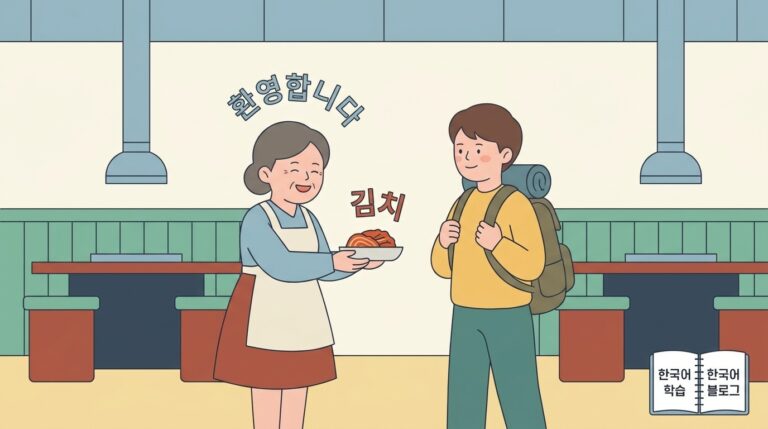
Let’s test your skills! Imagine you are at a lively K-BBQ restaurant in Hongdae. The pork belly is sizzling on the grill, K-Pop music is playing, and you need more delicious Kimchi.
Cast:
- You: A friendly foreign traveler (A2 level)
- Min-jun: Your Korean friend/senior (28 years old)
- Imo-nim: The friendly restaurant owner (50s)
Dialogue:
- Min-jun: (Smiling) “삼겹살 진짜 맛있지? 많이 먹어!”
(Sam-gyeop-sal jin-jja ma-sit-ji? Ma-ni meo-geo!)
(The pork belly is really delicious, right? Eat a lot!) - You: (Nodding enthusiastically) “네, 진짜 맛있어요! 그런데 민준 씨, 김치가 없어요.”
(Ne, jin-jja ma-si-sseo-yo! Geon-de Min-jun-ssi, gim-chi-ga eop-seo-yo.)
(Yes, it is really delicious! But Min-jun, there is no Kimchi left.) - Min-jun: (Laughing) “그럼 이모님 불러서 더 달라고 하자! 네가 한번 불러볼래?”
(Geu-reom I-mo-nim bul-leo-seo deo dal-la-go ha-ja! Ne-ga han-beon bul-leo-bol-rae?)
(Then let’s call Auntie and ask for more! Do you want to try calling her?) - You: (Gulping nervously, looking around the busy restaurant) “제가요? 어떻게 불러야 해요?”
(Je-ga-yo? Eo-tteo-ke bul-reo-ya hae-yo?)
(Me? How should I call her?) - Min-jun: (Winking) “Just use what you learned! She is over there.”
🔀 Decision Point: What do you say to get her attention?
- Option A: “야! 김치 더 줘!” (Ya! Gim-chi deo jwo! – Hey! Give me more kimchi!)
- Option B: “이모님~ 여기 김치 좀 더 주세요!” (I-mo-nim~ yeo-gi gim-chi jom deo ju-se-yo! – Auntie~ more kimchi here, please!)
- Option C: “김민정 씨! 김치 주세요!” (Kim Min-jeong ssi! Gim-chi ju-se-yo! – Ms. Kim Min-jeong! Give me kimchi!)
💡 Choices Analysis:
- Best Choice is Option B! Calling her “Imonim” is super sweet and warm. Adding “Yeo-gi” (here) and “Jom deo ju-se-yo” (please give some more) is the ultimate polite, local way to get fast service with a big smile.
- Option A is a major disaster! “Ya” means “Hey!” and is highly rude unless you are talking to a childhood friend. You might get a very angry look!
- Option C is too awkward. Even if you somehow found out her real name, calling a restaurant owner by her full name + “Ssi” sounds like a cold business transaction.
Phase 6: 10-Second Emotion Shadowing Drill
Let’s practice saying these lines with the perfect emotion! Pay attention to the pauses (/) and have fun!
- [😊 Warm & Friendly]
“이모님! / 여기 / 김치 / 좀 더 주세요!”
(I-mo-nim! / yeo-gi / gim-chi / jom deo ju-se-yo!)
Takeaway: Melt her heart by raising your tone slightly at “nim”! -
[🥺 Polite & Apologetic]
“저기요… / 실례지만 / 길 좀 물어볼게요.”
(Jeo-gi-yo… / sil-lye-ji-man / gil jom mu-reo-bol-ge-yo.)
Takeaway: Say “Jeogiyo” softly with a gentle smile to show you don’t want to disrupt them. -
[😤 Confident & Professional]
“부장님, / 좋은 아침입니다!”
(Bu-jang-nim, / jo-eun a-chim-im-ni-da!)
Takeaway: Keep a clear, respectful voice to show energy and professional respect to your manager!
Phase 7: K-Culture Mini Dictionary
| Word (Hangul / Romanization) | Meaning | Cultural Insight |
|---|---|---|
| 존댓말 (Jondaetmal) | Honorific/Polite speech | The polite language system in Korea. Always use this with people you meet for the first time! |
| 호칭 (Hoching) | Addressing titles | The specific title you call someone based on their age, job, or relationship with you. |
| 정 (Jeong) | Warm affection/Bonding | A unique Korean feeling of social connection, warmth, and mutual sharing. |
| 막내 (Maknae) | The youngest person | The youngest member of a family, office team, or K-Pop group (like BTS’s Jungkook!). |
Phase 8: Traveler’s Survival Kit
If you are traveling to Korea soon, save these three lifesaver expressions on your phone!
🚨 Survival Cards
- “저기요!” (Jeo-gi-yo!)
- When to use: To catch a server’s eye, ask for help, or get a stranger’s attention.
- Pro Tip: Keep your hand raised slightly at shoulder level when saying this!
- “실례합니다.” (Sil-lye-ham-ni-da.)
- When to use: To squeeze past people on a crowded subway or bus.
- Pro Tip: Bow your head slightly as you pass.
- “사장님, 계산해 주세요!” (Sah-jang-nim, gye-san-hae ju-se-yo!)
- When to use: “Excuse me owner, I’d like to pay the bill!”
- Pro Tip: Say this with a warm smile before heading to the counter.
📌 Editor’s Travel Note:
When traveling in Seoul, Google Maps doesn’t always show the best walking routes. Make sure to download the Naver Map App Download Page or KakaoMap for perfect real-time navigation. For payments, tipping is not expected anywhere in Korea, so you don’t need to worry about extra math at the table!
Phase 9: Think Deeper — “Why Age Matters So Much in Korea”
In Western cultures, age is often just a number. But in Korea, age is the foundation of social relationships. The moment Koreans meet, they often ask, “How old are you?” This isn’t because they are nosy! They ask to establish the correct Hoching (호칭 – titles) and level of politeness. It helps create a harmonious order where younger people respect elders, and older people protect and care for the younger ones.
💬 Your Turn: How does your culture show respect to older people? Do you have different titles for them, or is everyone addressed similarly? Let me know in the comments below!
Phase 10: FAQ & Avoiding Common Mistakes
Q: Can I call a female stranger “Ajoomma” (아줌마)?
A: No, avoid this! While “Ajoomma” means middle-aged woman, it can sometimes feel a bit sensitive or make them feel old. Always use the much warmer and safer “Imonim” (이모님 – Auntie) or “Sajangnim” (사장님) instead!
Q: I am older than my Korean friend. Can I just use their first name?
A: Yes, but check first! If you are older, you can call them by their name + “Ah/Ya” (e.g., Minjun-ah). However, wait until they tell you they are comfortable with informal speech (반말 – Banmal).
Q: Can I use “Oppa” for my male university professor who looks very young?
A: Absolutely not! No matter how young or handsome your professor looks, always address them as “Gyosu-nim” (교수님 – Professor).
🚨 Common Mistakes Alert!
- Using “Dangsin” (당신): It sounds like you are looking for a fight on the street! Use “Jeogiyo” instead.
- Calling your boss “Oppa/Hyeong”: This is highly unprofessional in the office. Use their job title + “nim” (e.g., Bu-jang-nim).
- Forgetting to bow: Saying polite words without a small head nod can still feel cold. Always nod or bow slightly!
Phase 11: Action Missions
- 🥉 Bronze (At-Home Challenge): Record a voice note on your phone saying, “이모님, 김치 좀 더 주세요!” with a bright, friendly voice. Listen to make sure your “nim” tone sounds warm!
- 🥈 Silver (Social Media Challenge): Go to your favorite K-Drama clip on YouTube, find a moment where a character uses a title, and comment with the title they used and why!
- 🥇 Gold (Real-World Challenge): The next time you visit a local Korean restaurant or supermarket, look the owner in the eyes, bow slightly, and say “Sajangnim, kamsahamnida!” (Thank you, owner!).
- 🎮 K-Culture Mission: Watch one episode of a K-Drama today and count how many times they say “Oppa” vs “Ssi”. You will start noticing the social hierarchy immediately!
Phase 12: Interactive Quiz Challenge
Test your new skills below!
🙋♀️ Q1: You dropped your wallet, and a friendly-looking middle-aged man picks it up for you. How do you address him?
- Correct Answer: “아저씨, 감사합니다!” (A-jeos-si, kam-sa-ham-ni-da! – Sir/Uncle, thank you!)
- Why: “Ajeossi” is a polite, respectful way to call a middle-aged man you don’t know. Well done!
✍️ Q2: Fill in the blank: “부장___, 이 보고서 읽어보세요.” (Manager, please read this report.)
- Correct Answer: 님 (nim)
- Why: You must add “~님” after a professional title (Bujang-nim) to show respect in the workplace.
ox Q3: True or False: It is perfectly fine to call your boss “Oppa” or “Eonni” if they are very friendly.
- Correct Answer: False!
- Why: Even with friendly bosses, always maintain professional boundaries at the office by using their official title + “~님”.
What was your score? Did you learn something new? Keep practicing with Daily Hangul, and soon you will be speaking like a true Seoulite! 다음에 또 만나요! (See you next time!)







