

Too Long or Too Short? How to Describe Objects in Korean Like a Local
Phase 1: Empathy (Welcome to Your Daily Hangul Space!)
안녕하세요! (An-nyeong-ha-se-yo!) Hello! I am your lead editor and tutor at Daily Hangul.
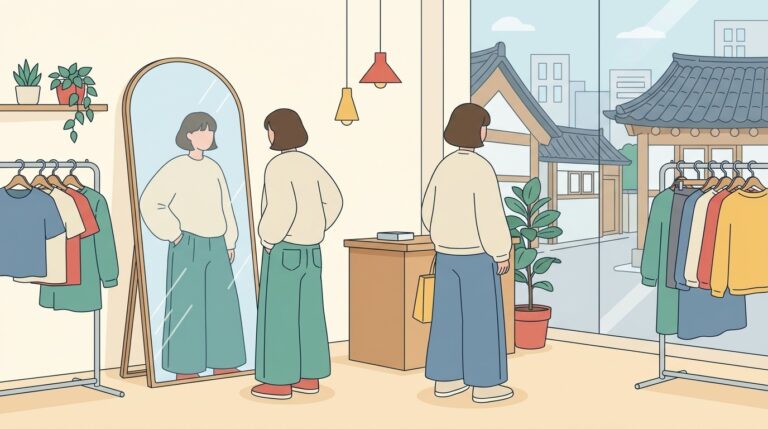
Imagine this: You are in a trendy clothing boutique in Hongdae, Seoul. You find the perfect pair of Korean-style wide-leg jeans. You excitedly head to the fitting room, slip them on, and look in the mirror. Oh no! They are dragging on the floor.
You step out, and the friendly shop assistant smiles and asks, “어떠세요? (Eo-tteo-se-yo? – How is it?)” You want to say, “They are too long!” but your mind goes blank. You end up gesturing wildly, pointing at your feet with an awkward laugh.
Don’t worry! We have all been there. In this guide, we are going to master two essential Korean adjectives: 길어요 (gireoyo – It’s long) and 짧아요 (jjalbayo – It’s short). Whether you are shopping for clothes, describing a movie run-time, or talking about hair lengths, these words will instantly level up your conversational confidence.
This guide was built from real-world student feedback, helping hundreds of learners just like you shop and chat in Korea without the sweat. Let’s dive in!
Phase 2: Core Expressions Deep Dive
Let’s break down the two main words you need. Since you are an A1 beginner, we will focus on the polite, natural conversational form (-아요/어요).
1. 길어요 (gi-reo-yo)
- Pronunciation: [ghee-ruh-yo] / Sounds like “key” but with a soft G + “ruh” (as in run) + “yo” (as in yo-yo).
- Meaning: It is long.
- K-Culture Moment: You will hear this constantly in hair salons (미용실 – mi-yong-sil) in Seoul. When the stylist asks about your hair, you might point and say, “머리가 길어요 (meo-ri-ga gi-reo-yo – My hair is long).”
- Editor’s Insight: The base verb is 길다 (gilda). When we speak politely, it changes to 길어요. Keep your tongue relaxed on the “l” sound!
- Situation Spectrum:
- Friends (Casual): ✅ (as 길어 – gi-reo)
- Colleagues (Semi-formal): ✅ (길어요 – gi-reo-yo)
- Bosses/Elders (Formal): ✅ (길어요 – gi-reo-yo)
- 🤔 Think About It: In English, we say “The pants are long” (plural). But in Korean, we just say “Pants long” (바지 길어요). Isn’t it wonderful how simple Korean can be?
2. 짧아요 (jjal-ba-yo)
- Pronunciation: [jjal-bah-yo] / The double ‘ㅉ’ is a sharp, crisp ‘JJ’ sound. Pronounce ‘jjal’ like the first syllable of ‘jalapeño’ but sharper, followed by ‘bah-yo’.
- Meaning: It is short.
- K-Culture Moment: Think of K-Pop stage outfits. Stylists often use cropped shirts or short skirts. Fans online often discuss these styles using terms like “바지가 짧아요 (ba-ji-ga jjal-ba-yo – The pants are short)”.
- Editor’s Insight: The spelling has double consonants at the bottom (ㄼ), which looks scary! But when followed by ‘아’, the ‘ㄹ’ stays with the first syllable, and ‘ㅂ’ moves to the next. So it sounds like [짤바요 – jjal-ba-yo]. Easy, right?
- Situation Spectrum:
- Friends (Casual): ✅ (as 짧아 – jjal-ba)
- Colleagues (Semi-formal): ✅ (짧아요 – jjal-ba-yo)
- Bosses/Elders (Formal): ✅ (짧아요 – jjal-ba-yo)
- 🤔 Think About It: How does your culture view short clothing compared to Korea? In Korea, short skirts are very common, but showing too much shoulder/cleavage is traditionally avoided. Language and fashion are always connected!
3. 조금 길어요 / 조금 짧아요 (jo-geum gi-reo-yo / jo-geum jjal-ba-yo)
- Pronunciation: [jo-geum ghee-ruh-yo] / [jo-geum jjal-bah-yo]
- Meaning: It is a bit long / It is a bit short.
- Editor’s Insight: “조금 (jo-geum)” means “a little” or “a bit”. It is the ultimate magic word to soften your sentence so you don’t sound too blunt!
Phase 3: Textbook Korean vs. Real-World Korean
Textbooks often teach highly formal or stiff sentences that sound like robot speech to locals. Let’s compare!
Situation 1: Giving feedback in a clothing store
- 📖 Textbook Korean: “이 바지는 너무 깁니다.” (I ba-ji-neun neo-mu gim-ni-da.) – “These trousers are excessively long.” (Very stiff, sounds like a military report.)
- 🗣️ Real Korean: “이거 조금 길어요.” (I-geo jo-geum gi-reo-yo.) – “This is a bit long.” (Soft, natural, and polite.)
- 💡 Why is it different? Koreans value “Nunchi” (social tact) and politeness. Saying “너무 깁니다” sounds like a direct complaint, whereas “조금 길어요” is friendly and cooperative.
Situation 2: Asking for a haircut style
- 📖 Textbook Korean: “머리를 짧게 자르십시오.” (Meo-ri-reul jjal-ge ja-reu-sip-si-o.) – “Cut my hair short.” (Sounds like a command to a subordinate.)
- 🗣️ Real Korean: “조금 짧게 잘라주세요.” (Jo-geum jjal-ge jal-la-ju-se-yo.) – “Please cut it a bit short.” (Warm, polite, and commonly used.)
- 💡 Why is it different? Adding “주세요 (ju-se-yo – please do for me)” changes a dry command into a polite request.
Phase 4: K-Culture Deep Dive & Non-verbal Manners
4-1. Nunchi & Body Language
When saying “길어요” (It’s long) or “짧아요” (It’s short) in a shop, non-verbal cues help a lot.
* The Hem Pinch: Gently pinch the extra fabric of your sleeve or pant leg and lift it slightly while saying “조금 길어요.” This shows the assistant exactly where you want it.
* The Head Tilt: Tilt your head slightly to the side with a soft smile when saying “짧아요.” This signals, “It’s a bit short for me, but thank you anyway!”
4-2. K-Fashion Trend: “Over-fit” (오버핏)
In Korea, you will see many people wearing oversized t-shirts, baggy pants, and long coats. This style is called 오버핏 (O-beo-pit – Over-fit). If you try on an oversized shirt and think it is too big, the clerk might say, “오버핏 스타일이에요 (It is an oversized style).” Knowing this helps you understand if an item is meant to look “길어요” on purpose!
Phase 5: Real-life Roleplay Scenario
Setting: A cool street-wear shop in Hongdae. Indie music plays in the background, and there are racks of colorful clothing.
Characters: You (A fashionable shopper) & Minji (민지 – A friendly shop assistant with a welcoming smile).
- Turn 1 (Minji): 어서 오세요! (Eo-seo o-se-yo!)
(🎭 Smiling warmly, bowing slightly)
“Welcome!” - Turn 2 (You): 안녕하세요! (An-nyeong-ha-se-yo!)
(🎭 Nodding politely)
“Hello!” - Turn 3 (Minji): 뭐 찾으시는 옷 있으세요? (Mwo chat-eu-si-neun ot it-seu-se-yo?)
(🎭 Gesturing to the racks)
“Are you looking for any specific clothes?” - Turn 4 (You): 바지 찾고 있어요. (Ba-ji chat-go it-seo-yo.)
(🎭 Pointing to the pants section)
“I am looking for pants.” - Turn 5 (Minji): 이 청바지 어때요? 요즘 인기가 많아요. (I cheong-ba-ji eo-tteo-yo? Yo-jeum in-gi-ga man-a-yo.)
(🎭 Showing you a trendy pair of jeans)
“How about these blue jeans? They are very popular lately.” - Turn 6 (You): 예뻐요! 입어봐도 돼요? (Yeop-peo-yo! Ip-eo-bwa-do dwae-yo?)
(🎭 Holding up the jeans with a sparkle in your eyes)
“Pretty! Can I try them on?” - Turn 7 (Minji): 네, 탈의실은 이쪽이에요. (Ne, tal-ui-sil-eun i-jjok-i-e-yo.)
(🎭 Pointing to the fitting rooms on the left)
“Yes, the fitting room is this way.” - Turn 8 (You – stepping out of the fitting room): 저기요… (Jeo-gi-yo…)
(🎭 Raising your hand slightly, looking a bit unsure)
“Excuse me…” - Turn 9 (Minji): 어머, 잘 어울려요! 어떠세요? (Eo-meo, jal eo-ul-ryeo-yo! Eo-tteo-se-yo?)
(🎭 Clapping hands together in admiration)
“Oh, it looks great on you! How is it?” - Turn 10 (You): 바지가 조금 길어요. (Ba-ji-ga jo-geum gi-reo-yo.)
(🎭 Pinching the bottom of the jeans dragging on the floor)
“The pants are a bit long.” - Turn 11 (Minji): 아, 기장이 조금 기네요! 한 사이즈 작은 걸로 드릴까요? (Ah, gi-jang-i jo-geum gi-ne-yo! Han sa-i-jeu ja-geun geol-ro deu-ril-kka-yo?)
(🎭 Nodding understandingly)
“Ah, the length is a bit long! Shall I give you one size smaller?” - Turn 12 (You): 네, 감사합니다! (Ne, gam-sa-hap-ni-da!)
(🎭 Smiling happily)
“Yes, thank you!”
🔀 Decision Point
What if you tried on a jacket instead, and the sleeves did not cover your wrists at all? What would you say to Minji?
- A) “소매가 조금 길어요.” (So-mae-ga jo-geum gi-reo-yo.)
- B) “소매가 조금 짧아요.” (So-mae-ga jo-geum jjal-ba-yo.)
- C) “소매가 너무 작아요.” (So-mae-ga neo-mu jag-a-yo.)
Solution
- Best Choice: B! “소매 (so-mae)” means sleeves. Saying “소매가 조금 짧아요” (The sleeves are a bit short) explains the issue perfectly.
- Risky Choice: A! Saying “길어요” means “long,” which is the exact opposite of what you want!
- Incorrect: C! “작아요 (jag-a-yo)” means “small” in size, but for specific lengths like sleeves or pants, using “짧아요” is much more natural and precise.
Phase 6: 10-Second Emotion Shadowing Drill
Let’s practice speaking with real emotion! Follow the slash / marks for natural breathing pauses.
- [🥺 Worried/Whiny] “아… / 이거 / 조금 / 길어요…”
(Ah… / i-geo / jo-geum / gi-reo-yo…)
“Ah… this is a bit too long…” - [😊 Pleased & Lighthearted] “머리 / 짧아요! / 마음에 들어요!”
(Meo-ri / jjal-ba-yo! / ma-eum-e deu-reo-yo!)
“My hair is short! I like it!” - [😤 Decisive & Clear] “이 바지는 / 너무 / 짧아요!”
(I ba-ji-neun / neo-mu / jjal-ba-yo!)
“These pants are way too short!”
Phase 7: K-Culture Mini Dictionary
| Word (Korean) | Romanization | English Translation | Cultural Context & Usage |
|---|---|---|---|
| 기장 | Gi-jang | Length (of clothing) | You will see this on online shopping size charts or at alteration shops. |
| 오버핏 | O-beo-pit | Oversized Fit | A major fashion trend in South Korea for relaxed, cool vibes. |
| 수선 | Su-seon | Alteration / Repair | If your pants are too long (길어요), you take them for “수선” to shorten them. |
| 핏 | Pit | Fit (of clothes) | Used to praise someone’s style: “핏이 좋아요” (The fit is great!). |
Phase 8: Traveler’s Survival Kit
If you are traveling in Korea, keep these three golden phrases ready in your pocket!
Survival Cards
- 이거 다른 사이즈 있어요? (I-geo da-reun sa-i-jeu it-seo-yo?)
“Do you have this in another size?”
💡 Pro Tip: Use this when an item is too long or short and you need a different fit. - 기장 좀 줄여주세요. (Gi-jang jom jul-yeo-ju-se-yo.)
“Please shorten the length.”
💡 Pro Tip: Perfect phrase to use at a Korean dry cleaner or tailor (세탁소 – se-tak-so). - 이거 너무 길어요. (I-geo neo-mu gi-reo-yo.)
“This is too long.”
💡 Pro Tip: Say this while showing the extra length to the shop assistant.
📌 Editor’s Travel Note
When shopping in areas like Dongdaemun or Myeongdong, you can use the Naver Map App to search for “세탁소” (Se-tak-so – Dry cleaner/tailor) or “옷수선” (Ot-su-seon – Clothing alteration) if you need your newly bought pants shortened quickly. Many local neighborhood dry cleaners can alter your pants within an hour for around 3,000 to 5,000 KRW!
(Note: Prices may vary slightly depending on the region and fabric type.)
Phase 9: Deep Thinking — “One Step Deeper”
In Western cultures, sizes are often described strictly through numbers or labels (Small, Medium, Large). However, in Korea, conversations about clothes often focus heavily on specific descriptions of length and proportion (e.g., “기장 – length”, “품 – width”). This stems from a culture that values meticulous detail and personal presentation.
Next time you shop, think about how describing the length (길어요/짧아요) rather than just the size (크고 작음) changes how you interact with the clothing and the person helping you.
💬 Your Turn: How do people in your hometown react when clothes do not fit right? Do they look for a different size, or do they get them altered? Share your thoughts in the comments below!
Phase 10: FAQ & Avoiding Misunderstandings
Q: Can I use “길어요” and “짧아요” to describe time, like a movie or a meeting?
A: Yes, absolutely! You can say “영화가 길어요 (The movie is long)” or “회의가 짧아요 (The meeting is short)”. It works for both physical objects and duration of time.
Q: What is the difference between “작아요 (jag-a-yo)” and “짧아요 (jjal-ba-yo)”?
A: “작아요” means small in overall volume or size. “짧아요” specifically means short in physical length. If you wear pants that are tight around your waist, they are “작아요” (small). If the legs of the pants don’t reach your ankles, they are “짧아요” (short).
Q: How do I tell a hairdresser not to cut my hair too short?
A: You should say, “너무 짧게 자르지 마세요” (Neo-mu jjal-ge ja-reu-ji ma-se-yo), which translates to “Please do not cut it too short.”
🚨 Common Mistakes Alert!
- Mistake: Confusing “짧아요” with “작아요”.
❌ 이 바지 너무 작아요 (when you actually mean they are too short).
✅ Correct Action: Say “이 바지 너무 짧아요” if they are short, and “작아요” if they are too tight. - Mistake: Mispronouncing “짧아요” as “짤아요” (jjal-a-yo).
❌ 짤아요
✅ Correct Action: Keep the ‘ㅂ’ sound alive! Pronounce it as [짤바요 – jjal-bayo]. - Mistake: Forgetting to add “조금” (jo-geum) when pointing out issues to store assistants.
❌ 이거 길어요! (Can sound a bit demanding).
✅ Correct Action: Say “이거 조금 길어요” (This is a bit long) to keep the tone soft and polite.
Phase 11: Action Missions
Ready to put your knowledge to the test? Try these fun challenges!
- 🥉 Bronze (The Mirror Challenge): Go to your closet, pick out your longest coat or shortest t-shirt, look in the mirror, and say out loud: “이거 길어요!” or “이거 짧아요!” 3 times with emotion.
- 🥈 Silver (The Social Media Hunt): Find a photo of a K-Pop idol wearing an oversized outfit or cropped top. Write a comment or a post draft using: “바지가 길어요” (The pants are long) or “티셔츠가 짧아요” (The t-shirt is short).
- 🥇 Gold (The Local Shopping Mission): Next time you shop at an online Korean brand store (like Musinsa) or a physical store, identify one item that is too long or short for your preference and write/say: “조금 길어요/짧아요.”
- 🎮 K-Culture Mission: Watch your favorite K-Drama today. Listen closely to see if any character says “길다” (long) or “짧다” (short) during a conversation! (Hint: Look for scenes in hair salons, clothing stores, or when they discuss time).
Phase 12: Interactive Quiz Challenge
Test your skills with our mini-game! Click each question to reveal the correct answer.
1. Situation Quiz
You are at a coffee shop and your friend brings you a very short straw for a tall drink. What do you say?
👉 Click to see the answer
Answer: “빨대가 조금 짧아요.” (Ppal-dae-ga jo-geum jjal-ba-yo. – The straw is a bit short.)
Why? “빨대 (ppal-dae)” means straw, and “짧아요” is the correct adjective for short.
2. Fill in the Blanks
Complete the dialogue:
- A: 이 치마 어때요? (How about this skirt?)
- B: 예쁜데… 저한테 조금 ___________. (It’s pretty… but it is a bit long for me.)
👉 Click to see the answer
Answer: 길어요 (gi-reo-yo)
Full sentence: “예쁜데… 저한테 조금 길어요.” (It’s pretty, but it’s a bit long for me).
3. True or False
True or False: The word “짧아요” is pronounced as “jjal-a-yo.”
👉 Click to see the answer
Answer: FALSE!
It is pronounced as [jjal-ba-yo]. You must pronounce the ‘ㅂ’ sound as it carries over to the next syllable!







