

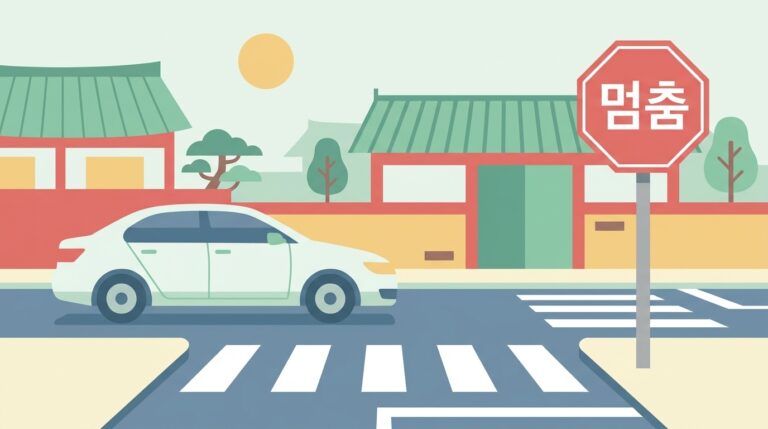
Master the Turn: Navigating Korea’s Mandatory Right-Turn Stop and the Driver’s Dilemma
Phase 1: Empathy (An Immersive Opening)
안녕하세요! Hello, fellow Korean language and culture explorers! Your Daily Hangul editor is back, bringing you the ultimate survival guide to a topic that has recently sparked absolute pandemonium on Korean roads.
Picture this: You are behind the wheel of a sleek rental car in the middle of Gangnam, Seoul, much like a stylish lead in a high-octane K-Drama thriller. The neon lights of the city are reflecting off your hood, and you feel on top of the world. Suddenly, you approach an intersection. You want to make a right turn. The traffic light ahead is glowing a resolute red, but the pedestrian crossing signal directly to your right is… green, yet completely devoid of pedestrians.
You hesitate. In your home country, you might coast through a right-turn-on-red after a quick glance. But here, you freeze. Suddenly, a cacophony of honks (빵빵! / ppang-ppang!) erupts from the line of cars trailing behind you. Your heart rate spikes. Do you go? Do you stay? If you go, will a police officer step out from the shadows to hand you a hefty fine? If you stay, will you face the wrath of fifty impatient Seoul drivers?
This is the quintessential “Right-Turn Dilemma” (우회전 일시 정지 의무화와 운전자의 혼란) that currently plagues both locals and expats alike in South Korea. Following the sweeping traffic law amendments of 2023, the rules governing right turns have undergone a paradigm shift. Today, we will not only demystify these regulations but also equip you with the advanced linguistic tact (눈치 / nunchi) and driving vernacular to handle this stressful scenario like a true Seoulite.
This guide is forged from the real-life driving anxieties of our advanced C2 learners and verified by local drivers who navigate the concrete jungles of Seoul daily. Let’s dive in!
Phase 2: Deep Dive into 3 Key Expressions
To confidently articulate your road-trip experiences or dissect traffic safety in Korean, you must master these three highly nuanced, advanced expressions.
1. 일시 정지 (Il-si jeong-ji)
- Pronunciation: [il-shee jung-jee] / Sounds like “ill-see” followed by “jung-jee”.
- Meaning: Literal: Temporary stop | Real-world Nuance: A complete, absolute wheel-lock halt (0 km/h) for a minimum of 2–3 seconds before proceeding.
- K-Culture Moment: This phrase is emblazoned on red octagonal signs across Korea and is frequently discussed on Korean news channels during enforcement seasons.
- Editor’s Insight: English speakers often mistake “temporary stop” for a rolling yield (서행 / seohaeng). In Korean jurisprudence, if your wheels are rolling even slightly, it is not an il-si jeong-ji, and you are liable for a fine.
- Situation Spectrum:
- Casual: ✅
- Semi-formal: ✅
- Formal: ✅
- — Think About It: Korea has rapidly shifted from a hyper-accelerated “Palli-Palli” (빨리빨리 – fast-paced) culture to a pedestrian-first legal framework. How does the linguistic precision of “일시 정지” (temporary stop) contrast with “정지” (permanent/full stop) in your native language’s traffic signs?
2. 단속 (Dan-sok)
- Pronunciation: [dahn-sok] / Rhymes with “frock” but with a soft “d”.
- Meaning: Literal: Crackdown/Enforcement | Real-world Nuance: Active police monitoring and ticketing of traffic violations.
- K-Culture Moment: You’ll often hear characters in K-Dramas exclaim, “오늘 단속 떴다!” (They’re running a crackdown today!) when warning friends about drunk driving or traffic stings.
- Editor’s Insight: Dan-sok carries a heavy, regulatory weight. When paired with u-hoe-jeon (우회전 – right turn), it refers to police officers waiting just around the corner from an intersection to catch rolling turners.
- Situation Spectrum:
- Casual: ✅
- Semi-formal: ✅
- Formal: ✅
- — Think About It: Why do you think Korean public policy relies so heavily on intensive “enforcement periods” (집중 단속 기간) to change driver behavior, rather than subtle, year-round policing?
3. 눈치 싸움 (Nunchi ssa-um)
- Pronunciation: [noon-chee sah-oom] / Combined from “Nunchi” (social wit) and “Ssa-um” (fight/battle).
- Meaning: Literal: Tact battle | Real-world Nuance: A silent Mexican standoff or psychological tug-of-war where parties try to read each other’s intentions without speaking.
- K-Culture Moment: This is a staple of Korean variety shows (like Running Man) where players try to predict each other’s moves. On the road, it refers to the tense stand-off between the driver, the pedestrian on the curb, and the honking car behind.
- Editor’s Insight: The right-turn rule requires you to stop if a pedestrian “intends to cross” (건너려고 할 때). Deciphering that “intention” is the ultimate nunchi ssa-um.
- Situation Spectrum:
- Casual: ✅
- Semi-formal: ☀
- Formal: ☑
- — Think About It: How does a highly high-context society like Korea resolve traffic conflicts through non-verbal nunchi compared to low-context cultures that rely strictly on legal codification?
Phase 3: Textbook Korean vs. Real Korean (Real Korean Showcase)
Let’s compare the sterile sentences of standard textbooks with the vibrant, natural prose spoken by native drivers.
Situation 1: Expressing frustration about the car behind you honking
- ‖ Textbook Korean: 뒤에 있는 차량이 경적을 반복하여 울리고 있습니다. (Dwi-e in-neun cha-ryang-i gyeong-jeok-eul ban-bok-ha-yeo ul-ri-go it-seup-ni-da.)
- Translation: The vehicle behind me is repeatedly sounding its horn.
- │ Real Korean: 뒤차가 계속 빵빵거려요. (Dwi-cha-ga gyeo-sok ppang-ppang-geo-ryeo-yo.)
- Translation: The car behind me keeps going “ppang-ppang” (honking)!
- │ Why the difference? Textbooks use archaic, written-register terms like “경적을 울리다” (to sound a horn) and “차량” (vehicle). In real life, Koreans use the punchy onomatopoeia “빵빵거리다” (to repeatedly honk) and shorten “뒤에 있는 차” to the slick “뒤차”.
Situation 2: Warning someone about police enforcement around the bend
- ‖ Textbook Korean: 경찰이 우회전 위반을 단속하고 있으니 주의하십시오. (Gyeong-chal-i u-hoe-jeon wi-ban-eul dan-sok-ha-go it-seu-ni ju-ui-hap-si-o.)
- Translation: Please be careful as the police are enforcing right-turn violations.
- │ Real Korean: 저기 모퉁이 돌면 바로 우회전 단속해요. 조심하세요. (Jeo-gi mo-tung-i dol-myeon ba-ro u-hoe-jeon dan-sok-hae-yo. Jo-sim-ha-se-yo.)
- Translation: They’re cracking down on right turns right around that corner. Watch out.
- │ Why the difference? The textbook sentence sounds like a sterile robotic GPS warning. Real Koreans use descriptive spatial terms like “모퉁이 돌면 바로” (right around the corner) to give practical, immediate advice.
Phase 4: K-Culture Deep Dive & Non-Verbal Manners
4-1. Nunchi and the Non-Verbal Code of the Road
Driving in Korea is a highly interactive performance. When navigating the right-turn dilemma, your physical gestures are just as critical as your signal lights.
- The Hazard Light Thank You (비상등 깜빡이): If you had to make a sudden stop because a pedestrian darted out, or if you cut in slightly to make a right turn, immediately press your hazard light button (비상등) and let it blink three times. In Korea, this is the universal non-verbal translation of “I’m sorry” or “Thank you for your patience.”
- The Hand-Wave Apology: If you make eye contact with a pedestrian or a driver you’ve inconvenienced, raise your right hand slightly near your rearview mirror, palm facing forward. It instantly diffuses tension.
4-2. The Cultural Battle over Right-Turn Rules
In modern K-Dramas, you might see wealthy corporate heirs speeding through Seoul’s intersections in their sports cars. Historically, right turns on red were treated fluidly. However, Korea’s soaring pedestrian accident rates in urban zones prompted the 2023 legislative crackdown.
This created a massive cultural clash between the older generation of drivers, who prioritize speed and efficiency, and the younger generation and traffic police, who champion pedestrian safety. When you drive in Korea, you are stepping directly into this sociological transition zone.
Phase 5: Interactive Roleplay Scenario
Setting: It is 8:30 PM on a rainy Friday in Gangnam. You are driving a rental SUV, trying to find your way to a famous K-BBQ restaurant. Your Korean friend, Min-jun, is in the passenger seat navigating. You approach a busy intersection. The light is red, the pedestrian crosswalk to your right is flashing green, and there is an elderly lady standing near the curb holding an umbrella.
Cast:
- You (the anxious driver)
- Min-jun (your cool, rule-abiding local friend)
Dialogue:
- Min-jun: — (pointing ahead) — 여기서 우회전 해야 돼. (Yeo-gi-seo u-hoe-jeon hae-ya dwae.)
- Translation: (pointing ahead) We need to turn right here.
- You: — (gripping the steering wheel) — 어? 빨간불인데 그냥 가도 돼? (Eo? Ppal-gan-bul-in-de geu-nyang ga-do dwae?)
- Translation: (gripping the steering wheel) Oh? The light is red, can I just go?
- Min-jun: — (shaking his head) — 안 돼! 일단 멈춰. 무조건 일시 정지해야 돼. (An dwae! Il-dan meom-chweo. Mu-jo-geon il-si jeong-ji-hae-ya dwae.)
- Translation: (shaking his head) No! Stop first. You must make a temporary stop under any circumstances.
- You: — (pressing the brakes fully) — 섰어. 근데 보행자 신호가 초록불인데 아무도 안 건너잖아. (Seot-eo. Geun-de bo-haeng-ja sin-ho-ga cho-rok-bul-in-de a-mu-do an geon-neo-ja-na.)
- Translation: (pressing the brakes fully) I’ve stopped. But the pedestrian light is green and no one is crossing.
- Min-jun: — (pointing to the curb) — 저기 할머니 서 계시잖아. 건널 수도 있으니까 초록불 끝날 때까지 기다려. (Jeo-gi hal-meo-ni seo gye-si-ja-na. Geon-neol su-do is-seu-ni-ka cho-rok-bul kkeut-nal ttae-kka-ji gi-da-ryeo.)
- Translation: (pointing to the curb) Look, that grandmother is standing there. She might cross, so wait until the green light ends.
- [Sound Effect] — Ppang! Ppang! (뒤차가 세차게 클락션을 울림 / The car behind honks aggressively.)
- You: — (panicking) — 헉! 뒤차 빵빵거려! 어떡해? 그냥 가야 할 것 같아! (Heok! Dwi-cha ppang-ppang-geo-ryeo! Eo-tteok-hae? Geu-nyang ga-ya hal geot ga-ta!)
- Translation: (panicking) Oh! The car behind is honking! What do I do? I feel like I have to go!
- Min-jun: — (putting his hand on your shoulder) — 절대 안 돼. 지금 가면 우회전 단속에 걸려. 벌금 세게 나와. (Jeol-dae an dwae. Ji-geum ga-myeon u-hoe-jeon dan-sok-e geol-ryeo. Beol-geum se-ge na-wa.)
- Translation: (putting his hand on your shoulder) Absolutely not. If you go now, you’ll get caught in the right-turn crackdown. The fine is heavy.
- You: — (taking a deep breath) — 아, 진짜 심장 떨린다… 한국에서 운전하기 너무 힘드네. (A, jin-jja sim-jang tteol-rin-da… Han-guk-e-seo un-jeon-ha-gi neo-mu him-deu-ne.)
- Translation: (taking a deep breath) Ah, my heart is literally pounding… Driving in Korea is so stressful.
- Min-jun: — (laughing) — 이게 바로 한국 도로 위의 눈치 싸움이야. 잘 참았어! (I-ge ba-ro Han-guk do-ro wi-ui nunchi ssa-um-i-ya. Jal cha-mat-eo!)
- Translation: (laughing) This is exactly the tact battle of Korean roads. Good job holding your ground!
☑ Decision Point:
The car behind you is now flashing its high beams in irritation. What do you do?
- Option A: Succumb to the peer pressure, hit the gas, and complete the right turn while cursing under your breath.
- Option B: Maintain your complete stop, ignore the high beams, check the pedestrian signals, and wait until the elderly lady either crosses or the light turns red.
- Option C: Put the car in park, step out, and perform a dramatic bowing apology to the driver behind you.
│ Best Choice Analysis:
Option B is the gold standard of modern Korean driving. Honking in Korea is common and often denotes impatience rather than actual danger. If you choose Option A, you risk a 60,000 KRW fine and penalty points on your license. Safety and legality always triumph over local impatience.
│ Bad Choice Analysis:
Option A is a high-risk gamble. Police officers frequently hide at key intersections in Gangnam precisely to catch drivers who fold under the pressure of honking cars. Option C is wildly theatrical and dangerous in active traffic!
Phase 6: 10-Second Emotion Shadowing Drill
Let’s practice saying these high-stress phrases with the exact emotional pitch of a local driver!
- Phrase 1: [😤 Frustrated and under pressure]
- “아니, / 보행자가 없는데 / 대체 왜 서라는 거야?”
- A-ni, / bo-haeng-ja-ga eop-neun-de / dae-che wae seo-ra-neun geo-ya?
- “Seriously, / there are no pedestrians, / why on earth do I have to stop?”
- Phrase 2: [☑ Urgent and warning]
- “뒤에서 / 아무리 빵빵거려도 / 절대 가면 안 돼!”
- Dwi-e-seo / a-mu-ri ppang-ppang-geo-ryeo-do / jeol-dae ga-myeon an dwae!
- “No matter how much / they honk from behind / you must absolutely not go!”
Phase 7: K-Culture Mini-Dictionary
Explore these four terms essential to understanding the Korean roadway landscape.
+------------------------------------------------------------+
| 1. 초보 운전 (Chobo Unjeon) - "Novice Driver"              |
| - Crucial for tourists. Many Koreans put hilarious stickers|
|   on their rear windows like "저도 제가 무서워요" (Even I  |
|   am scared of myself). It instantly buys you patience.   |
+------------------------------------------------------------+
| 2. 비상등 (Bisangdeung) - "Hazard Lights"                 |
| - The ultimate Swiss Army knife of driving non-verbal comm.|
|   Used for saying sorry, thank you, or warning of danger.  |
+------------------------------------------------------------+
| 3. 꼬리물기 (Kkorimulgi) - "Biting the Tail"               |
| - Entering an intersection even when the traffic is blocked|
|   ahead, resulting in blocking the cross-traffic. Heavily  |
|   fined.                                                   |
+------------------------------------------------------------+
| 4. 신호 위반 (Sinho Wiban) - "Signal Violation"           |
| - Violating any red light, including the new right-turn    |
|   signals installed at confusing intersections.            |
+------------------------------------------------------------+
Phase 8: Traveler’s Survival Kit
Top 3 Survival Expressions for Driving in Korea
+-------------------------------------------------------------------------+
| Expression 1: 여기서 우회전하면 돼요?                                  |
| Pronunciation: Yeo-gi-seo u-hoe-jeon-ha-myeon dwae-yo?                  |
| Pro Tip: Use this when double-checking directions with a local passenger|
| before making a turn.                                                   |
+-------------------------------------------------------------------------+
| Expression 2: 네비게이션이 이상해요.                                    |
| Pronunciation: Ne-bi-ge-i-syeon-i i-sang-hae-yo.                        |
| Pro Tip: Korean GPS units can be incredibly detailed; use this phrase  |
| if the voice prompt is confusing you near a complex exit.              |
+-------------------------------------------------------------------------+
| Expression 3: 제 차선이 맞나요?                                        |
| Pronunciation: Je cha-seon-i man-na-yo?                                 |
| Pro Tip: Essential when navigating multiple turning lanes in Seoul.     |
+-------------------------------------------------------------------------+
– Editor’s Travel Note:
When driving in South Korea, Google Maps is notoriously unreliable due to government security restrictions on spatial data. Instead, always download the Naver Map App Download Page or use KakaoMap for real-time lane guidance, right-turn speed camera alerts, and traffic status.
Phase 9: Deep Reflection — “One Step Deeper”
Korea’s driving rules reflect a fascinating tension between the historic collective drive for economic acceleration (the legacy of the Palli-Palli era) and a modern, high-income democracy’s commitment to public safety and human-centric infrastructure.
The confusion surrounding the new right-turn law is not just a regulatory oversight; it is a manifestation of society transitioning from prioritizing the flow of machines to protecting the safety of individuals. It forces drivers to slow down, look, and utilize nunchi not for selfish speed, but for communal safety.
✉ Your Turn: How does your home country manage right turns at red lights? Is it a fluid process, or do you have strict stop-and-go mandates? Let us know in the comments below!
Phase 10: FAQ & Avoiding Misunderstandings
Q: Can I turn right if there are absolutely no pedestrians at the green crosswalk?
A: Yes, but only after a complete, dead stop. You must stop behind the limit line, wait for a few seconds, look both ways, and if the path is entirely clear, you may proceed slowly. However, if a pedestrian is even standing near the curb, it is legally safer to wait.
Q: What is the fine if I get caught violating the right-turn rule?
A: Violators face a fine of 60,000 KRW (for passenger cars) and 10 demerit points on their driving record. If an accident occurs, it is treated as a major traffic law violation, which carries criminal liability.
Q: Are there dedicated right-turn lights in Korea?
A: Yes, they are being rolled out nationwide. Look for a three-tiered horizontal light with an arrow pointing right. If there is a right-turn signal (우회전 신호등), you must only turn when that arrow is green.
☀ Common Mistakes Warning Board
- Rolling Yields: Assuming slowing down to 5 km/h is enough. (Correct action: Complete 0 km/h stop).
- Ignoring the Curb: Only looking at the crosswalk itself, ignoring people walking toward it. (Correct action: Scan the curb before proceeding).
- Panicking due to honking: Letting the driver behind dictate your safety. (Correct action: Ignore the honks; prioritize legal safety).
Phase 11: Action Missions
- ┗ Bronze (Home Challenge): Practice the shadowing drill in front of a mirror with a fierce, dramatic look. Record yourself saying “뒤차가 계속 빵빵거려요” to perfect your flat “ppang-ppang” sound.
- ┗ Silver (Network Challenge): Share your favorite “funny Korean driving sticker” on social media with a caption explaining Chobo Unjeon (초보 운전).
- ┗ Gold (Real-world Challenge): Next time you ride in a Korean taxi, observe how the driver handles right turns. Count how many seconds they stop when the light is red!
Phase 12: Interactive Quiz Challenge
Test your new wisdom with our quick interactive quiz!
1. What does “일시 정지” actually mean in practice?
- A) Slowing down to look around.
- B) Stopping fully with wheels completely locked.
- C) Speeding up to clear the intersection.
┐ Click here for the Answer!
Correct Answer: B
To avoid a fine, you must come to a complete, absolute stop. A rolling stop is treated as a violation.
2. Translate to natural Korean: “The car behind me keeps honking!”
- A) 뒤 차량이 경적을 반복합니다.
- B) 뒤차가 계속 빵빵거려요.
- C) 뒤차가 운전을 잘해요.
┐ Click here for the Answer!
Correct Answer: B
“뒤차가 계속 빵빵거려요” is the natural, native colloquial standard.
3. True or False: If a pedestrian light is green but no one is on the street, you can turn right without stopping.
- A) True
- B) False
┐ Click here for the Answer!
Correct Answer: B (False)
You must always come to a complete stop first, regardless of pedestrian presence, if the main traffic light is red or the pedestrian light is green.







