

Clutching Your Temples in Seoul? How to Say “My Head Hurts” in Korean Like a True Local
Phase 1: Oh, My Head! The K-Drama Headache Realized
안녕하세요! (Annyeonghaseyo!) Hello! It is your favorite friendly Korean tutor and local guide from Daily Hangul (매일한글).
We have all seen this iconic K-Drama scene: a character hears shocking news—like their son marrying someone they do not approve of—and they instantly gasp, clutch their temples, and eventually lie in bed with a white towel tied tightly around their forehead. In Korea, this is the ultimate visual symbol of a stress-induced headache!
But what happens if you are traveling in Seoul, walking through the neon-lit streets of Hongdae, and you suddenly get a real, painful headache? Knowing how to tell someone your head hurts is not just a basic survival skill; it is a gateway to receiving warm, immediate help from locals who are always ready to point you to the nearest pharmacy.
Let’s learn how to express this discomfort naturally, so you do not have to rely on dramatic K-Drama miming!
Phase 2: Core Expressions Deep Dive
Here are the three most common and natural ways to say “My head hurts” in Korean. Let’s look at when and how to use them.
1. 머리가 아파요 (Meoriga apayo)
- Pronunciation: meo-ri-ga a-pa-yo / Sound-alike: “Mux-ree-gah ah-pah-yo” (Say “meo” like the first syllable of “merry” but softer, and “apayo” like “ah-pah” plus “yo”).
- Meaning: “My head hurts” or “I have a headache.”
- K-Culture Moment: You will hear this in almost every daily life scene in K-Dramas when a character wakes up after a late-night drinking session (Hoesik, 회식) with too much Soju!
- Editor’s Insight: This is the absolute gold standard of headache expressions. It is simple, polite, and instantly understood by everyone from young children to doctors.
- Situation Spectrum:
- Friends & Casual (반말): 머리 아파 (Meori apa) – ✅
- Workplace & Polite (존댓말): 머리가 아파요 (Meoriga apayo) – ✅
- Boss & Formal (높임말): 머리가 아픕니다 (Meoriga apnida) – ✅
- 🤔 Think About It: In English, we say “I have a headache” (using the verb “have”). In Korean, we say “The head hurts” (using the adjective “to be hurt/painful”, 아프다). Why do you think Korean focuses on the body part itself rather than “owning” the pain?
2. 두통이 있어요 (Dutongi isseoyo)
- Pronunciation: doo-tong-i is-seo-yo / Sound-alike: “Doo-tong-ee ees-suh-yo”.
- Meaning: “I have a headache” (Literal: “Headache exists”).
- K-Culture Moment: This is the phrase you use when describing your symptoms to a pharmacist or a doctor in a clinical setting.
- Editor’s Insight: Dutong (두통) comes from Hanja (Chinese characters), where Du (두) means head and Tong (통) means pain. It sounds slightly more professional and clinical than meoriga apayo.
- Situation Spectrum:
- Friends & Casual (반말): 두통 있어 (Dutong isseo) – ⚠️ (A bit too formal for close friends)
- Workplace & Polite (존댓말): 두통이 있어요 (Dutongi isseoyo) – ✅
- Boss & Formal (높임말): 두통이 있습니다 (Dutongi isseumnida) – ✅
- 🤔 Think About It: Many medical terms in Korean use Hanja. If Du (두) means head, can you guess what Tong (통) means in other words like Chitong (치통 – toothache)? Yes, pain!
3. 머리가 지끈거려요 (Meoriga jikkeungeoryeoyo)
- Pronunciation: meo-ri-ga ji-kkeun-geo-ryeo-yo / Sound-alike: “Mux-ree-gah jee-kkeun-guh-ryuh-yo” (Make sure to tense your tongue on the double “kk” sound!).
- Meaning: “My head is throbbing/pulsing with pain.”
- K-Culture Moment: Perfect for when you are overwhelmed by the loud, energetic music playing in a trendy K-Beauty store in Myeongdong.
- Editor’s Insight: This uses the mimic word (ideophone) jikkun-jikkun (지끈지끈), which describes a dull, throbbing pain. Using this makes you sound incredibly fluent and expressive!
- Situation Spectrum:
- Friends & Casual (반말): 머리 지끈거려 (Meori jikkeungeoryeo) – ✅
- Workplace & Polite (존댓말): 머리가 지끈거려요 (Meoriga jikkeungeoryeoyo) – ✅
- Boss & Formal (높임말): 머리가 지끈거립니다 (Meoriga jikkeungeorimnida) – ⚠️ (Slightly too descriptive for formal settings)
Phase 3: Textbook Korean vs. Real Korean
When you study with traditional textbooks, you often learn stiff sentences. Let’s look at how actual Koreans talk when their head is pounding.
Scenario 1: Describing a Severe Headache
- 📖 Textbook Korean: “저는 극심한 두통을 앓고 있습니다.” (Jeoneun geuksimhan dutongeul alkgo isseumnida. – “I am suffering from a severe headache.”)
- 🗣️ Real Korean: “머리 깨질 것 같아요.” (Meori kkaejil geot gatayo. – “My head feels like it’s going to split/break open.”)
- 💡 Why the difference? Koreans love highly visual, emotional expressions. Saying your head is “going to split” (kkaejida) conveys the severity of your pain instantly and naturally.
Scenario 2: Asking for Medicine
- 📖 Textbook Korean: “두통약을 처방해 주시겠습니까?” (Dutongyageul cheobanghae jusigesseumnika? – “Could you prescribe me headache medicine?”)
- 🗣️ Real Korean: “혹시 타이레놀 있어요?” (Hoksi tairenol isseoyo? – “By any chance, do you have Tylenol?”)
- 💡 Why the difference? Over-the-counter painkillers are easily accessible. Asking for “Tylenol” specifically is the fastest way to get relief in Korea without needing a complex prescription conversation.
Phase 4: K-Culture Deep Dive & Non-verbal Manners
4-1. The Body Language of Pain
In Korea, expressing pain is often accompanied by subtle physical cues. If you have a headache:
1. The Temple Massage: Gently press your index and middle fingers to your temples while speaking. This visually communicates your pain before you even finish your sentence.
2. The Polite Bow of Request: If you are asking a convenience store clerk or hotel receptionist for help, bow your head slightly (~15 degrees) to show that you are sorry to trouble them while asking for assistance.
4-2. The Convenience Store Lifeline
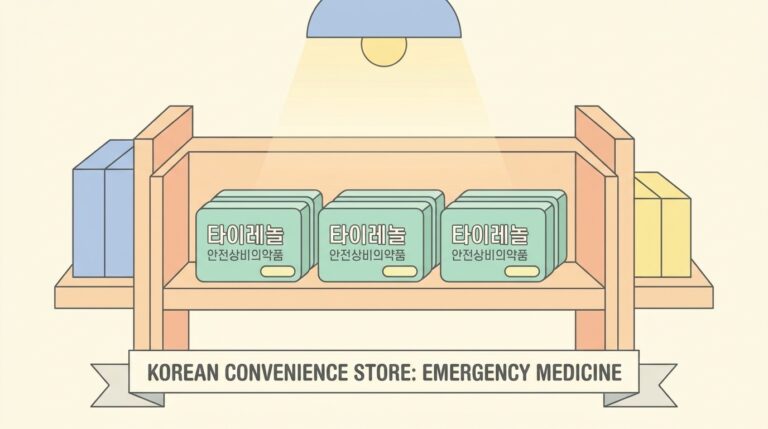
Did you know that you can buy basic medicine in Korean convenience stores? In 2012, Korea introduced the “Safety Emergency Medicine” (Anjeon Sangbi Uiyakpun, 안전상비의약품) system.
If you have a headache late at night when pharmacies (Yakguk, 약국) are closed, look for the nearest CU, GS25, or 7-Eleven. They stock basic painkillers like Tylenol (타이레놀) and Children’s Brufen (부루펜 syrup) near the cash register. However, keep in mind that they are only allowed to sell one pack per person to prevent misuse!
Phase 5: Interactive Roleplay Scenario
The Setting: It is 11:30 PM. You are staying in a cozy guesthouse in Mapo-gu, Seoul. Your head is throbbing after a long day of sightseeing. You walk into a brightly lit GS25 convenience store. The bell chimes, and a friendly cashier named Ji-hoon greets you.
The Dialogue
- Ji-hoon (Cashier): 어서 오세요! (Eoseo oseyo!)
(🎭 Welcoming you with a polite head nod behind the counter.)
“Welcome!” -
You (The Traveler): 안녕하세요… 혹시 약 있어요? (Annyeonghaseyo… hoksi yak isseoyo?)
(🎭 Holding your forehead with one hand, looking slightly tired.)
“Hello… by any chance, do you have medicine?” -
Ji-hoon: 아, 어디 아프세요? (Ah, eodi apeuseyo?)
(🎭 Stepping out from behind the register with a worried expression.)
“Oh, does somewhere hurt? / Are you not feeling well?” -
You: 네, 머리가 너무 아파요. (Ne, meoriga neomu apayo.)
(🎭 Frowning slightly to show the discomfort.)
“Yes, my head hurts so much.” -
Ji-hoon: 두통약 찾으시는군요. 저기 계산대 옆에 타이레놀 있어요. (Dutongyak chajiseuneungun-yo. Jeogi gyesandae yeope tairenol isseoyo.)
(🎭 Pointing to a small display rack right next to the POS machine.)
“Ah, you are looking for headache medicine. We have Tylenol over there next to the register.” -
You: 아, 다행이다! 이거 하나 주세요. (Ah, dahaengida! Igeo hana juseyo.)
(🎭 Picking up a green box of Tylenol and placing it on the counter.)
“Oh, thank goodness! Please give me one of these.” -
Ji-hoon: 네, 이 약은 하루에 세 번, 식사 후에 드시는 게 좋아요. (Ne, i yageun harue se beon, siksa hue deusineun ge johayo.)
(🎭 Scanning the barcode of the medicine.)
“Okay, it is best to take this medicine three times a day, after meals.” -
You: 아, 네. 감사합니다. 카드로 계산해 주세요. (Ah, ne. Gamsahamnida. Kadeuro gyesanhae juseyo.)
(🎭 Handing over your travel card with both hands.)
“Ah, yes. Thank you. Please charge it to my card.” -
Ji-hoon: 계산 완료되었습니다. 여기 카드랑 영수증이요. 아프지 마세요! (Gyesan wanryodeueosseumnida. Yeogi kadeurang yeongsujeungiyo. Apeuji maseyo!)
(🎭 Handing back your card with both hands and smiling warmly.)
“Payment is complete. Here is your card and receipt. Get well soon!” -
You: 감사합니다. 안녕히 계세요. (Gamsahamnida. Annyeonghi gyeseyo.)
(🎭 Bowing slightly as you take the medicine.)
“Thank you. Goodbye!”
🔀 Decision Point: Choose Your Next Step!
If the cashier tells you they don’t have Tylenol left, what should you do?
- Option A: Say “약국 어디에요?” (Yakguk eodieyo? – “Where is the pharmacy?”)
- Best Choice! This is direct, polite, and will prompt the cashier to point you to the nearest local pharmacy.
- Option B: Say “병원으로 가고 싶어요!” (Byeongwoneuro gago sipeoyo! – “I want to go to the hospital!”)
- Risk Choice! This sounds very dramatic for a mild headache and might cause the cashier to call an ambulance (119) for you!
- Option C: Say nothing and walk out crying.
- Bad Choice! Koreans are incredibly helpful. Just ask, and they will help you find a solution!
Phase 6: 10-Second Emotion Shadowing Drill
Let’s practice saying these phrases with real feelings! Speak out loud, pausing at the / marks.
- [🥺 Exhausted and in pain]
머리가… / 너무 / 아파요…
(Meo-ri-ga… / neo-mu / a-pa-yo…)
“My head… hurts… so much…” -
[😫 Exasperated/Stressed]
아, / 머리 / 지끈거려!
(Ah, / meo-ri / ji-kkeun-geo-ryeo!)
“Ugh, my head is throbbing!” -
[🙏 Relieved and grateful]
약 있어서 / 정말 / 다행이에요!
(Yak is-seo-seo / jeong-mal / da-haeng-i-e-yo!)
“It is such a relief / that there is / medicine!”
Phase 7: K-Culture Mini Dictionary
| Word (Korean + Romanization) | English Meaning | Local Context & Usage |
|---|---|---|
| 두통 (Dutong) | Headache | Use this formal term when looking for medicine or describing symptoms to doctors. |
| 약국 (Yakguk) | Pharmacy | Look for the glowing green or red sign that says 약 (Yak – Medicine) on street corners. |
| 편의점 (Pyeon-ui-jeom) | Convenience Store | Open 24/7. Your best bet for emergency painkillers outside of regular business hours. |
| 타이레놀 (Tairenol) | Tylenol | The most widely recognized brand of acetaminophen painkiller in Korea. |
Phase 8: Traveler’s Survival Kit
Top 3 Survival Phrases
- 혹시 두통약 있어요? (Hoksi dutongyak isseoyo?)
- “Do you happen to have headache medicine?”
- Pro Tip: Use this at any hotel lobby or local mart.
- 가까운 약국이 어디에 있나요? (Gakkaun yakgugi eodie innayo?)
- “Where is the nearest pharmacy?”
- Pro Tip: Perfect to ask pedestrians on the street.
- 물 좀 주실 수 있나요? (Mul jom jusil su innayo?)
- “Could you please give me some water?”
- Pro Tip: Use this to take your medicine immediately after buying it.
📌 Editor’s Travel Note
When navigating Korea, standard Google Maps does not always provide updated pedestrian routes. Download the official Naver Map App Download Page or the KakaoMap application to search for nearby “약국” (pharmacies) in real-time. Note that pharmacies in Korea are generally closed on Sundays, so check the hours on your map app beforehand!
Phase 9: Deep Reflection — “One Step Deeper”
Korean is a sensory-rich language. Instead of simply saying “I have pain,” Korean speakers use specific words to describe how they feel pain. Words like 지끈지끈 (jikkun-jikkun – throbbing), 욱신욱신 (uksin-uksin – aching/pulsating), and 띵하다 (tting-hada – feeling dizzy/foggy) make the language incredibly expressive.
This reflects a culture that values deep empathy and emotional connection. By describing the physical sensation so precisely, the listener can almost “feel” the speaker’s discomfort and offer more appropriate care.
💬 Your Turn: How do you describe a headache in your native language? Do you also have visual words like “throbbing” or “splitting”? Let me know in the comments below!
Phase 10: FAQ & Common Mistakes
Q: Can I buy Ibuprofen at a Korean convenience store?
A: Yes, but it is usually sold under the brand name 부루펜 (Burupen), which is a syrup suspension mostly for children, or as generic ibuprofen softgels. For adult doses of ibuprofen, it is always safer to visit a registered 약국 (pharmacy).
Q: Do I need a prescription to buy Tylenol in Korea?
A: No. Tylenol is classified as an over-the-counter medicine (Iban Uiyakpun, 일반의약품) and can be bought freely at both pharmacies and 24-hour convenience stores without any prescription.
Q: What are the operating hours of Korean pharmacies?
A: Most standard street pharmacies operate from 9:00 AM to 7:00 or 8:00 PM on weekdays, and close early on Saturdays. Many are closed entirely on Sundays. If you need medicine on a Sunday, search for a “휴일지킴이약국” (Holiday Guardian Pharmacy) online or simply go to a convenience store!
🚨 Common Mistakes Alert!
- Mistake 1: Saying “머리가 매워요” (Meoriga maewoyo – “My head is spicy”) instead of “머리가 아파요” (Meoriga apayo).
- Correct Action: Keep maewoyo for spicy Korean food like Shin Ramyun! For pain, always use apayo.
- Mistake 2: Using informal language (Banmal) like “머리 아파” to an elderly pharmacist.
- Correct Action: Always end your sentence with -요 (-yo) to show respect: “머리가 아파요.”
Phase 11: Action Missions
- 🥉 Bronze (At-Home Challenge): Record a voice note of yourself saying “머리가 아파요” three times with different emotions (tired, stressed, relieved).
- 🥈 Silver (Network Challenge): Share a K-Drama screenshot of a character holding their head on social media, and caption it in Korean: “머리가 지끈거려요!”
- 🥇 Gold (Real-world Challenge): Next time you enter a Korean convenience store, find the small medicine shelf and identify where the Green Tylenol box is located. (No need to buy it unless you actually need it!)
Phase 12: Interactive Quiz Challenge
1. Which phrase means “My head is throbbing with pain”?
- A) 머리가 아파요
- B) 머리가 지끈거려요
- C) 두통이 있어요
Click to reveal answer
Correct Answer: B
Explanation: “지끈거려요” specifically describes a throbbing, pulsating sensation in the head!
2. Fill in the blank:
“혹시 __________ 있어요?” (By any chance, do you have Tylenol?)
Click to reveal answer
Correct Answer: 타이레놀 (Tairenol)
3. True or False:
You can buy stronger prescription painkillers at any CU convenience store in Seoul.
Click to reveal answer
Correct Answer: False
Explanation: Convenience stores only sell basic, non-prescription emergency safety medicines like Tylenol. Stronger painkillers require a doctor’s prescription and a visit to a pharmacy (약국).







