

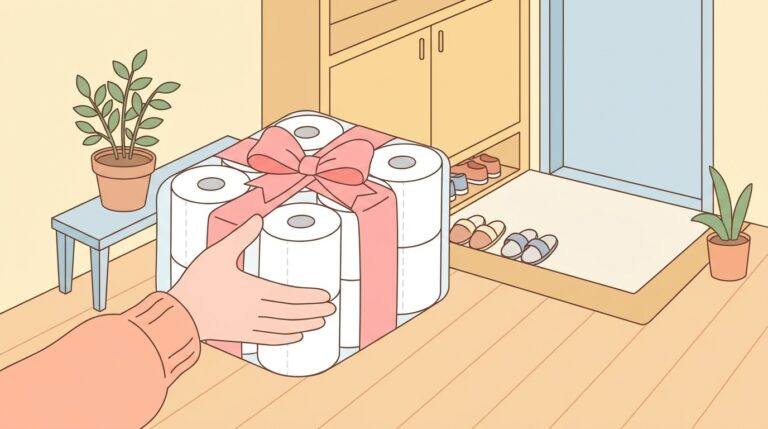
Housewarming Magic: Why Koreans Gift Toilet Paper at a ‘Jipdeuri’ (집들이)
Phase 1: Empathy (A Story-Driven Opening)
안녕하세요! (Annyeonghaseyo!) Welcome back to Daily Hangul, your premium guide to the beautiful nuances of Korean language and culture. I’m your Chief Editor and your trusty local navigator.
Imagine this scenario: Your close Korean friend, Minjun, has finally moved into a cozy new studio apartment in the trendy neighborhood of Mapo, Seoul. Excitedly, he invites you to his 집들이 (jipdeuri – housewarming party). You want to be a stellar guest, so you head to a local supermarket to find a gift. You pass by luxurious wines, beautifully packaged teas, and fancy scented candles. But then, you spot a local Korean shopper walking out proudly with a massive, 30-roll pack of… toilet paper wrapped in a shiny ribbon.
Wait, what? Toilet paper as a housewarming gift?
If you come from a culture where gifting bathroom supplies is seen as a lazy, last-minute supermarket run, this might shock you. But in Korea, handing over a giant pack of toilet paper is actually one of the most thoughtful, culturally brilliant blessings you can offer. If you know the linguistic secret behind this gift, your Korean friends will look at you with eyes wide with admiration and say, “Wow, you are a total 인싸 (inssa – insider)!”
This guide was built from real-world questions asked by our intermediate students who survived their first Korean housewarming parties. Let’s dive deep into the beautiful language and heartwarming customs of Korean home visits so you can ace your next invite!
Phase 2: Core Expressions Deep Dive
To speak like a local, you need to understand not just the words, but the cultural DNA attached to them. Let’s analyze three essential expressions for visiting a Korean home.
1. 집들이 (Jip-deu-ri)
- Pronunciation: [jip-deu-ri] / Sound-alike: “jeep-dew-ree” (Pronounce the ‘d’ and ‘r’ smoothly together)
- Meaning: Literal: “Home-entering” | Real-world Nuance: A housewarming party where friends, family, or colleagues are invited to celebrate a new home.
- K-Culture Moment: In K-Dramas like Because This Is My First Life, you often see roommates or newlyweds frantically cleaning their living room and preparing a massive feast of K-food (like Bulgogi and Japchae) right before their friends ring the doorbell for a chaotic, fun-filled jipdeuri.
- Editor’s Insight: A jipdeuri is not a passive “drop-by-and-leave” event. It’s an active sharing of warmth. The host feeds you until you can barely walk, and in return, you bring energy, laughter, and blessings to fill the empty space.
- Situation Spectrum:
- Friends & Casual: ✅
- Co-workers & Semi-formal: ✅
- Bosses & Formal: ✅
- 🤔 Think About It: In many Western countries, housewarming parties are casual, bring-your-own-beer events. Why do you think Korean jipdeuri hosts put so much effort into preparing a massive home-cooked feast for their guests? How does this reflect the concept of collective community?
2. 풀리다 (Pul-li-da)
- Pronunciation: [pul-li-da] / Sound-alike: “pool-lee-dah” (Make sure to double the ‘l’ sound for a crisp pronunciation)
- Meaning: Literal: To untie, to unroll, or to unravel | Real-world Nuance: For problems to be solved smoothly, or for life to work out easily without hitches.
- K-Culture Moment: This word is the entire reason why toilet paper is gifted! Just as toilet paper unrolls effortlessly from its roll, Koreans wish that all your life’s problems will “unravel” just as smoothly.
- Editor’s Insight: This is a beautiful linguistic pun. By gifting toilet paper, you are physically saying, “May your life unroll easily!”
- Situation Spectrum:
- Friends & Casual: ✅
- Co-workers & Semi-formal: ✅
- Bosses & Formal: ⚠️ (The pun is fine, but use a polite sentence structure when explaining it!)
- 🤔 Think About It: How does your native language use metaphors of physical movement (like “unrolling” or “unraveling”) to describe luck or success?
3. 대박 나다 (Daebak na-da)
- Pronunciation: [dae-bak na-da] / Sound-alike: “day-back nah-dah”
- Meaning: Literal: A great gourd bursts open (historically bringing wealth) | Real-world Nuance: To hit the jackpot, to become extremely successful, or to hit it big.
- K-Culture Moment: You hear this constantly in K-Pop when fans wish their favorite idols a successful album release (“이번 앨범 대박 나자!”). At a jipdeuri, you wish this for your friend’s new chapter of life in their new home.
- Editor’s Insight: While originally slang, “대박” is now widely accepted in daily life. Saying “새 집에서 대박 나세요!” (Hit the jackpot in your new home!) is a highly energetic and positive blessing.
- Situation Spectrum:
- Friends & Casual: ✅
- Co-workers & Semi-formal: ✅
- Bosses & Formal: ⚠️ (For strict formal settings, “번창하세요” – be prosperous – is safer, but “대박 나세요” is widely used in warm semi-formal settings too!)
- 🤔 Think About It: Why does modern Korean culture embrace highly energetic and direct slang like “대박” even in blessings, compared to traditional, reserved idioms?
Phase 3: Textbook Korean vs. Real Korean
When you study with a textbook, you learn grammatically perfect but incredibly stiff sentences. Here is how to swap those textbook phrases for natural, warm expressions that real Koreans use.
Situation 1: Asking what to bring to the party
- 📖 Textbook Korean: “집들이 선물로 무엇이 필요합니까?” (Jipdeuri seonmullo mueosi piryohamnikka?) – “What is required as a housewarming gift?”
- 🗣️ Real Korean: “나 갈 때 뭐 사 갈까?” (Na gal ttae mwo sa galkka?) – “What should I buy/bring when I come over?”
- 💡 Why the difference? The textbook version sounds like an official survey. In real friendships, Koreans prefer a warm, casual offer. Using “사 가다” (to buy and go) sounds natural and proactive.
Situation 2: Handing over the toilet paper with a blessing
- 📖 Textbook Korean: “이것은 당신을 위한 집들이 선물입니다.” (Igeoseun dangsineul wihan jipdeuri seonmul-imnida.) – “This is a housewarming gift for you.”
- 🗣️ Real Korean: “휴지처럼 모든 일 다~ 잘 풀려라!” (Hyuji-cheoreom modeun il da~ jal pullyeora!) – “Just like this toilet paper, may everything unravel super smoothly!”
- 💡 Why the difference? Simply saying “here is a gift” misses the entire cultural charm of the toilet paper! Saying “잘 풀려라” adds wit, warmth, and shows that you truly understand Korean culture.
Phase 4: K-Culture Deep Dive & Non-Verbal Manners
To truly connect with Koreans, you must master the silent language of respect and the cultural codes behind their habits.
4-1. Nunchi (눈치) & Non-Verbal Tips
- The Shoes-Off Protocol: This is non-negotiable. As soon as you step into the 현관 (hyeongwan – entryway), step out of your shoes. Make sure your socks are clean and do not have holes! Point your shoes toward the door as a polite gesture.
- The Two-Handed Handover (두 손 사용하기): Even if you are handing over a massive, light pack of toilet paper, use both hands. Using one hand can look dismissive, whereas using two hands signals: “I am giving this to you with my full heart and respect.”
4-2. The Cultural Code: Why Bubbles and Rolls?
Historically, moving into a new home in Korea was a vulnerable transition. People believed in evil spirits (액운) that could bring bad luck. Thus, gifts were selected to symbolically protect the home.
* Laundry Detergent (세제 – Seje): Along with toilet paper, this is the most popular gift. Why? Because detergent creates lots of bubbles. In Korean folklore, bubbles symbolize growing wealth and prosperity multiplying quickly (거품처럼 돈이 늘어나다).
Phase 5: The Mapo Studio Housewarming (Interactive Roleplay)
Let’s test your social instincts! You are standing outside Minjun’s door. You can hear the muffled sound of music and laughing inside. You are carrying a 30-roll pack of premium toilet paper with a pink ribbon on it.
Cast:
- You (The Cultured Guest): Eager to show off your intermediate Korean skills.
- Minjun (The Excited Host): Proud of his new place, busy hosting.
[Doorbell rings. The door swings open, revealing a beaming Minjun.]

Minjun: 🎭 (With a huge grin, waving his hands)
"어! 왔어? 어서 와! 진짜 반갑다!"
(Oh! You're here? Come on in! So glad to see you!)

You: 🎭 (Smiling warmly, stepping into the entryway)
"초대해 줘서 고마워, 민준아! 집 진짜 좋다!"
(Thanks for inviting me, Minjun! Your place is so nice!)

Minjun: 🎭 (Modestly waving his hand, pointing inside)
"아냐, 아직 정리가 안 돼서 좁아. 얼른 들어와. 신발은 그냥 거기 두면 돼!"
(No, it's cramped because I haven't finished organizing yet. Come on in. You can just leave your shoes there!)
🔀 Decision Point!
Now you are about to hand him the giant package of toilet paper. What do you do?
- Option A: Drop the toilet paper on the floor, kick your shoes off carelessly, and say: “여기, 화장실용 종이.” (Yeogi, hwajangsil-yong jong-i. – Here, paper for toilet use.)
- Option B: Hold the pack with both hands, bow slightly, smile, and say: “민준아! 새 집에서 대박 나고, 휴지처럼 모든 일 다~ 잘 풀려라!” (Minjuna! Sae jib-eseo daebak nago, hyuji-cheoreom modeun il da~ jal pullyeora!)
- Option C: Hide the toilet paper behind your back because you suddenly feel embarrassed about gifting bathroom supplies in public.
💡 Choices Analyzed:
- If you chose Option A: Oh dear! Calling it “화장실용 종이” (paper for toilet use) sounds clinical and awkward. Kicking your shoes off carelessly also hurts your 눈치 (social points).
- If you chose Option B (Best Choice): Absolutely flawless! You used both hands, delivered a brilliant linguistic pun, wished him prosperity (대박), and showed genuine cultural respect. Minjun will probably brag about you to his other friends all night!
- If you chose Option C: Don’t be shy! Giving toilet paper is a proud Korean tradition. Hiding it makes the atmosphere awkward.
Phase 6: 10-Second Shadowing Drill
Let’s inject some genuine Korean emotion into your speech! Practice saying these phrases with the correct emotional rhythm. The slashes / indicate brief pauses.
- [😊 Filled with warm wishes and excitement]
“휴지처럼 / 모든 일 다~ / 잘 풀려라!”
(Hyuji-cheoreom / modeun il da~ / jal pullyeora!)
“Just like this toilet paper, may everything unravel super smoothly!” -
[🤩 Full of genuine awe and compliment]
“우와, / 집 진짜 좋다! / 인테리어 대박인데?”
(Uwa, / jip jinjja jota! / interi-eo daebak-inde?)
“Wow, your place is amazing! The interior design is absolutely killer!”
Phase 7: K-Culture Mini Dictionary
| Word (Korean/Romanized) | Translation | Cultural Context & Usage |
|---|---|---|
| 집들이 (Jipdeuri) | Housewarming Party | Not just a party; it’s a blessing ceremony for friends to fill the new home with laughter and warm energy. |
| 정 (Jeong) | Deep Affection / Bond | The invisible social glue of Korea. Preparing tons of food for guests and bringing practical, symbolic gifts is the ultimate expression of Jeong. |
| 두루마리 휴지 (Durumari Hyuji) | Roll of Toilet Paper | Literally “rolling paper.” It must be the roll type, not facial tissues, so that it can symbolically “unroll” easily. |
| 액막이 (Aegmagi) | Warding off bad luck | Traditional acts or gifts meant to keep bad spirits out of a newly established household. |
Phase 8: Traveler’s Survival Kit
Even if you aren’t attending a housewarming party today, keep these three survival phrases handy for any home visit in Korea!
Survival Cards
- Card 1: Entering the house
- Korean: “실례합니다” (Sillyehamnida)
- English: “Excuse me (for entering your space)”
- Pro Tip: Say this softly as you cross the threshold of the front door.
- Card 2: Before eating the feast
- Korean: “잘 먹겠습니다!” (Jal meokgetseumnida!)
- English: “I will eat well! / Thank you for the meal!”
- Pro Tip: Raise your spoon slightly and say this with energy to show appreciation for the host’s hard work in the kitchen.
- Card 3: Thanking the host
- Korean: “오늘 초대해 줘서 진짜 고마워.” (Oneul chodaehae jwoseo jinjja gomawo.)
- English: “Thank you so much for inviting me today.”
- Pro Tip: Say this right before you put your shoes back on at the end of the night.
📌 Editor’s Travel Note:
If you are navigating to a friend’s new apartment complex in Korea, Google Maps often gets lost. Download the Naver Map App Download Page or Kakao Maps ahead of time. These local apps will guide you directly to the exact building and entrance number! (Note: App features may update periodically).
Phase 9: One Step Deeper — “The Warmth of Practical Blessings”
Historically, Korean housewarmings involved gifting matches (성냥) or candles (양초). These represented fire, wishing that the household’s fortune would spread rapidly like wildfire. As Korea modernized and urbanized in the mid-20th century, practical items like toilet paper and powdered laundry detergent replaced matches.
What makes this beautiful is the seamless blend of ancient shamanistic blessings with high-density apartment life practicality. Korea is a culture that values high utility and emotional sincerity (정). Gifting something that the host will absolutely use daily, combined with a witty wish for their life to go smoothly, shows the genius of Korean socialization. It’s not about how expensive the gift is; it is about how deeply you care for their daily well-being.
💬 Your Turn: How do people in your country celebrate a new home? Do you give symbolic gifts, or is it more about aesthetic home decor? Let us know in the comments below!
Phase 10: FAQ & Avoiding Mistakes (FAQ Schema Optimized)
Q: Can I buy tissues in a box (각티슈) instead of rolled toilet paper (두루마리 휴지)?
A: It depends, but rolled toilet paper is highly preferred. While tissue boxes are practical, they don’t “unroll” continuously. The linguistic pun of things “unraveling smoothly” relies specifically on the roll shape of durumari hyuji.
Q: Is it rude to ask the host directly what they need?
A: Not at all! In fact, close friends often send a KakaoTalk message asking, “Is there anything you need?” Modern Koreans might ask for specific coffee capsules, scented candles, or even trash bags. However, if you want to play it safe and traditional, toilet paper is the timeless classic.
Q: Should I wrap the toilet paper pack in wrapping paper?
A: No, it’s not necessary. Most Koreans carry the plastic bundle of rolls as-is. If you want to make it look cute, you can tie a simple ribbon around the plastic handle. It’s meant to be a raw, practical, and highly friendly gesture!
🚨 Common Mistakes Warning Board
- Walking in with your shoes on: This is the ultimate social disaster. Even if the host says “Oh, it’s fine!”, they don’t mean it. Take them off!
- Bringing a gift that is too expensive: Bringing luxury home decor can actually burden the host, as they will feel pressured to give you an equally expensive gift later. Keep it practical.
- Arriving completely empty-handed (빈손): In Korea, arriving “with empty hands” (빈손으로 가다) is seen as lacking affection and manners. Always bring at least a small drink set or toilet paper!
Phase 11: Action Missions
Put your learning into action with these fun challenges!
- 🥉 Bronze (The Mirror Challenge): Stand in front of a mirror and practice saying the blessing: “휴지처럼 모든 일 다~ 잘 풀려라!” three times with a bright, warm smile.
- 🥈 Silver (The Social Media Challenge): Take a photo of a roll of toilet paper at home and post it on your Instagram Stories with the hashtag #잘풀려라 (May it go smoothly) to wish your followers a great week.
- 🥇 Gold (The Real-World Mission): The next time you visit a Korean friend’s home (or even your local friend’s new place), bring a pack of toilet paper with a ribbon on it and confidently explain the cultural meaning in Korean!
Phase 12: Interactive Quiz Challenge
Test your knowledge of Korean housewarming culture!
1. Why is toilet paper gifted at a housewarming party (집들이)?
👉 Click to reveal the answer and explanation!
Answer: Because of the verb 풀리다 (to unravel/unroll). Just like toilet paper unrolls smoothly from the roll, the gift symbolizes the wish that all of the host’s life problems and plans will unravel smoothly and successfully!
2. True or False: You should always use only one hand to hand over a gift to make it look casual.
👉 Click to reveal the answer!
Answer: False! In Korea, handing things over with both hands (두 손) is a crucial non-verbal sign of respect and sincerity. Even a bundle of toilet paper should be offered with both hands!
3. Complete the dialogue: “새 집에서 ______ 나세요!” (May you hit the jackpot in your new home!)
👉 Click to reveal the answer!
Answer: 대박 (Daebak). The full natural phrase is: “새 집에서 대박 나세요!”
See you in the next lesson of Daily Hangul! 항상 응원합니다 (We are always rooting for you)!







