

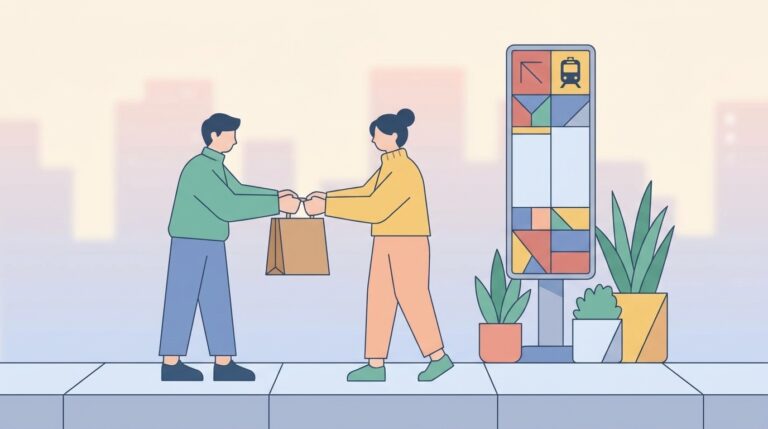
Watch Out for Bricks! How to Master Korean Secondhand Markets Without Getting Scammed
Phase 1: Empathy (스토리 몰입형 오프닝)
안녕하세요! (Annyeonghaseyo!) Hello! It’s your trusty Korean friend and Senior Editor of Daily Hangul.
Imagine this scene from a classic K-Drama: You are sitting in a cozy Seoul cafe, sipping an iced Americano (아아 – A-A). Your heart beats fast because you just found the deal of a lifetime online—a pristine, sold-out vintage leather jacket just like the one Gong Yoo wore, or perhaps that ultra-rare K-Pop photocard you’ve been hunting for months. The seller on Joonggonara (중고나라) asks you to wire the money first, promising to send it via express delivery. You pay, wait by the mailbox for days, and finally, a heavy package arrives! You tear it open, only to find… a literal clay brick (벽돌).
Yes, the infamous “Byeokdol Sagi” (벽돌 사기 – Brick Scam) is one of Korea’s oldest running internet jokes and a painful reality for careless buyers. In Korea’s bustling secondhand market, scamming is rare due to high public safety, but when it happens, getting a brick instead of your item is the ultimate symbol of being tricked.
Learning how to navigate these transactions in natural Korean won’t just save your wallet; it will also make you look like a seasoned local who knows the system. Let’s make sure you never end up with a very expensive building material!
Phase 2: Core Expressions Deep Dive (핵심 표현 3선 심층 분석)
Let’s look at the three most crucial protective terms you need when trading secondhand in Korea.
1. 직거래 (Jik-georae)
- Pronunciation: [Jik-geo-rae] / Sounds like: “Jeek-gaw-ray”
- Meaning: Face-to-face transaction / Direct trade.
- K-Culture Moment: This is the heart of Karrot Market (당근마켓), Korea’s hyper-local neighborhood trading app. You meet the seller near a subway exit (usually exit 11 of any station!) to check the item before handing over cash.
- Editor’s Insight: If a seller absolutely refuses Jik-georae even though you offer to go to their neighborhood, treat this as a massive red flag (빨간 불 – ppal-gan bul)!
- Situation Spectrum:
- Casual (Friends/Subway meetings): ✅
- Semi-formal (Business/Polite strangers): ✅
- Formal (Elderly sellers): ✅ (Always polite and universally used!)
- 🤔 Think About It: Why do you think face-to-face trading is so incredibly popular in Korea compared to shipping? (Hint: Think about Korea’s high population density and the safety of public spaces!)
2. 안전결제 (Anjeon-gyeolje)
- Pronunciation: [An-jeon-gyeol-je] / Sounds like: “Ahnd-juhn-gyuhl-jay”
- Meaning: Escrow service / Safe payment system.
- K-Culture Moment: In K-Dramas about young adults trying to save money, you often see characters insisting on using official platforms to hold their money until they verify the package.
- Editor’s Insight: Scammers hate this. They will try to send you a fake link that looks exactly like the official escrow site. Always use the built-in system of the app (like Naver Pay or Karrot Pay) and never click external links!
- Situation Spectrum:
- Casual: ✅
- Semi-formal: ✅
- Formal: ✅
- 🤔 Think About It: In Korean culture, insisting on Anjeon-gyeolje can sometimes make old-school sellers feel like you don’t trust them. How do we balance safety with Korean politeness? (We will learn this below!)
3. 택배거래 (Taekbae-georae)
- Pronunciation: [Taek-bae-geo-rae] / Sounds like: “Tek-beh-gaw-ray”
- Meaning: Delivery/Shipping transaction.
- K-Culture Moment: Korea’s delivery system (Taekbae) is unbelievably fast, often arriving overnight. This makes shipping trades tempting, but it is also where 90% of scams happen.
- Editor’s Insight: When doing a Taekbae-georae, always ask for a photo of the item next to a handwritten note containing today’s date and your phone number to prove they actually have it.
- Situation Spectrum:
- Casual: ✅
- Semi-formal: ✅
- Formal: ✅
Phase 3: Textbook Korean vs. Real Korean (교과서 한국어 vs 진짜 한국어)
When trading online, textbook phrases can sound too mechanical or even suspicious. Let’s look at how native Koreans actually negotiate to ensure safety.
Situation 1: Suggesting a Direct Meetup
- 📖 Textbook Korean: “나는 당신을 직접 만나서 물건을 받고 싶습니다.” (I want to meet you in person to receive the item.)
- Why it’s awkward: It sounds like an interrogation or a translated movie script!
- 🗣️ Real Korean: “혹시 직거래 가능할까요? 제가 그쪽 동네로 갈게요!” (Is direct trade possible, by any chance? I can go to your neighborhood!)
- Why it works: Saying you will go to their neighborhood (그쪽 동네 – geu-jjok dong-nae) shows high courtesy and increases the chance they will agree to meet in person.
Situation 2: Asking for Safe Payment When They Want Direct Wire
- 📖 Textbook Korean: “당신을 믿지 못하니 안전결제를 해주십시오.” (I don’t trust you, so please do safe payment.)
- Why it’s awkward: Super blunt! It actively accuses the seller of being a liar.
- 🗣️ Real Korean: “제가 사기 피해 경험이 있어서 그런데, 안전결제 부탁드려도 될까요? 수수료는 제가 낼게요!” (I have experienced scamming before, so could I please request safe payment? I will pay the transaction fee!)
- Why it works: By blaming a past “bad experience” and offering to cover the platform fee (수수료 – su-su-ryo), you save the seller’s pride while keeping yourself 100% safe.
Phase 4: K-Culture Deep Dive & Non-verbal Manners (비언어적 매너)
4-1. The Art of the “Subway Exit Bow” (직거래의 비언어적 매너)
When meeting a stranger for a Jik-georae at a subway station, Koreans use specific non-verbal cues to identify each other:
1. The Phone Clutch: Walk slowly holding your phone screen-up, looking slightly lost. This is the universal sign of a secondhand trader.
2. The Polite Greeting: When you lock eyes, do a gentle 15-degree bow and say “혹시… 당근?” (Are you… Karrot?) with a soft smile.
3. The Unboxing Check: It is not rude to open the box and check the item right in front of them! In fact, sellers expect you to do a quick inspection. Simply say, “잠시 확인만 해볼게요!” (Let me just check it quickly!).
4-2. The “Manner Temperature” (매너온도)
On the Karrot Market app, every user starts with a “Manner Temperature” of 36.5°C (human body temperature). If they are nice, receive good reviews, and don’t scam, their temperature goes up. If someone with a temperature of 31°C tries to sell you an expensive iPhone through delivery only… run away!
Phase 5: Interactive Roleplay Scenario (실전 롤플레이)
Setting: It’s 7:00 PM on a chilly Friday. You are trying to buy a rare K-Pop lightstick for an upcoming concert. You are messaging a seller named Minho (민호) on an app. Minho’s profile looks a bit rushed.
Cast:
- You (The Smart Buyer)
- Minho (민호 – The Seller)
1. 민호: "응원봉 아직 안 팔렸어요. 바로 사실 건가요?"
   (Eung-won-bong a-jik an pal-lyeot-seo-yo. Ba-ro sa-sil geon-ga-yo?)
   🎭 [Impatiently] "The lightstick is still available. Are you buying right away?"

2. You: "네! 정말 사고 싶었어요. 혹시 홍대입구역에서 직거래 가능할까요?"
   (Ne! Jeong-mal sa-go sip-eot-seo-yo. Hok-si Hong-dae-ip-gu-yeok-e-seo jik-georae ga-neung-hal-kka-yo?)
   🎭 [Politely but firmly] "Yes! I really wanted to buy it. Is direct trade possible at Hongdae Station by any chance?"

3. 민호: "아, 제가 오늘 야근이라 직거래는 힘들 것 같아요. 택배로 보내드릴게요."
   (Ah, je-ga o-neul ya-geun-i-ra jik-georae-neun him-deul geot gat-a-yo. Taek-bae-ro bo-nae-deu-ril-ge-yo.)
   🎭 [Making excuses] "Ah, I have to work late tonight, so direct trade might be difficult. I'll send it via delivery."

4. You: "아쉽네요... 그럼 혹시 안전결제는 가능하신가요?"
   (A-swip-ne-yo... Geu-reom hok-si an-jeon-gyeol-je-neun ga-neung-ha-sin-ga-yo?)
   🎭 [Proposing safety] "That's a pity... Then is safe payment possible, perhaps?"

5. 민호: "수수료 아까운데 그냥 제 계좌로 입금해주세요. 사기 아니에요~ ㅎㅎ"
   (Su-su-ryo a-kka-un-de geu-nyang je gye-jwa-ro ip-geum-hae-ju-se-yo. Sa-gi a-ni-e-yo~ haha)
   🎭 [Dismissive] "The transaction fee is a waste, just wire it to my account. It's not a scam~ haha"

6. You: "죄송하지만 제가 예전에 벽돌 사기를 당한 적이 있어서요... 번거로우시겠지만 안전결제 부탁드립니다!"
   (Joe-song-ha-ji-man je-ga ye-jeon-e byeok-dol sa-gi-reul dang-han jeok-i is-seo-seo-yo... Beon-geo-rou-si-get-ji-man an-jeon-gyeol-je bu-tak-deu-rip-ni-da!)
   🎭 [Using a white lie for defense] "I'm sorry, but I have been scammed with a brick before... I know it’s a hassle, but I kindly request safe payment!"

7. 민호: "에이, 까다로우시네. 그럼 제가 링크 보내드릴 테니까 여기서 결제하세요. [LINK]"
   (Ei, kka-da-rou-si-ne. Geu-reom je-ga ring-keu bo-nae-dril te-ni-kka yeo-gi-seo gyeol-je-ha-se-yo.)
   🎭 [Sending an external link] "Gosh, you are demanding. Okay, I'll send you a link, so pay here. [LINK]"
🔀 Decision Point!
What should you do now?
* A: Trust him and click the link to pay immediately. It looks like Naver Pay!
* B: Refuse to click the link, report the user on the app, and say: “외부 링크는 사용하지 않습니다.” (I do not use external links.)
* C: Ask him if you can meet his friend instead for a direct trade.
Best Choice: B
Never, ever click links sent by sellers. Official safe payments are handled directly within the app’s chat screen or payment system. External links are almost always phishing sites designed to steal your bank details. Saying “외부 링크는 불안해서 어플 내 결제만 진행할게요” (I’m nervous about external links, so I will only pay within the app) is the perfect B1-level defense!
Phase 6: 10-Second Emotion Shadowing Drill (10초 감정 섀도잉)
Let’s practice speaking like a native with real emotions! Pay attention to the pauses (/).
- [🥺 Disappointed & Pleading]
- “혹시 / 오늘 / 직거래는 / 진짜 안 될까요?”
- Hok-si / o-neul / jik-georae-neun / jin-jja an-doel-kka-yo?
- “Is direct trade / today / really not possible / by any chance?”
- [😤 Polite but Firmly Safe]
- “외부 링크는 / 안 해요. / 어플로 / 결제할게요.”
- Oep-u ring-keu-neun / an hae-yo. / Eo-peul-lo / gyeol-je-hal-ge-yo.
- “External links / I don’t do. / Through the app / I will pay.”
Phase 7: K-Culture Mini Dictionary (K-Culture 미니 사전)
| Word (Korean/Roman) | Meaning | Real-World Context |
|---|---|---|
| 벽돌사기 (Byeokdol-sagi) | Brick Scam | Receiving trash/bricks instead of the purchased items via shipping. |
| 먹튀 (Meok-twi) | Eat and Run | Short for “먹고 튀다” (eat and run). Used when someone takes your deposit money and disappears. |
| 매너온도 (Maeneor-ondo) | Manner Temp | The rating system in Karrot Market; higher means more trustworthy. |
| 네고 (Nego) | Negotiation | Short for “negotiation.” Asking for a price drop: “네고 되나요?” (Can I get a discount?) |
Phase 8: Traveler’s Survival Kit (여행자를 위한 생존 키트)
If you are visiting Korea and want to buy rare items (like cheap concert tickets or vintage clothing) locally, keep these in your pocket!
Survival Cards
- “실물 사진 좀 보여주실 수 있나요?”
- Sil-mul sa-jin jom bo-yeo-ju-sil su in-na-yo?
- Pro Tip: Ask this to make sure they actually own the item and aren’t using stolen internet photos.
- “선입금은 어렵습니다.”
- Seon-ip-geum-eun eo-ryeop-seup-ni-da.
- Pro Tip: “Advance payment is difficult.” Use this if they pressure you to send money before meeting.
- “사기조회 해봤습니다.”
- Sa-gi-jo-hoe hae-bwat-seup-ni-da.
- Pro Tip: “I have searched the scam database.” In Korea, you can search phone numbers on The Cheat (더치트) to see scam history.
Phase 9: Deep Thoughts — “One Step Deeper” (한 발 더 깊이)
In South Korea, you will often notice a strange paradox. People leave $2,000 MacBooks on cafe tables while they go to the restroom for an hour without any fear of theft. Yet, when it comes to online secondhand transactions, scams still occur. Why?
Physical spaces in Korea are heavily monitored by high-definition CCTVs, and public trust is exceptionally high. However, the internet offers a shield of anonymity. The “Brick Scam” became a cultural phenomenon because it represents the ultimate breakdown of this physical trust online. By insisting on Jik-georae (meeting in person), Koreans are simply bringing online transactions back into the safe, physical world they trust so deeply.
💬 Your Turn: How do people trade secondhand items in your country? Do you meet in public, or is shipping more common? Have you ever heard of someone getting a “brick”? Let us know in the comments!
Phase 10: FAQ & Common Mistakes (자주 묻는 질문)
Q: Can foreigners use Korean secondhand apps like Karrot Market?
A: Yes, but with a catch. You need a working Korean phone number (for SMS verification) to sign up. If you are a traveler with a data-only SIM, you may need to ask a local friend to help you make contact.
Q: What is the safest public spot for direct trades?
A: Subway station exit gates. You don’t even have to tap your transit card out of the station; you can literally trade across the turnstiles!
Q: What should I do if the seller insists on KakaoTalk (카카오톡) chat instead of the app?
A: Say no. Scammers try to move you off the official platform to KakaoTalk so their accounts don’t get banned on the app. Stay on the app!
🚨 The Top 3 Rookie Mistakes to Avoid:
- Paying with gift cards (상품권): If a seller asks for culture vouchers or Google Play cards instead of bank transfers, it is 100% a scam.
- Trusting screenshots: Scammers easily photoshop fake delivery receipts. Verify everything live.
- Not checking ‘The Cheat’: Always run the seller’s account number through Korea’s anti-scam database before transferring any cash.
Phase 11: Action Missions (액션 미션)
- 🥉 Bronze: Look up “당근마켓” (Karrot Market) on Google Play or App Store and explore how the “Manner Temperature” system works.
- 🥈 Silver: Practice saying this out loud with confidence: “직거래 희망합니다. 번개페이 가능할까요?” (I wish to do direct trade. Is Bungae Pay [safe pay] possible?)
- 🥇 Gold: The next time you watch a modern K-Drama, spot the moment characters use a secondhand app or meet someone on the street holding a paper bag—that is a Jik-georae in action!
Phase 12: Interactive Quiz Challenge (인터랙티브 퀴즈)
1. Which payment method is the SAFEST online when you cannot meet in person?
- A) Direct Bank Transfer (계좌이체)
- B) Safe Payment / Escrow (안전결제)
- C) Sending cash in an envelope
Reveal Answer
Correct Answer: B
Safe Payment (안전결제) protects your money until you receive and verify the product. Never do direct bank transfers to strangers unless you absolutely trust them!
2. Fill in the blank:
“배송 중에 사기를 당하지 않으려면, 직접 만나서 거래하는 __________(을/를) 해야 합니다.”
Reveal Answer
Correct Answer: 직거래 (Direct / Face-to-face trade)







