

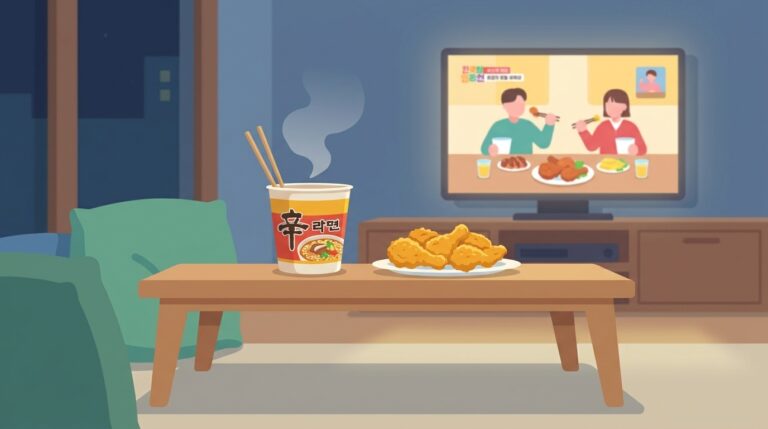
Craving Late-Night Snacks? Learn the Real Korean of Mukbang Culture!
안녕하세요! (An-nyeong-ha-se-yo!) I’m your lead editor at Daily Hangul, your friendly neighborhood Korean tutor and local culture navigator.
Have you ever found yourself scrolling through YouTube at midnight, watching someone devour a steaming bowl of spicy Ramyun or a plate of golden, crispy fried chicken? Before you know it, you are staring at your fridge, your stomach rumbling.
This is the magic—and the trap!—of Mukbang (먹방), Korea’s famous eating shows. But when you want to join the live chat or talk to your Korean friends about these delicious late-night cravings, textbook Korean like “음식을 먹고 싶습니다” (I want to eat food) sounds a bit too robotic.
Today, we will dive into the delicious world of Yashik (야식 – late-night snacks) and learn the exact words real Koreans use when their mouths start watering. By the end of this guide, you will sound like a true Korean insider next time you watch a Mukbang!
Phase 2: 3 Key Expressions to Say When You are Hungry
Let’s look at three essential expressions that every Korean speaker uses when they see delicious food late at night.
1. 배고파 죽겠어! (Bae-go-pa juk-get-seo!)
- Pronunciation: Bae-go-pa jook-get-suh (Sounds like “Bae” + “go” + “pa” + “jook” + “get” + “suh”)
- Meaning: “I’m starving to death!” / “I am dying of hunger!”
- K-Culture Moment: You will hear this in almost every K-Drama when characters come home after a long, stressful day at work and immediately collapse onto the sofa.
- Editor’s Insight: Don’t worry, you aren’t actually dying! Koreans use the word “죽겠어” (juk-get-seo – I will die/It is killing me) to add dramatic emphasis to any feeling—like being tired, hot, or, in this case, hungry.
- Situation Spectrum:
- Friends & Close relationships: ✅ (Perfect!)
- Co-workers (Semi-formal): ⚠️ (Use “배고파요” instead)
- Bosses & Elders (Formal): 🚫 (Too casual)
- 🤔 Think About It: Why do you think Korean culture uses such dramatic expressions for daily physical feelings? Does your native language have a dramatic way of saying “I’m hungry”?
2. 군침 도네 (Gunchim do-ne)
- Pronunciation: Goon-chim doh-neh (Sounds like “Goon” + “chim” + “doh” + “neh”)
- Meaning: “My mouth is watering!”
- K-Culture Moment: This is the ultimate comment to type in a Mukbang live stream chat when the creator takes that first, crunchy bite of fried chicken.
- Editor’s Insight: “군침” (gunchim) means extra saliva that forms when you see tasty food. Adding “네” (ne) at the end shows you are realizing something in the moment. It’s perfect for reacting to food visuals!
- Situation Spectrum:
- Friends & Close relationships: ✅ (Very natural)
- Co-workers (Semi-formal): ✅ (With polite ending: “군침 도네요”)
- Bosses & Elders (Formal): ⚠️ (Only if you are sharing a meal together)
3. 야식 당긴다! (Yashik dang-gin-da!)
- Pronunciation: Ya-shik dang-gin-da (Sounds like “Ya” + “shik” + “dang” + “gin” + “da”)
- Meaning: “I’m totally craving a late-night snack!”
- K-Culture Moment: Picture a Friday night in Seoul. You and your friends are watching a movie, and suddenly someone looks up and says this phrase. It is the universal signal to open the food delivery app!
- Editor’s Insight: “당기다” (dang-gi-da) literally means “to pull.” So, “야식 당긴다” means the late-night snacks are literally pulling your heart and stomach toward them!
- Situation Spectrum:
- Friends & Close relationships: ✅ (Most common)
- Co-workers (Semi-formal): ✅ (Use “야식 당기네요” with a smile)
- Bosses & Elders (Formal): 🚫 (Too informal)
Phase 3: Textbook Korean vs. Real Korean
Let’s see how school-style Korean compares to what people actually say in the streets of Seoul!
Situation 1: Expressing your late-night hunger
- 📖 Textbook Korean: “밤늦게 음식을 먹고 싶습니다.” (Bam-neut-ge eum-shig-eul meog-go ship-seub-ni-da.) – “I want to eat food late at night.”
- 🗣️ Real Korean: “야식 당기는데 치맥 고?” (Ya-shik dang-gi-neun-de chi-maek go?) – “I’m craving a late-night snack. Chicken and beer, shall we go?”
- 💡 Why is it different? Koreans love efficiency and rhythm. Instead of long sentences, they combine words like Chicken and Maekju (beer) into “치맥” (Chimaek) and use the English word “Go” (고?) to suggest an action.
Situation 2: Looking at a delicious Mukbang screen
- 📖 Textbook Korean: “이 음식이 아주 맛있어 보입니다.” (I eum-shig-i a-ju ma-shis-seo bo-im-ni-da.) – “This food looks very delicious.”
- 🗣️ Real Korean: “비주얼 대박이다!” (Bi-ju-eol dae-bag-i-da!) – “The visual is amazing/awesome!”
- 💡 Why is it different? The word “비주얼” (visual) is widely used to describe how beautiful food looks. “대박” (daebak) means jackpot or awesome, which immediately shows your excitement.
Phase 4: K-Culture Deep Dive & Non-verbal Manners
4-1. The Sound of Deliciousness: Slurping
In many Western cultures, making loud noises while eating is considered impolite. But in Korea, especially when eating noodles (Ramyun, Jajangmyeon, or Naengmyeon), slurping loudly is a sign of appreciation! It shows the cook that the food is so delicious you can’t wait to eat it. In Mukbang, this sound is amplified to give viewers a satisfying sensory experience.
4-2. Why is Mukbang so Popular in Korea?
Korea is historically a communal eating society. Historically, eating was a social event shared with family or neighbors. Today, with more people living alone (known as the “Hon-bap” or solo-dining generation), watching Mukbang provides a sense of connection. It offers 대리만족 (dae-ri-man-jok)—vicarious satisfaction. If you are on a diet, watching someone else eat a giant plate of noodles can strangely make you feel full!
Phase 5: Late-Night Live Chat Roleplay
The Setting: It’s 11:30 PM. You and your Korean friend, Minjun, are sitting in your living room, watching a live Mukbang stream. The host is eating extra-spicy pork feet (족발 – jokbal).
Cast:
* You (A2 Korean learner who is starting to feel very hungry)
* Minjun (Your local friend, who is also a huge fan of late-night snacks)
Dialogue:
- Minjun: (Looking at the TV screen) 와, 저 족발 진짜 맛있겠다!
(Wow, jeo jok-bal jin-jja ma-shit-get-da!)
(Wow, that jokbal looks so good!) - You: (Rubbing your stomach) 그러게. 나 지금 배고파 죽겠어.
(Geu-reo-ge. Na ji-geum bae-go-pa juk-get-seo.)
(I agree. I’m starving to death right now.) - Minjun: (Laughing) 벌써 밤 11시 반인데? 야식 먹으면 안 돼!
(Beol-seo bam yeol-han-shi ban-in-de? Ya-shik meog-eu-myeon an dwae!)
(It’s already 11:30 PM! We shouldn’t eat late-night snacks!) - You: (Pointing at the screen) 하지만 저 붉은 양념을 봐. 군침 도네!
(Ha-ji-man jeo bulg-eun yang-nyeom-eul bwa. Gun-chim do-ne!)
(But look at that red sauce. My mouth is watering!) - Minjun: (Swallowing) 아… 진짜 비주얼 대박이다.
(Ah… jin-jja bi-ju-eol dae-bag-i-da.)
(Ah… the visual is truly amazing.) - You: (Looking hopeful) 민준아, 솔직히 너도 야식 당기지?
(Min-jun-ah, sol-jik-hi neo-do ya-shik dang-gi-ji?)
(Minjun, honestly, you are craving a late-night snack too, right?) - Minjun: (Nodding with a defeated smile) 응, 사실 치킨 너무 먹고 싶어.
(Eung, sa-shil chi-kin neo-mu meog-go shi-peo.)
(Yeah, honestly, I really want to eat chicken.) - You: (Clapping your hands) 그럼 지금 배달 앱 열까?
(Geu-reom ji-geum bae-dal aep yeol-kka?)
(Then shall we open the delivery app right now?) - Minjun: (Grabbing his phone) 역시 야식은 치킨이지! 반반으로 주문할까?
(Yeok-shi ya-shig-eun chi-kin-i-ji! Ban-ban-eu-ro ju-mun-hal-kka?)
(As expected, late-night snacks mean chicken! Shall we order half-and-half?) - You: (Smiling widely) 대박! 빨리 주문해 줘!
(Dae-bak! Ppal-li ju-mun-hae jwo!)
(Awesome! Please order quickly!)
🔀 Decision Point!
What should you say next to sound like a perfect Korean foodie?
- Choice A: “다이어트 해야 돼서 저는 안 먹을게요.” (I’m on a diet, so I won’t eat.)
- 👉 Editor’s Feedback: Oh no! This is a total vibe-killer! Late-night snacks are a team sport in Korea.
- Choice B: “치맥 고?” (Chimaek, go?)
- 👉 Editor’s Feedback: Excellent! Suggesting “Chimaek” (Chicken + Beer) will make Minjun look at you like you are a local genius!
- Choice C: “저는 치킨을 별로 안 좋아합니다.” (I don’t like chicken very much.)
- 👉 Editor’s Feedback: Too formal and a little cold. Even if you don’t like chicken, you can suggest pizza, ramyun, or tteokbokki instead!
Phase 6: 10-Second Emotion Shadowing Drill
Let’s practice speaking with real Korean emotion! Focus on the pauses (/) and follow the feeling.
- [🥺 Hungry & Whiny]
- 아… / 배고파 / 죽겠어!
- Ah… / bae-go-pa / juk-get-seo!
- (Drag the “Ah…” and make your voice sound weak at “juk-get-seo”)
- [🤤 Mouth-watering & Mesmerized]
- 우와… / 군침 / 도네!
- U-wa… / gun-chim / do-ne!
- (Say “U-wa” with your eyes wide open, and end with a soft “do-ne”)
- [🤩 Excited & Decisive]
- 오늘 야식은 / 치맥 / 고!
- O-neul ya-shig-eun / chi-maek / go!
- (Put energy into the final “go!”)
Phase 7: K-Culture Mini Dictionary
| Word | Pronunciation | English Meaning | Local Context |
|---|---|---|---|
| 먹방 | Muk-bang | Eating Show | A combination of “먹는” (eating) and “방송” (broadcast). Now a global word! |
| 야식 | Ya-shik | Late-night snack | Literally “night food.” It usually refers to foods ordered after 10 PM. |
| 치맥 | Chi-maek | Chicken & Beer | The ultimate food pairing in Korea, especially loved during soccer matches. |
| 대리만족 | Dae-ri-man-jok | Vicarious satisfaction | Experiencing joy or satisfaction through someone else’s actions (like watching Mukbang). |
Phase 8: Traveler’s Survival Kit
TOP 3 Expressions for Midnight Cravings
- “배달 돼요?” (Bae-dal dwae-yo?) – “Do you deliver?”
- “카드 결제 가능한가요?” (Ka-deu gyeol-je ga-neung-han-ga-yo?) – “Can I pay by card?”
- “맵지 않게 해주세요.” (Maep-ji anh-ge hae-ju-se-yo.) – “Please make it not too spicy.”
📌 Editor’s Travel Note:
To order food like a local, download the official Baedal Minjok App on Google Play Store or Yogiyo App on App Store. Note that you usually need a Korean phone number for payment, but many places let you select “pay the rider directly” (현장 결제 – hyeon-jang gyeol-je) with cash or card!
Phase 9: Deep Thoughts — “One Step Deeper”
In Korea, food is more than just nutrition; it is a way to express care. When Koreans greet each other, they often say, “밥 먹었어?” (Have you eaten?). It’s their version of “How are you?”.
The rise of Mukbang shows how digital media has adapted to this food-centric, community-oriented culture. Even if you are dining alone in a small studio apartment in Seoul, turning on a live Mukbang makes you feel like you are sharing a table with a friendly face.
💬 Your Turn: Do you have late-night snack cultures in your country? What is your favorite comfort food when you watch food videos? Let us know in the comments below!
Phase 10: FAQ & Common Mistakes
Q: Can I use “배고파 죽겠어” to my boss at work?
A: No! “죽겠어” is too dramatic and casual. To your boss or teacher, always say: “조금 배가 고픕니다” (Jo-geum bae-ga go-peup-ni-da – I am a little hungry) or “식사하러 가실까요?” (Shik-sa-ha-reo ga-shil-kka-yo? – Shall we go eat?).
Q: Is slurping always okay in Korea?
A: Depends. It is highly accepted and even welcomed for noodle dishes. However, when eating soup, rice, or side dishes with a spoon, try not to clink your metal spoon against the bowl too loudly.
Q: Is “야식” only eaten on weekends?
A: No. Because delivery services are open 24/7 in major Korean cities, many people enjoy a small “야식” during weekdays to relieve stress after overtime work.
🚨 Common Mistake Alert!
- Wrong: “나 오늘 먹방 먹고 싶어.” (I want to eat Mukbang today.)
- Correct: “나 오늘 야식 먹고 싶어.” (I want to eat a late-night snack today.)
- Explanation: Many learners confuse “Mukbang” (the video show) with the actual food. You cannot eat a Mukbang, but you can eat Yashik while watching a Mukbang!
Phase 11: Action Missions
- 🥉 Bronze (Room Challenge): Look in the mirror tonight and practice saying “군침 도네!” with your most hungry expression.
- 🥈 Silver (Network Challenge): Next time you watch a Korean food video, write “비주얼 대박!” in the comment section.
- 🥇 Gold (Real-Life Challenge): Go to a Korean restaurant or convenience store and ask the staff: “이거 많이 매워요?” (Is this very spicy?) before purchasing a late-night ramen.
Phase 12: Interactive Quiz Challenge
1. Which expression means “My mouth is watering”?
- A) 배고파 죽겠어
- B) 군침 도네
- C) 대박이다
See Answer & Explanation
Correct Answer: B
* Explanation: “군침 도네” (Gunchim done) translates to “saliva is turning,” which means your mouth is watering! A means “I’m starving to death,” and C means “Awesome.”
2. Fill in the blank:
“오늘 밤에 맛있는 치킨이랑 맥주, 즉 (____) 먹자!”
* A) 먹방
* B) 치맥
* C) 야식
See Answer & Explanation
Correct Answer: B
* Explanation: “치맥” (Chimaek) is the perfect short word for Chicken (치킨) and Beer (맥주)!







