

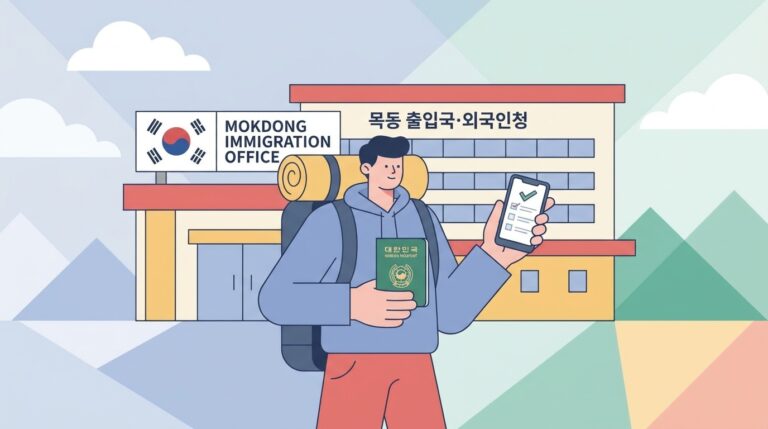
Unlock Your Korean Dream: The Warm and Strategic Guide to Visas, Status, and Bureaucracy
안녕하세요! Welcome back to another masterclass with Daily Hangul. I’m your senior editor, your seasoned Korean tutor, and your local Seoul navigator who has spent the last decade guiding hundreds of expats through the complex labyrinth of Korean life.
If you have ever watched a K-Drama like Start-Up or Itaewon Class, you’ve probably cheered for ambitious characters fighting to make their dreams come true in Seoul. But behind the glossy screens and the neon-lit streets of Hongdae lies a formidable rite of passage that every aspiring long-term resident must face: 출입국외국인청 (Chul-ip-guk Oe-guk-in-cheong – The Immigration Office).
Picture this: You are sitting in a plastic chair at the Seoul Southern Immigration Office. The ticket machine is chiming relentlessly. You have a stack of papers thicker than a Harry Potter novel, and your palms are sweating. You’ve prepared everything, but one mispronounced word or a misunderstood administrative nuance could mean the difference between getting your residency card or booking a one-way ticket home.
Don’t worry. This guide is built on real-world case studies of students—like Sarah, a graphic designer from New York who successfully navigated the transition from a student visa to a professional F-series residency. Today, we are going to master the high-level vocabulary, the unspoken cultural rules, and the exact conversational strategies you need to conquer Korea’s visa system like a true insider.
Phase 2: Three Core Visa Expressions Deep Dive
To confidently navigate immigration, you need to speak the language of administration. At a C1 level, simple words like “비자 (visa)” won’t cut it. Let’s look at three highly sophisticated, essential terms.
1. 발급 조건 (Bal-geup Jo-geon)
- Pronunciation: [bal-geup jo-geon] / Sound-alike: “bahl-gup joh-guhn”
- Meaning: Issuance conditions / Eligibility criteria.
- K-Culture Moment: Think of this as the demanding checklist in a drama where a chaebol parent lists the absurd “conditions” for their child’s spouse. In the real world, it’s the strict legal criteria set by the Ministry of Justice.
- Editor’s Insight: When discussing visas, Koreans rarely say “What do I need for a visa?” Instead, they ask about the “발급 조건” to sound professional and precise.
- Situation Spectrum:
- Casual: ⚠️ (Sounds a bit too formal for casual chit-chat, but acceptable)
- Semi-formal: ✅
- Formal (Immigration Office): ✅
- 🤔 Think About It: Why does Korean administrative language rely heavily on Sino-Korean characters (Hanja)? How does this compare to Latin-derived legal terms in English?
2. 체류 자격 (Che-ryu Ja-gyeok)
- Pronunciation: [che-ryu ja-gyeok] / Sound-alike: “chuh-ryoo jah-gyuhk”
- Meaning: Status of sojourn / Visa classification.
- K-Culture Moment: In K-Dramas, when characters get in trouble with the law, their “체류 자격” is often checked immediately. It defines what you are legally allowed to do (e.g., work, study, or start a business) in Korea.
- Editor’s Insight: Expats often conflate “비자” (the entry permit) with “체류 자격” (your legal status while living here). If you want to impress an officer, use “체류 자격 변경” (change of sojourn status) instead of “비자 바꾸기” (changing visa).
- Situation Spectrum:
- Casual: 🚫 (Too stiff for beers with friends)
- Semi-formal: ✅
- Formal: ✅
- 🤔 Think About It: How does your legal “status” shape your identity in a foreign country? In Korea, your status is tied to a specific card (거소증 or 외국인등록증)—how does carrying this physical identity feel to you?
3. 심사를 거치다 (Sim-sa-reul Geo-chi-da)
- Pronunciation: [sim-sa-reul geo-chi-da] / Sound-alike: “seem-sah-ruhl guh-chee-dah”
- Meaning: To undergo screening / To go through an evaluation process.
- K-Culture Moment: This is the agonizing montage in a survival show like Show Me The Money or Physical: 100 where contestants wait for the judges’ final verdict.
- Editor’s Insight: This phrase elevates your Korean instantly. It shows you respect the bureaucratic process. Instead of saying “They are checking my papers,” say “심사를 거치고 있습니다” (It is undergoing screening).
- Situation Spectrum:
- Casual: ⚠️
- Semi-formal: ✅
- Formal: ✅
- 🤔 Think About It: Korean culture highly values patience and respect for process. How does “going through a screening” reflect the country’s meticulous attention to detail and security?
Phase 3: Textbook Korean vs. Real Korean
When you study from a textbook, the language is often sanitized and overly polite. Let’s look at how Koreans actually talk about immigration in the real world.
Scenario 1: Finding out if your visa is approved
- 📖 Textbook Korean: “비자 신청이 승인되었는지 확인해 주시겠습니까?” (Would you please check if my visa application has been approved?)
- 🗣️ Real Korean: “혹시 비자 나왔어요?” (Did my visa come out?)
- 💡 Why is it different? The verb “나오다” (to come out) is the ultimate colloquial shortcut for any document being issued, printed, or approved. It sounds incredibly natural and less robotic.
Scenario 2: Renewing your visa status
- 📖 Textbook Korean: “체류 기간 연장을 신청하러 왔습니다.” (I have come to apply for an extension of my period of sojourn.)
- 🗣️ Real Korean: “비자 연장하러 왔어요.” (I’m here to extend my visa.) / “갱신하러 왔어요.” (I’m here to renew.)
- 💡 Why is it different? While “체류 기간 연장” is written on the forms, spoken Korean prioritizes speed and conversational flow. “비자 연장” strikes the perfect balance of politeness and natural phrasing.
⚠️ Bottom Note: Since you are aiming for C1, use the textbook terms on paper, but use the “Real Korean” alternatives when speaking directly to officers to build instant rapport.
Phase 4: K-Culture Deep Dive & Non-Verbal Etiquette
4-1. Nunchi (눈치) and Immigration Office Body Language
In Korea, Nunchi (tact/situational awareness) is your greatest superpower. When dealing with busy government officials, your body language speaks louder than your vocabulary.
* The Two-Hand Rule (양손): Whenever you hand over your passport, application forms, or business cards, always use both hands. This is a non-negotiable sign of respect in Korean culture.
* The Polite Bow (목례): When your number is called, do not just slide into the chair. Give a slight, respectful head bow (목례 – mong-nye) before sitting down. It sets a cooperative, polite tone instantly.
* Voice Modulation: Speak in a calm, slightly lower register. High-pitched, anxious, or demanding tones can be perceived as aggressive in highly structured bureaucratic environments.
4-2. The Visa Caste System in Korean Media
Have you noticed how dramas depict the lives of foreign characters? In Itaewon Class, Kim Toni struggles immensely because of his visa status, highlighting the very real social hierarchies tied to visa categories. An E-7 (Specialty Occupation) visa binds you to your employer, while an F-2-7 (Points-based Residency) or F-5 (Permanent Residency) grants you absolute freedom. Understanding this hierarchy will help you understand the anxieties and aspirations of the expat community in Korea.
Phase 5: Interactive Roleplay Scenario
The Setting
You are at the Mokdong Immigration Office. The air smells of ozone from the heavy-duty copy machines and instant Maxim Gold coffee. Officer Park, a tired but meticulous government official, is reviewing your documents for a change of status to an F-2-7 residency visa.
Cast
- You: An ambitious foreign professional seeking long-term residency.
- Officer Park (박 주무관): A busy official who has seen a thousand applicants today.
Dialogue
- Officer Park: (Looking up from a computer screen) “번호표 142번 맞으시죠? 앉으세요. 어떤 일 때문에 오셨나요?” (Ticket 142, correct? Please sit down. What brings you here?)
- You: 🎭 (Smiling politely, bowing slightly) “안녕하세요, 주무관님. 오늘 E-7에서 F-2-7로 체류 자격 변경을 신청하려고 왔습니다.” (Hello, officer. I’m here today to apply for a change of sojourn status from E-7 to F-2-7.)
- Officer Park: “아, 점수제 우수 인재 비자요? 서류 다 준비해 오셨어요? 하나씩 보여주세요.” (Ah, the points-based talented individual visa? Did you prepare all the documents? Show them to me one by one.)
- You: 🎭 (Handing over a thick folder with both hands) “네, 여기 신청서랑 재직증명서, 그리고 사회통합프로그램(KIIP) 이수증입니다.” (Yes, here is the application, certificate of employment, and my Korea Immigration and Integration Program completion certificate.)
- Officer Park: (Flipping through the papers, humming) “점수 계산표는 직접 작성해 오셨나요? 몇 점 나오시죠?” (Did you fill out the points sheet yourself? How many points do you get?)
- You: “네, 가점 포함해서 총 85점입니다. 소득 증빙 서류도 국세청에서 발급받아 첨부했습니다.” (Yes, including bonus points, it’s 85 points in total. I also attached the income proof issued by the National Tax Service.)
- Officer Park: (Peering closely at a document) “어… 그런데 여기 회사 사업자등록증 사본에 직인이 안 찍혀 있네요?” (Uh… but the seal is missing on this copy of your company’s business registration certificate?)
- You: 🎭 (Maintaining composure, leaning in slightly) “아, 그 서류 뒤쪽에 보시면 원본 대조필 직인이 찍혀 있습니다. 한번 확인해 주시겠습니까?” (Ah, if you look at the back of that document, the certified copy seal is stamped there. Would you mind checking?)
- Officer Park: (Turns the page over) “아, 여기 있네요. 다행입니다. 이거 누락되면 보완 서류 제출하러 다시 오셔야 하거든요.” (Ah, here it is. Thank goodness. If this was missing, you would have had to come back to submit supplementary documents.)
- You: “휴, 다행이네요. 꼼꼼히 봐주셔서 정말 감사합니다, 주무관님.” (Phew, what a relief. Thank you so much for checking so thoroughly, officer.)
- Officer Park: “네, 심사 기간은 한 달 정도 소요됩니다. 승인되면 문자로 안내해 드릴게요.” (Yes, the screening process will take about a month. If approved, we will notify you by text.)
🔀 Decision Point
Officer Park notices a minor discrepancy in your Korean language test certificate dates. He sighs and looks frustrated. What do you do?
- Option A: Show him the official guidelines on your phone and argue that the date is valid. (Risk: Might cause him to lose face and reject your file out of spite.)
- Option B: Apologize profusely, ask if you can submit a supplementary document (보완 서류) via fax by tomorrow, and speak with a soft, cooperative tone. (Best Choice!)
- Option C: Stay silent and hope he just bypasses it. (Risk: Highly likely to result in visa rejection or delays.)
Best Choice Analysis (Option B): In Korean bureaucracy, cooperation beats confrontation. Offering to submit a 보완 서류 (supplementary document) via fax saves the officer the hassle of canceling your appointment while allowing you to fix the issue gracefully.
Phase 6: 10-Second Emotion Shadowing Drill
Let’s train your mouth and your emotions to sound like a native. Pay attention to the pauses (/) and the emotional direction.
1. 🥺 [Desperate & Polite]
“제발 / 서류에 문제가 / 없어야 할 텐데 / 걱정이에요.”
(Je-bal / seo-ryu-e mun-jae-ga / eop-seo-ya hal ten-de / geok-jeong-i-e-yo.)
“I really hope / there are no issues with my documents / I’m so worried.”
2. 😊 [Warm & Professional]
“바쁘신 와중에 / 꼼꼼하게 검토해 주셔서 / 정말 감사합니다!”
(Ba-ppeu-sin wa-jung-e / kkom-kkom-ha-ge geom-to-hae ju-syeo-seo / jeong-mal gam-sa-hap-ni-da!)
“Despite your busy schedule, / thank you so much / for reviewing this so thoroughly!”
3. 😤 [Confident & Reassuring]
“모든 발급 조건을 / 충족했으니까 / 이번에는 / 꼭 나올 거예요!”
(Mo-deun bal-geup jo-geon-eul / chung-jok-haet-seu-ni-kka / i-beon-e-neun / kkok na-ol geo-yeo-yo!)
“Since I met / all the eligibility criteria, / this time / it will definitely come out!”
Phase 7: K-Culture Mini Dictionary
| Word (Korean + Romanization) | English Translation | Real-world Contextual Nuance |
|---|---|---|
| 출입국외국인청 (Chul-ip-guk Oe-guk-in-cheong) |
Immigration Office | The ultimate place of destiny for expats. Known for long queues and tense energy. |
| 거소증 (Geo-so-jeung) |
Domestic Residence Card | Specifically for overseas Koreans (F-4 visa holders). It acts as your golden ticket to the Korean banking and healthcare systems. |
| 비자런 (Bi-ja-reon) |
Visa Run | Leaving the country (usually to Japan) for a weekend to reset a tourist visa. Highly discouraged for long-term stays! |
| 서류 지옥 (Seo-ryu Ji-ok) |
Document Hell | The humorous but painful state of gathering dozens of notarized and apostilled papers for Korean visas. |
Phase 8: Traveler’s & Expat’s Survival Kit
Survival Phrases TOP 3
- “보완 서류는 팩스로 보내도 될까요?” (Bo-wan seo-ryu-neun paek-seu-ro bo-nae-do doel-kka-yo?)
- Pro Tip: “Can I send the supplementary documents via fax?” Save yourself another trip to the office!
- “체류 연장 수수료는 어디서 내나요?” (Che-ryu yeon-jang su-su-ryo-neun eo-di-seo nae-na-yo?)
- Pro Tip: “Where do I pay the extension fee?” Usually paid at an ATM inside the immigration building.
- “외국인등록증 재발급 신청서 주세요.” (Oe-guk-in-deung-rok-jeung jae-bal-geup sin-cheong-seo ju-se-yo.)
- Pro Tip: “Please give me the application form for a replacement ARC.” Essential if you lose your physical card.
📌 Editor’s Travel & Life Note
Before even thinking about stepping foot into the physical immigration office, you must secure an online reservation. This is done exclusively via the Hi Korea Official Portal, the primary government site for foreigners. Try to book your slot at least two months in advance, especially during the peak graduation seasons of February and August!
Phase 9: Think Deeper — “한 발 더 깊이”
In Western cultures, residency status is often viewed through the lens of individual rights and legal entitlement. In Korea, however, the visa system reflects a deep-rooted collective mentality.
The system is designed to evaluate how seamlessly an individual can integrate into and benefit the “Korean community” (우리 사회 – uri sahwe). This is why the F-2-7 visa heavily rewards volunteer work, tax contributions, and proficiency in the Korean language (via the KIIP program). It is not just about having a job; it is about proving that you respect, understand, and want to become a productive thread in the tightly woven fabric of Korean society.
💬 Your Turn: How does your home country evaluate immigrant eligibility? Is it based on a points system, or does it focus purely on employment sponsorship? Let me know your thoughts in the comments below! Let’s discuss!
Phase 10: FAQ & Common Mistakes
Q: Can I work part-time on a Student (D-2) visa?
A: Yes, but with strict conditions (Depends). You must obtain “시간제 취업 허가” (part-time work permit) from immigration first. Working without this approval can lead to heavy fines and deportation.
Q: What is the F-2-7 visa everyone is talking about?
A: It is a Points-Based Resident Visa. It evaluates your age, income, education, and Korean proficiency. If you score 80 out of 120 points, you gain residency status, freeing you from being tied to a single employer.
Q: How long does it take to get a residency card after applying?
A: Usually 3 to 6 weeks. During peak periods (start of university semesters), it can take up to two months. Plan your international travels accordingly!
🚨 Common Mistakes Warning Board
- Not reporting a change of address within 15 days: If you move, you must update your address at the local community center (주민센터) or online. Failure to do so leads to a hefty fine of up to 1 million KRW!
- Using “비자” instead of “체류 자격” on forms: When filling out immigration forms, look for “체류 자격” (Status of Sojourn) to indicate your visa type.
- Forgetting to print the National Tax Service Income Certificate (소득금액증명원): Many expats print simple bank statements, but immigration specifically requires the official tax document from the Hometax portal.
Phase 11: Action Missions
- 🥉 Bronze (Mirror Challenge): Stand in front of a mirror and practice handing over an imaginary passport with both hands while bowing slightly and saying: “안녕하세요, 체류 기간 연장하러 왔습니다.”
- 🥈 Silver (Network Challenge): Log onto your social media or an expat forum and share one tip you learned from this guide using the hashtag
#DailyHangul. - 🥇 Gold (Reality Challenge): Go to the Hi Korea Official Portal and download the “통합신청서” (Unified Application Form). Try filling out the personal information and status sections entirely in Korean.
Phase 12: Interactive Quiz Challenge
Test your visa and immigration smarts below!
Q1. Which of the following is the most natural way to ask if your visa has been approved? (Click to expand)
Answer: “혹시 비자 나왔어요?” (Did the visa come out?)
Explanation: While “승인되었습니까” is technically correct, native speakers and seasoned expats use the verb “나오다” for issued documents.
Q2. True or False: You have 30 days to report a change of address in Korea. (Click to expand)
Answer: False!
Explanation: You must report a change of address within 15 days. Any later, and you will face a steep fine!
Q3. Complete the sentence: “E-7에서 F-2-7로 _____ 자격을 변경하고 싶습니다.” (Click to expand)
Answer: 체류 (Che-ryu)
Explanation: “체류 자격” translates to “status of sojourn” or visa status, which is the correct legal term used on application forms.







