

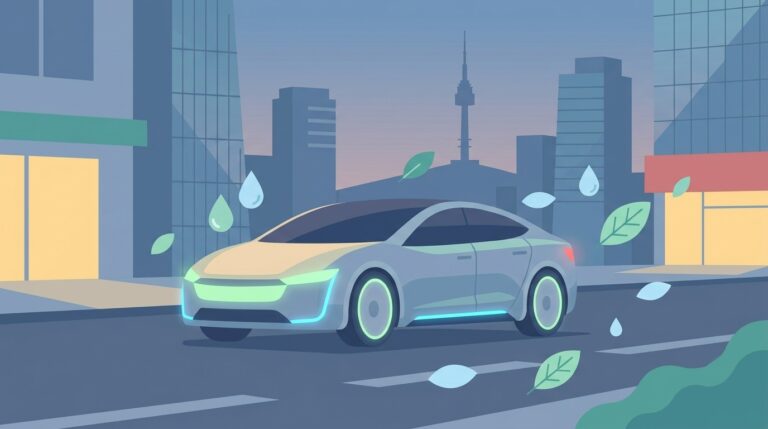
The Hydrogen Hype vs. Reality: Master C1 Korean Mobility Debates with Daily Hangul
안녕하세요! (An-nyeong-ha-se-yo! — Hello!) It is your trusted Korean culture navigator and Daily Hangul senior editor. Have you ever found yourself watching a sleek, futuristic vehicle glide through a high-end K-Drama like Queen of Tears or Crash Landing on You, and wondered: “Wait, is that a hydrogen car? And how do Koreans actually talk about this cutting-edge tech?”
If you are striving for C1-level fluency, simply saying “수소 자동차가 좋아요” (su-so ja-dong-cha-ga jo-a-yo — Hydrogen cars are good) won’t cut it. To truly connect with tech-savvy Koreans in Pangyo Techno Valley (Korea’s Silicon Valley) or engage in deep, intellectual debates over maekju (beer) about Korea’s net-zero carbon initiatives, you need the precise vocabulary, the cultural context, and the subtle linguistic nuances that show you aren’t just reading from a textbook.
Today, we are diving deep into the possibilities and limitations of hydrogen cars (수소 자동차의 가능성과 한계). We will explore the linguistic tools you need to sound like a local industry insider, complete with real-world scenarios and cultural insights. Let’s rev up our intellectual engines!
Phase 2: Core Expressions Deep Dive
To navigate high-level discussions about green mobility, you need expressions that capture both the optimism and the skepticism surrounding hydrogen technology. Here are three essential C1-level expressions.
1. 친환경 모빌리티의 선두 주자 (chin-hwan-gyeong mo-bil-li-ti-ui seon-du ju-ja)
- Pronunciation: [chin-hwan-gyeong mo-bil-li-ti-ui seon-du ju-ja] / Sound-alike: cheen-hwan-gyuhng moh-beel-lee-tee-wee suhn-doo joo-jah
- Meaning: The frontrunner of eco-friendly mobility.
- K-Culture Moment: Think of a high-powered CEO in a corporate K-Drama delivering a passionate pitch in a glass boardroom about beating global competitors to dominate the green car market.
- Editor’s Insight: 선두 주자 (frontrunner/pioneer) is a highly professional term. Combining it with 친환경 모빌리티 immediately elevates your speech, signaling that you understand Korea’s ambitious push toward carbon neutrality.
- Situation Spectrum:
- Casual (Friends): ⚠️ (A bit too formal, unless used playfully to describe a friend who always buys the newest eco-friendly gadgets)
- Semi-formal (Colleagues): ✅ (Perfect for office discussions)
- Formal (Business/Presentations): ✅ (Highly recommended)
- 🤔 Think About It: Why does Korean corporate culture place such a heavy emphasis on being the 선두 주자 (frontrunner) rather than a fast follower? How does this reflect the rapid post-war economic development (한강의 기적 — Miracle on the Han River)?
2. 충전 인프라 구축이 시급하다 (chung-jeon in-peu-ra gu-chuk-i si-geup-ha-da)
- Pronunciation: [chung-jeon in-peu-ra gu-chuk-i si-geup-ha-da] / Sound-alike: choong-juhn een-peuh-rah goo-chook-ee shee-geup-hah-dah
- Meaning: Establishing charging infrastructure is highly urgent.
- K-Culture Moment: You are chatting with a taxi driver in Seoul who drives a hydrogen cab, complaining about having to drive 20 minutes out of his way just to find a functioning charging station.
- Editor’s Insight: 구축 (construction/establishment) and 시급하다 (to be urgent) are premium Hanja (Sino-Korean) words. Using 시급하다 instead of 빨리 해야 해요 (must do quickly) instantly makes you sound like a policy analyst.
- Situation Spectrum:
- Casual (Friends): ⚠️
- Semi-formal (Colleagues): ✅
- Formal (Business/Presentations): ✅
- 🤔 Think About It: In your home country, is infrastructure development driven primarily by government initiatives, or does the private sector take the lead? How does this compare to Korea’s highly centralized, state-backed infrastructure projects?
3. 아직은 시기상조다 (a-jik-eun si-gi-sang-jo-da)
- Pronunciation: [a-jik-eun si-gi-sang-jo-da] / Sound-alike: ah-jeek-eun shee-gee-sahng-joh-dah
- Meaning: It is still premature / too early.
- K-Culture Moment: Two friends over hot chicken wings discussing whether to buy an electric vehicle (EV) or a hydrogen fuel cell vehicle (FCEV) right now.
- Editor’s Insight: 시기상조 (時期尙早) is a powerful four-character idiom (사자성어) meaning ‘the time is not yet ripe’. It is the ultimate polite yet firm way to express skepticism about any new trend or technology.
- Situation Spectrum:
- Casual (Friends): ✅
- Semi-formal (Colleagues): ✅
- Formal (Business/Presentations): ✅
- 🤔 Think About It: Idioms like 시기상조 allow you to disagree without sounding aggressive. How does this align with the Korean cultural value of maintaining social harmony (화합 — hwa-hap)?
Phase 3: Textbook Korean vs. Real Korean
Textbooks teach you grammatically correct sentences, but native speakers use idioms and metaphorical expressions to add flavor and speed to their conversations. Let’s look at how to bridge that gap.
Situation 1: Expressing skepticism about buying a hydrogen car
- 📖 Textbook Korean: 수소 자동차는 환경에 좋습니다. 그러나 충전소가 부족합니다. (Hydrogen cars are good for the environment. But there are not enough charging stations.)
- 🗣️ Real Korean: 친환경이라 끌리긴 하는데, 아직은 충전소 찾기가 하늘의 별 따기예요. (It’s tempting because it’s eco-friendly, but finding a charging station is still like plucking stars from the sky.)
- 💡 Why the difference? 하늘의 별 따기 (plucking stars from the sky) is a deeply ingrained idiom used daily by Koreans to describe anything nearly impossible. Using it here shows you understand the practical frustration of eco-car owners.
Situation 2: Debating the timeline for mass adoption of hydrogen tech
- 📖 Textbook Korean: 수소 기술은 아직 완전하지 않아서 시간이 많이 필요합니다. (Hydrogen technology is not perfect yet, so it needs a lot of time.)
- 🗣️ Real Korean: 상용화 단계까지 가려면 아직 넘어야 할 산이 많죠. (There are still many mountains to climb before we reach the commercialization stage.)
- 💡 Why the difference? 넘어야 할 산이 많다 (having many mountains to climb) is the perfect business-casual metaphor. Korea is a mountainous country, so using geographical metaphors to describe challenges feels incredibly natural to native ears.
Phase 4: K-Culture Deep Dive & Non-Verbal Manners
4-1. The Art of Intellectual Humility (Nunchi and Backchanneling)
When debating complex topics like future mobility in Korea, 눈치 (nunchi — social reading/tact) is your best friend. In Korean culture, winning a debate is not about crushing your opponent with facts; it’s about finding common ground while demonstrating your own insight.
* The Nod & Agree Method: Before presenting a counterargument (e.g., highlighting the limitations of hydrogen), always validate the other person’s point first. Use backchanneling phrases like “아, 그 말씀도 일리가 있네요. 하지만…” (Ah, that makes sense too. However…) while slightly bowing your head. This shows you are listening actively and respect their intellect.
4-2. The Symbolism of the Nexo (넥쏘) in Korean Media
In Korea, driving a hydrogen SUV like the Hyundai Nexo (넥쏘) is a unique status symbol. Unlike driving an imported German luxury car, which can sometimes be viewed as flashy or materialistic, driving a hydrogen car signals that you are wealthy, technologically forward-thinking, and socially responsible. In K-Dramas, you will often see young, innovative startup CEOs driving these whisper-quiet, water-emitting vehicles to emphasize their clean, progressive image.
Phase 5: Interactive Roleplay Scenario
Setting: A sleek, minimalist café in Pangyo Techno Valley. The faint aroma of roasted coffee beans mixes with the quiet hum of electric shuttles outside. You are having coffee with Ji-min, a passionate eco-startup developer.
Cast:
* You (Tech Consultant): Analytical, looking at both sides of the coin.
* Ji-min (지민 – Developer): An enthusiastic believer in the hydrogen economy.
1. 지민: (눈을 반짝이며 커피잔을 내려놓는다)
   "결국 미래 모빌리티의 끝판왕은 수소차 아닐까요? 전기차는 배터리 한계가 분명하잖아요."
   (Ultimately, isn't the final boss of future mobility the hydrogen car? EVs clearly have battery limitations.)

2. You: (미소를 지으며 고개를 끄덕인다)
   "지민 씨 말씀처럼 친환경 관점에서는 수소차가 확실한 대안이죠. 배기가스 대신 물만 나오니까요."
   (Like you said Ji-min, from an eco-friendly perspective, hydrogen cars are definitely the alternative. Since they only emit water instead of exhaust.)

3. 지민: (신나서 몸을 조금 앞으로 기울이며)
   "맞아요! 게다가 충전 시간도 5분 내외로 전기차보다 훨씬 빠르고요!"
   (Exactly! Plus, the charging time is around 5 minutes, which is much faster than EVs!)

4. You: (조금 진중한 표정으로 턱을 괴며)
   "그건 큰 장점이죠. 하지만 아직 일반 소비자가 체감하기에는 충전 인프라 구축이 시급해 보여요."
   (That is a huge advantage. But for average consumers to really feel the benefits, establishing charging infrastructure seems highly urgent.)

5. 지민: (아쉽다는 듯이 입술을 내밀며)
   "하긴... 서울에도 수소 충전소가 몇 개 없어서 충전 셔틀을 해야 할 지경이긴 해요."
   (True... there are so few hydrogen stations even in Seoul that people practically have to run charging shuttles.)

6. You: (공감하듯 고개를 저으며)
   "그리고 수소 생산 과정에서 여전히 탄소가 배출된다면 진정한 친환경이라 하기도 어렵고요."
   (And if carbon is still emitted during the hydrogen production process, it is hard to call it truly eco-friendly.)

7. 지민: (깊은 한숨을 쉬며)
   "결국 '그린 수소' 생산 기술 개발이 핵심이겠네요. 아직 갈 길이 머네요."
   (So ultimately, developing 'green hydrogen' production technology is the key. There is still a long way to go.)

8. You: (따뜻하게 미소 지으며)
   "맞아요. 기술과 인프라가 동시에 가야 하니, 아직 대중화는 시기상조가 아닐까 싶어요."
   (Exactly. Since technology and infrastructure must go hand-in-hand, I think mass adoption might still be premature.)

9. 지민: (커피를 한 모금 마시며)
   "그래도 한국 정부가 '수소 경제'에 엄청 드라이브를 걸고 있으니 기대해 볼 만해요!"
   (Still, the Korean government is driving the 'hydrogen economy' so hard, it is worth looking forward to!)

10. You: (잔을 들며 가볍게 짠을 제안한다)
    "그렇죠. 머지않아 도로에 수소차만 가득할 날을 기대해 보죠!"
    (Right. Let's look forward to the day when the roads are full of hydrogen cars in the near future!)
🔀 Decision Point: How will you steer the conversation next?
- Option A: “수소차는 절대 대중화될 수 없어요. 전기차가 무조건 이깁니다.” (Hydrogen cars can never go mainstream. EVs will win no matter what.)
- Critique: 🚫 Too aggressive! In Korean social dynamics, making such absolute, dismissive statements halts the harmonious flow of the conversation and can make you seem close-minded.
- Option B: “정부 보조금이 더 나오면 저도 넥쏘 한 대 뽑고 싶네요.” (If government subsidies increase, I’d love to pull out a Nexo myself.)
- Critique: ✅ Best Choice! 한 대 뽑다 (to pull/get a new car) is a wonderful, highly natural colloquialism. This option shows deep cultural alignment, awareness of economic factors (subsidies), and keeps the vibe light and friendly.
- Option C: “친환경 차보다는 대중교통이 최고입니다.” (Public transit is best compared to eco-cars.)
- Critique: ⚠️ A bit of a party pooper. While true, it completely derails the exciting tech discussion you were having with Ji-min.
Phase 6: 10-Second Emotion Shadowing Drill
Let’s inject some soul into your pronunciation. Practice these sentences with emotional inflection, using the / marks to pause naturally.
1. [😊 Hopeful & Inspired]
- Korean: “수소차 시대가 / 진짜 올까요? / 가슴이 웅장해지네요!”
- Pronunciation: [Su-so-cha si-dae-ga / jin-jja ol-kka-yo? / ga-seum-i ung-jang-hae-ji-nae-yo!]
- Translation: Will the hydrogen car era / really come? / My heart feels so grand (I’m so excited)!
2. [🙄 Skeptical & Realistic]
- Korean: “말은 참 좋은데… / 충전 인프라부터 / 깔고 말해야죠.”
- Pronunciation: [Mal-eun cham jo-eun-de… / chung-jeon in-peu-ra-bu-teo / kkal-go mal-hae-ya-jo.]
- Translation: The idea is great, but… / they should lay down / the charging infrastructure first.
Phase 7: K-Culture Mini Dictionary
| Word (Korean + Romanization) | English Translation | Real-world Context & Usage |
|---|---|---|
| 친환경 (chin-hwan-gyeong) | Eco-friendly | From grocery bags to cars, this is the ultimate buzzword in modern Korean society. |
| 차박 (cha-bak) | Car camping | A massive lifestyle trend in Korea where people sleep in their SUVs. Quiet, emissions-free EVs and hydrogen cars are prized for cha-bak. |
| 가성비 (ga-seong-bi) | Cost-effectiveness | A core value for modern Koreans. If a tech lacks 가성비 (due to high hydrogen fuel costs), it struggles to succeed. |
| 얼리어답터 (eol-ri-eo-dap-teo) | Early Adopter | English loanword used constantly in Korea to describe tech-pioneers who buy hydrogen cars or foldable phones first. |
Phase 8: Traveler’s Survival Kit
If you are renting a car in Korea (especially in eco-friendly havens like Jeju Island), keep these survival phrases handy!
- Card 1: “친환경 차량 할인 되나요?”
- Pronunciation: [chin-hwan-gyeong cha-ryang hal-in doe-na-yo?]
- Pro Tip: Korea offers huge discounts (up to 50%) for eco-friendly vehicles at public parking lots and toll booths. Always ask this!
- Card 2: “가장 가까운 충전소가 어디예요?”
- Pronunciation: [ga-jang ga-kka-un chung-jeon-so-ga eo-di-yeo-yo?]
- Pro Tip: Essential if you rent an EV or hydrogen car.
- Card 3: “충전기 타입이 어떻게 돼요?”
- Pronunciation: [chung-jeon-gi ta-ip-i eo-tteo-ke dwae-yo?]
- Pro Tip: Different cars use different chargers. Ask the rental company this before departing.
📌 Editor’s Travel Note: When renting a car in Korea, do not rely on Google Maps as its navigation features are limited due to security laws. Instead, download the Naver Map App or KakaoMap. These apps show real-time locations and availability of both EV and hydrogen charging stations across the peninsula.
Phase 9: Deep Thinking — “One Step Deeper”
Korea’s obsession with hydrogen technology is deeply tied to its national identity as an industrial powerhouse. Having very few natural resources, Korea historically had to import almost all of its fossil fuels. Achieving “Energy Independence” through hydrogen technology is not just an environmental goal; it is a strategic national dream. However, this dream constantly collides with the 빨리빨리 (ppal-li-ppal-li — hurry, hurry) culture. Koreans expect rapid results, and the slow rollout of expensive hydrogen charging stations creates a fascinating social tension between long-term national ideals and short-term daily convenience.
💬 Your Turn: How does your home country balance the dream of green energy with the harsh realities of infrastructure costs? Let’s discuss in the comments below! (영어나 한국어 모두 환영합니다!)
Phase 10: FAQ & Avoiding Misunderstandings (FAQ Schema)
Q: Are hydrogen cars actually safe? Koreans seem to drive them a lot.
A: Yes! FCEVs like the Nexo have undergone rigorous safety testing. However, there is still a slight public stigma in Korea regarding the word 수소 (hydrogen) because some people mistakenly associate it with dangerous hydrogen bombs. In Korean, it’s helpful to clarify that it is 안전한 연료전지 수소 (safe fuel-cell hydrogen).
Q: Can a tourist easily rent and drive a hydrogen car in Korea?
A: Technically yes, if you have an International Driving Permit (IDP). However, unless you are staying near a major city with multiple stations, renting a standard EV or hybrid is highly recommended for tourists due to the scarcity of hydrogen refueling points.
Q: What is the difference between 전기차 (EV) and 수소차 (FCEV) in daily Korean conversation?
A: In daily chats, 전기차 (jeon-gi-cha) is seen as the practical, highly accessible present, while 수소차 (su-so-cha) is viewed as the futuristic, premium, but currently inconvenient dream.
🚨 Common Mistakes Warning Panel
- Mistake 1: Confusing 수소 (su-so — Hydrogen) with 산소 (san-so — Oxygen). Saying “산소 자동차” will make people think your car runs on fresh air!
- Mistake 2: Pronouncing 충전 (chung-jeon — charging) as 조전 (jo-jeon). Make sure to spit out that aspirated ‘ch’ sound so you don’t confuse your listener.
- Mistake 3: Saying “수소차는 시기상조입니다” to a developer who just pitched you their startup. It’s too blunt. Soften it with “아직 대중화되려면 조금 시간이 필요할 것 같아요” (I think it might take a bit of time to go mainstream).
Phase 11: Action Missions
- 🥉 Bronze (Living Room Challenge): Record a voice memo of yourself saying the emotional shadowing sentences with perfect intonation. Focus on the sigh in the skeptical sentence!
- 🥈 Silver (Network Challenge): Post a screenshot of your favorite eco-friendly K-Drama car on Instagram or Twitter, tag us, and use the caption: “수소차는 아직 시기상조일까요?”
- 🥇 Gold (Real-world Challenge): Next time you talk to a Korean friend or teacher, casually drop the idiom: “넘어야 할 산이 많다” when discussing a hard project or life goal. Watch their eyes widen in surprise!
🎮 K-Culture Mission: Watch an episode of a recent modern K-Drama and count how many times you spot a green license plate (which denotes eco-friendly vehicles in Korea!).
Phase 12: Interactive Quiz Challenge
1. Situation Judgement
You want to politely tell your Korean colleague that while hydrogen technology is amazing, the infrastructure is not ready. Which is the most natural and polite C1 expression?
* A) 수소차 진짜 별로예요. (Hydrogen cars are really bad.)
* B) 기술은 좋지만, 아직 대중화는 시기상조인 것 같아요. (The tech is good, but I think mass adoption is still premature.)
* C) 왜 충전소를 안 만들까요? 바보 같아요. (Why don’t they make charging stations? It’s foolish.)
Click to see the Answer & Explanation
- Correct Answer: B
- Explanation: Option B uses the sophisticated Hanja term 시기상조 and softens the opinion with ~인 것 같아요 (I think/it seems like), making it highly polite and professional. Option A and C are too aggressive and grammatically basic.
2. Fill in the Blanks
Fill in the missing idiom that means “plucking stars from the sky” (extremely difficult):
* “요즘 서울에서 수소 충전소 찾기는 __________예요.”
Click to see the Answer & Explanation
- Correct Answer: 하늘의 별 따기
- Explanation: “요즘 서울에서 수소 충전소 찾기는 하늘의 별 따기예요.” (Finding a hydrogen charging station in Seoul these days is like plucking stars from the sky.)
3. True or False
- True or False: In Korea, driving an eco-friendly car like the Nexo can carry a positive status symbol of being socially responsible and technologically forward-thinking.
Click to see the Answer & Explanation
- Correct Answer: True
- Explanation: Unlike in some countries where eco-cars are viewed purely practically, in Korea, owning high-end eco-friendly cars carries a sophisticated, trend-leading, and respectable social status.







