

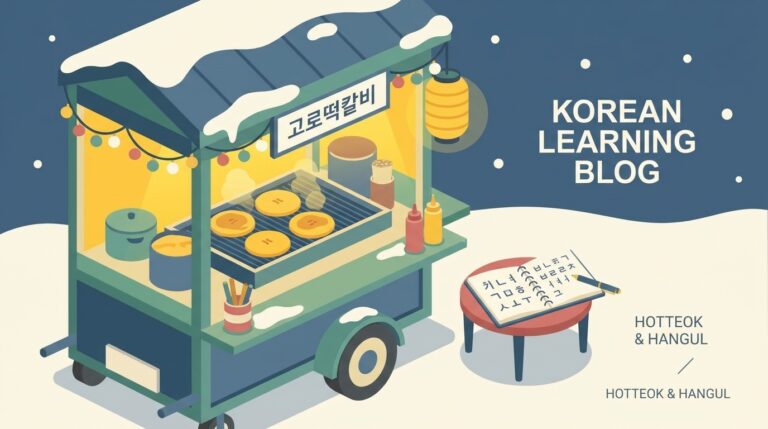
Sweet, Warm, and Crispy: How to Order Hotteok Like a Seoul Local
안녕하세요! (Annyeonghaseyo!) I am your Chief Editor from Daily Hangul, your friendly Seoul guide and Korean tutor. Have you ever walked down a cold street in Seoul and smelled a sweet, heavenly aroma of caramelized sugar, cinnamon, and roasting dough? If yes, you have met Hotteok (호떡), Korea’s ultimate winter street food!
Imagine this: It is a chilly evening in Insadong. You see a cozy street cart (포장마차 – pojangmacha) glowing under warm lights. People are laughing, holding small paper cups with steaming, golden pancakes inside. You want to join them, but your heart beats fast. “How do I order? What if I say the wrong thing?”
Don’t worry! Today, we will learn how to order Hotteok easily, even if you are an absolute beginner (A1). By the end of this guide, you will order like a true Seoulite and get a warm smile from the vendor!
Phase 2: Core Phrases for Your Hotteok Adventure
Let’s learn the 3 magical phrases you need. They are short, simple, and incredibly useful!
1. 호떡 하나 주세요 (Hotteok hana juseyo)
- Pronunciation: Ho-tteok ha-na joo-seh-yo
- Sound-alike guide: “Ho” (like home) + “tteok” (like duck but with a sharp ‘T’) + “hana” (like Han Solo) + “juseyo” (like Joo-say-yo)
- Meaning: “One Hotteok, please.”
- K-Culture Moment: This is the most common phrase you hear in K-dramas when the main characters stop by a street cart after work for a quick, sweet snack.
- Editor’s Insight: “주세요” (juseyo) is the ultimate magic word in Korea. Put it after any noun, and you are instantly polite!
- Situation Spectrum:
- Friends/Casual: ✅ (With a friendly tone)
- Semi-formal: ✅ (Perfect for street vendors)
- Formal: ✅ (Very polite)
- Think About It: In English, we say “Can I get…?” or “I want…”. Why do you think Korean uses “주세요” (Please give me)? It shows how Korean culture values direct yet humble requests!
2. 뜨거워요? (Tteugeoweoyo?)
- Pronunciation: Tteu-geo-wo-yo?
- Sound-alike guide: “Tteu” (like th in through but tight) + “geo” (like girl without ‘rl’) + “wo-yo” (like war-yo)
- Meaning: “Is it hot?”
- Editor’s Insight: Hotteok is filled with melted brown sugar syrup. When it is fresh, that syrup is like sweet lava! Asking this helps you prepare your tongue.
- Situation Spectrum:
- Friends/Casual: ✅ (뜨거워? – Tteugeoweo?)
- Semi-formal: ✅
- Formal: ✅
3. 종이컵에 주세요 (Jong-i-keobe juseyo)
- Pronunciation: Jong-ee-cup-ae joo-seh-yo
- Meaning: “Please put it in a paper cup.”
- Editor’s Insight: Korean street vendors fold the hot pancake and slide it into a small paper cup. It is the perfect, eco-friendly way to hold hot food without burning your hands!
- Situation Spectrum:
- Friends/Casual: ☀
- Semi-formal: ✅
- Formal: ✅
Phase 3: Textbook Korean vs. Real Korean
Sometimes, textbooks make things too complicated. Let’s look at how real Koreans talk at street food carts.
Situation 1: Ordering Three Hotteoks
- ‑ ‑ Textbook Korean: ‑‑
호떡 세 개를 구입하고 싶습니다.
(Hotteok se-gaereul gu-iphago sipsumnida.)
“I would like to purchase three pieces of Hotteok.” - ‑ ‑ Real Korean: ‑‑
호떡 세 개 주세요!
(Hotteok se-gae juseyo!)
“Three Hotteoks, please!” - ‑ ‑ Why the difference? Street food stalls are fast and busy. Real Koreans drop complicated grammar and keep it short and sweet!
Situation 2: Asking for a Napkin
- ‑ ‑ Textbook Korean: ‑‑
화장지를 제공해 주실 수 있습니까?
(Hwajangjireul jegonghae jusil su isumnika?)
“Is it possible for you to provide toilet/tissue paper?” - ‑ ‑ Real Korean: ‑‑
휴지 좀 주세요~
(Hyuji jom juseyo~)
“Can I have some tissue, please~” - ‑ ‑ Why the difference? “좀” (jom) means “a little” or “please.” Adding “좀” makes your request sound much softer, warmer, and more natural.
Phase 4: K-Culture Deep Dive & Nunchi Tips
4-1. The Art of “Two Hands” (Body Language)
In Korea, respect is shown through physical actions. When the vendor hands you the hot cup of Hotteok, always receive it with both hands. You can also give a slight nod of your head. This small gesture shows huge respect and will instantly melt the vendor’s heart!
4-2. The Winter “Jeong” (‑‑)
“Jeong” is a unique Korean word for warm affection and bonding. Sharing street food in winter is a core element of “Jeong” in Korea. It’s why you see K-drama characters sharing street snacks when they want to become closer friends or confess their love!
Phase 5: Interactive Roleplay Scenario
- Setting: A snowy evening near Hongdae Station. Steam rises from a small cart. The seller, a kind grandma (called “Imo” or Auntie), is flipping golden dough on a sizzling grill.
-
Cast:
- You (Hungry traveler)
- Imo (‑‑ – Friendly street food vendor)
The Dialogue
- You: (‑‑ Smiling warmly) 안녕하세요! (Annyeonghaseyo!) – Hello!
- Imo: (‑‑ Wiping her hands on her apron) 네, 어서 오세요! 뭐 드릴까요? (Ne, eoseo oseyo! Mwo deurilkkayo?) – Yes, welcome! What can I get for you?
- You: 호떡 하나 주세요. (Hotteok hana juseyo.) – One Hotteok, please.
- Imo: 네, 하나요! 바로 만들어 줄게요. (Ne, hanayo! Baro mandeureo julgeyo.) – Okay, one! I will make it for you right away.
- You: (‑‑ Watching the oil sizzle) 와, 맛있겠다! (Wa, masitgetda!) – Wow, looks delicious!
- Imo: (‑‑ Laughing proudly) 우리 집 호떡이 진짜 맛있어요! (Uri jip hotteoki jinja masisseoyo!) – Our Hotteok is really delicious!
- You: 휴지 좀 주세요. (Hyuji jom juseyo.) – Can I have some tissue, please?
- Imo: (‑‑ Handing you a napkin) 여기요. 아주 뜨거우니까 조심해요! (Yeogiyo. Aju tteugeounikka josimhaeyo!) – Here you go. It is very hot, so be careful!
- You: (‑‑ Receiving the paper cup with both hands) 감사합니다! (Gamsahamnida!) – Thank you!
‑‑ Decision Point
Imo warns you: “아주 뜨거우니까 조심해요! (It is very hot, so be careful!)”
What do you say?
- Choice A: “네, 조심할게요!” (Ne, josimhalgeyo!) – “Yes, I will be careful!”
- Choice B: “괜찮아요.” (Gwenchanayo.) – “It’s okay.” (Sounds slightly cold if not said with a big smile)
- Choice C: No answer, just start eating immediately.
Best Choice Analysis: Choice A is perfect! It shows you understood her warm warning and appreciate her care. She might even give you an extra smile!
Phase 6: 10-Second Shadowing Drill
Let’s practice speaking with real Korean emotion! Try saying these out loud:
- [‑‑ Excited & Happy]
호떡 / 하나 / 주세요! (Ho-tteok / ha-na / joo-seh-yo!) -
[‑‑ Careful & Polite]
휴지 / 좀 / 주세요~ (Hyu-ji / jom / joo-seh-yo~)
Phase 7: K-Culture Mini Dictionary
- 호떡 (Hotteok): Sweet pancake filled with cinnamon, brown sugar, and nuts.
- 이모 (Imo): Literally “aunt,” but used to call middle-aged female restaurant or street vendors friendly.
- 포장마차 (Pojangmacha): Tented street food carts selling warm snacks.
- 꿀 (Kkul): Literally “honey,” but often used to describe the sweet syrup inside Hotteok.
Phase 8: Traveler’s Survival Kit
Top 3 Survival Phrases
- 얼마예요? (Eolmayeyo?) – “How much is it?”
- 카드로 돼요? (Kadeuro dweyo?) – “Do you accept cards?” (Pro Tip: Some small carts prefer cash or bank transfer!)
- 계좌이체 돼요? (Gyejwai-che dweyo?) – “Can I do a bank transfer?”
‑‑ Editor’s Travel Note:
Street vendors love cash! Make sure to carry a few 1,000 KRW bills in your pocket. To find the best local food spots, download the Naver Map App instead of Google Maps, as Google Maps does not show accurate walking paths in Korea!
Phase 9: Think Deeper
In many Western cultures, street food is grab-and-go. In Korea, street food stalls are places where people stand together, block the cold wind, share stories, and connect. It represents the “we” culture of Korea.
‑‑ Your Turn: Do you have a sweet street food in your country that people eat to stay warm? Share your stories in the comments below!
Phase 10: FAQ & Common Mistakes
Q: Can I pay with a credit card at street stalls?
A: It depends. Many modern stalls accept cards, but smaller, traditional ones run by grandmas might only take cash or bank transfers. It is always safe to carry cash (1,000 to 5,000 KRW)!
Q: What is “Ssiat Hotteok” (‑‑‑‑)?
A: It is a famous style of Hotteok from Busan filled with healthy, crunchy seeds (ssiat). It is less sweet and very nutty!
‑‑ Common Mistakes to Avoid
- Biting too fast: The sugar syrup inside is extremely hot. Do not bite the center immediately!
- Using one hand: Receiving your food with one hand can look impolite. Use two hands!
Phase 11: Action Missions
- ‑‑ Bronze (Home Challenge): Practice saying “호떡 하나 주세요” 3 times in front of your mirror.
- ‑‑ Silver (Social Challenge): Take a picture of your favorite sweet snack and post it on social media with the caption: “호떡 먹고 싶어요!” (I want to eat Hotteok!)
- ‑‑ Gold (Real-world Challenge): Go to a Korean market or street cart and order using only Korean!
Phase 12: Interactive Quiz Challenge
1. What is the polite word to ask for something in Korean?
- A) 주세요 (Juseyo)
- B) 고마워 (Gomawo)
Click to see the Answer!
Correct Answer: A) 주세요 (Juseyo). This is the magic phrase for ordering and asking politely!
2. True or False: You should always receive street food with only one hand in Korea.
Click to see the Answer!
Correct Answer: False. Always use two hands to show respect and warm manners!







