

Stop Saying “Chwimi”! How to Ask About Hobbies in Korean Like a Cozy Local Friend
Phase 1: Empathy (Welcome to the Cozy Hanok Cafe!)
안녕하세요! (An-nyeong-ha-se-yo! – Hello!) I’m your Senior Editor at Daily Hangul, your trusty Korean language partner and cultural guide.
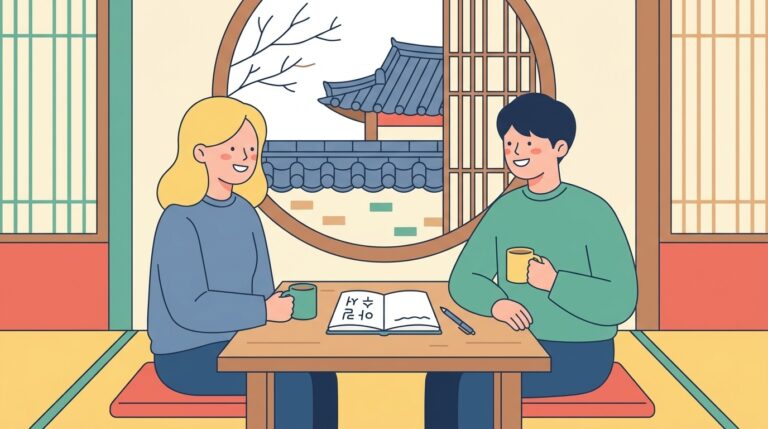
Imagine this: You are sitting in a beautifully renovated Hanok (traditional Korean house) cafe in the trendy neighborhood of Ikseon-dong, Seoul. Warm yellow lights hang above, and the smell of sweet dalgona coffee fills the air. You’re chatting with Minji, a friendly Korean coworker you’ve wanted to get closer to.
You want to break the ice, so you recall your beginner textbook and ask:
- “취미가 무엇입니까?” (Chwi-mi-ga mu-eot-im-ni-ka?)
Suddenly, the warm atmosphere freezes. Minji blinks in surprise. Why? Because you just sounded like a stern HR manager conducting a formal job interview!
In Korean culture, asking about hobbies is the ultimate way to build a connection, but textbooks often teach stiff, outdated sentences. Today, we are going to unlock the natural, warm, and real-life ways to ask about hobbies. By the end of this guide, you won’t just ask a question—you will start a genuine, laughter-filled conversation like a true local!
This guide is built on real feedback from hundreds of students at Daily Hangul who wanted to transition from “textbook robot” to “caring friend.” Let’s dive in!
Phase 2: Deep Dive into the Top 3 Real-Life Expressions
Here are the three golden phrases that will make any Korean smile and open up to you.
1. 취미가 뭐예요? (Chwi-mi-ga mwo-yae-yo?)
- Pronunciation: Chwi-mi-ga mwo-yae-yo? / Sound-alike: “Chee-mee-gah moy-eh-yo?”
- Meaning: What is your hobby? (Polite and standard)
- K-Culture Moment: This is the safe, polite go-to phrase when two characters in a romantic K-drama are walking through a park on their first date.
- Editor’s Insight: While “취미” (chwi-mi) means hobby, ending the sentence with the friendly “-요” (-yo) makes it gentle and approachable. It’s polite enough for people you’ve just met but casual enough to keep the mood light.
- Situation Spectrum:
- Casual Friends: ✅
- Coworkers / Semi-formal: ✅
- Boss / Formal Elders: ⚠️ (May sound slightly informal to a very strict boss, but generally acceptable)
- 🤔 Think About It: In Korean, we rarely say “당신의 취미” (dang-sin-ui chwi-mi – your hobby). Why do you think Koreans drop the word “your” in daily conversations? (Hint: Korean is a highly context-dependent language where “we” and “common ground” are valued over spelling out pronouns!)
2. 쉬는 날에 보통 뭐 해요? (Shwi-neun nal-ae bo-tong mwo hae-yo?)
- Pronunciation: Shwi-neun nal-ae bo-tong mwo hae-yo? / Sound-alike: “Shee-noon nal-eh bo-tong mwo-heh-yo?”
- Meaning: What do you usually do on your days off?
- K-Culture Moment: This is exactly how K-Pop idols answer questions in cozy lifestyle vlogs. It conjures images of lying in bed, eating late-night ramen, or visiting aesthetic cafes.
- Editor’s Insight: This is actually the most natural way to ask about hobbies in Korea. Many Koreans feel pressured by the word “hobby” (thinking they must do something grand like mountain climbing or playing violin). Asking about “days off” is relaxing and invites cozy answers like “I just watch Netflix!”
- Situation Spectrum:
- Casual Friends: ✅
- Coworkers / Semi-formal: ✅
- Boss / Formal Elders: ⚠️ (Keep it polite by keeping the “요” ending)
3. 요즘 빠져 있는 거 있어요? (Yo-jeum ppa-jyeo in-neun geo it-seo-yo?)
- Pronunciation: Yo-jeum ppa-jyeo in-neun geo it-seo-yo? / Sound-alike: “Yo-jum pah-jyo een-noon guh eet-suh-yo?”
- Meaning: Is there anything you are hooked on lately? / What are you into these days?
- K-Culture Moment: Think of a fun K-variety show host asking a guest about their current obsession—be it a new mobile game, a K-drama like Queen of Tears, or a specific convenience store snack.
- Editor’s Insight: The word “빠지다” (ppa-ji-da) literally means “to fall into” or “to drown in.” Saying you “fell into” something means you love it passionately. This phrase is incredibly warm and trendy!
- Situation Spectrum:
- Casual Friends: ✅
- Coworkers / Semi-formal: ✅
- Boss / Formal Elders: 🚫 (Too casual and subjective for a formal environment)
- 🤔 Think About It: Culturally, Koreans love trends (called 유행 – yu-haeng). Asking what someone is “hooked on lately” reflects the fast-paced, passionate nature of Korean youth culture.
Phase 3: Textbook Korean vs. Real Korean
Let’s look at how textbooks can sometimes make you sound like a robot, and how you can fix it instantly!
Scenario 1: Breaking the ice with a new classmate
- 📖 Textbook Korean: “당신의 취미는 무엇입니까?” (Dang-sin-ui chwi-mi-neun mu-eot-im-ni-ka? – “What is your hobby?”)
- 🗣️ Real Korean: “요즘 뭐 하고 놀아요?” (Yo-jeum mwo ha-go nol-ah-yo? – “What do you do for fun lately?”)
- 💡 Why it’s different: “놀다” (nol-da) means “to play” or “to hang out.” Asking what someone does to “play” these days is warm, youthful, and immediately breaks down social walls.
Scenario 2: Sharing your own hobby
- 📖 Textbook Korean: “제 취미는 음악 감상입니다.” (Je chwi-mi-neun eum-ak gam-sang-im-ni-da. – “My hobby is music appreciation.”)
- 🗣️ Real Korean: “저 요즘 뉴진스 노래에 완전 꽂혔어요!” (Jeo yo-jeum NewJeans no-rae-ae wan-jeon kkot-hyeot-eo-yo! – “I’m totally hooked on NewJeans’ songs lately!”)
- 💡 Why it’s different: “음악 감상” (eum-ak gam-sang) sounds like a formal resume entry. Real Koreans use dynamic words like “꽂히다” (kkot-hi-da – to be plugged into/obsessed with) to show genuine, contagious excitement!
Phase 4: K-Culture Deep Dive & Non-Verbal Etiquette
4-1. “Nunchi” (눈치) and Body Language
When asking about hobbies, Korean culture places huge importance on 리액션 (ri-aek-syeon – reactions).
* The Head Tilt and Nod: When your partner answers, nod your head slightly and say “아~ 진짜요?” (Ah~ jin-jja-yo? – Oh, really?).
* Eye Contact: Keep soft, friendly eye contact. Avoid stiff postures. Lean in slightly to show you are entering their personal “cozy zone.”
4-2. The “So-hwak-haeng” (소확행) Culture Code
In the past, Koreans felt they had to have highly productive hobbies (learning English, playing classical instruments). Today, the trend is 소확행 (So-hwak-haeng)—Small but Certain Happiness.
When you ask a Korean about their hobby, don’t be surprised if they say “just lying down” (누워 있기), “café hopping” (예쁜 카페 가기), or “looking at the Han River” (한강 보기). Valuing these tiny moments of rest is a core part of modern Korean lifestyle.
Phase 5: Interactive Euljiro LP Bar Roleplay
The Setting: You are at a trendy, dimly-lit LP vinyl bar in Euljiro, Seoul. Old-school Korean city pop is playing softly in the background. You are sitting at the bar next to Minjun, a cool local graphic designer.
Minjun: (Smiling warmly, sliding a menu toward you)
        여기 분위기 진짜 좋죠?
        (Yeo-gi bun-wi-gi jin-jja jot-jyo?)
        "The atmosphere here is really great, right?"

You:    (Nodding eagerly)
        네, 정말 마음에 들어요!
        (Nae, jeong-mal ma-eum-ae deul-eo-yo!)
        "Yes, I really love it!"

Minjun: (Curious)
        한국에는 여행으로 오신 거예요?
        (Han-guk-ae-neun yeo-haeng-eu-ro o-sin geo-yae-yo?)
        "Did you come to Korea for travel?"

You:    (Proudly)
        네! 한국 문화가 좋아서 왔어요.
        (Nae! Han-guk mun-hwa-ga jo-ah-seo wat-eo-yo.)
        "Yes! I came because I love Korean culture."

Minjun: (Shining eyes)
        우와, 대단해요!
        (U-wa, dae-dan-hae-yo!)
        "Wow, that's amazing!"
🔀 Decision Point: Minjun asks you:
“쉬는 날에 보통 뭐 하세요?” (What do you usually do on your days off?)
How do you respond? Choose your path:
- Option A: “제 취미는 독서와 음악 감상입니다.” (Je chwi-mi-neun dok-seo-wa eum-ak gam-sang-im-ni-da.)
- Option B: “저 요즘 K-드라마에 완전 빠졌어요!” (Jeo yo-jeum K-deu-ra-ma-ae wan-jeon ppa-jyeot-eo-yo!)
- Option C: “그냥 집에서 자요.” (Geu-nyang jib-ae-seo ja-yo.)
💡 The Editor’s Analysis:
- Best Choice: Option B! This is incredibly natural. It shares a specific, relatable interest and uses the lively “완전 빠졌어요” (totally hooked) phrase. Minjun will immediately ask which drama you are watching!
- Safe but Stiff: Option A. While grammatically perfect, it feels like you are reading from a 1990s school textbook. It limits the natural flow of conversation.
- A Bit Too Minimal: Option C. “I just sleep at home” is honest and very Korean, but as a beginner looking to make friends, it might end the conversation too quickly unless you add a laugh!
Phase 6: 10-Second Emotion Shadowing Drill
Let’s practice speaking with feeling. Read these aloud, focusing on the pauses (/) and emotional cues!
- [😊 Bright and Curious]
- “취미가 / 뭐예요?”
- (Chwi-mi-ga / mwo-yae-yo?)
- [🤩 Super Excited]
- “저 요즘 / K-pop에 / 완전 / 빠졌어요!”
- (Jeo yo-jeum / K-pop-ae / wan-jeon / ppa-jyeot-eo-yo!)
- [🥺 Friendly and Cozy]
- “쉬는 날에 / 보통 / 뭐 해요?”
- (Shwi-neun nal-ae / bo-tong / mwo hae-yo?)
Phase 7: K-Culture Mini Dictionary
| Word | Hangul / Romanization | Meaning & Cultural Usage |
|---|---|---|
| 덕질 | 덕질 (Deok-jil) | Actively fangirling/fanboying. Combining “Deoku” (Otaku/Geek) + “jil” (action). Used for deeply pursuing hobbies like collecting merchandise or going to concerts. |
| 소확행 | 소확행 (So-hwak-haeng) | Small but certain happiness. Finding peace in simple hobbies like sipping hot tea or buying freshly baked bread. |
| 홈루덴스 | 홈루덴스 (Hom-ru-den-seu) | “Home Ludens” (playing human at home). A modern keyword for homebodies who create cozy hobbies inside their rooms. |
| 불멍 | 불멍 (Bul-meong) | Staring blankly at a campfire to empty your mind. A massive hobby trend in Korea’s camping scene. |
Phase 8: Traveler’s Survival Kit
Planning a trip to Korea soon? Keep these three handy expressions close to your heart!
- “요즘 서울에서 어떤 카페가 핫해요?”
- Yo-jeum Seoul-ae-seo eo-tteon ka-pe-ga hat-hae-yo?
- “Which cafes are hot in Seoul these days?”
- “추천해 주실 만한 취미 있어요?”
- Chu-cheon-hae ju-sil man-han chwi-mi it-seo-yo?
- “Is there any hobby you would recommend?”
- “저랑 같이 산책할래요?”
- Jeo-rang gat-i san-chaek-hal-rae-yo?
- “Would you like to go for a walk with me?” (Walking along the Han River is the ultimate local hobby!)
📌 Editor’s Travel Note: To discover where locals enjoy their hobbies, download the Naver Map App. Use search terms like
#을지로맛집(Euljiro Hot Restaurants) or#망원동카페(Mangwon-dong Cafes) on Instagram to find trendy local hangout spots. (Note: Local popular spots can change rapidly, so checking recent uploads is highly recommended!)
Phase 9: Deep Thoughts — “One Step Deeper”
In Western cultures, when someone asks about your hobbies, you might talk about hiking, painting, or playing soccer.
In Korea, however, the concept of “hobbies” is deeply linked to the collective rhythm of life. During the economic boom, hobbies were seen as luxurious or lazy. But today, the Korean youth have redefined hobbies as a form of “healing” (힐링). A hobby isn’t something you have to master; it is simply a safe space where you can pause your busy life.
💬 Your Turn: Does your culture view hobbies as something you need to be good at, or purely as a way to rest? Share your thoughts in the comments below! We love reading your cultural stories.
Phase 10: FAQ & Common Mistakes (FAQ Schema Optimized)
Q: Can I ask an older person or a boss “취미가 뭐예요?”
A: Yes, but with care. While “-요” (-yo) is polite, it is safer to ask a superior: “주말에 보통 어떻게 보내세요?” (Ju-mal-ae bo-tong eo-tteok-hae bo-nae-sae-yo? – “How do you usually spend your weekends?”). This sounds highly respectful.
Q: What is the difference between “취미” and “특기”?
A: “취미” (Chwi-mi) is what you enjoy doing (Hobby), while “특기” (Teuk-gi) is what you are exceptionally good at (Specialty/Talent). In resume forms, Koreans are always asked to write both!
Q: Is “Netflix 보기” (watching Netflix) considered a real hobby in Korea?
A: Absolutely! In fact, “넷플릭스 보기” (Net-pleuk-seu bo-gi) is arguably the most common hobby answer among Korean university students and young workers today.
🚨 Common Mistakes Alert!
- Overusing “당신” (Dang-sin): Avoid saying “당신의 취미” (your hobby). It sounds unnatural. Just say “취미가 뭐예요?”
- Using “~입니다” (Imnida) in casual bars: Saying “제 취미는 ~입니다” in a cozy bar feels overly robotic. Stick to “~요” (-yo).
- Using “~를 좋아합니다” (I like…) with complex verbs: Instead of “저는 영화 감상을 좋아합니다,” simply say “영화 보는 거 좋아해요” (Yeong-hwa bo-neun geo jo-ah-hae-yo – I like watching movies).
Phase 11: Daily Hangul Action Missions!
Ready to put this into action? Complete these three fun missions:
- 🥉 Bronze Mission (The Mirror Challenge): Stand in front of a mirror, smile, and say “쉬는 날에 보통 뭐 해요?” naturally three times.
- 🥈 Silver Mission (Social Media Drop): Leave a comment on your favorite K-Pop idol’s social media or a language exchange forum using: “요즘 빠져 있는 노래 있어요?” (Is there a song you are hooked on lately?)
- 🥇 Gold Mission (Real Connection): Next time you meet a Korean speaker, don’t ask “취미가 뭐예요?” Instantly ask them: “요즘 빠져 있는 드라마 있어요?” (Are you hooked on any K-dramas lately?)
🎮 K-Culture Bonus Mission: Watch a lifestyle vlog of your favorite Korean celebrity on YouTube. Listen closely for the word “쉬는 날” (days off) and count how many times they say it!
Phase 12: Interactive Quiz Challenge
Let’s test your new skills! Can you score a perfect 3/3?
1. Which phrase is the most natural way to ask a Korean peer about their hobbies without making them feel pressured?
- A) 취미가 무엇입니까?
- B) 쉬는 날에 보통 뭐 해요?
- C) 특기가 있습니까?
👉 Click here to reveal the answer!
Correct Answer: B!
Asking about “days off” (쉬는 날) is the warmest, most stress-free way to invite a natural conversation about hobbies in modern Korea. Option A is too formal, and Option C asks for their special talent, which feels like an audition!
2. Fill in the blank: “저 요즘 한국어 공부에 완전 _________!” (I’m totally hooked on studying Korean lately!)
- A) 꽂혔어요 (kkot-hyeot-eo-yo)
- B) 입니다 (im-ni-da)
- C) 씁니다 (sseup-ni-da)
👉 Click here to reveal the answer!
Correct Answer: A!
“꽂혔어요” (from 꽂히다, to be plugged into/hooked) is the perfect dynamic slang to show you are passionately obsessed with a hobby!
3. True or False: Asking about hobbies in Korea is considered rude if you’ve just met someone.
- True / False
👉 Click here to reveal the answer!
Correct Answer: False!
Asking about hobbies or weekend plans is a very friendly, polite way to build rapport (relationship) and break the ice in Korea, as long as you use polite “-요” endings!
Did you enjoy today’s cozy lesson? Learning Korean is more than just memorizing vocabulary; it’s about connecting with real hearts. Bookmark Daily Hangul for more warm, practical guides, and see you in the next unit! 다음에 또 만나요! (Dae-eum-ae tto man-na-yo! – See you next time!)






