

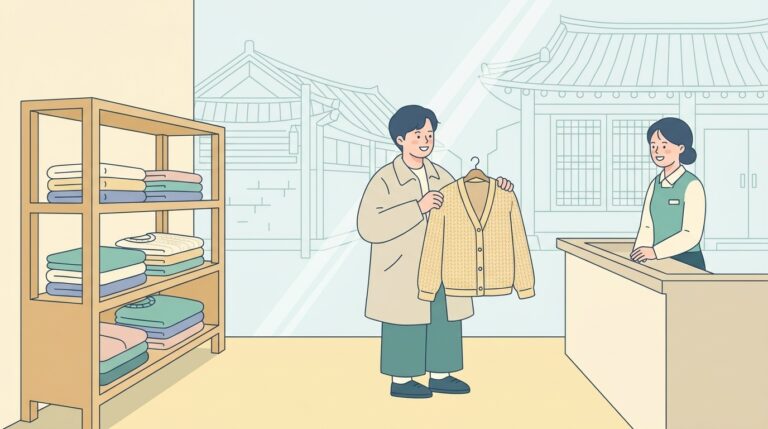
Keep Your K-Fashion Fresh: How to Ask About Fabrics and Laundry in Korean
안녕하세요! (An-nyeong-ha-se-yo!) Your trusted Daily Hangul editor and local culture guide is back!
Imagine this: You’re strolling through the trendy streets of Sinsa-dong Garosu-gil, surrounded by sleek boutiques. You find the perfect wool-blend cardigan—exactly like the one your favorite K-drama lead wore in Queen of Tears. You buy it, wear it proudly, and then comes the terrifying part: washing it. You throw it in your Airbnb washing machine, and… oh no. Your gorgeous oversized cardigan has shrunk to fit a teddy bear.
We’ve all been there! Shopping for Korean fashion (K-fashion) is incredibly exciting, but caring for those unique fabrics can be a challenge. Today, we’re diving deep into the world of Korean fabric names and laundry instructions so you can shop with confidence and keep your wardrobe looking pristine.
Phase 2: Core Expressions Deep Dive
Let’s master the three most important phrases you’ll need at any Korean boutique or neighborhood dry cleaner (세탁소 – se-taek-so).
1. 이거 물세탁 해도 돼요? (Can I water-wash this?)
- Pronunciation: I-geo mul-se-tak hae-do dwae-yo?
- Sound-alike: “Ee-guh mool-she-tack hae-do dweh-yo?”
- Meaning: Can I machine-wash or hand-wash this with water (as opposed to dry cleaning)?
- K-Culture Moment: This is the exact question a smart consumer asks when shopping in Hongdae’s independent designer shops where care labels might be missing or confusing.
- Editor’s Insight: “물세탁” (mul-se-tak) literally translates to “water washing.” In Korea, clothes that require delicate care are often dry-cleaned, so asking if a garment can handle regular water is a lifesaver.
- Situation Spectrum:
- Casual (Friends): 이거 물세탁 해도 돼? (✅)
- Semi-formal (Clerk): 이거 물세탁 해도 돼요? (✅)
- Formal (Elderly tailor): 혹시 이 제품 물세탁이 가능한가요? (✅)
- 🤔 Think About It: Why does Korean have a specific word for “water washing” (물세탁) instead of just saying “washing”? This reflects Korea’s highly developed dry-cleaning culture, where regular laundry and dry cleaning are strictly categorized.
2. 이 옷 재질이 어떻게 돼요? (What is this fabric made of?)
- Pronunciation: I ot jae-jil-i eo-tteo-ke dwae-yo?
- Sound-alike: “Ee oht jae-jeel-ee uh-ttuh-keh dweh-yo?”
- Meaning: What is the material/texture of this clothing?
- K-Culture Moment: Picture a high-end shopping scene in a Hanok-style boutique in Samcheong-dong, where you want to know if a beautiful trench coat is made of pure cotton or a synthetic blend.
- Editor’s Insight: Koreans use the word “재질” (jae-jil – material/texture) or “소재” (so-jae – raw material). Asking “어떻게 돼요?” (How does it become?) is a polite, indirect way of asking “What is it?” without sounding too demanding.
- Situation Spectrum:
- Casual: 이 옷 재질이 뭐야? (✅)
- Semi-formal: 이 옷 재질이 어떻게 돼요? (✅)
- Formal: 이 제품의 원단 소재를 여쭤봐도 될까요? (✅)
- 🤔 Think About It: Notice how we don’t say “이 옷 재질이 무엇입니까?” (What is this material?). In Korean culture, asking for information indirectly using “어떻게 돼요?” (eo-tteo-ke dwae-yo) is much warmer and politer.
3. 드라이클리닝 맡겨야 하는 소재인가요? (Does this fabric need to be dry-cleaned?)
- Pronunciation: Deu-ra-i-keul-li-ning mat-gyeo-ya ha-neun so-jae-in-ga-yo?
- Sound-alike: “Deu-ry-kleen-ing mat-gyuh-yah ha-noon so-jae-een-gah-yo?”
- Meaning: Is this a material that I must hand over for dry cleaning?
- K-Culture Moment: You are standing in a local neighborhood laundry shop (세탁소), handing over a delicate silk blouse or a heavy wool coat.
- Editor’s Insight: The verb “맡기다” (mat-gi-da) means “to entrust” or “to leave.” In Korea, you don’t just “do” dry cleaning; you “entrust” your clothes to the experts.
- Situation Spectrum:
- Casual: 이거 드라이 해야 돼? (✅)
- Semi-formal: 이거 드라이클리닝 맡겨야 돼요? (✅)
- Formal: 혹시 이 제품은 드라이클리닝이 필수인가요? (✅)
- 🤔 Think About It: Korea’s local dry cleaners are highly trusted. Why do you think modern apartments in Korea still have dry-cleaning delivery trucks visiting daily? It’s because looking neat and wrinkle-free is a major part of Korean social etiquette.
Phase 3: Textbook Korean vs. Real-World Korean
Let’s bridge the gap between classroom Korean and what Koreans actually say on the streets!
Situation 1: Asking if a fabric shrinks in the wash
- 📖 Textbook Korean: 이 섬유는 세탁 시 수축합니까? (Does this fiber contract during washing? – Too academic, sounds like a textile science lab!)
- 🗣️ Real Korean: 이거 빨면 많이 줄어들어요? (Does this shrink a lot if I wash it?)
- 💡 Why it’s different: Conversational Korean prefers the intuitive verb “줄어들다” (jul-eo-deul-da – to shrink/decrease) over the Chinese character-based (Hanja) academic term “수축” (su-chuk – contraction).
Situation 2: Checking if a t-shirt is 100% cotton
- 📖 Textbook Korean: 이것은 백 퍼센트 면 섬유입니까? (Is this a one-hundred percent cotton fiber? – Stiff and unnatural.)
- 🗣️ Real Korean: 이거 면 100(백)이에요? 또는 이거 순면이에요? (Is this 100% cotton? / Is this pure cotton?)
- 💡 Why it’s different: Koreans love efficiency. Saying “면 백” (myeon-baek – cotton 100) or using the prefix “순-” (sun- – pure, as in “순면”) is the ultimate local way to ask.
Phase 4: K-Culture Deep Dive & Non-Verbal Manners
4-1. Nunchi & Shopping Etiquette
When inspecting fabrics in Korea, it is polite to show respect for the garments. If you want to feel the texture, gently touch the hem of the sleeve using your fingertips. When handing a delicate item to a store clerk or a laundry master (세탁소 사장님), always use both hands (양손 – yang-son). This subtle physical gesture shows that you value their expertise and care for the clothing.
4-2. The Magic of the Neighborhood “Setaek-so” (세탁소)
In K-dramas, you often see characters visiting the local dry cleaner to chat, gossip, or get clothing altered. These neighborhood shops are cultural hubs. The master (사장님) can fix almost anything! From altering trousers (수선 – su-seon) to removing stubborn kimchi stains (얼룩 제거 – eol-ruk je-geo), they are the guardians of Korean fashion.
Phase 5: Live Roleplay — Shopping in Samcheong-dong
Setting: A minimalist designer boutique on a rainy afternoon. The soft scent of green tea fills the air. You are holding a beautiful knit sweater.
- Cast:
- You (B2 Korean Learner): Looking for high-quality, long-lasting knitwear.
- Min-ji (Shop Owner): A stylish and extremely helpful Seoul local.
- Dialogue:
- Min-ji: 어서 오세요! 편하게 둘러보세요. (Welcome! Please feel free to look around.)
- You: (Gently touching the sleeve) 저기요, 혹시 이 베이지색 가디건 다른 사이즈도 있나요? (Excuse me, do you have this beige cardigan in other sizes?)
- Min-ji: 아, 그 디자인은 프리사이즈(Free size)로 나왔어요. 낙낙하게 입는 스타일이에요. (Ah, that design comes in free size. It’s styled to fit loosely.)
- You: 아, 그렇군요. 근데 이거 재질이 어떻게 돼요? 되게 부드럽네요. (Ah, I see. But what material is this? It’s very soft.)
- Min-ji: 그 옷은 울이랑 캐시미어 혼방이에요. 그래서 맨살에 입어도 전혀 안 까끌거려요. (That one is a wool and cashmere blend. So even if you wear it on bare skin, it won’t feel scratchy at all.)
- You: 와, 캐시미어 혼방이군요! 혹시 이거 물세탁 해도 돼요? (Wow, a cashmere blend! Can I water-wash this?)
- Min-ji: 음… 아무래도 울이랑 캐시미어라, 첫 세탁은 드라이클리닝을 추천해 드려요. 그 다음부터는 미지근한 물에 울샴푸로 손빨래 하셔도 돼요. (Hmm… since it’s wool and cashmere, I recommend dry cleaning for the first wash. After that, you can hand-wash it in lukewarm water with wool detergent.)
- You: 아, 울샴푸로 손빨래하는 게 좋겠네요. 세탁기 울코스는 안 될까요? (Ah, hand-washing with wool detergent would be best. Would the wool cycle on a washing machine not work?)
- Min-ji: 세탁기 울코스로 돌리실 때는 꼭 세탁망에 넣어서 약하게 돌리셔야 해요. 그리고 늘어날 수 있으니까 절대 걸어서 말리지 마시고, 평평하게 뉘어서 말려주세요! (If you use the machine’s wool cycle, you must put it in a laundry net and run it gently. And since it can stretch, never hang it to dry; please lay it flat to dry!)
- You: 와, 친절한 설명 감사해요! 관리만 잘하면 진짜 오래 입겠어요. 이걸로 할게요. (Wow, thanks for the kind explanation! If I care for it well, I’ll wear it for a long time. I’ll take this one.)
🔀 Decision Point: What do you say when paying?
- Option A: “이거 대충 세탁기에 돌릴게요. 계산해 주세요.” (I’ll just roughly toss this in the washing machine. Please check me out.) -> Risky! Sounds a bit blunt and dismissive of the shop owner’s advice.
- Option B: “추천해 주신 대로 관리 잘해서 예쁘게 입을게요. 계산해 주세요!” (I’ll take good care of it just like you recommended and wear it beautifully. Please check me out!) -> Best Choice! Warm, polite, and shows true appreciation for her expertise.
- Option C: “너무 귀찮네요. 그냥 안 살래요.” (Too annoying. I won’t buy it.) -> Unfriendly! Standard polite refusal is better if you change your mind.
Phase 6: 10-Second Emotion Shadowing Drill
Let’s practice expressing polite concern about fabric care. Say this out loud with a slightly worried but polite tone:
“이거 / 물세탁 해도 돼요? / 혹시 / 줄어들거나 / 늘어날까 봐 / 걱정돼서요.”
- Emotional Guide: [🥺 Worried, yet incredibly polite and appreciative]
- Pronunciation Flow: I-geo / mul-se-tak hae-do dwae-yo? / hok-si / jul-eo-deul-geo-na / neu-reo-nal-kka-bwa / gyeok-jeong-dwae-seo-yo.
- Translation: “Can I water-wash this? I’m just worried it might shrink or stretch out.”
Phase 7: K-Culture Mini Dictionary
- 혼방 (Hon-bang): Blend fabric (e.g., 울 혼방 = wool blend). Essential word to check the fabric ratio on clothing tags.
- 손빨래 (Son-ppal-lae): Hand washing. A compound word combining “손” (hand) and “빨래” (laundry).
- 울샴푸 (Ul-syam-pu): Wool shampoo. In Korea, this refers to mild liquid detergent designed for delicate clothes, wool, and silk.
- 세탁망 (Se-tak-mang): Laundry net. Used universally in Korean households to prevent friction and stretching in the washing machine.
Phase 8: Traveler’s Survival Kit
Top 3 Survival Expressions
- 이거 물 빠짐 있어요? (I-geo mul ppa-jim is-seo-yo?)
- 💡 Pro Tip: Use this to ask if the color of denim or dyed fabrics will bleed during washing.
- 드라이클리닝 해 주세요. (Deu-ra-i-keul-li-ning hae ju-se-yo.)
- 💡 Pro Tip: Say this when dropping off your precious coats or blazers at a local dry cleaner.
- 소매 길이 좀 줄여주실 수 있나요? (So-mae gi-ri jom jul-yeo-ju-sil su in-na-yo?)
- 💡 Pro Tip: Use this to ask if they can shorten the sleeve length of a jacket.
📌 Editor’s Travel Note: Need to find a nearby coin laundry or traditional dry cleaner in Seoul? Simply open your Naver Map App and search for “코인빨래방” (Coin Laundromat) or “세탁소” (Laundry Shop). While coin laundromats accept credit cards, traditional neighborhood dry cleaners often appreciate cash or bank transfers for minor repairs.
Phase 9: Deep Thought — “An Appearance of Respect”
In Korea, clothing care goes beyond personal style. Keeping your clothes clean, stainless, and wrinkle-free is considered a form of respect (예의 – ye-ui) toward others. Walking into a business meeting or a social gathering with wrinkled or poorly washed clothes can be perceived as neglectful. This deep cultural value is why neighborhood 세탁소 (laundry shops) are so abundant, affordable, and trusted across the country.
💬 Your Turn: How does your home country view clothing care? Is dry cleaning a luxury or an everyday service? Let us know in the comments below!
Phase 10: FAQ & Common Mistakes
Q: Can I use a regular coin laundromat for my delicate K-fashion items?
A: Generally, no. Coin laundromats (코인빨래방) are designed for heavy-duty laundry like bedsheets and cotton t-shirts. For delicate wool, cashmere, or silk blends, always look for a traditional neighborhood 세탁소 and ask for 드라이클리닝 (dry cleaning).
Q: What does “드라이” mean on laundry tags in Korea?
A: It is the standard Korean abbreviation for “dry cleaning.” If a tag has a circle with the word “드라이,” it must be dry-cleaned.
🚨 Common Mistakes Alert!
- Mistake 1: Asking “이거 줄여주세요” (Please shrink this) when you actually mean “이거 작아지나요?” (Will this shrink?). “줄여주세요” is what you say to a tailor to alter/shorten the size!
- Mistake 2: Using standard detergent for wool garments. Always ask for 울샴푸 (wool shampoo) at the supermarket.
Phase 11: Action Missions
- 🥉 Bronze (At-Home Challenge): Look at your clothes right now. Find one care label and try to translate its composition to Korean (e.g., Cotton = 면, Polyester = 폴리에스테르).
- 🥈 Silver (Social Challenge): Take a photo of your favorite outfit and post it on social media with the caption: “이 옷 재질이 정말 부드러워요!” (The material of this clothing is really soft!).
- 🥇 Gold (Real-Life Challenge): Walk into a local clothing store or dry cleaner and confidently ask: “이거 물세탁 해도 돼요?” or “드라이클리닝 맡겨야 돼요?”
Phase 12: Interactive Quiz
Test your K-fashion care knowledge!
🔍 Q1: What is the most natural way to ask if a fabric shrinks in the wash?
Answer: 이거 빨면 많이 줄어들어요? (Option like “수축합니까?” is too academic for daily shopping!)
🔍 Q2: True or False: You should use regular laundry detergent for wool and cashmere in Korea.
Answer: False! You should use 울샴푸 (wool shampoo) to protect the delicate fibers.
🔍 Q3: Match the Korean word to its meaning: ① 혼방 ② 손빨래 ③ 세탁소
Answer:
① 혼방 = Blend fabric
② 손빨래 = Hand wash
③ 세탁소 = Laundry shop/Dry cleaners
“,







