

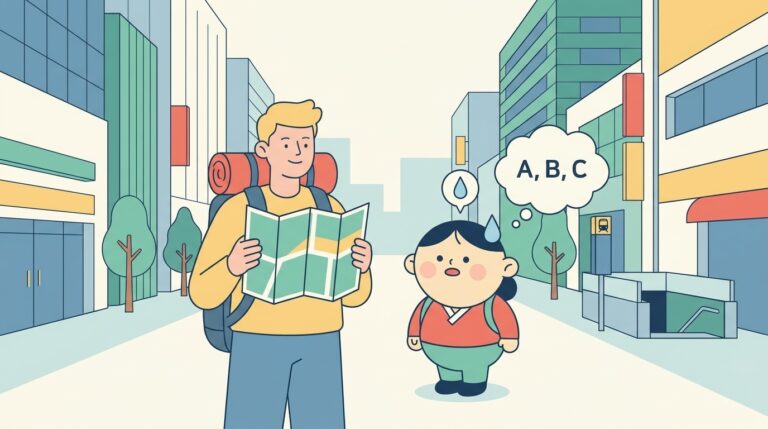
Why Do Koreans Run Away From You? The Truth About Korean English Phobia and How to Break the Ice
Phase 1: Empathy — Friday Night in Hongdae
Imagine this: It is a cool Friday evening in the trendy streets of Hongdae, Seoul. The neon signs are glowing with bright pinks and yellows, and the delicious smell of sweet and spicy Tteokbokki (떡볶이 / spicy rice cakes) fills the air. You are trying to find a famous cafe, but your phone GPS is acting confused.
You see a young, stylish Korean office worker holding an iced Americano. You walk up, smile, and say, “Excuse me, do you know where…?”
Suddenly, the person’s eyes widen with panic. They freeze like a statue. They quickly cross their arms to make a giant ‘X’ sign with their hands, whisper “Ah… sorry!” and walk away as fast as they can, looking down at the pavement.
Ouch. Your heart sinks. Did you do something wrong? Do they not like foreigners?
No! Absolutely not!
What you just experienced is not rejection. It is a legendary Korean phenomenon called Yeong-eo Ulleongjeung (영어 울렁증), which literally translates to “English Nausea” or “English Phobia.”
In this guide, you will discover why friendly Koreans sometimes run away from English speakers, how to understand their secret stress, and learn three magic phrases that will instantly turn their panic into a warm, helpful smile. Let’s dive in!
Phase 2: Three Core Expressions to Melt the Ice
To make local friends and get help on the streets of Seoul, you do not need perfect Korean. You just need to show that you understand their feelings. Here are three super-easy phrases to use:
1. 영어 잘 못해도 괜찮아요 (Yeong-eo jal mot-hae-do gwen-chan-ah-yo)
- Pronunciation: [Yung-uh jal mot-hae-do gwen-chahn-ah-yo] / Sound-alike: “Young-uh jal mote-eh-do gwen-chan-ah-yo”
- Meaning: “It is okay if you are not good at English!”
- K-Culture Moment: You will see this exact relief in Korean variety shows like Running Man or 2 Days & 1 Night. When a foreign guest appears, the Korean cast members look terrified until someone says, “It’s okay!” instantly bringing back their big laughs.
- Editor’s Insight: This is your absolute superpower phrase. It instantly lowers the local person’s heart rate because you are taking away their pressure to speak “perfect” English.
- Situation Spectrum:
- Friends & Casual: ✅
- Coworkers & Semi-formal: ✅
- Bosses & Formal: ✅
- 🤔 Think About It: Why do you think Koreans feel so much pressure to speak English perfectly? Does your country have a similar pressure when speaking a second language?
2. 잠시만요 (Jam-si-man-yo)
- Pronunciation: [Jam-see-man-yo] / Sound-alike: “Gym-see-man-yo”
- Meaning: “Just a moment, please.”
- K-Culture Moment: In K-Dramas, you see busy Seoulites saying this politely as they squeeze through a crowded subway door or when pausing a phone call.
- Editor’s Insight: If a Korean person is trying to help you but looks frozen, they might be searching their brain for English words. Saying “Jam-si-man-yo” gives them a polite pause button to breathe or check their translation app.
-
Situation Spectrum:
- Friends & Casual: ✅
- Coworkers & Semi-formal: ✅
- Bosses & Formal: ✅
- 🤔 Think About It: How does giving someone a few seconds to think change the energy of a conversation?
3. 괜찮아요 (Gwen-chan-ah-yo)
- Pronunciation: [Gwen-chan-ah-yo] / Sound-alike: “Gwen-chahn-ah-yo”
- Meaning: “It’s okay” / “No worries.”
- K-Culture Moment: The ultimate K-Drama healing phrase. Whether someone spills coffee or makes a mistake, saying “Gwen-chana-yo” with a soft smile always saves the day.
- Editor’s Insight: If you ask for help and the person looks too stressed to answer, just smile warmly and say “Gwen-chan-ah-yo.” It lets them know there is no pressure and that you appreciate their effort anyway.
-
Situation Spectrum:
- Friends & Casual: ✅
- Coworkers & Semi-formal: ✅
- Bosses & Formal: ✅
- 🤔 Think About It: “Gwenchana” represents the warm, empathetic heart of Korean culture. How does showing empathy help when there is a language barrier?
Phase 3: Textbook Korean vs. Real Korean
Let’s compare the cold sentences you find in old grammar books with the friendly, natural phrases locals actually use.
Situation 1: Asking if they speak English
- 📖 Textbook Korean: 영어 할 수 있습니까? (Yeong-eo hal su its-seumnika?)
- Why it is awkward: This sounds like a strict job interview question. It can feel like you are testing their abilities, which increases their anxiety!
- 🗣️ Real Korean: 혹시… 영어 가능하세요? (Hoksi… yeong-eo ganeung-haseyo?)
- Why it is better: “Hoksi” means “by any chance.” This creates a gentle cushion. “Ganeung-haseyo?” (Is it possible?) is much softer and more polite.
Situation 2: Asking for directions
- 📖 Textbook Korean: 나를 도와주세요! (Nareul dowajuseyo!)
- Why it is awkward: This sounds very dramatic! It sounds like you are in serious physical danger or drowning.
- 🗣️ Real Korean: 저기요, 길 좀 여쭤볼게요. (Jeogiyo, gil jom yeotjjeobolgeyo.)
- Why it is better: “Jeogiyo” gets attention gently (like “Excuse me”), and “gil jom yeotjjeobolgeyo” means “I’d like to ask for directions for a moment.” It sounds casual, safe, and very natural.
⚠️ Bottom Note: As a B1 learner, using “Hoksi” (혹시) is your best friend. It shows you respect their personal space and feelings!
Phase 4: K-Culture Deep Dive & Non-verbal Manners
4-1. The ‘X’ Gesture and Korean Nunchi (눈치)
If a Korean person makes an ‘X’ sign with their arms, do not be offended! In Western cultures, crossing arms can look defensive or rude. In Korea, it is simply a visual emergency signal that means: “My brain cannot process English right now, and I am too embarrassed to make a mistake!”
To handle this with perfect Nunchi (the Korean art of reading the room and understanding feelings):
1. Maintain Personal Space: Koreans highly value physical distance. Do not stand too close when asking for help.
2. The Polite Head Bow: A slight tilt of your head and upper body while saying “Jeogiyo” (Excuse me) instantly shows that you respect Korean etiquette.
4-2. The Shadow of the Korean English Education System
Why are they so scared? In Korea, students study English grammar and reading for over 10 years to pass the extremely difficult college entrance exam, the Suneung (수능).
However, because the tests focus purely on grammar rules and translation, most Koreans rarely get to speak English with real people. They are terrified of making a tiny grammatical mistake in public because Korean society often values perfection. When you approach them, they do not want to fail you or look foolish, so they run away to save face!
Phase 5: Interactive Role-Play Scenario
The Setting: You are standing near Euljiro 3-ga Station on a rainy night. Streetlights reflect on the wet road. You are looking for a hidden, hip alleyway cafe. You see Min-su, a tired office worker holding an umbrella.
The Dialogue
- You: (🎭 Approaching slowly with a gentle smile and a slight bow) 저기요, 혹시… (Jeogiyo, hoksi…)
- Min-su: (🎭 Eyes widening in surprise, holding his breath) Oh! Hello… yes?
- You: (🎭 Noticing his tense shoulders, speaking softly) 영어 잘 못하셔도 진짜 괜찮아요! (Yeong-eo jal mot-hasyeodo jinjja gwen-chaneuyo!)
- Min-su: (🎭 Blushing but smiling with huge relief, shoulders dropping) Ah! Really? Thank you! 한국어 잘하시네요! (You speak Korean well!)
- You: (🎭 Shaking your head modestly) 아니에요, 조금만 해요. 을지로 카페 어떻게 가요? (Anieyo, jogeumman haeyo. Euljiro cafe eotteoke gayo?)
- Min-su: (🎭 Nodding happily, tapping his phone screens) Ah, Euljiro Cafe! 잠시만요… (Jam-si-man-yo…)
- You: (🎭 Waiting patiently) 네, 천천히 하세요. (Ne, cheon-cheon-hi haseyo.)
- Min-su: (🎭 Showing you his phone screen) Look here! Go straight and turn right at the convenience store! 편의점 오른쪽이요!
- You: (🎭 Giving a warm 15-degree bow) 아, 확인했어요! 진짜 감사합니다. (Ah, hwaginhaess-eoyo! Jinjja gamsahamnida.)
- Min-su: (🎭 Waving warmly with a proud smile) No problem! Enjoy your Korean trip! 한국 여행 즐겁게 하세요!
🔀 Decision Point
If Min-su looks like he is going to run away the second you speak, what should you do?
- A) Use the Magic Korean Phrase: Bow slightly, smile, and say: “영어 잘 못하셔도 진짜 괜찮아요!”
- B) Get Loud and Direct: Grab his shoulder, point at your map, and shout: “ENGLISH? CAFE? HERE?”
- C) Screen Thrust: Say nothing, walk directly into his personal space, and put your phone 2 inches away from his face with Google Translate open.
💡 Feedback
- If you chose A (Best Choice): You are an absolute K-culture master! This removes all his panic and makes him feel safe and helpful. You will likely make a local friend!
- If you chose B (Bad Choice): Oh no! This is the ultimate fight-or-flight trigger. Min-su will probably run away at lightning speed.
- If you chose C (Risk Choice): This is very invasive in Korea. Pushing a screen into someone’s face without polite greetings like “Jeogiyo” is considered quite rude.
Phase 6: 10-Second Emotion Shadowing Drill
Let’s practice speaking with real Korean emotion! Focus on the pauses marked by / and the feelings in the brackets.
- [🥺 Shy & Softly]
저기요… / 혹시… / 영어 가능하세요?
(Jeo-gi-yo… / hok-si… / yeong-eo ga-neung-ha-se-yo?) -
[😊 Warm & Reassuring]
영어 잘 못하셔도 / 진짜 / 괜찮아요!
(Yeong-eo jal mot-ha-syeo-do / jin-jja / gwen-chan-ah-yo!) -
[😤 Helpful & Bright]
길 좀 / 여쭤볼게요!
(Gil jom / yeot-jjeo-bol-ge-yo!)
Phase 7: K-Culture Mini Dictionary
| Word | Romanization | Meaning | Cultural Context |
|---|---|---|---|
| 울렁증 | Ulleongjeung | Stage fright / Phobia | Often used for “English Phobia” (영어 울렁증) or “Camera Phobia” (카메라 울렁증). |
| 수능 | Suneung | College Entrance Exam | The high-pressure, life-changing exam that shapes Korea’s intense study culture. |
| 주입식 교육 | Juipsik Gyoyuk | Cramming / Rote learning | The style of education focused on memorization rather than creative discussion. |
| 길치 | Gilchi | Directions-challenged | A cute way to describe someone who gets lost easily, even with a map! |
| 눈치 | Nunchi | Social sensitivity | The ability to read other people’s unspoken feelings and adjust your behavior. |
Phase 8: Traveler’s Survival Kit
If you get lost in Korea, here are 3 quick lifelines to keep in your pocket:
- “길을 잃었어요” (Gireul ireoss-eoyo) — “I am lost.”
- “도와주실 수 있나요?” (Dowajusil su innayo?) — “Can you help me?”
- “지하철역이 어디예요?” (Jihacheol-yeoki eodi-yeyo?) — “Where is the subway station?”
📌 Editor’s Travel Note
Google Maps does not work well for walking directions in Korea due to security laws. For the best travel experience, download the Naver Map App Download Page or the KakaoMap App Download Page before you arrive. They are highly accurate and offer English options!
Phase 9: Deep Reflection — “One Step Deeper”
Behind the funny “running away” stories lies a deeper story about South Korea’s rapid economic growth. In just a few decades, Korea transformed into a global tech and cultural powerhouse. To compete globally, speaking English became a strict requirement for high-paying jobs.
This high standard created a society where making mistakes in public is highly stressful. Understanding this allows us to see that the stranger running away from you is actually fighting an invisible monster of high expectations.
💬 Your Turn: How does your home country view mistakes when learning a new language? Do you feel similar anxiety? Let us know in the comments below!
Phase 10: FAQ & Avoiding Common Mistakes
Q: Are Koreans unfriendly to foreigners?
A: No, absolutely not! Koreans are famous for their Jeong (정 / warm affection and hospitality). If they run away, it is because of their own anxiety about speaking English incorrectly, not because of you.
Q: Should I try to speak English anyway?
A: Yes, but slowly! If you start with a tiny bit of Korean (like “Jeogiyo”), it shows you are trying. This immediately makes them feel more comfortable trying their English with you.
Q: What should I do if they still run away?
A: Just smile, bow your head slightly, say “Gwen-chan-ah-yo!” and try asking someone else. Do not take it personally!
🚨 Common Mistakes Alert!
- Speaking too fast: Even if a Korean knows English, fast native speech is very hard to process under pressure.
- Not using physical manners: Standing too close or touching someone’s arm to get attention is considered rude in Korea.
- Forgetting to bow: A small head tilt goes a long way in showing polite intentions.
Phase 11: Action Missions
- 🥉 Bronze Mission (My Room Challenge): Record your voice saying “Yeong-eo jal mot-hasyeodo jinjja gwen-chaneuyo!” three times with a warm, friendly smile.
- 🥈 Silver Mission (Social Challenge): Share this blog post on your social media and tell us your favorite K-Drama scene where characters looked shy or nervous.
- 🥇 Gold Mission (Real-world Challenge): Next time you meet a Korean speaker (online or offline), start the conversation with “Hoksi…” (혹시) and see how their expression softens!
- 🎮 K-Culture Mission: Watch an episode of a Korean travel variety show (like Youth Over Flowers) and count how many times the cast members look nervous when ordering food in English!
Phase 12: Interactive Quiz Challenge
Test your new K-culture knowledge! Click the boxes below to check the answers.
1. What does the arm gesture ‘X’ mean when a Korean does it on the street?
Click to reveal the answer!
It is a polite, panicked signal meaning “System Error: English Not Found!” It is not rude; it just means they are too shy to speak English. Say “Gwen-chana-yo” to make them feel safe!
2. Fill in the blank: “혹시… 영어 _______?” (By any chance, is English possible?)
Click to reveal the answer!
가능하세요? (ganeung-haseyo?)
This is the most natural and polite way to ask if someone can speak English without putting pressure on them!
3. True or False: Google Maps is the best map app to use when walking around Seoul.
Click to reveal the answer!
False! Due to local security regulations, Google Maps is not fully functional for walking directions in Korea. You should use Naver Map or KakaoMap for the best experience!







