

The Smart Shopper’s Secret: How to Score Epic Fashion Deals at Korean Outlets like a Local
안녕하세요! Welcome back to another edition of Daily Hangul, your premium guide to mastering not just the Korean language, but the vibrant lifestyle of Seoul and beyond. I’m your senior editor and your trusted “Seoulite friend.”
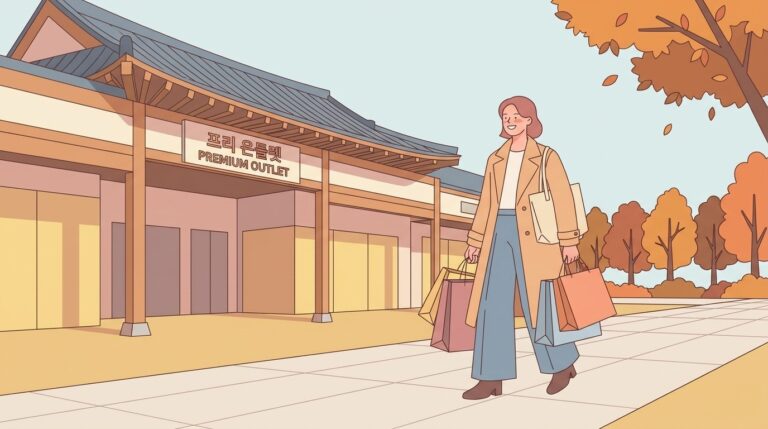
Have you ever watched a K-drama where the stylish lead struts down the street in an effortlessly chic trench coat, looking like a million bucks? You might think they spent their entire paycheck on it. But here is a little secret: many fashion-forward Koreans actually get their high-end looks at a fraction of the price by hunting for hidden treasures at Korea’s massive premium outlets, like Yeoju Premium Outlets (여주 프리미엄 아울렛) or Gasan Digital Outlet Valley (가산 아울렛 단지).
However, if you walk into these massive fashion hubs only armed with basic, dry textbook phrases like “이것은 얼마입니까?” (How much is this?), you might miss out on the deepest discounts, clearance items, or exclusive member benefits. Today, we are upgrading your shopping game to an intermediate (B2) level. By the end of this guide, you will know exactly what to say to find the best deals, navigate outlet-specific tags, and charm the retail staff into revealing the hidden racks!
Phase 2: Three Essential Outlet Expressions for the Ultimate Hunt
To shop like a pro, you need to understand the words that Korean fashionistas use when they are hunting for bargains.
1. 득템하다 (Deuk-tem-hada)
- Pronunciation: [deuk-tem-ha-da] / Sound-alike: “Dook-tem-ha-da” (Imagine the sound “Deuk” as in a satisfying click when a puzzle piece fits, combined with “tem” like the word “item”).
- Meaning: To score an amazing deal; to find a rare or valuable item unexpectedly.
- K-Culture Moment: Think of those iconic K-drama scenes where the main character finds a luxury vintage jacket hidden in a corner rack for 80% off. They hug the jacket and scream, “완전 득템했다!” (I totally scored!).
- Editor’s Insight: This word is a blend of the Hanja 득 (得 – to obtain) and the English word 아이템 (Item). It is incredibly popular among youth and fashion-conscious crowds. Use it when you find something high-quality for an unbelievably low price.
- Situation Spectrum:
- Casual (Friends): ✅ (Perfect!)
- Semi-formal (Co-workers): ✅ (Shows you know local slang)
- Formal (Boss/Elderly): ⚠️ (Slightly too casual, but acceptable in light conversation)
- 🤔 Think About It: “득템” combines traditional Sino-Korean roots with modern English loanwords. How does your native language create slang for finding great deals?
2. 이월 상품 (I-wol sang-pum)
- Pronunciation: [i-wol sang-pum] / Sound-alike: “Ee-wol sahng-poom”.
- Meaning: Carry-over items; past-season stock.
- K-Culture Moment: When K-pop idols head to the airport, their “Airport Fashion” (공항 패션) dictates the newest seasonal trends. Once those seasons pass, those gorgeous designer pieces transition into 이월 상품 and head straight to premium outlets at huge discounts.
- Editor’s Insight: In department stores, they focus on “신상품” (new arrivals). At outlets, you want to actively look for “이월 상품” because that is where the 40% to 70% discounts live. Don’t worry—Korean fashion moves so fast that “last season” still looks incredibly modern!
- Situation Spectrum:
- Casual: ✅
- Semi-formal: ✅
- Formal: ✅ (This is a standard, polite business/retail term)
- 🤔 Think About It: In some cultures, buying past-season items is seen as outdated. In Korea, however, “smart consumerism” (합리적 소비) is highly respected. Why do you think looking for “이월 상품” is considered a badge of honor for Korean shoppers?
3. 추가 할인 (Chu-ga hal-in)
- Pronunciation: [chu-ga hal-in] / Sound-alike: “Choo-gah hahl-een”.
- Meaning: Additional discount.
- K-Culture Moment: Imagine walking into an outlet store during a holiday weekend. The sign says 50% off, but you want to know if your foreign passport, membership card, or purchasing multiple items unlocks even more savings.
- Editor’s Insight: Outlets often stack promotions. Asking politely, “혹시 추가 할인 되는 거 있나요?” (Is there by any chance any additional discount applied?) can prompt the staff to check their system for brand-day promos or coupon books you might have missed.
- Situation Spectrum:
- Casual: ✅
- Semi-formal: ✅
- Formal: ✅
- 🤔 Think About It: Koreans value polite assertiveness. Asking for a discount directly in a department store is a no-no, but in an outlet environment, inquiring about systemic extra discounts (추가 할인) is completely normal and smart.
Phase 3: Textbook Korean vs. Real-World Korean
When you study with standard textbooks, the dialogue can feel a bit robotic. Let’s see how a textbook teaches shopping versus how real Koreans actually talk at outlets.
Scenario 1: Asking if an item is on sale
- 📖 Textbook Korean: “이 옷은 세일합니까?” (Is this clothing on sale?)
- 🗣️ Real Korean: “이거 할인 적용되는 상품인가요?” (Is this item eligible for the discount?)
- 💡 Why it’s different: “세일” is understood, but using “할인 적용” (discount applied) sounds much more professional, mature, and natural for a B2 speaker. It shows you understand shopping transactions.
Scenario 2: Expressing satisfaction with a bargain
- 📖 Textbook Korean: “이 물건은 매우 저렴하고 좋습니다.” (This item is very cheap and good.)
- 🗣️ Real Korean: “이 가격에 이 퀄리티면 진짜 대박이네요!” (At this price, with this quality, this is truly amazing/daebak!)
- 💡 Why it’s different: Real-world shoppers focus on “가성비” (cost-performance ratio). Describing a bargain as “대박” (amazing/jackpot) showcases authentic emotional connection and local fluency.
Phase 4: K-Culture Deep Dive & Non-Verbal Manners
4-1. The Art of “Nunchi” (눈치) and Outlet Etiquette
When shopping in crowded Korean outlets, especially during peak weekend hours, Nunchi (clout/tact) is your best friend.
1. Space Awareness: If someone is looking at a clothing rack, it is polite to wait a step back rather than squeezing in next to them.
2. The Mirror Rule: Mirror space is prime real estate. If you try on a coat, step up to the mirror, check your fit quickly, and step aside so others can use it.
3. Handling Clothes: Unlike fast-fashion stores where clothes are thrown around, outlet shoppers in Korea generally respect the garments. Always ask the staff before taking a mannequin’s jacket or opening packaged items: “이거 입어봐도 되나요?” (Can I try this on?).
4-2. The Premium Outlet Landscape in Korea
Korea’s outlets are not just shopping centers; they are beautifully designed lifestyle parks.
* Yeoju Premium Outlets: Surrounded by nature, it features high-end luxury brands (Gucci, Prada, Burberry) at steep discounts.
* Gasan Digital Outlet Valley: Located right in Seoul, this is where urbanites go after work for “퇴근길 쇼핑” (after-work shopping) to grab domestic Korean brands at absolute steals.
Phase 5: The Yeoju Outlet Showdown (Interactive Roleplay)
Let’s put your skills to the test! You are at a premium outlet looking for a classic trench coat. You find a gorgeous one, but there’s no discount sticker on it. You decide to approach the store clerk (점원).
- Setting: A beautifully lit, spacious boutique store at the Yeoju Outlets. Warm instrumental music is playing in the background.
- Your Role: A smart, polite foreign shopper who wants to find the absolute best deal.
- NPC Clerk (민우 – Min-woo): Highly professional, helpful, and easily impressed by foreigners who speak natural Korean.
🎭 Roleplay Dialogue
- 민우 (Clerk): (Approaching with a warm bow) “어서 오세요, 고객님. 찾으시는 스타일이 있으신가요?”
- [Eo-seo o-se-yo, go-gaek-nim. Chat-eu-si-neun seu-ta-il-i is-seu-sin-ga-yo?]
- “Welcome, valued customer. Is there a specific style you are looking for?”
- You: (Politely nodding) “네, 봄에 입을 만한 트렌치코트를 찾고 있어요. 이거 혹시 피팅해 볼 수 있을까요?”
- [Ne, bom-e ib-eul man-han teu-ren-chi-ko-teu-reul chat-go is-seo-yo. I-geo hok-si pi-ting-hae bol su is-seul-ka-yo?]
- “Yes, I’m looking for a trench coat suitable for spring. Could I try this on by any chance?”
- 민우 (Clerk): (Smiling warmly) “네, 당연하죠! 피팅룸은 이쪽입니다. 입고 편하게 거울 보셔도 됩니다.”
- [Ne, dang-yeon-ha-jyo! Pi-ting-rum-eun i-jjok-im-ni-da. Ip-go pyeon-ha-ge geo-ul bo-syeo-do doem-ni-da.]
- “Yes, of course! The fitting room is this way. Feel free to wear it and look in the mirror.”
- You: (Walking out of the fitting room, adjusting the collar) “사이즈는 딱 맞네요. 그런데 이 제품은 할인 혜택이 어떻게 되나요? 가격표에는 정가만 적혀 있어서요.”
- [Sa-i-jeu-neun ttak mat-ne-yo. Geon-de i je-pum-eun hal-in hye-taek-i eo-tteok-ge doem-ni-ga-yo? Ga-gyeok-pyo-e-neun jeong-ga-man jeok-hyeo is-seo-seo-yo.]
- “The size fits perfectly. By the way, what kind of discount benefits apply to this product? Only the original price is written on the price tag.”
- 민우 (Clerk): “아, 고객님! 그 제품은 이번 주부터 이월 상품 특별 기획전에 들어가서 기본 40% 할인이 적용됩니다.”
- [Ah, go-gaek-nim! Geu je-pum-eun i-beon ju-bu-teo i-wol sang-pum teuk-byeol gi-hoek-jeon-e deul-eo-ga-seo gi-bon sa-sip pro hal-in-i jeok-yong-doem-ni-da.]
- “Ah! That item just went into our special ‘past-season stock’ promotion starting this week, so a basic 40% discount applies.”
- You: “와, 40% 나요? 대박이네요! 혹시 외국인 관광객이나 멤버십 회원을 위한 추가 할인 혜택도 적용 가능한가요?”
- [Wa, sa-sip pro-na-yo? Dae-bak-i-ne-yo! Hok-si oe-guk-in gwan-gwang-gaek-i-na meom-beo-sip hoi-won-eul wi-han chu-ga hal-in hye-taek-do jeok-yong gang-eung-han-ga-yo?]
- “Wow, 40%? That’s amazing! By any chance, are additional discount benefits for foreign tourists or membership cardholders also applicable?”
- 민우 (Clerk): (Surprised by your fluency) “어머, 한국어를 정말 잘하시네요! 네, 마침 오늘부터 외국인 여권을 제시해 주시면 브랜드 자체적으로 5% 추가 할인을 더 해 드리고 있습니다.”
- [Eo-meo, han-guk-eo-reul jeong-mal jal-ha-si-ne-yo! Ne, ma-chim o-neul-bu-teo oe-guk-in yeo-gwon-eul je-si-hae ju-si-myeon beu-raen-deu ja-che-jeok-eu-ro o pro chu-ga hal-in-eul deo hae deu-ri-go is-seum-ni-da.]
- “Oh my, you speak Korean so well! Yes, actually, starting today, if you present a foreign passport, we are offering an additional 5% discount directly from our brand.”
- You: “정말요? 그럼 이 코트 완전 득템하는 거네요! 이걸로 구매할게요. 여권 여기 있습니다.”
- [Jeong-mal-yo? Geu-reom i ko-teu wan-jeon deuk-tem-ha-neun geo-ne-yo! I-geol-ro gu-mae-hal-ge-yo. Yeo-gwon yeo-gi is-seum-ni-da.]
- “Really? Then I am totally scoring a major bargain with this coat! I will purchase this one. Here is my passport.”
- 민우 (Clerk): “감사합니다, 고객님! 이쪽 계산대에서 도와드리겠습니다. 정말 현명한 쇼핑 하시는 거에요!”
- [Gam-sa-ham-ni-da, go-gaek-nim! I-jjok gye-san-dae-e-seo do-wa-deu-ri-ges-seum-ni-da. Jeong-mal hyeon-myeong-han syo-ping ha-si-neun geo-e-yo!]
- “Thank you! I will help you at this register. You are truly doing some smart shopping!”
🔀 Decision Point: The Checkout Twist
As you reach the counter, Min-woo mentions that if you spend 30,000 KRW more, you get a free designer scarf. What do you do?
- A) “괜찮아요, 이것만 살게요.” (No thank you, I’ll just buy this.)
- Editor’s Analysis: A safe, practical choice. It shows polite refusal, which is highly respected in Korea to avoid wasteful spending.
- B) “3만 원만 더 채우면 된다고요? 저기 있는 양말이나 액세서리 추가해서 살게요!” (Just 30,000 won more to fill? I’ll add those socks or accessories over there to buy!)
- Editor’s Analysis: Best Choice! “더 채우다” (to fill/top up the amount) is a highly colloquial retail phrase. This shows fantastic conversational flexibility and gets you a free luxury gift!
- C) “깎아주시면 안 돼요?” (Can’t you cut the price for me?)
- Editor’s Analysis: Risky Choice! Asking a clerk in a corporate outlet to arbitrarily lower the price on the spot (깎아주다) is awkward and socially unacceptable. Stick to established store promos!
Phase 6: 10-Second Emotional Shadowing Drill
Let’s practice speaking with the exact pitch, rhythm, and emotion of a native Seoulite. Pay attention to the pauses (/).
Drill 1: Finding an epic bargain!
- Sentence: “이 가격에 / 이 퀄리티면 / 진짜 대박이에요!”
- Pronunciation: [I ga-gyeok-e / i kwol-li-ti-myeon / jin-jja dae-bak-i-e-yo!]
- Emotion: [😊 Delighted, breathless with excitement. Lean into the word “진짜” (jin-jja) with emphasis!]
Drill 2: Asking for additional discount politely
- Sentence: “혹시 / 여권 할인 같은 거 / 추가로 더 되나요?”
- Pronunciation: [Hok-si / yeo-gwon hal-in gat-eun geo / chu-ga-ro deo doe-na-yo?]
- Emotion: [🥺 Hopeful, with a polite head-tilt. End with a soft, rising tone on “되나요?”]
Phase 7: K-Culture Mini Dictionary
| Word (한글/Romanization) | English Translation | Real-world Context |
|---|---|---|
| 오픈런 (Open-run) | Running to the store as soon as it opens | Used when shoppers wait in long lines from early morning to grab limited edition items as soon as outlet doors open. |
| 가성비 (Gaseongbi) | Cost-performance ratio | The ultimate value-for-money concept. If a cheap bag lasts 10 years, Koreans say: “가성비 최고!” (Best cost-performance!) |
| 하울 (Haul) | Shopping Haul | Very common on Korean YouTube and Instagram. Creator videos showcasing everything bought at an outlet are called “아울렛 하울” (Outlet Haul). |
| 소확행 (So-hwak-haeng) | Small but certain happiness | Buying a small luxury item (like a nice cardholder or perfume) at an outlet to boost your mood without breaking the bank. |
Phase 8: Traveler’s Survival Kit for Outlet Lovers
Top 3 Survival Phrases
- “이거 새 제품으로 있나요?” [I-geo sae je-pum-eu-ro is-na-yo?]
- Pro Tip: Outlet clothes are touched by many hands. Always ask if they have a “new, packaged product” (새 제품) in the back before paying.
- “택스 리펀 받을 수 있을까요?” [Taek-seu ri-peon bad-eul su is-seul-ka-yo?]
- Pro Tip: Most major premium outlets offer instant tax refunds. Keep your physical passport ready!
- “이거랑 저거랑 / 같이 계산해 주세요.” [I-geo-rang jeo-geo-rang / gat-i gye-san-hae ju-se-yo.]
- Pro Tip: Use this when buying things together with a friend to reach the minimum threshold for special gift promotions.
📌 Editor’s Travel Note
When heading to Yeoju Premium Outlets, taking a taxi from Seoul can be incredibly expensive. Instead, download the Naver Map App (네이버 지도) and search for the direct express bus running from Seoul Express Bus Terminal. It is comfortable, incredibly cheap, and drops you off right at the gates of shopping heaven!
Phase 9: Deep Thoughts — Modern “Flex” Culture vs. “Smart Consumerism”
In recent years, the hip-hop slang word “플렉스” (Flex) took over Korea. Young Koreans love showing off luxury items on social media. However, a fascinating counter-trend called “합리적 소비” (Rational/Smart Consumerism) has emerged alongside it. Today, it is no longer cooler to say “I bought this for $2,000.” Instead, young Koreans proudly brag about buying a $2,000 jacket for $500 at an outlet. This shift shows how modern Korean society respects wisdom, patience, and financial savvy over mindless spending.
💬 Your Turn: Is thriftiness and bargain hunting celebrated in your home country, or is there a pressure to buy everything brand new? Let’s talk about it in the comments below!
Phase 10: FAQ & Avoiding Common Mistakes
Q: Can I return or exchange items bought at Korean outlets?
A: Yes, but the window is often shorter than regular department stores (usually 7 days instead of 14 or 30 days). Always keep the receipt and do not cut off the tags! Ask at purchase: “교환이나 환불 가능한가요?” (Are exchanges or refunds possible?)
Q: Is bargaining (haggling) allowed at corporate premium outlets?
A: No. Outlets have fixed POS-system prices. Do not try to ask the cashier for a personalized discount. Stick to asking for systemic additional discounts (like passport discounts or coupon booklets).
Q: Are the products at Korean outlets lower quality or fake?
A: Absolutely not. Outlets in Korea are strictly regulated, and premium outlets are run directly by massive corporations like Shinsegae or Lotte. Everything is 100% authentic; they are simply past-season or overstock items.
🚨 Common Mistakes Warning Board
- Mistake 1: Asking “이거 깎아주세요” (Please cut the price) to a luxury brand clerk. Correct Action: Ask “혹시 제휴 할인 카드나 쿠폰 있나요?” (By any chance, are there partnership discount cards or coupons?)
- Mistake 2: Assuming “Tax Free” is automatic. Correct Action: You must show your physical passport before the transaction is completed to get the immediate refund printed on your receipt.
- Mistake 3: Damaging garments during fitting. Correct Action: If trying on light-colored clothes (especially white knitwear or shirts), female shoppers should use the facial covers (페이스 커버) provided in the fitting room to prevent makeup stains.
Phase 11: Daily Hangul Action Missions!
- 🥉 Bronze (At-Home Challenge): Record yourself saying “이 가격에 이 퀄리티면 진짜 대박이에요!” in a voice memo. Focus on the emotional rise and fall.
- 🥈 Silver (Network Challenge): Take a photo of your favorite fashion piece, post it on your Instagram Story, and caption it with “나의 최애 득템!” (My favorite bargain find!) and tag us @DailyHangul.
- 🥇 Gold (Real-World Challenge): The next time you visit a Korean brand store or outlet, look a clerk in the eye, smile, and ask: “혹시 이거 추가 할인 적용되나요?”
Phase 12: Interactive Quiz Challenge
Test your outlet shopping mastery below! Click the toggles to check your answers.
1. Which term describes a piece of clothing carried over from last season?
- A) 신상품 (Sin-sang-pum)
- B) 이월 상품 (I-wol sang-pum)
- C) 사은품 (Sa-eun-pum)
🔍 Click to see the Answer & Explanation
Correct Answer: B) 이월 상품
- Explanation: “이월 상품” is past-season stock. “신상품” means new arrivals, and “사은품” refers to free gifts given with a purchase!
2. Fill in the blank:
“이 가방 너무 예뻐요! 오늘 완전 ( )했네요!”
(This bag is so pretty! I totally scored a major bargain today!)
🔍 Click to see the Answer & Explanation
Correct Answer: 득템
- Explanation: “득템했다” (or “득템”) is the perfect modern slang to express the joy of finding a treasure at an amazing price.
3. True or False: You should try to haggle and ask for individual discounts at corporate Korean outlets.
🔍 Click to see the Answer & Explanation
Correct Answer: False
- Explanation: Corporate outlets have fixed prices. Instead of haggling, ask for system-based 추가 할인 (additional discounts) like passport benefits or membership coupons.
Happy shopping, and may your next trip to Korea be filled with incredible fashion finds! 다음 시간에도 더 유익하고 재미있는 한국어 공부로 만나요! (See you next time with more useful and fun Korean studies!)







