

The Anatomy of a Korean ‘Open Run’ (오픈런): Navigating the High-Stakes Culture of Waiting Lines and Consumer Desire
안녕하세요! Welcome back to Daily Hangul, your ultimate insider guide to the linguistic and cultural currents shaping contemporary South Korea. I’m your senior editor and cultural navigator.
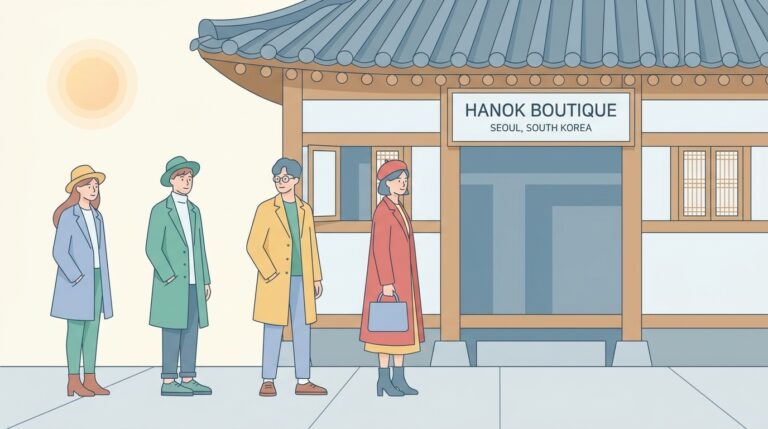
Imagine this: It’s a brisk Friday morning in Seongsu-dong (성수동), the Brooklyn of Seoul. The sun hasn’t fully risen, yet a queue of nearly two hundred impeccably dressed people snakes around the block. Some are sitting on folding camping chairs; others are sipping lukewarm lattes, eyes glued to their smartphones. Are they waiting for a rare vaccine? A political rally? No. They are waiting for the clock to strike 10:30 AM to enter a limited-edition fashion pop-up or secure a box of artisanal salt bread (소금빵).
This is South Korea’s Open Run (오픈런) phenomenon.
If you have ever felt bewildered by the sheer dedication of Koreans lining up overnight, or if you’ve wanted to join the fray but didn’t know how to talk about it like a local, you are in the right place. Today, we are diving deep into the linguistic arsenal and socio-cultural psychology of the “Open Run.” By the end of this guide, you will not only understand the systemic drive behind this cultural kinetic energy, but you’ll also be able to navigate these high-stakes waiting lines with the linguistic precision of a seasoned Seoulite.
Phase 2: Three Essential Expressions, Deconstructed
To talk about trend-chasing in Korea, you must move beyond textbook definitions. Here are three sophisticated expressions that will instantly elevate your conversational Korean to a C2 level.
1. 오픈런 (O-peun-reon)
- Pronunciation: [opeun-reon] / Sound-alike: “Open” + “Run” (pronounced with a flat, non-rhotic Korean ‘r’ sound)
- Meaning: The act of sprinting to a retail store or restaurant the absolute second it opens to secure highly coveted, limited-edition goods or entry.
- K-Culture Moment: You will see this depicted in modern slice-of-life K-Dramas where characters wake up at 5:00 AM to secure a luxury handbag for a mother-in-law’s wedding gift, or line up at a famous barbecue joint in Jeju Island.
- Editor’s Insight: While “Open Run” borrows English words, its meaning is uniquely Korean. It is not just about physically running; it denotes a highly calculated, strategic social ritual involving queue-tracking apps, social media surveillance, and physical endurance.
- Situation Spectrum:
- Friends & Casual (사석): ✅ (Extremely common)
- Colleagues & Semi-formal (비즈니스): ✅ (Used frequently when discussing weekend plans or lifestyle trends)
- Formal / Superiors (격식): ⚠️ (Use with caution; opt for “개점 대기” [gae-jeom dae-gi] or “선착순 대기” [seon-chak-sun dae-gi] to sound more polished)
- 🤔 Think About It: Consider how the etymology of “Open Run” reflects the speed-oriented ethos of Korean society (Ppalli-Ppalli / 빨리빨리). Is there a comparable term in your native language that captures this specific mixture of panic, consumerism, and excitement?
2. 득템하다 (Deuk-tem-ha-da)
- Pronunciation: [deuk-tem-ha-da] / Sound-alike: “Deuk” (like “look” with a ‘d’) + “tem” (like “item” without the ‘i’) + “hada”
- Meaning: To score, acquire, or successfully purchase a rare, highly coveted, or bargain item after significant effort.
- K-Culture Moment: Used by K-Pop fandoms when they finally secure rare photocards (포카) at a pop-up store, or foodies who manage to get the last batch of viral pastries.
- Editor’s Insight: This is a portmanteau of the Hanja character 득 (得 – to gain/obtain) and the English word “item” (템). It originated in online gaming communities (gaining rare loot) but has fully migrated into everyday conversational Korean.
- Situation Spectrum:
- Friends & Casual (사석): ✅ (A staple of casual banter)
- Colleagues & Semi-formal (비즈니스): ✅ (Perfect for lighthearted lunch chats)
- Formal / Superiors (격식): 🚫 (Too slangy; use “구매하다” [gu-mae-ha-da] or “획득하다” [hoek-deuk-ha-da] instead)
- 🤔 Think About It: Why does Korean slang so seamlessly blend classical Chinese characters (Hanja) with English loanwords? It reflects a linguistic elasticity that mirrors Korea’s rapid historical transition into a globalized tech hub.
3. 대기 타다 (Dae-gi ta-da)
- Pronunciation: [dae-gi ta-da] / Sound-alike: “Dae-gee” + “tah-dah”
- Meaning: To actively wait, camp out, or put oneself on standby for an event, product release, or digital ticketing drop.
- K-Culture Moment: In K-Dramas, you’ll hear friends coordinating online ticketing battles: “나 PC방에서 대기 타고 있어” (I’m on standby at the PC bang).
- Editor’s Insight: The verb 타다 (to ride) is colloquially attached to actions requiring momentum or prolonged states. To “ride the waiting” implies a proactive, highly focused state of waiting, rather than merely passing time.
- Situation Spectrum:
- Friends & Casual (사석): ✅
- Colleagues & Semi-formal (비즈니스): ⚠️ (Acceptable among close peers)
- Formal / Superiors (격식): 🚫 (Use “대기하다” [dae-gi-ha-da] or “기다리다” [gi-da-ri-da])
- 🤔 Think About It: “Riding” the wait suggests that waiting itself is an active sport in Korea. How does this shift your perception of patience as a passive virtue versus an active strategy?
Phase 3: Classroom Korean vs. Real-World Korean
Let’s look at how textbooks fail to capture the kinetic reality of Seoul’s fast-paced streets.
Scenario 1: Discussing a long waiting line
- 📖 Classroom Korean: “사람들이 가게 앞에서 오랫동안 기다리고 있습니다.” (People are waiting in front of the store for a long time.)
- 🗣️ Real-world Korean: “지금 거기 웨이팅 장난 아니에요. 다들 오픈런 하려고 대기 타고 있더라고요.” (The wait there right now is no joke. Everyone is on standby to pull an open run.)
- 💡 Why the Difference? The classroom sentence is grammatically flawless but sterile. It lacks the modern urban urgency. Real-world Korean utilizes “웨이팅” (waiting) as a noun that “is no joke” (장난 아니다) to emphasize popularity, alongside “대기 타다.”
Scenario 2: Expressing success in purchasing a limited item
- 📖 Classroom Korean: “어렵게 한정판 물건을 사는 데 성공했습니다.” (I succeeded in buying the limited edition item with difficulty.)
- 🗣️ Real-world Korean: “진짜 피 터지는 오픈런 뚫고 이거 겨우 득템했어요!” (I barely managed to score this after breaking through a bloody open run!)
- 💡 Why the Difference? “피 터지는” (blood-splattering/extremely fierce) is a visceral, highly descriptive colloquialism used to describe intense competition, whether in academic exams, ticketing, or open runs. Combining it with “뚫고” (penetrating/breaking through) and “득템” creates a triumphant, dramatic narrative common in Korean speech.
Phase 4: K-Culture Deep Dive & Non-Verbal Nuances
4-1. The Art of the Queue: Nunchi (눈치) and Line Etiquette
If you find yourself in an physical “open run” line in Seoul, there is an unwritten code of conduct dictated by Nunchi (눈치)—the Korean art of reading the room:
* Digital Queuing Primacy: Increasingly, physical lines are being replaced by digital waitlists (like CatchTable or Tabling). If you arrive and see people standing around without a neat line, check if there is a tablet near the entrance. You must register immediately. Standing near the door without registering is considered a major faux pas.
* Space and Privacy: Unlike some Western cultures where a wide physical buffer is maintained, Korean lines can be tightly packed. However, respect personal space by keeping your voice low. Loud, boisterous phone conversations while waiting in line are highly frowned upon.
* The “Line-Sitter” Protocol: Having one person stand in line while five friends join at the last second is a surefire way to invite glares and audible sighs from those behind you. If you must leave the line temporarily, politely inform the person behind you (“잠시 화장실 좀 다녀오겠습니다” – I’ll be back from the restroom shortly).
4-2. Cultural Codes: Why the Obsession with the Open Run?
Behind the open run lies a fascinating mix of trend-sensitivity (유행 민감성), FOMO (소외 불안감), and “Flex” culture (플렉스 문화). In a collectivist society that has transitioned from poverty to hyper-wealth in a single generation, consuming the “right” brand is a marker of taste, social currency, and identity. When a pop-up store opens in Seongsu-dong, posting a photo on Instagram with the hashtag #오픈런 isn’t just about the product; it is a declaration: “I am fast, I am connected, and I am living in the absolute present of Seoul’s cultural frontier.”
Phase 5: Interactive Roleplay Scenario
Setting: A chilly Saturday morning, 7:15 AM outside a legendary bagel boutique in Anguk-dong. The temperature is 3°C, but the queue already has 45 people.
Characters:
* 민지 (Minji): Your trend-savvy Korean friend who convinced you to wake up at 5:30 AM.
* You (C2 Speaker): Resilient, articulate, and determined to score the famous spring onion cream cheese bagel.
The Script (10+ Turns)
- 민지: (입김을 불며 손을 비비며) 야, 진짜 일찍 나온 보람이 있다! 우리 앞에 한 40명밖에 없어. 이 정도면 완전 선방한 거야.
(Yong-jin: [Blowing warm breath into her hands] Hey, waking up early was totally worth it! There are only about 40 people ahead of us. We really dodged a bullet here.) - You: (겉옷 깃을 여미며) 그러게. 나 사실 아침에 일어날 때는 ‘내가 꼭 이렇게까지 해야 되나’ 싶었거든? 근데 막상 와서 줄 서보니까 심장이 두근거리네.
(You: [Tightening your coat collar] Seriously. To be honest, when I woke up this morning, I was like, “Do I really have to go this far?” But now that I’m actually in line, my heart is pumping.) - 민지: (스마트폰으로 실시간 인스타 스토리를 확인하며) 내 말이! 지금 실시간 검색어 보니까 성수점은 벌써 대기 등록 마감됐대. 역시 우리가 안국으로 오길 잘했어.
(Minji: [Checking live Instagram stories] Exactly! I just looked at the real-time search trends, and the Seongsu branch has already closed registration. I knew we made the right call coming to Anguk.) - You: 와, 거긴 진짜 피 터지는구나. 혹시 여기는 웨이팅 등록 키오스크 몇 시에 열려? 8시 반 맞지?
(You: Wow, it’s a bloodbath over there. By the way, what time does the waiting registration kiosk open here? It’s 8:30, right?) - 민지: 어, 8시 반에 현장 등록 시작하고, 매장은 10시에 오픈해. 등록만 해두면 근처 한옥 카페 들어가서 몸 좀 녹이다가 시간 맞춰 오면 돼.
(Minji: Yeah, on-site registration starts at 8:30, and the shop opens at 10:00. Once we register, we can go warm up in a nearby Hanok cafe and come back on time.) - You: 다행이다. 나 솔직히 10시까지 여기서 생으로 칼바람 맞으면서 대기 타야 되는 줄 알고 쫄았거든.
(You: Thank goodness. To be honest, I was terrified that we’d have to physically camp out here in this freezing wind until 10:00 AM.) - 민지: (웃음) 하하, 아무리 한국인들이 오픈런에 미쳐있어도 그 정도로 아날로그는 아니야! 시스템이 다 있다고. 근데 오늘 네 목표가 정확히 뭐야? 시그니처 베이글 맞아?
(Minji: [Laughs] Haha, no matter how crazy Koreans are about open runs, we aren’t that analog! There is a system for everything. But what is your exact goal today? Is it the signature bagel?) - You: 당연하지! 시그니처 대파 크림치즈 베이글이랑 무화과 베이글은 무조건 사야지. 힘들게 온 만큼 넉넉하게 사서 냉동실에 쟁여둘 거야.
(You: Of course! I absolutely have to buy the signature spring onion cream cheese bagel and the fig bagel. Since we went through all this trouble, I’m going to buy plenty and hoard them in my freezer.) - 민지: (눈을 반짝이며) 좋은 자세야. 내 친구는 저번에 와서 늦게 들어가는 바람에 솔드아웃돼서 빈손으로 돌아갔거든. 너 오늘 꼭 득템하길 바란다.
(Minji: [Eyes sparkling] That’s the spirit. My friend came last time, got in too late, and went home empty-handed because they were sold out. I really hope you score big today.) - You: 고마워. 만약 내가 성공하면 아침 일찍 나 데리고 나와 준 보답으로 너한테 베이글 하나 쏜다!
(You: Thanks. If I succeed, I’ll buy you a bagel as a thank you for dragging me out early this morning!) - 민지: 오, 진짜? 나 대파 베이글 엄청 좋아하는데! 약속했다? 자, 이제 키오스크 직원분들 준비하시는 것 같아. 슬슬 줄 앞으로 서자.
(Minji: Oh, really? I absolutely love the spring onion bagel! Is that a promise? Look, I think the kiosk staff are getting ready. Let’s start moving closer.)
🔀 Decision Point
At 8:25 AM, a group of three people quietly slips in front of the person directly ahead of you. They are acting natural, pretending they were part of that person’s group all along. The queue is getting restless. What do you do?
- Option A: Politely but firmly address the group directly using advanced, polite yet assertive Korean.
- Option B: Turn to Minji and complain loudly in Korean so the line-cutters hear you and feel embarrassed.
- Option C: Say nothing and shrug it off. (It’s just bagels, right?)
Best Choice: Option A
- Why: In Korea, direct public confrontation is generally avoided, but line-cutting (새치기) in an open run is considered highly disrespectful because everyone is investing precious time and facing cold weather. Speaking up politely but firmly establishes clear boundaries without escalating into a brawl.
- The Magic Sentence: “죄송한데, 저희 다 아침 일찍 와서 줄 서 계신 거거든요. 뒤쪽으로 가셔서 대기해 주시겠어요?” (Excuse me, but we’ve all been waiting here since early morning. Could you please go to the back to wait?)
- Why it works: It uses “저희” (we/us) to appeal to the collective agreement of the group, and “대기해 주시겠어요?” (could you wait?) which is phrased as a polite request but carries strong normative weight.
Risk Choice: Option B
- Why: While passive-aggressive murmuring (궁시렁거리기) is common, it can create a hostile environment and make your friend Minji feel uncomfortable. It’s better to speak directly and politely or let the store staff handle it.
Phase 6: 10-Second Emotional Shadowing Drill
To sound like a native, you must master the high-low pitch contours that convey real emotion—triumph, exhaustion, or relief. Practice these sentences with the specified emotional cue.
1. [😊 Elated and Triumphant]
- Sentence: 아침 일찍 / 일어난 보람이 있네요! / 진짜 대박! / 겨우 득템했어요!
- Pronunciation: [Ah-chim il-jjik / i-reo-nan bo-ram-i in-neyo! / Jin-jja dae-bak! / Gyeo-u deuk-tem-haet-seo-yo!]
- Cadence Guide: Elevate the pitch on “보람” (value/worth) and place a strong, punchy emphasis on “진짜 대박!” before letting “득템했어요” slide into a satisfied lower register.
2. [🥺 Exhausted yet Relieved]
- Sentence: 세 시간이나 / 대기 타느라 / 발가락 감각이 없어졌지만… / 그래도 살았어요!
- Pronunciation: [Se si-gan-i-na / dae-gi ta-neu-ra / bal-ga-rak gam-gak-i eop-seo-jeot-ji-man… / Geu-rae-do sal-at-seo-yo!]
- Cadence Guide: Drag out “세 시간이나” with a sigh. Pause heavily after “없어졌지만…” to emphasize the physical toll, then brighten the voice slightly on “살았어요” (I made it/I bought it).
Phase 7: K-Culture Mini-Dictionary
Understanding these four terms will instantly contextualize the mechanics of modern Korean urban consumer culture.
| Word (Korean + Romanization) | English Equivalent | Context & Socio-Cultural Nuance |
|---|---|---|
| 1. 밤샘 대기 (Bam-saem Dae-gi) | Overnight Queuing | Literal: “Night-leak waiting.” It describes camping out overnight. Usually associated with luxury watch drops, limited sneakers, or front-row concert queuing. |
| 2. 리셀테크 (Ri-sel-te-keu) | Resell Technology | A portmanteau of “Resell” and “Tech” (as in finance/investment). Many people participate in open runs not to use the product, but to resell it on platforms like KREAM for double the price, treating queuing as a lucrative side hustle. |
| 3. 웨이팅 지옥 (We-i-ting Ji-ok) | Waiting Hell | The chaotic, exhausting state of high-demand venues where the wait times stretch to several hours. To survive “waiting hell,” one must be armed with digital apps and backup plans. |
| 4. 인스타각 (In-seu-ta-gak) | “Instagram-worthy” | Literal: “Instagram angle.” The visual quality of an item or venue that makes it perfect for social media verification. This aesthetic drive is the primary fuel powering the entire open-run ecosystem. |
Phase 8: Traveler’s Survival Kit
If you are visiting Korea and want to participate in a trendy pop-up or restaurant opening, keep these three phrases in your back pocket.
Survival Phrases TOP 3
- “여기 대기 줄 맞나요?”
- [Yeo-gi dae-gi jul man-na-yo?]
- Use Case: When you arrive at a chaotic street corner and see a crowd, use this to confirm you are lining up for the correct venue.
- Pro Tip: If they say no, ask, “그럼 웨이팅 줄은 어디예요?” (Then where is the waiting line?)
- “대기 몇 팀이나 남았어요?”
- [Dae-gi myeot tim-i-na nam-at-seo-yo?]
- Use Case: To ask the door staff or check with the person holding the tablet how many groups are ahead of you.
- Pro Tip: Keep in mind that “팀” (team) refers to a party/group, not individual people.
- “혹시 오늘 대기 마감됐나요?”
- [Hok-si o-neul dae-gi ma-gam-dwaet-na-yo?]
- Use Case: Use this when arriving in the afternoon to check if the registration list has already closed for the day.
- Pro Tip: If it is closed, the staff will say, “네, 금일 웨이팅 마감되었습니다.” (Yes, today’s waiting list is closed.)
📌 Editor’s Travel Note
- Essential Apps: Do not rely on Google Maps in Korea. Download Naver Map for navigating and CatchTable Global or Tabling for digital queue registration. Many trendy spots in Seongsu and Anguk require a Korean phone number for SMS notifications, but premium tourist hotspots are increasingly integrating email or international phone options on their kiosks.
- Note on Timings: Pop-up store schedules and queuing protocols are highly fluid and can change overnight based on crowd density. Always verify the latest updates on the official brand Instagram account the night before.
- No Tipping: Remember, there is absolutely zero tipping culture in Korea. The price you see on the screen is exactly what you pay—no hidden fees, no matter how long the service took.
Phase 9: Deep Reflection — “A Step Deeper”
To understand the “Open Run” is to understand the soul of modern urban Korea. On one hand, South Korea is a marvel of hyper-efficiency; it is a country where you can get fresh groceries delivered to your door by 6:00 AM if you order by midnight. Why, then, do people willingly freeze on a pavement for three hours to buy a bagel or a pair of shoes?
This paradox lies in the intersection of collectivist belonging and curated individualism. In a historically hyper-competitive society, being left behind is a deep-seated anxiety. If “everyone” is talking about a specific experience, not participating feels like cultural exclusion. Simultaneously, in an era of digital saturation, physical waiting has become a form of experiential trophy hunting. The physical discomfort of the queue increases the psychological value of the item once obtained. The open run is not merely consumerism; it is a performative modern pilgrimage where the journey (the wait) is just as vital as the destination (the product).
💬 Your Turn:
How does your hometown approach hyper-exclusive trends? Do people camp out for sneaker drops or culinary crazes, or is there a different social mechanism at play? Let us know in the comments below!
Phase 10: FAQ & Avoiding Pitfalls
Q: Can I participate in an open run if I don’t have a Korean phone number?
A: Yes, but with conditions. While many digital kiosks require a Korean mobile number (+82) for KakaoTalk notifications, major tourist-heavy locations (like London Bagel Museum or popular Hanok cafes) now allow you to register via email or ask the door staff directly for manual input. Always carry your passport and physical credit card just in case.
Q: Is “open run” slang used by older generations?
A: It is understood, but less practiced. Older generations (50s and above) are highly familiar with the term because it is widely reported in national news as a economic trend. However, they may refer to it with a bit of skepticism or use more formal terms like “줄서기” (lining up).
Q: What is the difference between “오픈런” (Open Run) and “티켓팅” (Ticketing)?
A: Medium and Location. “오픈런” specifically refers to a physical sprint/waiting line at a brick-and-mortar store or venue. “티켓팅” (often called Pi-keting / 피케팅 due to its bloody competitive nature) refers exclusively to online ticketing for concerts, trains, or events.
🚨 The Top 3 Common Mistakes Made by Foreigners
- Assuming a physical line is the only queue: Always check for a digital tablet near the door first. If you stand in a physical line without registering on the tablet, you will lose your spot entirely.
- Confusing “대기” with “예약”: “대기” (dae-gi) means waiting in line on-site. “예약” (ye-yak) means an advance reservation made days or weeks prior. Do not show up to a “reservation-only” pop-up expecting to get in via an open run unless walk-ins are explicitly stated.
- Using overly informal slang with store staff: While you can tell your friend “나 득템했어!”, never say to the cashier “이거 득템할게요.” Use polite, standard language: “이거 결제해 주세요.” (Please process the payment for this.)
Phase 11: Action Missions
Are you ready to test your cultural grit? Complete these three progressive challenges!
- 🥉 Bronze (The Mirror Challenge): Practice your delivery. Look in the mirror and say the standard greeting to confirm your position in line: “여기 대기 줄 맞나요?” with natural, polite intonation.
- 🥈 Silver (The Digital Sleuth): Open Instagram. Search the hashtags #오픈런 and #성수동웨이팅. Observe the types of venues people are lining up for right now. Write down two Korean terms you see repeated in the captions.
- 🥇 Gold (The Real-World Quest): The next time you visit a famous cafe or boutique in Korea, don’t walk away if there is a line. Walk up to the kiosk, register your waiting number, and successfully enter the venue using the survival phrases learned today.
🎮 K-Culture Mission:
Watch an episode of a recent slice-of-life K-Drama (e.g., Work Later, Drink Now or My Liberating Notes). Spot a scene where characters are waiting in line or trying to secure a trendy reservation, and listen closely to see if they say “웨이팅,” “대기,” or “뚫다.”
Phase 12: Interactive Quiz Challenge
Test your knowledge of South Korea’s high-stakes queue culture!
1. Situational Judgment
You have been waiting for two hours at an open run. The store finally opens, and you manage to purchase the absolute last limited-edition tumbler. Your Korean friend asks how it went. Which response is the most natural and culturally resonant for a C2 speaker?
- A) “제가 마침내 그 컵을 구매하는 영광을 누렸습니다.”
- B) “진짜 피 터지는 웨이팅 뚫고 이거 겨우 득템했어요!”
- C) “줄 서서 기다리기가 참 힘들었지만 보람찼습니다.”
Click to reveal the Answer & Explanation
Correct Answer: B
While A is overly archaic and formal (sounds like a historical drama protagonist), and C is grammatically correct but slightly dry, B perfectly captures the modern urban colloquial flow, combining the visceral “피 터지는” with the triumph of “득템하다.”
2. Fill-in-the-Blank Dialogue
Fill in the missing words in this conversation between two friends.
민수: 너 오늘 아침 일찍 백화점 앞에 왜 있었어?
지선: 아, 명품 가방 사려고 아침 6시부터 ( [1] ) 했거든. 드디어 내 최애 가방 ( [2] )했잖아!
- A) [1] 밤샘, [2] 대기
- B) [1] 오픈런, [2] 득템
- C) [1] 예약, [2] 구매
Click to reveal the Answer & Explanation
Correct Answer: B
“오픈런을 하다” is the verb form of doing an open run, and “득템하다” is the verb for scoring a desired item. Option A uses nouns incorrectly in these grammatical slots, and Option C is too standard/sterile for this casual peer dynamic.
3. True or False: K-Culture Trivia
Statement: In South Korea, digital waiting apps like CatchTable or Tabling always require you to stand physically in front of the store after registering.
Click to reveal the Answer & Explanation
Answer: FALSE
One of the biggest advantages of digital queuing is that once your phone number is registered, you are free to wander around, visit other shops, or sit in a nearby cafe. The app will send you automated alerts (usually via KakaoTalk) when you are “5th in line” and “1st in line,” giving you ample time to walk back.







