

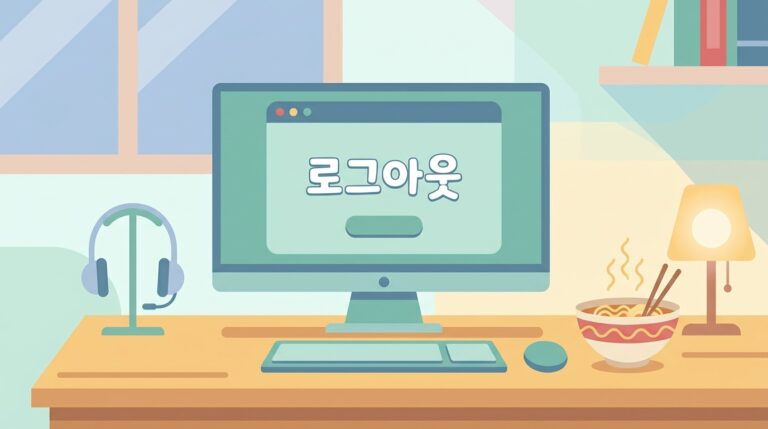
How to Log Out of a Korean PC Bang Like a Pro! (Without Losing Your Time or Data)
안녕하세요! (An-nyeong-ha-se-yo!) Hello! It’s your favorite friendly Korean tutor and local guide from Daily Hangul.
Imagine this: You are sitting in a state-of-the-art PC방 (PC Bang / Korean PC Cafe) in Hongdae, Seoul. You’ve just finished a thrilling 3-hour gaming session of League of Legends, washed down with a delicious bowl of cheese ramyun and iced peach tea ordered directly to your desk. Now, your screen says your prepaid time is almost up, or you simply need to leave to meet a friend at a K-BBQ spot.
You stare at the screen. Millions of Korean words are flashing. Where is the log-out button? Do you need to tell the staff? What if someone steals your account?
Don’t panic! Today, we will master the absolute basics of ending your PC Bang session smoothly. This is a crucial skill for every K-Traveler and K-Culture fan. Let’s dive in!
Phase 2: 3 Key Expressions for Ending Your PC Bang Session
Even as an absolute beginner (A1), these three simple phrases will make you sound natural and confident!
1. 로그아웃해요 (Ro-geu-a-ut-hae-yo)
- Pronunciation: Lo-geu-ah-oot-hae-yo / Sounds like “Log-out” with a soft “ha-yo” at the end.
- Meaning: “I am logging out” or “Let’s log out.”
- K-Culture Moment: You will hear this constantly in gaming K-Dramas when friends play online together and decide to pack up for the night.
- Editor’s Insight: The word is derived directly from the English “Log out,” but pronounced with a Korean accent. Adding 해요 (hae-yo) makes it polite and natural!
- Situation Spectrum:
- Friends / Casual: ✅ (Just say 로그아웃해 Lo-geu-ah-oot-hae)
- Staff / Semi-formal: ✅
- Formal settings: ⚠️
- 🤔 Think About It: Why do you think Korean adopts so many English tech words? It makes connecting with global gaming culture super fast and fun!
2. 다 썼어요 (Da sseot-eoyo)
- Pronunciation: Tah-sut-uh-yo / Think of “Da” (all) + “sut-uh-yo” (used).
- Meaning: “I have finished” (Literally: “I used it all”).
- K-Culture Moment: When you stand up and hand your entry card back to the busy PC Bang cashier.
- Editor’s Insight: This is a fantastic multi-use phrase! You can use it when you finish using a computer, a restroom, or even a pen that someone lent you.
- Situation Spectrum:
- Friends / Casual: ✅
- Staff / Semi-formal: ✅
- Formal settings: ✅
3. 계산해 주세요 (Gye-san-hae ju-se-yo)
- Pronunciation: Gyeh-san-hae joo-seh-yo / “Gyeh-san” (pay/calculate) + “ju-se-yo” (please give me).
- Meaning: “Please calculate the bill / I’d like to pay.”
- K-Culture Moment: If you didn’t prepay at the kiosk, you’ll need to say this at the counter before you leave.
- Editor’s Insight: This is one of the most powerful survival phrases in Korea! Use it at restaurants, cafes, and PC Bangs alike.
- Situation Spectrum:
- Friends / Casual: 🚫 (Too polite for close friends)
- Staff / Semi-formal: ✅
- Formal settings: ✅
Phase 3: Textbook Korean vs. Real Korean
Let’s look at how textbooks teach this versus how real Koreans actually talk in the gaming zone.
Situation 1: Telling the system you are shutting down
- 📖 Textbook Korean: “컴퓨터 사용을 종료하겠습니다.” (Keom-pyu-teo sa-yong-eul jong-ryo-ha-get-seub-ni-da. – “I will terminate the use of the computer.”)
- 🗣️ Real Korean: “로그아웃할게요~” (Lo-geu-ah-oot-hal-ge-yo – “I’ll log out!”)
- 💡 Why is it different? The textbook version sounds like a robotic system announcement. In real life, Koreans prefer the friendly, soft future-intention ending -ㄹ게요 (-l-ge-yo).
Situation 2: Leaving the PC Bang counter
- 📖 Textbook Korean: “안녕히 계십시오.” (An-nyeong-hi gye-ship-si-o. – “Goodbye” – extremely formal).
- 🗣️ Real Korean: “수고하세요!” (Su-go-ha-se-yo! – “Keep up the great work!”)
- 💡 Why is it different? In Korea, it is polite to acknowledge the hard work of service staff. Saying “수고하세요” shows warmth and local fluency!
Phase 4: K-Culture Deep Dive & Non-verbal Manners
4-1. “Nunchi” (눈치) & Keyboard Manners
When you log out of a PC Bang, do not just stand up and walk away. True Korean gamers practice high-level 눈치 (Nunchi – situational awareness/tact). Before leaving, gently push your keyboard back under the monitor stand, place the mouse neatly next to it, and put your headset back on its hook. If you ordered food, you don’t have to wash the dishes, but leaving them stacked neatly is a sign of a highly respected guest!
4-2. The PC Bang Ecosystem
Korean PC Bangs are not dark, dusty basements. They are vibrant social hubs with ultra-fast gigabit internet, ergonomic gaming chairs, and food menus that rival trendy cafes. It’s very common to see K-Pop fans streaming comeback videos, students writing essays, and friends competing in intense battles. Logging out properly ensures your leftover paid hours are securely saved to your account for your next visit!
Phase 5: The Ultimate PC Bang Exit Roleplay
Let’s test your skills! You are ending your gaming session at “Cyber Space PC” in Seoul. You need to log out, double-check your payment, and leave. Your conversation partner is Min-ho (민호), the friendly, hardworking PC Bang staff member.
- Setting: A bright, buzzing PC Bang with the sound of clicking keyboards and yummy ramyun smells in the air.
- Your Role: An excited international student learning Korean.
-
Dialogue:
- You: 🎭 (Hesitantly pointing at the screen) 저기요, 로그아웃 어떻게 해요? (Jeo-gi-yo, lo-geu-a-ut eo-tteoh-ge hae-yo? – Excuse me, how do I log out?)
- Min-ho: 🎭 (Smiling warmly) 아, 화면 오른쪽 위에 ‘사용 종료’ 버튼 누르시면 돼요! (Ah, hwa-myeon o-reun-jjok wi-e ‘sa-yong jong-ryo’ beot-eun nu-reu-si-myeon dway-yo! – Oh, just click the ‘End Session’ button on the top right of the screen!)
- You: 🎭 (Clicking the button) 아! 찾았어요. 감사합니다. (Ah! Cha-jat-eo-yo. Gam-sa-ham-ni-da. – Ah! I found it. Thank you.)
- Min-ho: 🎭 (Checking the system) 네, 잘 됐습니다! 혹시 카드로 결제하셨나요? (Ne, jal dway-seub-ni-da! Hok-si ka-deu-ro gyeol-je-ha-syeot-na-yo? – Yes, it’s done! Did you pay by card?)
- You: 🎭 (Nodding) 네, 키오스크에서 카드 결제했어요. (Ne, ki-o-seu-keu-e-seo ka-deu gyeol-je-ha-seot-eo-yo. – Yes, I paid by card at the kiosk.)
- Min-ho: 🎭 (Nodding back) 아, 선불이시군요! 그럼 바로 가셔도 됩니다. (Ah, seon-bul-i-si-gun-yo! Geu-reom ba-ro ga-syeo-do dwip-ni-da. – Ah, it was prepaid! Then you can leave right away.)
- You: 🎭 (Gathering your bag and putting the headset back) 네, 다 썼어요! (Ne, da sseot-eo-yo! – Yes, I’m all done!)
- Min-ho: 🎭 (Cleaning the desk next to yours) 네~ 오늘 즐거운 시간 되셨나요? (Ne~ o-neul jeul-geo-un si-gan dway-syeon-na-yo? – Yes~ did you have a fun time today?)
- You: 🎭 (Giving a big thumbs up) 네, 진짜 재미있었어요! 라면도 맛있었어요! (Ne, jin-jja jae-mi-is-seot-eo-yo! Ra-myeon-do mas-is-seot-eo-yo! – Yes, it was really fun! The ramyun was delicious too!)
- Min-ho: 🎭 (Genuinely happy) 감사합니다! 다음에 또 오세요! (Gam-sa-ham-ni-da! Da-eum-e tto o-se-yo! – Thank you! Please come again!)
- You: 🎭 (Waving politely) 네, 수고하세요! (Ne, su-go-ha-se-yo! – Yes, keep up the great work!)
🔀 Decision Point!
As you walk away, you realize you left your phone charger plugged into the PC’s USB port! What do you say?
- Option A: “충전기 주세요” (Chung-jeon-gi ju-se-yo – “Give me charger.”)
- Option B: “죄송한데, 충전기 두고 왔어요!” (Jway-song-han-de, chung-jeon-gi du-go wat-eo-yo! – “Excuse me, but I left my charger behind!”)
- Option C: “이거 내 꺼예요!” (I-geo nae kkeo-yae-yo! – “This is mine!”)
💡 Best Choice Analysis:
Option B is the absolute best! It starts with a polite apology (“죄송한데” – excuse me / sorry, but) and clearly states the situation. Option A is too blunt, and Option C might sound defensive.
Phase 6: 10-Second Emotional Shadowing Drill
Let’s practice speaking with real Korean emotion! Use the slashes / to pause and mimic the emotional tags.
- [😊 Expressing Relief & Completion]
- 다 / 썼어요! (Da / sseot-eo-yo!)
- Pronunciation Guide: Tah / sut-uh-yo!
- [💖 Expressing Warm Gratitude to Staff]
- 수고하세요 / 감사합니다! (Su-go-ha-se-yo / Gam-sa-ham-ni-da!)
- Pronunciation Guide: Soo-go-hah-seh-yo / Kahm-sah-hahm-nee-dah!
- [🙋 Confirming Your Exit]
- 로그아웃 / 할게요! (Lo-geu-a-ut / hal-ge-yo!)
- Pronunciation Guide: Lo-geu-ah-oot / hahl-gheh-yo!
Phase 7: K-Culture Mini Dictionary
| Word (Korean) | Romanization | English Translation | Real-world Context |
|---|---|---|---|
| PC방 | PC Bang | PC Cafe | A social gaming sanctuary with super-fast internet and delicious food. |
| 로그아웃 | Ro-geu-a-ut | Log Out | The action of terminating your computer session safely. |
| 선불 | Seon-bul | Prepayment | Paying before you use the service (very common at modern PC Bang kiosks). |
| 충전 | Chung-jeon | Recharging / Top-up | Adding more cash/time to your PC Bang account. |
Phase 8: Traveler’s Survival Kit
Survival Cards (Save these on your phone!)
- Card 1: Help with Kiosk
- Korean: “이거 어떻게 사용해요?” (I-geo eo-tteoh-ge sa-yong-hae-yo?)
- Meaning: “How do I use this?” (Perfect when struggling with the ticket machine).
- Card 2: Finding Your Account
- Korean: “아이디 비밀번호 잊어버렸어요.” (A-i-di bi-mil-beon-ho i-jeo-beo-ryeot-eo-yo.)
- Meaning: “I forgot my ID and password.”
- Card 3: Food Order Query
- Korean: “음식 주문 어디서 해요?” (Eum-sik ju-mun eo-di-seo hae-yo?)
- Meaning: “Where do I order food?” (Usually, it’s a menu built into your PC screen!).
📌 Editor’s Travel Note
Before stepping into a PC Bang, make sure you have a reliable map app. Google Maps doesn’t work well in Korea. Download the Naver Map App Download Page or KakaoMap App Download Page to find the nearest high-rated PC Bang in your area. Most PC Bangs accept international credit cards at the self-service kiosks, but keeping 5,000 KRW in cash is always a smart backup plan!
Phase 9: Think About It — “Community in Public Spaces”
In many Western countries, gaming is often seen as a solitary activity done at home. However, in Korea, the PC방 has always been a highly social, collective experience. Friends go together after school or work, sit side-by-side, and communicate loudly through headsets while sharing snacks.
Because of this shared community space, keeping your desk neat and logging out properly is a way of showing respect to the next person who will sit in your chair.
💬 Your Turn: How does gaming culture differ in your country? Do you have similar spaces like PC Bangs? Tell us in the comments below!
Phase 10: FAQ & Avoiding Common Mistakes
Q: What happens if I forget to log out of my PC Bang computer?
A: If you paid by the hour without creating an account (using a guest ticket), the computer usually logs out automatically once your prepaid time hits zero. However, if you have an active account with remaining time, someone else could sit down and use your paid hours! Always click ‘사용 종료’ (End Session) before walking away.
Q: Can I log out and keep my leftover time for next week?
A: Yes! If you created a registered account at that specific PC Bang, any remaining time is automatically saved to your ID when you log out. You can use it whenever you return.
Q: Do I need to clean up my ramyun bowls?
A: No, you do not need to carry them to the kitchen. The PC Bang staff will clean your desk after you log out. However, piling empty cups neatly and putting trash in the small bin at your desk is highly appreciated.
🚨 Common Mistakes Warning Board
- Leaving the PC turned on: Make sure the screen goes black or returns to the login screen before you leave.
- Forgetting personal items: Check the wireless charging pad at your desk! People constantly leave their smartphones and transit cards (T-Money) behind.
- Using too much slang with older staff: If the owner is an older grandmother or grandfather (이모님 / 사장님), stick to polite honorifics like 감사합니다 (Gam-sa-ham-ni-da) instead of casual gamer talk.
Phase 11: Action Mission!
- 🥉 Bronze (At-Home Challenge): Practice saying “로그아웃할게요!” (Lo-geu-ah-oot-hal-ge-yo) 3 times out loud in front of your mirror with a confident smile!
- 🥈 Silver (Social Challenge): Share a photo of your gaming setup on Instagram or X (Twitter), tag #DailyHangul, and use the caption: “오늘도 PC방 스타일로 다 썼어요!” (I used it all today in PC Bang style!)
- 🥇 Gold (Real-world Challenge): Next time you visit Korea, walk into a PC Bang, order a snack through the PC screen, log out successfully, and say “수고하세요!” to the staff as you walk out the door.
Phase 12: Interactive Quiz Challenge
Test your new PC Bang survival skills!
Q1. What is the most polite and natural way to tell the cashier you are finished using the PC?
- A) 꺼라 (Kkeo-ra)
- B) 다 썼어요 (Da sseot-eoyo)
- C) 컴퓨터 죽었다 (Keom-pyu-teo jug-eot-da)
Q2. True or False?
- In Korea, it is polite to say “수고하세요” (Su-go-ha-se-yo) to service workers when leaving a business.
🔍 Click here to reveal the Answers & Explanations!
- A1 Answer: B) 다 썼어요. This means “I used it all / I am finished” and is perfectly polite and natural for A1 learners.
- A2 Answer: True! “수고하세요” is a beautiful Korean phrase that acknowledges and thanks workers for their effort. It makes you sound like a true local!
See you in the next lesson! 다음에 또 만나요! (Da-eum-e tto man-na-yo!)







