

Master the Korean Noraebang Remote: How to Search Songs Like a local
Phase 1: Empathy (Stuck in the Neon Glow?)
안녕하세요! (Annyeonghaseyo!) Welcome back to Daily Hangul, your premium space for mastering real-world Korean and local culture. I’m your senior editor and veteran cultural navigator.
Picture this: You are out in Hongdae with your Korean friends. After a fantastic dinner of sizzling 삼겹살 (samgyeopsal), someone shouts the magic word: “노래방 가자!” (Let’s go to the Noraebang!)
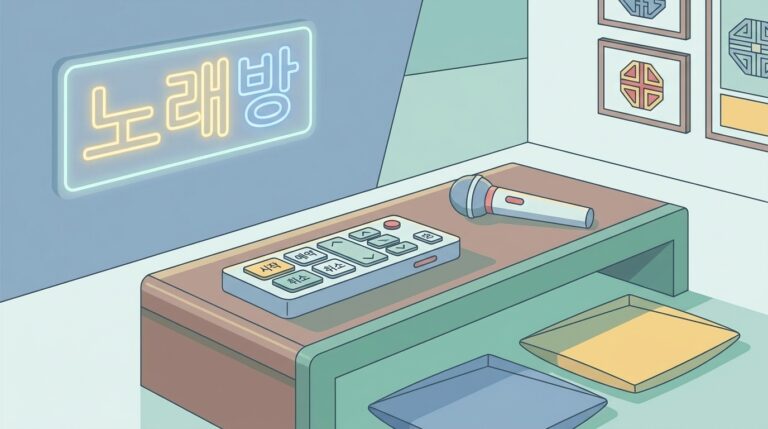
You walk into a room pulsing with neon lights, tambourines shaking, and a huge screen. Your friend hands you a massive, brick-like remote control (리모컨 – rimokon) that looks like the cockpit of a spaceship. Hundreds of buttons, all in Hangul. The timer is ticking down. Your friends are looking at you with expectation, waiting for you to queue up your jam. You want to sing that K-drama OST you’ve practiced for weeks, but your fingers freeze. How on earth do you search for it?
Don’t panic! Today, we are going to transform you from a frozen bystander into the absolute star of the Noraebang. Mastering the remote control isn’t just about pressing buttons; it’s your golden ticket to showing your friends that you truly understand the flow of Korean fun. Let’s dive in!
Phase 2: Core Expressions Deep Dive
To navigate the remote like a local, you need to master these three crucial expressions. Let’s break down their grammar, nuance, and hidden social context.
1. 노래 검색해 봐 (Norae geomsaekhae bwa)
- Pronunciation: [Noh-reh geom-saek-hae bwah]
- Meaning: “Try searching for a song.”
- K-Culture Moment: This is what your Korean friend will say while handing you the remote control like a sacred torch.
- Editor’s Insight: The pattern -해 봐 (-hae bwa) means “try doing [something].” It is much softer and friendlier than a direct command like “검색해” (Search!). It encourages you to take your time and give it a shot.
- Situation Spectrum:
- Friends & Casual (반말): ✅
- Co-workers & Semi-formal (존댓말 – 노래 검색해 보세요): ✅
- Bosses & Elders (Formal): ⚠️ (You should search the song for them instead!)
- 🤔 Think About It: In Korean culture, offering someone a turn to search for a song is a sign of hospitality. Why do you think Koreans prioritize making sure guests or newcomers get to sing first?
2. 제목으로 찾아요 (Jaemogeuro chajayo)
- Pronunciation: [Chae-mog-eu-roh cha-jah-yo]
- Meaning: “I search by the song title.”
- K-Culture Moment: When you know the name of the song (like “Dynamite” or “꽃” by Jisoo) but forgot the artist’s name under pressure.
- Editor’s Insight: The particle -으로/로 (-euro/ro) acts as “by means of.” Here, 제목 (title) + 으로 means “using the title.” The verb 찾다 (to look for/find) becomes 찾아요 in polite everyday speech.
- Situation Spectrum:
- Friends & Casual (제목으로 찾아): ✅
- Co-workers & Semi-formal (제목으로 찾아요): ✅
- Bosses & Elders (Formal – 제목으로 찾습니다): ✅
- 🤔 Think About It: How does your native language express the method of doing something? Is it as simple as adding a small particle like “으로” to the noun?
3. 가수 이름이 뭐지? (Gasu ireumi mwoji?)
- Pronunciation: [Kah-soo ee-reum-ee mwoh-jee]
- Meaning: “What was the singer’s name again?”
- K-Culture Moment: You are staring at the remote, and your mind suddenly goes blank. You look up at the ceiling trying to remember who sang that beautiful ballad.
- Editor’s Insight: Ending a question with -지 (-ji) indicates that you are asking yourself a question out loud, or softly prompting someone nearby to help you recall. It sounds incredibly natural and native.
- Situation Spectrum:
- Friends & Casual: ✅
- Co-workers & Semi-formal (가수 이름이 뭐죠?): ✅
- Bosses & Elders (Formal): 🚫 (Avoid using soft self-talk endings with superiors.)
- 🤔 Think About It: Notice how ending with “-지” softens the tone compared to “뭐예요?” (What is it?). How do you soften your questions when you’re thinking out loud in your culture?
Phase 3: Textbook Korean vs. Real Korean
When you learn Korean from a standard textbook, you might sound like a robot in a lively Noraebang. Let’s look at how native speakers actually talk.
Situation 1: Finding a song in the massive book vs. on the screen
- 📖 Textbook Korean: “책에서 노래 번호를 선택하십시오.” (Please select the song number from the book.)
- 🗣️ Real Korean: “책 뒤져보지 말고 그냥 리모컨으로 검색해!” (Don’t waste time flipping through the book, just search with the remote!)
- 💡 Why the difference? Speed is everything in a Noraebang! Flipping through the thick printed songbook is considered old-school and slow. True pros jump straight to the keypad search.
Situation 2: Reserving your song
- 📖 Textbook Korean: “제 노래를 예약하겠습니다.” (I will reserve my song.)
- 🗣️ Real Korean: “나 이거 예약해 줘!” or “우선예약 눌러도 돼?” (Queue this up for me! / Can I press ‘Priority Reserve’?)
- 💡 Why the difference? “우선예약” (Priority Reservation) is a powerful, high-stakes button that pushes your song to the very front of the queue. Asking politely before pressing it shows great manners!
Phase 4: K-Culture Deep Dive & Non-verbal Manners
4-1. Nunchi (눈치) & Remote Control Etiquette
To survive a Korean Noraebang, you must exercise 눈치 (Nunchi – situational wit/tact). The remote control is the ultimate power tool in the room.
* The Golden Rule: Never hog the remote. Once you queue one or two songs, immediately hand it over to someone else with both hands as a sign of respect.
* The Cancel (취소) Taboo: Never press the “취소” (Cancel) button while someone else is singing, even if their song is a 10-minute slow ballad and you are bored. It is considered highly rude!
4-2. The Magic of “Service” (서비스)
If you go to a local Noraebang, don’t pack your bags when the timer hits zero. Often, the owner will suddenly add 10, 20, or even 30 bonus minutes for free! This is called 서비스 (Seobiseu – service/freebie). When the screen flashes extra time, it is customary to cheer and keep singing with high energy.
Phase 5: Real-world Roleplay Scenario
The Setting: You are at a trendy Noraebang in Sinchon at 11:00 PM with your classmate Minji. The room is filled with flashing lights, and the tambourines are ready.
- Minji (NPC): (Passing you the glowing plastic remote) “자, 너 먼저 시작해! 노래 검색해 봐.”
(Here, you start first! Try searching for a song.) - You: “와, 고마워! 근데 리모컨 버튼이 너무 많아서 헷갈려.”
(Wow, thanks! But there are so many buttons on the remote, I’m confused.) - Minji (NPC): (Laughing) “괜찮아, 괜찮아! 한국 노래 뭐 부르고 싶어?”
(It’s okay, it’s okay! What Korean song do you want to sing?) - You: “그… 최근에 본 드라마 OST인데, 제목이 기억 안 나.”
(That… K-drama OST I watched recently, but I can’t remember the title.) - Minji (NPC): “가수 이름은 알아? 가수 이름으로 찾으면 빨라!”
(Do you know the singer’s name? It’s fast if you search by the singer’s name!) - You: “아! 아이유(IU)가 불렀어.”
(Ah! IU sang it.) - Minji (NPC): “그럼 리모컨에서 ‘가수’ 버튼 누르고 ‘아-이-유’라고 쳐 봐!”
(Then press the ‘Singer’ button on the remote and type ‘I-U’!) - You: (Pressing the buttons carefully) “오, 나왔어! 제목은 ‘Love Wins All’이야!”
(Oh, it appeared! The title is ‘Love Wins All’!) - Minji (NPC): “우와, 대박! 이제 ‘예약’ 버튼 눌러!”
(Wow, awesome! Now press the ‘Reserve’ button!)
🔀 Decision Point: What do you do next?
Your song is queued, but the current song just ended. The room is silent.
* Option A: Wait patiently for the screen to start your song. (Safe, but a bit passive!)
* Option B: Press the green “시작” (Start) button to kick off your performance immediately! (Excellent choice—keeps the energy high!)
* Option C: Press “우선예약” (Priority Reserve) repeatedly to make sure your song plays next. (Risk! If someone else had a song queued, you just cut in line!)
- Best Choice: Option B! In Korean Noraebangs, keeping the momentum going is key. Pressing “시작” keeps the party vibe alive.
Phase 6: 10-Second Shadowing Drill
Let’s practice saying these like a real native, focusing on emotion and natural pausing points (/).
- [👀 Curious & Searching]
- 리모컨 / 어디 있어? / 나 노래 검색할래!
- Rimokon / eodi isseo? / na norae geomsaekhallae!
- “Where is the remote? / I want to search for a song!”
- [🔥 Excited & Urgent]
- 대박! / 내 최애 곡 찾았다! / 예약 눌러줘!
- Daebak! / nae choeae gok chajatda! / yeyak nulleojwo!
- “Awesome! / I found my favorite song! / Press reserve!”
Phase 7: K-Culture Mini Dictionary
| Word (Hangul / Romanization) | English Meaning | Cultural Context |
|---|---|---|
| 1. 서비스 (Seobiseu) | Service / Freebie | Free bonus minutes added to your Noraebang session by the generous owner. |
| 2. 취소 (Chwisoh) | Cancel | The button to stop a song. Use with extreme caution so you don’t ruin the mood! |
| 3. 탬버린 (Taembeorin) | Tambourine | The ultimate hype instrument provided in every room. Shake it vigorously to support your friends. |
| 4. 떼창 (Ttechang) | Group Sing-along | Singing the chorus of a famous song together in unison. Perfect for K-pop anthems. |
Phase 8: Traveler’s Survival Kit
Top 3 Noraebang Survival Phrases
- “번호가 몇 번이에요?” (Beonhoga myeot beon-ieyo?)
- Meaning: “What is the song number?”
- Pro Tip: If you can’t find the song on the remote, search for it on your phone and ask your friend for the direct number to type in!
- “키 좀 낮춰 주세요.” (Ki jom natchwo juseyo.)
- Meaning: “Please lower the key (pitch) for me.”
- Pro Tip: Use this when a song is too high for your vocal range. The pitch control buttons are usually labeled 음정 (Key) ⬇️.
- “신나는 거 부르자!” (Sinnaneun geo bureuja!)
- Meaning: “Let’s sing something upbeat!”
- Pro Tip: Perfect phrase to change the vibe when the room gets too melancholic with slow ballads.
📌 Editor’s Travel Note: Before heading out, you can search for song numbers on the official TJ Media Song Search Page or download the TJ/Geumyoung mobile apps. Typing the 5-digit code directly into the remote is the ultimate pro move!
Phase 9: Deep Reflection — “A Step Deeper”
In many Western cultures, karaoke is done on a stage in front of a whole bar of strangers. In Korea, however, Noraebang (노래방 – Song Room) is private, cozy, and shared strictly with your group.
This reflects the Korean concept of 우리 (Uri – We/Us). The Noraebang is a safe, non-judgmental container where hierarchy melts away. Your company manager, older cousin, or strict teacher might let loose, shake a tambourine, and sing silly songs with you. It is a vital social outlet for releasing stress (스트레스 해소) in a highly structured society.
💬 Your Turn: Does your country have private karaoke rooms, or do you prefer singing on a big public stage? How does your culture release collective stress? Share your thoughts in the comments below!
Phase 10: FAQ & Common Mistakes
Q: Can I search for English or pop songs on the Korean remote?
A: Yes, absolutely! Look for a button labeled “팝송” (Pop Song) or “영/국명” (English/Korean search). You can easily search for global artists like Queen, Taylor Swift, or Billie Eilish using the English keyboard layout on the remote.
Q: What should I do if the time runs out while I’m singing?
A: Don’t panic! If you still have songs reserved, they will remain in the queue. If the owner gives you “서비스” (service time), your reserved songs will automatically start playing again!
Q: What’s the biggest etiquette mistake foreigners make?
A: Pressing “시작” (Start) over someone else’s song. Always wait for the screen to clear or ask: “이거 먼저 불러도 돼?” (Can I sing this first?) before jumping in.
Phase 11: Action Missions
- 🥉 Bronze (At-Home Challenge): Find your favorite K-pop song online and practice pronouncing its Korean title three times out loud.
- 🥈 Silver (Social Challenge): Post a screenshot of your favorite K-pop song on social media and tag #DailyHangul with the phrase: “이 노래 예약해 줘!” (Queue this song up for me!)
- 🥇 Gold (Real-world Challenge): The next time you visit Korea or a local Koreatown Noraebang, ask the staff: “리모컨 어떻게 써요?” (How do I use the remote control?) and search your first song completely on your own!
Phase 12: Interactive Quiz
1. Which button should you press to queue a song behind the current song without interrupting it?
- A) 취소 (Cancel)
- B) 시작 (Start)
- C) 예약 (Reserve)
2. Fill in the blank: “가수
______이(가) 뭐지?” (What was the singer’s name again?)
3. True or False: It is polite to press “취소” (Cancel) if you think your friend is singing too poorly.
🎉 Click to Reveal Answers & Explanations!
- Correct Answer: C) 예약 (Reserve). Pressing ‘시작’ will immediately cut off the current song, and ‘취소’ will delete it!
- Correct Answer: 이름 (ireum – name). “가수 이름이 뭐지?” is the complete, natural phrase.
- Correct Answer: False! Pressing “취소” on a friend’s song is a major party foul. Keep shaking those tambourines and cheer them on instead!







