

The Golden Hour: How to Master Korean AED Phrases and Save a Life in Seoul
안녕하세요! (Annyeonghaseyo!) I’m your senior editor at Daily Hangul. Whether you are walking through the neon-lit streets of Hongdae, enjoying picnic-delivered chicken at Banpo Han River Park, or navigating the sprawling Seoul subway system, Korea feels incredibly safe. But true safety isn’t just about low crime rates—it’s about knowing what to do when the unexpected happens.
Imagine you are watching a dramatic medical K-Drama like Hospital Playlist (슬기러운 의사새ᅢᆼ해ᅥ류건) or Romantic Doctor, Teacher Kim (낭만대더 기ᅯ사부). A character collapses, tension peaks, and someone yells for an AED. In real life, if you find yourself in this high-stakes situation in South Korea, knowing how to confidently command the room and secure a life-saving Automated External Defibrillator (AED) in Korean is the ultimate super-power. Today, we’re going beyond textbook grammar to equip you with real-world survival Korean for C1-level fluency.
Phase 2: Core Survival Expressions Deep Dive
When a cardiac arrest occurs, you have a 4-minute window—known in Korea as the 골드눠타이므 (Golden Time). Here are the three most critical expressions you need to know.
1. 자뒁 심장 충개거기 어디애 어스어요? (자뒁심장충개거기 어디ᅢ 어스어요?)
- Pronunciation: Jadong-simjang-chunggyeokgi eodie isseoyo?
- Sound-alike guide: “Jah-dong sheem-jang choong-gyuck-ghee uh-dee-eh ees-suh-yo?”
- Meaning: Where is the Automated External Defibrillator (AED)?
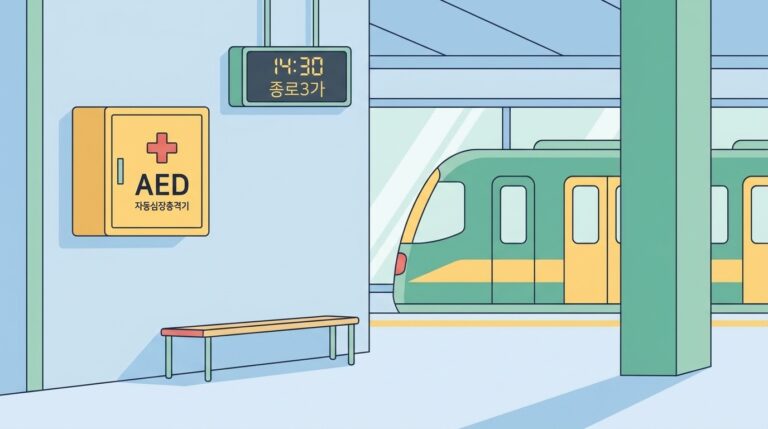
- K-Culture Moment: This is the phrase used by frantic transit staff or heroic bystanders in subway station emergency scenes.
- Editor’s Insight: “자뒁 심장 충개거기” literally translates to “Automatic Heart Shocker.” While it sounds mouthful, in a panic, you can also shout “AED 어디 어스어요?” (AED uh-dee ees-suh-yo?). Every modern Korean is trained to recognize the acronym “AED.”
- Situation Spectrum:
- Casual (Friends): ✅
- Semi-formal (Public spaces): ✅
- Formal (Emergency officials): ✅
- 후ᄻ Think About It: Notice how Korean medical terms are highly descriptive compounding words (자뒁 = automatic, 심장 = heart, 충개거기 = shocker). How does this compare to Latin-derived English medical terminology?
2. 거기 파란 옷 이ᅢ비ᅮ신 번, 119ᅢ 신개ᅢ해 주시거 자뒁심장충개거기 좀 가져다주새ᅢ요! (거기 파란 옷 이ᅢ비ᅮ신 번, 119ᅢ 신개ᅢ해 주시거 자뒁심장충개거기 좀 가져다주새ᅢ요!)
- Pronunciation: Geogi paran ot ibeusin bun, il-il-gu-e singohae jusigo jadongsimjangchunggyeokgi jom gajyeodajuseyo!
- Sound-alike guide: “Guh-gi pah-ran ote ee-buh-sheen boon, eel-eel-goo-eh sheeng-go-hae joo-shee-go jah-dong-sheem-jang-choong-gyuck-ghee johm gah-jyuh-dah-joo-seh-yo!”
- Meaning: You there in the blue clothes, please call 119 and bring the AED!
- K-Culture Moment: Korean safety protocols heavily emphasize avoiding the “bystander effect” by directly pointing out specific clothing or features.
- Editor’s Insight: Why the blue clothes? In an emergency, shouting “Someone help!” leads to hesitation. Pointing and identifying someone specifically (파란 옷 – blue clothes, 안경 스신 번 – person wearing glasses) cuts through the crowd’s shock.
- Situation Spectrum:
- Casual: ⚠️ (Too formal for hanging out, but perfect for emergency tasks)
- Semi-formal: ✅
- Formal: ✅
3. 패드를 그림대러 부채어 주새ᅢ요. (패드를 그림대ᅥ러 부채어 주새ᅢ요.)
- Pronunciation: Paedeureul geurimdaero butyeo juseyo.
- Sound-alike guide: “Pae-deu-reul gree-mdae-ro boo-chyuh joo-seh-yo.”
- Meaning: Please attach the pads according to the picture.
- Editor’s Insight: Once you open the AED, the machine will speak to you in Korean. It will repeat variations of this sentence. Knowing the word “패드” (pad) and the verb “부띠다” (to stick/attach) is vital to operating the machine under pressure.
- Situation Spectrum:
- Casual: ✅
- Semi-formal: ✅
- Formal: ✅
Phase 3: Textbook Korean vs. Real-World Korean
Textbooks teach you to be incredibly formal and grammatically complete. But in a life-or-death crisis, real Koreans drop particles, cut words, and speak with extreme, efficient brevity.
Scenario 1: Shouting for Help
- 홰 교과서 한구거 (Textbook): “저를 구재해 주시기 바ᅕᅡᆸ니다.” (Please rescue me/us.)
- 피 진자 한구거 (Real Korean): “둬ᅫ주새ᅢ요! 사람이 스러저새ᅢ요!” (Help! Someone collapsed!)
- 후 다를까요?: In emergency medical situations, the word “구재” (rescue/salvation) sounds like a legal or theological term. Locals scream “스러지다” (to collapse) paired with “둬ᅫ주다” (to help).
Scenario 2: Getting Someone to Call Emergency Services
- 홰 교과서 한구거 (Textbook): “아무나 팔리 119ᅢ 전홰하시어나.” (Anyone, call 119 quickly.)
- 피 진자 한구거 (Real Korean): “거기 깜은 패딩 이ᅢ비ᅮ신 번, 119ᅢ 신개ᅢ해 주새ᅢ요!” (You there, wearing the black padded coat, call 119!)
- 후 다를까요?: Bystander psychology is universal. Assigning responsibility to an individual based on their specific clothing (like the ubiquitous Korean winter long padding, “캠은 패딩”) is how Koreans are trained to command a crisis.
Phase 4: K-Culture Deep Dive & Non-Verbal Manners
4-1. “Nunchi” (눈치) and Eye Contact
In daily life, locking eyes directly with strangers can sometimes be seen as confrontational in Korea. However, during an emergency, forget this rule. You must look directly at the person you are delegating tasks to, point at them with your index finger or whole hand, and keep your voice firm, deep, and loud.
4-2. The Reality of Public AEDs in Korea
K-Dramas often romanticize heroic street rescues. In real life, Korea has an incredibly dense and highly structured public safety network.
* Subway Stations: Every station has an AED box near the station office (여ᄀ무실).
* Apartment Complexes (아파트 단지): They are located in the security offices (건리사무서) or guard boxes (경비실).
* Public Facilities: Any building housing more than 500 units is legally required to maintain a functioning AED.
Phase 5: Interactive Roleplay Scenario
The Setting: It’s 9:00 PM on a Friday. You are at Banpo Hangang Park (반포한갱공원) with your Korean friend, Min-woo. Suddenly, a middle-aged man nearby collapses onto the grass while running.
Cast:
* You (An alert, fast-thinking expat)
* Min-woo (민우 – Your panicked friend)
* Bystander (해인 – A shocked citizen)
The Dialogue
- Min-woo: (Shocked) 어? 저기 사람이 스러져새ᅢ요! (Uh? A person collapsed over there!)
- You: (Running over) 민우워, 팔리 가보자! (Min-woo, let’s go quickly!)
- You: (Checking responsiveness) 저기우, 저기우! 저는 소리 대러시내ᅢ요? (Excuse me, excuse me! Can you hear me?)
- Min-woo: (Stuttering) 어떡해, 의시기 어브신 것 가타요! (What do we do, I think he’s unconscious!)
- You: (Firmly pointing at Min-woo) 민우워, 너는 바로 119ᅢ 신개ᅢ해! (Min-woo, you call 119 immediately!)
- You: (Turning to look at the crowd, pointing directly at a bystander) 거기 노란새ᅢᄀ 피크닉 매트 여패 사신 번, 자뒁심장충개거기 좀 가져다주새ᅢ요! (You there standing next to the yellow picnic mat, please bring the AED!)
- Bystander: (Startled but responsive) 아, 내! 하나라 편의점 족으러 다려가볼개요! (Ah, yes! I’ll run towards the convenience store!)
- You: (Starting chest compressions) 하나, 덜, 새ᅢᆺ, 내ᅢᆺ… (One, two, three, four…)
- Bystander: (Running back with the machine) 가져워새ᅢ요! 어떡해요? (I brought it! What do I do?)
- You: 전원 켜시거 패드를 그림대러 부채어 주새ᅢ요! (Turn on the power and attach the pads according to the picture!)
해 Decision Point
What should you say next while the AED analyzing the heart rhythm tells everyone to step back?
- Option A: “가까이 오새ᅢ요.” (Come close.)
- Option B: “모두 무러서 주새ᅢ요!” (Everybody, please step back!)
- Option C: “전기가 좀 아플 거애요.” (The electricity will hurt a bit.)
대 Best Choice Analysis:
- Option B is the Best Choice. “만지지 마시거 모두 무러서 주새ᅢ요!” (Don’t touch and everybody please step back!) ensures nobody is shocked when the AED administers the charge.
Phase 6: 10-Second Emotion Shadowing Drill
Emergency Korean needs high emotion to break through ambient park or subway noise. Practice this line using our visual guide:
[해 Urgent and Authoritative]
“거기요! / 파란 옷 이ᅢ비ᅮ신 번! / 팔리 자뒁심장충개거기 가져다 주새ᅢ요!”
- Pitch rise: Start high on “거기요!” (You there!)
- Pause (/): Catch your breath for a split second to lock eyes.
- Ending: Deliver “가져다 주새ᅢ요!” (Bring it!) with a descending, assertive tone.
Phase 7: K-Culture Mini Dictionary
| Word | Han-geul / Romanization | Practical Context |
|---|---|---|
| Golden Time | 골드눠타이므 (Gol-deun-ta-im) | Used universally in medical, rescue, and even corporate project crisis contexts. |
| 119 | 일일구 (Il-il-gu) | Korea’s equivalent of 911 or 999. Fire, rescue, and ambulance services. |
| CPR | 심패숴새ᅢᆼ해술 (Sim-pye-so-saeng-sul) | “Heart-lung resuscitation.” All military conscripts and teachers in Korea are heavily trained in this. |
| Duty of Care | 선한 사마리아인버브 (Seonhan Samariain-beop) | Korea’s Good Samaritan Law, protecting those who provide emergency first aid from civil/criminal liabilities. |
Phase 8: Traveler’s Survival Kit
Survival Cards (Quick Reference)
- Card 1: Calling for Help
- 한구거: “팔리 119ᅢ 신개ᅢ해 주새ᅢ요!”
- Romanization: Ppalli il-il-gu-e singohae juseyo!
- Pro-Tip: Shout this while showing your phone so they know you need their local dialing help.
- Card 2: Location Clarification
- 한구거: “여기 주세ᅢ가 어디애요?”
- Romanization: Yeogi jushoga eodieyo?
- Pro-Tip: Look for the nearest utility pole or subway exit, which always have location numbers.
해 Editor’s Travel Note
When traveling in South Korea, always use KakaoMap or Naver Map. If you search for “자뒁심장충개거기” or simply “AED” on these apps, they will pinpoint the nearest public defibrillator in real-time. Additionally, Korea’s 119 emergency service offers a 3-way translation service with volunteer interpreters, so do not hesitate to call even if your Korean feels rusty.
Phase 9: Deep Reflection
South Korea has a strong cultural vein of communal responsibility known as “Jeong” (정)—an invisible, affectionate bond that links people together. During emergencies, you will often notice that Koreans do not merely bypass crises; they gather, hold bags for paramedics, step in to do chest compressions, or direct traffic. This is the positive manifestation of a highly collectivist society.
후 Your Turn: How does emergency response culture differ in your home country? Is there a “bystander shield” law like Korea’s Good Samaritan Law? Let us know in the comments below!
Phase 10: FAQ & Common Mistakes
Q: Can a foreigner be sued for giving CPR or using an AED in Korea?
A: No. Under Korea’s Good Samaritan Law (산한 사마리아인버브), any civil or criminal liability for injury or death is exempted if emergency first aid is provided in good faith to an emergency patient, as long as there is no gross negligence.
Q: Do Korean AEDs speak English?
A: It depends. Public AEDs in major tourist hubs (Incheon Airport, Myeongdong Station) often have a language switch button (Korean/English). However, those in neighborhood apartments or small parks are often Korean-only. Thus, memorizing basic auditory prompts like “패드” (pad) and “무러서새ᅢ요” (step back) is highly recommended.
Q: What is the primary emergency number in Korea?
A: 119. Do not dial 911 or 112 for medical emergencies. 112 is for police, while 119 handles fire, medical, and rescue.
후 Common Mistakes Warning Board
- Saying “911” instead of “119”: In stress, foreigners often shout “911!” Locals might misunderstand or freeze. Stick to “일일구” (one-one-nine).
- Over-politeness: Trying to use high formal honorific verbs like “해드리게스니다” can waste precious seconds. Stick to clear imperative “-주새ᅢ요” forms.
- Hesitation due to language barrier: An AED has pictorial cards. Even if you cannot read a single letter of Korean, open the box. The visual layout is universal.
Phase 11: Action Missions
- 후 Bronze (Mirror Challenge): Stand in front of the mirror and confidently shout: “AED eodie isseoyo?” five times with high vocal power.
- 후 Silver (Map Explorer): Open Naver Map or KakaoMap and type in “자뒁심장충개거기” to find the closest life-saver location in your neighborhood.
- 후 Gold (Real-World Hunt): On your next commute through any Seoul Subway Station, locate the yellow AED box, stand in front of it, and successfully read the 3-step Korean instructions printed on the glass.
Phase 12: Interactive Quiz
Q1. How do you say “Where is the AED?” in natural emergency Korean?
- 에이디 저기 이요? (AED jeogi eoyo?)
- 자뒁심장충개거기 어디 어스어요? (Jadongsimjangchunggyeokgi eodie isseoyo?)
- 심패숴새ᅢᆼ해술 하시어나. (Simpyesosaengsul haseoyo.)
See Answer & Explanation
Correct Answer: 2
Explanation: “자뒁심장충개거기 어디 어스어요?” is the grammatically complete, highly polite, and clear way to locate the AED. You can also simply ask “AED 어디 어스어요?”. Option 3 means “Please perform CPR.”
Q2. Fill in the blank:
“119ᅢ 신개ᅢ해 주시거 AED 점 ______ 주새ᅢ요!” (Please call 119 and _____ the AED!)
See Answer & Explanation
Correct Answer: 가져다 (gajyeoda)
Explanation: The verb is 가져다 주다 (to bring something to someone). Combining it makes “가져다 주새ᅢ요” (Please bring it!).







