

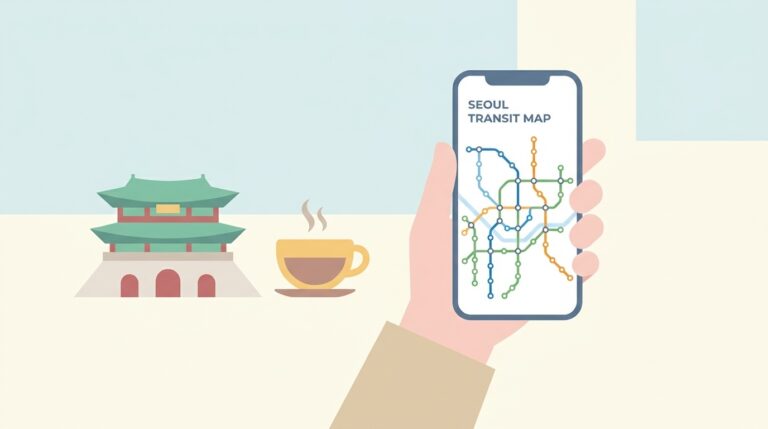
How to Plan Your K-Trip Itinerary Like a Local: No More Tangled Routes!
안녕하세요! (Annyeonghaseyo!) It’s your favorite senior editor from Daily Hangul (매일한글), your trusted local guide and Korean language tutor.
Have you ever opened Google Maps in Seoul, ready to plan a dream afternoon of hopping from a historic palace in Jongno to a trendy cafe in Seongsu, only to realize that… wait, why isn’t the walking route showing up? And why does this transit route look so incredibly complicated?
You are not alone. Many of my intermediate (B1) students tell me their first attempt at planning a Korean trip felt less like a vacation and more like a chaotic puzzle. In Korea, we have a very specific way of thinking about space, time, and flow when we plan a trip.
Today, we are going to dive into the art of 여행 일정(코스) 짜기 (Planning a travel itinerary/course). By the end of this guide, you’ll not only know the perfect natural phrases to plan a trip with your Korean friends, but you’ll also understand the unique local mindset that will save you hours of backtracking on the subway. Let’s get planning!
Phase 2: Deep Dive into 3 Core Expressions
To plan like a local, you need the right verbal tools. Let’s look at three essential expressions that every Korean uses when organizing a day out.
1. 코스를 짜다 (Koseu-reul jjada)
- Pronunciation: [Koseu-reul jjada] / (Sounds like “co-soo-ruel jjah-dah”)
- Meaning: To plan/craft an itinerary (Lit: “To weave/squeeze a course”)
- K-Culture Moment: You will hear this constantly in lifestyle K-Dramas like Our Beloved Summer or Lovestruck in the City, where characters spend hours deciding the perfect sequence of a date or a weekend getaway.
- Editor’s Insight: The verb 짜다 (jjada) literally means “to weave” (like yarn) or “to squeeze” (like a sponge). When paired with 코스 (course), it implies that you are carefully weaving different locations together to create a seamless, beautiful tapestry of a day. It’s not just making a list; it’s an art!
- Situation Spectrum:
- Friends/Casual: ✅
- Coworkers/Semi-formal: ✅
- Boss/Formal: ⚠️ (Better to use “일정을 계획하다” [il-jeong-eul gye-hoe-ha-da])
🤔 Think About It: In many Western cultures, we “make plans.” In Korea, we “weave courses.” How does the idea of “weaving” change how you think about connecting destinations?
2. 동선이 꼬이다 (Dongseon-i kko-ida)
- Pronunciation: [Dong-seon-i kko-i-da] / (Sounds like “dong-sun-ee kko-ee-dah”)
- Meaning: The route is messed up/inefficient (Lit: “The moving lines are tangled”)
- K-Culture Moment: Think of travel variety shows like Running Man or 2 Days & 1 Night. When members realize they have to travel from the far east of Seoul to the far west and back again, they scream: “동선 완전히 꼬였어!” (Our route is completely tangled!)
- Editor’s Insight: 동선 (Dong-seon) refers to the physical path or line of movement. 꼬이다 (kko-ida) means to get twisted or tangled. If you plan to visit N Seoul Tower (center), then Haeundae Beach (actually in Busan!), and then back to Myeongdong, your dongseon is hopelessly tangled. Keeping your dongseon clean is the golden rule of Korean travel.
- Situation Spectrum:
- Friends/Casual: ✅
- Coworkers/Semi-formal: ✅
- Boss/Formal: ✅
🤔 Think About It: Korea is incredibly dense, meaning a bad route can cost you hours in traffic or crowded subways. Have you ever had a travel route get “tangled” in your own country?
3. 여유롭게 보다 (Yeoyuroptge boda)
- Pronunciation: [Yeo-yu-rop-ge bo-da] / (Sounds like “yuh-yoo-rop-geh bo-dah”)
- Meaning: To sightsee leisurely/at a relaxed pace (Lit: “To look with leisure”)
- K-Culture Moment: This is the vibe of healing shows like BTS In the SOOP. Instead of rushing from one photo spot to another, you sit, drink tea, and enjoy the scenery.
- Editor’s Insight: Korean society is famous for its 빨리빨리 (ppalli-ppalli / hurry-hurry) culture. However, because daily life is so fast, Koreans deeply crave and romanticize 여유 (yeo-yu)—the psychological and physical room to breathe. When planning, proposing a “leisurely” course shows deep consideration for your travel partner’s energy levels.
- Situation Spectrum:
- Friends/Casual: ✅
- Coworkers/Semi-formal: ✅
- Boss/Formal: ✅
🤔 Think About It: Why do you think “leisure” (여유) is valued so highly in a society known for its extreme speed?
Phase 3: Textbook Korean vs. Real Korean
When you study with standard textbooks, the travel expressions can sound a bit like a dusty brochure. Let’s look at how real Koreans actually talk when planning a trip.
Situation 1: Deciding the first stop of the day
- 📖 Textbook Korean: “우리는 먼저 어디에 갈까요?” (Where shall we go first?)
- 🗣️ Real Korean: “첫 코스 어디로 잡을까?” (Where should we set/grab our first spot?)
- 💡 Why it’s different: Koreans love using the verb 잡다 (jab-da / to grab or catch) when deciding on locations, times, or dates. It sounds active, casual, and highly natural.
Situation 2: Warning someone about a packed schedule
- 📖 Textbook Korean: “일정이 너무 바쁩니다.” (The schedule is very busy.)
- 🗣️ Real Korean: “일정이 너무 빡빡해.” (The schedule is super tight/packed.)
- 💡 Why it’s different: 빡빡하다 (ppak-ppak-hada) gives the physical sensation of something being stiff or having absolutely no air or space. It is the ultimate natural adjective for a jam-packed itinerary.
Phase 4: K-Culture Deep Dive & Non-verbal Manners
4-1. The Body Language of Planning
When you are looking at a map or phone screen with a Korean friend, pay attention to how you point. Shoving a single index finger right in front of someone’s face can feel slightly aggressive. Instead, use a gently open hand to indicate a region on the screen, or lean in shoulder-to-shoulder. Sharing a screen is a sign of closeness, so don’t be afraid to sit side-by-side at the cafe table rather than across from each other!
4-2. The MBTI Craze: “Are you a J or a P?”
You cannot talk about planning a trip in modern Korea without mentioning MBTI. Koreans love categorizing travel styles into two main types:
* The “J” (Judging/Planner): They have excel sheets, booked tickets, backup plans for rainy days, and optimized dongseon (routes).
* The “P” (Perceiving/Spontaneous): They wake up, look at the weather, and say, “Let’s just see where the wind takes us!”
When planning a course, asking your friend “혹시 MBTI가 J야, P야?” (By the way, are you a J or a P?) is the ultimate conversational icebreaker. It shows you understand modern Korean social culture and instantly aligns your planning expectations!
Phase 5: Interactive Roleplay Scenario
Let’s put your skills to the test! You are sitting in a cozy cafe in Yeonnam-dong with Minjun (민준), a self-proclaimed “J” type who wants to help you plan a weekend trip to Busan.
Characters:
- You: An eager traveler who wants a balanced trip.
- Minjun: A passionate planner who loves efficiency but sometimes overpacks the schedule.
The Dialogue
- Minjun: 🎭 (Excitedly opens a map app on his phone)
“우리 부산 여행 코스 짜야지! 내가 대충 짜왔는데 한번 볼래?”
(Woo-ri Bu-san yeo-haeng ko-seu jja-ya-ji! Nae-ga dae-chung jja-wat-neun-de han-beon bol-rae?)
“We need to plan our Busan trip course! I roughly drafted one, want to take a look?” -
You: 🎭 (Leaning in to look at the screen)
“우와, 벌써 다 준비했어? 대단하다!”
(U-wa, beol-sseo da jun-bi-haet-eo? Dae-dan-ha-da!)
“Wow, you prepared it all already? Amazing!” -
Minjun: 🎭 (Beaming with pride)
“첫 코스로 감천문화마을에 갔다가, 점심 먹고 바로 해운대로 넘어가는 거야!”
*(Cheot ko-seu-ro Gam-cheon-mun-hwa-ma-eul-e gat-da-ga, jeom-sim meok-go ba-ro Hae-un-dae-ro neo-meo-ga-neun geo-ya!)”
“As our first course, we go to Gamcheon Culture Village, eat lunch, and then cross right over to Haeundae!” -
You: 🎭 (Squinting at the map, realizing Gamcheon and Haeundae are on opposite sides of Busan)
“음… 그렇게 가면 동선이 좀 꼬이지 않을까?”
(Eum… geu-reoh-ge ga-myeon dong-seon-i jom kko-i-ji an-eul-kka?)
“Hmm… if we go that way, won’t our route get a bit tangled?” -
Minjun: 🎭 (Gasps, checking the map again)
“아, 진짜네! 대중교통으로 가니까 거의 한 시간 반 걸린다. 미안해, 내가 놓쳤어!”
(Ah, jin-jja-ne! Dae-jung-gyo-tong-eu-ro ga-ni-kka geo-ui han si-gan ban geol-rin-da. Mi-an-hae, nae-ga no-chyeot-seo!)
“Oh, you’re right! Going by public transit takes almost an hour and a half. Sorry, I missed that!” -
You: 🎭 (Reassuring him with a warm smile)
“아니야, 괜찮아! 첫날은 해운대 근처에서 여유롭게 보는 게 어때?”
(A-ni-ya, gwen-cha-na! Cheot-nal-eun Hae-un-dae geun-cheo-e-seo yeo-yu-rop-ge bo-neun ge eo-ttae?)
“No, it’s okay! How about we look around the Haeundae area leisurely on the first day?” -
Minjun: 🎭 (Nodding eagerly)
“좋아! 그럼 해운대 해변이랑 블루라인파크 열차 타는 코스로 잡자.”
(Jo-ha! Geu-reom Hae-un-dae hae-byeon-i-rang beul-ru-ra-in-pa-keu yeol-cha ta-neun ko-seu-ro jap-ja.)
“Great! Then let’s set the course to Haeundae Beach and riding the Blue Line Park train.” -
You: 🎭 (High-fiving him)
“완벽해! 맛집은 내가 찾아볼게.”
(Wan-byeok-hae! Mat-jib-eun nae-ga cha-ja-bol-ge.)
“Perfect! I’ll look up the famous restaurants.” -
Minjun: 🎭 (Laughing)
“역시 너랑 여행 짜니까 너무 재밌다!”
(Yeok-si neo-rang yeo-haeng jja-ni-kka neo-mu jae-mit-da!)
“As expected, planning a trip with you is so much fun!”
🔀 Decision Point
Minjun suddenly suggests: “What if we add a late-night hike up Hwangnyeongsan Mountain right after dinner to see the night view?” You are already feeling tired just thinking about it. What do you say?
- A) “그건 너무 멀고 귀찮아요.”
- Feedback: Too blunt! It sounds a bit dismissive of his enthusiastic idea.
- B) “좋은데, 우리 첫날 일정이 너무 빡빡할 것 같아. 다음 날 갈까?” (Best Choice!)
- Feedback: Perfect! You acknowledged his good idea (“좋은데”), used the local expression for a tight schedule (“빡빡할 것 같아”), and gently suggested an alternative.
- C) “싫어요. 안 가요.”
- Feedback: Oops! This is way too cold and might ruin the planning chemistry.
Phase 6: 10-Second Shadowing Drill
Let’s practice speaking with real Korean emotion. Pay attention to the pauses (/) and channel your inner actor!
Drill 1
- Emotion: [😊 Excited & Enthusiastic]
- Korean: “우리 / 부산 여행 / 코스 짜자!”
- Pronunciation: Woo-ri / Bu-san yeo-haeng / ko-seu jja-ja!
- Meaning: “Let’s plan our Busan trip course!”
Drill 2
- Emotion: [🥺 Worried but Sweet]
- Korean: “오늘 / 동선이 / 완전히 / 꼬였어…”
- Pronunciation: O-neul / dong-seon-i / wan-jeon-hi / kko-yeot-seo…
- Meaning: “Our route is completely tangled today…”
Phase 7: K-Culture Mini Dictionary
| Word | Hangul / Romanization | Real-World Local Meaning |
|---|---|---|
| 1. 맛집 | [Mat-jib] | Lit: “Taste house.” A certified delicious restaurant. Essential to any course. |
| 2. 인생샷 | [In-saeng-syat] | Lit: “Life shot.” The absolute best photo of your life. Korean courses are often planned specifically around “인생샷” locations. |
| 3. 핫플 | [Hat-ple] | Slang for “Hot Place” (trendy cafes, shops, or neighborhoods currently viral on social media). |
| 4. 가성비 | [Ga-seong-bi] | Lit: “Cost-performance ratio.” Excellent value for money. Essential for budget-conscious travelers. |
Phase 8: Traveler’s Survival Kit
Survival Phrases TOP 3
- “네이버 지도로 보여주세요.”
- Romanization: [Na-i-beo ji-do-ro bo-yeo-ju-se-yo.]
- Pro Tip: Use this when asking a local for directions. Google Maps isn’t optimized for Korea; showing them Naver Map will get you instant, precise help.
- “여기서 얼마나 걸려요?”
- Romanization: [Yeo-gi-seo ol-ma-na geol-ryeo-yo?]
- Pro Tip: Essential for checking transit times before your dongseon gets tangled!
- “조금 쉬었다가 가요.”
- Romanization: [Jo-geum swi-eot-da-ga ga-yo.]
- Pro Tip: Use this politely when the schedule is too ppak-ppak (tight) and you need a cafe break.
📌 Editor’s Travel Note
Because of local security laws, Google Maps does not function properly for walking directions in South Korea. Before you board your flight, make sure to download the Naver Map App or KakaoMap App. Also, make sure to purchase a T-money card at any convenience store for seamless subway and bus transfers!
(Note: App availability and transfer rules are subject to local transit policy updates.)
Phase 9: Deep Reflection — “One Step Deeper”
Planning an itinerary reveals a lot about a country’s soul. Korea’s hyper-efficient infrastructure—where subways arrive every 2 minutes and high-speed KTX trains connect the entire country in half a day—has shaped a culture that values time efficiency. Because everything can run smoothly, there is a subtle social pressure to make sure it does.
However, the growing popularity of “slow travel” and “rest (쉼)” in Korea shows a beautiful counter-movement. Finding the balance between an optimized route and room to breathe is the ultimate goal of modern Korean travelers.
💬 Your Turn: Are you a “J” (meticulous planner) or a “P” (go-with-the-flow spontaneous traveler) when you visit a new country? Let me know in the comments below!
Phase 10: FAQ & Common Mistakes
Q: Can I just plan my trip using English names of places on Korean map apps?
A: Yes, but with caution! While Naver Map has improved its English search immensely, some hidden gems or local mat-jibs (restaurants) are only registered in Korean. We recommend saving both the English and Korean names (e.g., “Gyeongbokgung” and “경복궁”) in your notes!
Q: Is it rude to change plans last minute with a Korean friend?
A: It depends on their personality (Are they a J or a P?), but generally, try to give them a heads-up. Because Koreans value the flow of the dongseon, changing a location last minute might mess up the dining reservations or transport logistics they pre-planned.
Q: What is the best way to suggest a break?
A: Simply say, “우리 예쁜 카페 가서 커피 한잔할까?” (Shall we go to a pretty cafe and grab a cup of coffee?). Cafe-hopping is a highly respected part of any Korean travel course!
🚨 Common Mistakes Alert!
- Trusting Google Maps blindly: It will show you outdated transit times and won’t give walking paths. Use Naver Map.
- Ignoring restaurant “Break Times”: Many popular local spots close between 3:00 PM and 5:00 PM for prep. Always check this when planning your lunchtime course!
- Overestimating your energy: Trying to do Bukchon Hanok Village, Namsan Tower, and Gangnam in one day is a recipe for a tangled route and sore feet. Keep it regional!
Phase 11: Action Missions
- 🥉 Bronze (The Mirror Challenge): Look in the mirror and practice saying: “일정이 너무 빡빡해!” with a cute, playfully exhausted expression three times.
- 🥈 Silver (The Social Share): Take a screenshot of your dream Korean destination and post it on your social media with the caption: “내 다음 여행 코스!” (My next travel course!).
- 🥇 Gold (The Local Scout): Open KakaoMap or Naver Map, search for a neighborhood in Seoul (like Mapo-gu), and find two cafes within a 5-minute walking dongseon (moving line) of each other.
- 🎮 K-Culture Mission: Watch an episode of a Korean travel vlog on YouTube and write down how many times they use the words 맛집 (mat-jib) or 코스 (course)!
Phase 12: Interactive Quiz Challenge
1. Culture & Language Match
If your route is highly inefficient and you are crossing the city back and forth, your friend might complain that:
* A) 코스가 좋다 (The course is good)
* B) 동선이 꼬였다 (The route is tangled)
* C) 여유가 없다 (There is no leisure)
Click for Answer & Explanation
Correct Answer: B
“동선이 꼬였다” literally means your lines of movement are tangled, which is the perfect way to describe an inefficient route!
2. Fill in the Blank
Complete this natural sentence: “우리 첫날 일정이 너무 ( _____ ) 것 같아. 조금 쉬었다가 가자.”
* A) 가성비 있는 (cost-effective)
* B) 빡빡한 (tight/packed)
* C) 맛집인 (delicious restaurant)
Click for Answer & Explanation
Correct Answer: B
“빡빡한” (ppak-ppak-han) means tight or packed, perfectly matching the request to rest because the schedule is too full.
3. True or False?
“Koreans only use the word ‘짜다’ when they are talking about food being too salty.”
* True
* False
Click for Answer & Explanation
Correct Answer: False
While “짜다” does mean “salty,” it also means “to weave, frame, or plan” (as in 코스를 짜다 / to plan a course). Homonyms make Korean fun!
See? Planning a trip to Korea doesn’t have to be overwhelming. With a clean dongseon and some room for yeoyu, you are well on your way to experiencing Korea like a true local. Until next time, 행복한 여행 계획 세우세요! (Happy travel planning!)







