

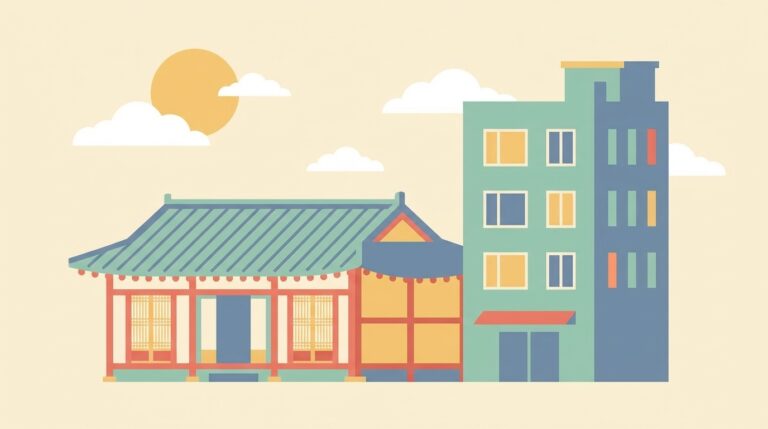
Living in Korea: How to Talk About Your Home in Korean (Apartment vs. House)
안녕하세요! (An-nyeong-ha-se-yo!) Hello! I am your lead editor at Daily Hangul. Have you ever watched a K-Drama and noticed how the characters’ homes tell a story? From the luxurious, high-tech apartments in The Penthouse to the cozy, romantic rooftop houses in Our Beloved Summer, Korean homes have a unique vibe.
But when Korean friends ask you, “어디에 살아요?” (Eo-di-e sa-ra-yo? / Where do you live?), many beginners freeze. Do you live in an ‘apartment’ or a ‘house’? In Korea, these words carry very specific cultural meanings! Today, let’s learn how to describe your home like a real local.
Phase 2: Core Housing Expressions
1. 아파트 (A-pa-teu)
- Pronunciation: [ah-pa-teu] / Sounds like “ah-part” but with a cute “teu” at the end!
- Meaning: Apartment complex / High-rise residential building.
- K-Culture Moment: Think of those massive, sleek concrete towers with security guards and beautiful gardens at the entrance. In Korea, owning an 아파트 is often seen as a symbol of stability and success.
- Editor’s Insight: In Western countries, “apartment” might mean a rented flat. In Korea, an 아파트 is usually a spacious, family-sized unit inside a large complex that people buy as an investment.
- Situation Spectrum:
- Friends & Casual: ✅
- Coworkers & Semi-formal: ✅
- Bosses & Formal: ✅
- — Think About It: Why do you think high-rise apartments became so popular in Korea compared to single-family homes? Let’s discuss below!
2. 주택 (Ju-taek)
- Pronunciation: [joo-tek] / Sounds like “Juice” without the ‘s’ + “tech”.
- Meaning: Single-family detached house.
- K-Culture Moment: The beautiful two-story houses with small gardens and iron gates often seen in slice-of-life K-Dramas like Reply 1988.
- Editor’s Insight: 주택 offers more privacy and your own yard, but it requires more maintenance (like clearing snow yourself!).
- Situation Spectrum:
- Friends & Casual: ✅
- Coworkers & Semi-formal: ✅
- Bosses & Formal: ✅
- — Think About It: Would you prefer the convenience of an 아파트 or the freedom of a 주택?
3. 원룸 (Won-rum)
- Pronunciation: [won-room] / Sounds like the English “One room”.
- Meaning: Studio apartment / One-room flat.
- K-Culture Moment: The classic cozy starter home for college students or young professionals in Seoul, decorated with aesthetic fairy lights.
- Editor’s Insight: Don’t say “스튜디오” (seub-tyu-di-o) for a studio apartment. Koreans call it a 원룸!
- Situation Spectrum:
- Friends & Casual: ✅
- Coworkers & Semi-formal: ✅
- Bosses & Formal: ☀️ (A bit too personal, but fine if asked directly)
Phase 3: Textbook Korean vs. Real Korean
Saying Where You Live
- — Textbook: 저는 아파트에 거주하고 있습니다. (Jeo-neun a-pa-teu-e geo-ju-ha-go it-seup-ni-da.) – “I am residing in an apartment complex.” (Way too formal and robotic!)
- — Real Korean: 저 아파트에 살아요. (Jeo a-pa-teu-e sa-ra-yo.) – “I live in an apartment.” (Natural, friendly, and polite!)
- — Why is it different?: Koreans prefer the active verb “살다” (sal-da / to live) over the clinical “거주하다” (geo-ju-ha-da / to reside) in daily conversations.
Talking About a Small Studio
- — Textbook: 제 집은 방이 하나뿐입니다. (Je ji-beun bang-i ha-na-ppun-im-ni-da.) – “My home has only one room.”
- — Real Korean: 저 원룸에 살아요. (Je won-rum-e sa-ra-yo.) – “I live in a studio.”
- — Why is it different?: Using the specific loanword 원룸 immediately paints a clear picture for any Korean local.
Phase 4: K-Culture Deep Dive
4-1. Nunchi & Modesty (우리 집 vs. 내 집)
When talking about your home in Korean, always say 우리 집 (u-ri jip / “our house”) instead of 내 집 (nae jip / “my house”), even if you live completely alone! Korea is a community-oriented society. Saying 내 집 can sound slightly selfish or overly individualistic.
4-2. Housewarming Culture (집들이)
When someone moves into a new 아파트 or 주택, they invite friends for a 집들이 (jip-deu-ri / housewarming party). The golden rule? You must bring laundry detergent (세제 – se-je) or toilet paper (휴지 – hyu-ji). The bubbles from the detergent and the rolling toilet paper symbolize smooth success and endless fortune in the new home!
Phase 5: Interactive Cafe Chat Roleplay
Setting: You are enjoying a iced americano at a trendy cafe in Seoul with your Korean classmate, Ji-a.
- Ji-a: (🎭 Smiling warmly) 민우 씨, 요즘 어디에 살아요? (Min-u ssi, yo-jeum eo-di-e sa-ra-yo? / Min-woo, where do you live these days?)
- You: (🎭 Thinking of your cozy studio) 저 신촌에 살아요. 원룸이에요. (Jeo Sin-chon-e sa-ra-yo. Won-rum-i-e-yo. / I live in Sinchon. It’s a studio.)
- Ji-a: (🎭 Nodding) 아, 원룸이군요! 혼자 살기 편하죠? (Ah, won-rum-i-gun-yo! Hon-ja sal-gi pyeon-ha-jyo? / Ah, a studio! It’s convenient for living alone, right?)
- You: (🎭 Agreeing) 네, 정말 편해요. 지아 씨는요? (Ne, jeong-mal pyeon-hae-yo. Ji-a ssi-neun-yo? / Yes, really convenient. How about you, Ji-a?)
- Ji-a: (🎭 Sipping her coffee) 저는 부모님하고 아파트에 살아요. (Jeo-neun bu-mo-nim-ha-go a-pa-teu-e sa-ra-yo. / I live in an apartment with my parents.)
- You: (🎭 Curious) 오, 아파트는 몇 층이에요? (O, a-pa-teu-neun myeot cheung-i-e-yo? / Oh, what floor is the apartment?)
- Ji-a: (🎭 Laughing) 15층이에요! 전망이 좋아요. (Sip-o cheung-i-e-yo! Jeon-mang-i jo-a-yo. / It’s the 15th floor! The view is nice.)
- You: (🎭 Amazed) 와, 정말 좋겠네요! (Wa, jeong-mal jo-ket-nae-yo! / Wow, that must be really nice!)
- Ji-a: (🎭 Clapping hands) 나중에 우리 집에 놀러 오세요! (Na-jung-e u-ri ji-be nol-reo o-se-yo! / Come visit our house later!)
- You: (🎭 Excited) 네, 꼭 갈게요! (Ne, kkok gal-ge-yo! / Yes, I will definitely go!)
🔀 Decision Point: How do you respond to Ji-a’s invitation?
- Choice A: “아니요, 괜찮아요.” (An-i-yo, gwen-cha-na-yo. / No, it’s okay.)
- Feedback: 🚫 Too cold! It might make Ji-a feel rejected.
- Choice B: “네, 꼭 갈게요! 집들이 선물로 휴지 가져갈게요!” (Ne, kkok gal-ge-yo! Jip-deu-ri seon-mul-lo hyu-ji ga-yeo-gal-ge-yo! / Yes, I’ll definitely go! I’ll bring toilet paper as a housewarming gift!)
- Feedback: ✅ Perfect! Showing that you know the 집들이 custom will instantly make her respect your cultural knowledge!
- Choice C: “내 집은 작아요.” (Nae ji-beun ja-ga-yo. / My house is small.)
- Feedback: ⚠️ Grammatically okay, but sounds a bit self-deprecating and uses “내 집” instead of the natural “우리 집”.
Phase 6: 10-Second Shadowing Drill
Practice speaking with emotional inflections!
- “우리 집은 / 아파트예요.” [😊 Proud and happy]
- u-ri ji-beun / a-pa-teu-ye-yo.
- “와, / 진짜 / 부럽다!” [🥺 Full of wonder and cute jealousy]
- wa, / jin-jja / bu-reop-da! (Wow, I’m so jealous!)
Phase 7: K-Culture Mini Dictionary
- 빌라 (Bil-la): Villa. In Korea, this refers to low-rise brick housing (usually 3 to 5 floors), not a Mediterranean luxury mansion.
- 오피스텔 (O-pi-seu-tel): Officetel. A hybrid of “office” and “hotel” – great for single living with 24/7 security.
- 옥탑방 (Ok-tap-bang): Rooftop room. Very romanticized in K-Dramas, but can be very hot in summer and cold in winter!
- 마당 (Ma-dang): Yard/Garden. A prized feature of traditional 주택.
Phase 8: Traveler’s Survival Kit
Survival Phrases
- 여기 주소가 어떻게 돼요? (Yeo-gi ju-so-ga eo-tteo-ke dwae-yo?) – “What is the address here?” (Use this when ordering food delivery to your Airbnb!)
- 몇 층이에요? (Myeot cheung-i-e-yo?) – “Which floor is it?”
- 공동현관 비밀번호가 뭐예요? (Gong-dong-hyeon-gwan bi-mil-beon-ho-ga mwo-ye-yo?) – “What is the main gate password?” (Crucial for getting into Korean apartments/villas!)
📌 Editor’s Travel Note: Always use the Naver Map App instead of Google Maps when navigating Korean neighborhoods, as Google Maps does not update housing addresses and building gates accurately in Korea!
Phase 9: One Step Deeper
The way Koreans view apartments reflects the country’s rapid economic rise. During the late 20th century, modern high-rises became symbols of modernization and convenient living. Today, while many Westerners dream of suburban houses, Koreans generally prefer apartments because they are secure, close to subway stations, and come with fantastic community amenities.
💬 Your Turn: In your home country, is it more popular to live in an apartment or a detached house? Share your thoughts in the comments below!
Phase 10: FAQ & Common Mistakes
Q: Is a “빌라” (Villa) expensive in Korea?
A: Usually, a 빌라 is cheaper to rent or buy than an 아파트. However, some luxury “villas” in Gangnam can cost millions of dollars!
Q: Can I say “맨션” (Mansion) for a big house?
A: Be careful! In Korea, “맨션” is an older word used for older, medium-sized apartment buildings built in the 1980s, not a giant luxury estate.
Q: What is “오피스텔”?
A: It is a studio apartment located in a commercial building. It is super convenient because shops and restaurants are usually right downstairs!
🙀 Common Mistakes Board
- Mistake 1: Saying “I live in a studio” as “저 스튜디오에 살아요.” (Koreans will think you live in a photography studio! Use 원룸 instead).
- Mistake 2: Saying “내 집” (my house) instead of 우리 집 (our house).
- Mistake 3: Assuming “빌라” means a resort house.
Phase 11: Action Missions
- 🥉 Bronze: Look in the mirror and say: “우리 집은 [아파트/주택/원룸]이에요.”
- 🥈 Silver: Text a Korean friend or write on your social media: “나중에 우리 집에 놀러 오세요!”
- 🥇 Gold: Find a K-Drama scene featuring a housewarming party (집들이) and spot the toilet paper or detergent gifts!
Phase 12: Interactive Quiz Challenge
1. Situation Quiz
Your Korean friend asks: “어디 살아요?” You live in a cozy 4-story brick residential building. What do you say?
* A) “저 아파트에 살아요.”
* B) “저 빌라에 살아요.”
* C) “저 맨션에 살아요.”
👉 Click to see the answer!
Answer: B! A 4-story brick building is typically called a 빌라 in Korea.
2. Fill-in-the-blank
“나중에 [ _ _ ] 집에 놀러 오세요!” (Come visit my/our house later!)
* A) 내 (Nae)
* B) 우리 (U-ri)
👉 Click to see the answer!
Answer: B! “우리” (our) is the natural, culturally warm way to refer to your home.
3. True or False?
In Korea, bringing laundry detergent to a housewarming party is a polite gesture.
* [True / False]
👉 Click to see the answer!
Answer: True! The bubbles represent rising success and fortune!







