

Floor Noise in Korea: Simple Ways to Handle Apartment Sounds Like a Local
Phase 1: Empathy (Welcome to the Apartment Life!)
안녕하세요! (An-nyeong-ha-se-yo!) Hello! Welcome back to Daily Hangul, your cozy space for learning practical Korean and local culture. I’m your head editor and veteran tutor.
Imagine this: You finally moved into your dream Korean apartment (아파트 – a-pa-teu). It is sleek, warm, and has a beautiful view of the Seoul skyline. You are happily eating your favorite late-night Korean chicken (치킨) and dancing along to the newest K-Pop hit. Life is perfect!
But suddenly… tap, tap, tap. A gentle knock on your door. Or maybe, you hear a rhythmic thumping sound from the ceiling right above your bed.
Welcome to the real world of Korean apartment living! In Korea, where over 60% of people live in shared buildings, floor noise or inter-floor noise (층간 소음 – cheung-gan so-eum) is a very common topic. Because Korean floors use a special underfloor heating system called Ondol (온돌), sounds can travel easily between levels.
Don’t worry! You don’t have to live in absolute silence. Today, we will learn how to handle this situation politely with warm, basic Korean phrases that will actually make your neighbors smile and appreciate your effort.
Phase 2: Core Expressions for Harmony
Here are 3 essential, beginner-friendly phrases to use when talking about noise.
1. 시끄러워요 (si-kkeu-reo-wo-yo)
- Pronunciation: [she-gheu-ruh-wah-yo] / Sounds like “she-grew-war-yo”
- Meaning: “It is noisy / loud.”
- K-Culture Moment: You often hear characters in K-Dramas cover their ears and playfully yell this when their friends sing bad karaoke (노래방) too loudly.
- Editor’s Insight: While it means “It’s noisy,” saying this directly to a neighbor’s face can sound a bit sharp. Use it softly with a gentle smile to keep the peace.
- Situation Spectrum:
- Friends & Casual: ✅ (시끄러워 / si-kkeu-reo)
- Coworkers & Semi-formal: ✅ (시끄러워요 / si-kkeu-reo-wo-yo)
- Boss & Formal: ⚠️ (시끄럽습니다 / si-kkeu-reop-seup-ni-da)
- 🤔 Think About It: Why does adding “yo” (요) at the end completely change the feeling of a sentence? It is the magic of Korean politeness!
2. 조용히 해주세요 (jo-yong-hi hae-ju-se-yo)
- Pronunciation: [jo-yong-hee hae-joo-seh-yo] / Sounds like “jo-yong-he-page-us-say-yo” without the ‘p’
- Meaning: “Please be quiet.”
- K-Culture Moment: Often whispered in Korean study cafes (독서실) or library scenes in high-school dramas.
- Editor’s Insight: This is the most polite and standard way to ask for quiet. It shows you respect the other person while making a clear request.
- Situation Spectrum:
- Friends & Casual: ✅ (조용히 해줘 / jo-yong-hi hae-jwo)
- Coworkers & Semi-formal: ✅ (조용히 해주세요 / jo-yong-hi hae-ju-se-yo)
- Boss & Formal: ✅ (조용히 해주십시오 / jo-yong-hi hae-ju-sip-si-o)
- 🤔 Think About It: In your culture, how do you ask someone to be quiet without sounding rude? How does it compare to this soft Korean request?
3. 죄송합니다 (joe-song-hap-ni-da)
- Pronunciation: [jweh-song-ham-nee-da] / Sounds like “jway-song-hahm-nee-dah”
- Meaning: “I am sorry.”
- K-Culture Moment: The classic bow! You see this in every drama when a character accidentally steps on someone’s foot or makes a mistake at work.
- Editor’s Insight: If a neighbor complains about your noise, saying “죄송합니다” first instantly cools down any anger. It is the ultimate shield of politeness!
- Situation Spectrum:
- Friends & Casual: ✅ (미안해 / mi-an-hae)
- Coworkers & Semi-formal: ✅ (죄송해요 / joe-song-hae-yo)
- Boss & Formal: ✅ (죄송합니다 / joe-song-hap-ni-da)
- 🤔 Think About It: Koreans value harmony highly. Why is saying “sorry” first so powerful in building trust in a community?
Phase 3: Textbook Korean vs. Real Korean
Let’s look at how textbooks teach these situations versus how locals actually speak to keep things friendly!
Situation 1: Asking a neighbor to lower the volume
- 📖 Textbook Korean: 소음을 줄여 주십시오. (so-eum-eul jul-yeo ju-sip-si-o) – “Please reduce the noise.” (Very stiff, like a military command)
- 🗣️ Real Korean: 조금만 조용히 해주세요. (jo-geum-man jo-yong-hi hae-ju-se-yo) – “Just a little bit quiet, please.” (Much softer and polite)
- 💡 Why is it different? Adding “조금만” (jo-geum-man – “just a little”) softens the request. It makes it sound like a small, easy favor rather than an angry complaint.
Situation 2: Apologizing and promising to be quiet
- 📖 Textbook Korean: 앞으로 주의하겠습니다. (ap-eu-ro ju-ui-ha-get-seup-ni-da) – “I will exercise caution in the future.” (Sounds like an official corporate apology)
- 🗣️ Real Korean: 네, 조심할게요! (ne, jo-sim-hal-ge-yo!) – “Yes, I’ll be careful!” (Warm and cooperative)
- 💡 Why is it different? “조심할게요” shows a friendly, personal promise. It reassures your neighbor that you genuinely care about their comfort.
Phase 4: K-Culture Deep Dive & Non-Verbal Manners
4-1. Nunchi (눈치) & Soft Manners
In Korea, direct confrontation can feel very aggressive. If you have a noise issue, do not knock loudly on your neighbor’s door in anger. Instead, Koreans use Nunchi (눈치)—tact and social awareness.
* The Note & Snack Method: If the noise is constant, write a polite sticky note in simple Korean and leave it on their door with a small treat, like a pack of Choco Pies or sweet Korean pears. This shows you want to be friends, not enemies!
* The Guard Office (경비실 – gyeong-bi-sil): Most apartments have a friendly security guard. If the noise is too loud at night, you can call the guard, and they will politely contact the neighbor for you. This keeps you safe from direct conflict!
4-2. The “Slipper” Culture
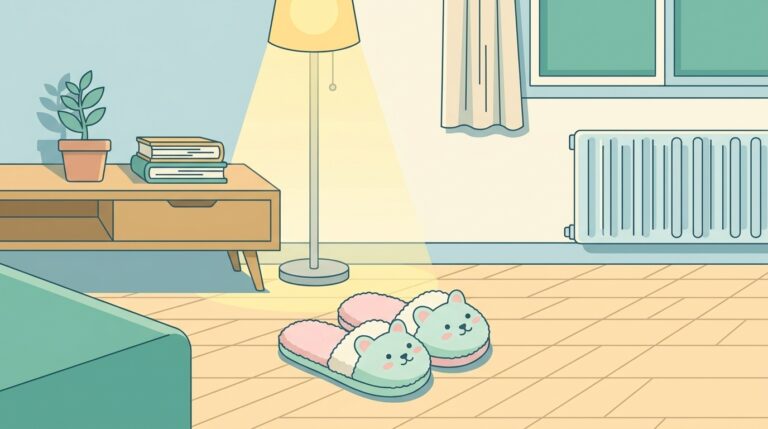
Why do Koreans wear indoor slippers? To prevent cheung-gan so-eum! Wearing soft, thick indoor slippers (슬리퍼) is the number one rule of living in a Korean apartment. It cushions your footsteps so your downstairs neighbor can sleep peacefully.
Phase 5: Interactive Roleplay Scenario
The Setting: You are walking down the hallway of your apartment building. You meet your downstairs neighbor, Min-su (민수), near the elevator. He looks a little tired.
Characters:
- You: Friendly resident trying your best with basic Korean.
- Min-su: Your polite but slightly tired downstairs neighbor.
The Conversation:
- Min-su: 🎭 (Smiling weakly) 안녕하세요! 잘 지내셨어요?
- An-nyeong-ha-se-yo! Jal ji-nae-syeot-seo-yo?
- “Hello! Have you been doing well?”
- You: 🎭 (Nodding politely) 안녕하세요, 민수 씨. 네, 잘 지내요.
- An-nyeong-ha-se-yo, Min-su ssi. Ne, jal ji-nae-yo.
- “Hello, Min-su. Yes, I am doing well.”
- Min-su: 🎭 (Hesitating, rubbing his neck) 저… 혹시 어제 저녁에 바쁘셨어요?
- Jeo… hok-si eo-je jeo-nyeok-ae ba-ppeu-syeot-seo-yo?
- “Uh… by any chance, were you busy yesterday evening?”
- You: 🎭 (Curious) 어제요? 아니요, 왜요?
- Eo-je-yo? A-ni-yo, wae-yo?
- “Yesterday? No, why?”
- Min-su: 🎭 (Politely pointing up) 조금 시끄러웠어요. 쿵쿵 소리가 났어요.
- Jo-geum si-kkeu-reo-wot-seo-yo. Kung-kung so-ri-ga nat-seo-yo.
- “It was a little noisy. There was a thumping sound.”
- You: 🎭 (Gasping softly, realizing you were dancing) 아! 정말 죄송합니다!
- Ah! Jeong-mal joe-song-hap-ni-da!
- “Ah! I am truly sorry!”
- Min-su: 🎭 (Smiling to reassure you) 괜찮습니다. 조금만 조용히 해주세요.
- Gwaen-chan-seup-ni-da. Jo-geum-man jo-yong-hi hae-ju-se-yo.
- “It is okay. Please just be a little quiet.”
- You: 🎭 (Bowing slightly) 네, 앞으로 조심할게요.
- Ne, ap-eu-ro jo-sim-hal-ge-yo.
- “Yes, I will be careful from now on.”
- Min-su: 🎭 (Relieved) 감사합니다. 좋은 하루 보내세요!
- Gam-sa-hap-ni-da. Jo-eun ha-ru bo-nae-se-yo!
- “Thank you. Have a nice day!”
- You: 🎭 (Smiling warmly) 네, 감사합니다! 안녕히 가세요.
- Ne, gam-sa-hap-ni-da! An-nyeong-hi ga-se-yo.
- “Yes, thank you! Goodbye.”
🔀 Decision Point!
What should you do next to make sure Min-su feels completely respected?
- A) Buy thick indoor slippers (슬리퍼) and wear them immediately.
- Best Choice! This solves the physical issue of the thumping sound (kung-kung), showing you are a great neighbor.
- B) Ignore him because it is your house and you can dance if you want.
- Bad Choice! This ruins your relationship with your neighbor and might lead to a formal complaint to the guard office.
- C) Knock on his door late at night to ask if it is quiet enough.
- Risk Choice! Visiting a neighbor late at night is considered impolite in Korea. Keep communication to daytime or use notes!
Phase 6: 10-Second Emotion Shadowing Drill
Let’s practice saying these with the perfect emotion! Pay attention to the pauses (/).
- [🥺 Apologetic & Sincere]
- 아! / 정말 / 죄송합니다.
- Ah! / jeong-mal / joe-song-hap-ni-da.
- “Ah! / Really / I am sorry.”
- [😊 Friendly & Promising]
- 네, / 이제 / 조심할게요!
- Ne, / i-jae / jo-sim-hal-ge-yo!
- “Yes, / from now on / I will be careful!”
- [🤫 Quietly whispering to a friend]
- 쉿! / 조금만 / 조용히 해줘.
- Swit! / jo-geum-man / jo-yong-hi hae-jwo.
- “Shh! / Just a little / be quiet.”
Phase 7: K-Culture Mini Dictionary
| Word (Korean + Romanization) | English Meaning | Cultural Context |
|---|---|---|
| 층간 소음 (cheung-gan so-eum) | Inter-floor noise | A huge social topic in modern Korea due to the high density of apartment living. |
| 슬리퍼 (seul-li-peo) | Indoor slippers | The ultimate peace-making tool. Almost every Korean household has soft slippers for guests and residents. |
| 경비실 (gyeong-bi-sil) | Guard/Security Office | The place where friendly neighborhood guards assist residents with deliveries, building safety, and noise complaints. |
| 이웃 (i-ut) | Neighbor | Traditionally, Koreans viewed neighbors as extended family. Good relationships with neighbors are highly valued. |
Phase 8: Traveler’s Survival Kit
If you are renting a temporary apartment or staying in a local studio (Officetel) via accommodation services during your trip, keep these phrases handy!
Top 3 Survival Phrases
- 조용히 해주세요 (jo-yong-hi hae-ju-se-yo) – Please be quiet. (Use when someone is loud in the hallway)
- 조심할게요 (jo-sim-hal-ge-yo) – I will be careful. (Use if someone mentions noise to you)
- 감사합니다 (gam-sa-hap-ni-da) – Thank you. (Always end with this to keep the atmosphere sweet)
📌 Editor’s Travel Note:
When finding your temporary home in Seoul, use the Naver Map app download page to locate nearby convenience stores where you can easily buy soft, cheap indoor slippers! Wearing slippers is the easiest way to prevent any awkward moments during your beautiful Korean holiday.
Phase 9: Deep Reflection — “One Step Deeper”
In traditional Korea, the concept of Jeong (정)—a deep feeling of warm attachment and community—meant that neighbors would share food and help each other daily. Today, high-rise apartments offer privacy, but they can sometimes feel isolated. When floor noise happens, it is a test of Jeong. By apologizing sincerely and responding softly, you are participating in a beautiful, centuries-old social dance of maintaining community harmony in a modern, concrete world.
💬 Your Turn: How do people handle noise complaints in your hometown? Do you talk directly to neighbors, or do you write notes? Let us know in the comments below!
Phase 10: FAQ & Common Mistakes (FAQ Schema)
Q: Can I knock on my ceiling with a broom if the upstairs neighbor is loud?
A: No, please avoid this. In Korea, knocking on the ceiling back can escalate the conflict. It is much better and more polite to contact the building’s 경비실 (guard office) to handle it calmly.
Q: What time should I be extra quiet in a Korean apartment?
A: Generally from 10:00 PM to 7:00 AM. This is called sleeping time, and sounds like washing machines, loud vacuuming, or running should be avoided.
Q: Do I need to buy slippers even if the floor is clean?
A: Yes! Slippers are not for cleanliness; they are to cushion your footsteps so the floor does not vibrate for the person downstairs.
🚨 Common Mistakes Alert!
- Walking with heavy heels: Walking with your heels striking the floor hard makes a deep “thumping” sound downstairs. Walk softly!
- Saying “왜요?” (wae-yo? – Why?) angrily: If a neighbor complains, saying “Why?” defensively can sound very rude. Start with “죄송합니다” (sorry) first.
- Moving heavy chairs without pads: Always put tennis balls or soft pads on the legs of your chairs and tables to prevent scraping sounds.
Phase 11: Action Mission!
Let’s put your new knowledge into action with these fun challenges!
- 🥉 Bronze Mission (My Room Challenge): Walk around your room and say “조심할게요” out loud three times while practicing your most polite bow.
- 🥈 Silver Mission (Slipper Selfie): If you are in Korea or have indoor slippers, put them on and share a picture of your slippers on your social media with the hashtag
#DailyHanguland the caption “조용히 해주세요”! - 🥇 Gold Mission (The Real Deal): Next time you hear a sound or want to show appreciation to someone, practice saying “감사합니다, 조심할게요” with a warm, friendly smile.
Phase 12: Interactive Quiz
Test your skills and cultural knowledge below!
1. What is the most polite way to ask a neighbor to be quiet?
- A) 시끄러워! (si-kkeu-reo!)
- B) 조금만 조용히 해주세요. (jo-geum-man jo-yong-hi hae-ju-se-yo.)
- C) 시끄럽습니다. (si-kkeu-reop-seup-ni-da.)
2. Fill in the blank:
When you want to say “I will be careful” to a neighbor, you say: “네, _______________.”
* A) 미안해 (mi-an-hae)
* B) 조심할게요 (jo-sim-hal-ge-yo)
* C) 조용히 해 (jo-yong-hi hae)
🎉 Click here to see the Answers and Explanations!
- Question 1 Answer: B
- Explanation: “조금만 조용히 해주세요” is soft, kind, and perfectly polite for neighbors.
- Question 2 Answer: B
- Explanation: “조심할게요” means “I will be careful,” showing your friendly and helpful intention!







