

Master the Korean Pharmacy: How to Hand in Your Prescription Like a Local
Phase 1: Empathy (Your Warm Welcome to Korea’s Cozy Pharmacies)
안녕하세요! (Annyeonghaseyo!) Hello there! Your friendly chief editor from Daily Hangul is here.
Imagine this: You are exploring the beautiful, neon-lit streets of Seoul. Suddenly, the changing weather gets to you, and you find yourself coughing at a doctor’s clinic. The doctor hands you a small slip of paper—a 처방전 (cheobangjeon / prescription)—and points you to the nearest 약국 (yakguk / pharmacy) with its iconic glowing green or red sign.
You walk in, and the pharmacist looks up. Your heart races. How do you hand over the prescription? What if they ask you questions in rapid Korean?
Don’t worry! Today, we are going to learn how to confidently navigate a Korean pharmacy, ask the right questions about your medication, and understand Korean medicine culture. By the end of this guide, you won’t just survive the experience; you will impress the pharmacist with your natural, polite Korean! Let’s dive in.
Phase 2: Core Expressions Deep Dive
Here are the three most essential phrases you need when submitting a prescription in Korea.
1. 처방전 접수해 주세요 (Cheobangjeon jeopsuhae juseyo)
- Pronunciation: [Cheo-bang-jeon jeop-su-hae ju-se-yo] / Sound-alike: “Chuh-bahng-juhn jup-soo-hae joo-seh-yo”
- Meaning: Please process/submit this prescription.
- K-Culture Moment: In almost every medical K-Drama (like Hospital Playlist), you see patients or their family members heading straight to the pharmacy counter, politely handing over this slip of paper.
- Editor’s Insight: “접수” (jeopsu) means to register or receive. By adding “~해 주세요” (hae juseyo / please do it for me), you sound incredibly polite, clear, and natural.
- Situation Spectrum:
- Casual (Friends): 🚫 (Too formal for friends, but you wouldn’t give them a prescription anyway!)
- Semi-formal (Pharmacist/Staff): ✅ (Perfect and highly recommended)
- Formal (Elderly/Strict setting): ✅
- 🤔 Think About It: Why does Korean use the verb “접수하다” (to register/receive) instead of just saying “여기요” (here)? It reflects the organized, process-oriented nature of Korean healthcare. How does your country handle prescriptions?
2. 하루에 몇 번 먹어야 해요? (Harue myeot beon meogeoya haeyo?)
- Pronunciation: [Ha-ru-e myeot beon meo-geo-ya hae-yo] / Sound-alike: “Ha-roo-eh myut buhn muh-guh-yah hae-yo”
- Meaning: How many times a day do I need to take this?
- K-Culture Moment: When K-Pop stars talk about keeping healthy during busy tour schedules on live streams, they often complain about having to take pills “하루에 세 번” (three times a day).
- Editor’s Insight: Koreans use the verb “먹다” (to eat) instead of “복용하다” (to take medicine) in daily conversations. It sounds much friendlier and less clinical!
- Situation Spectrum:
- Casual (Friends): ✅ (하루에 몇 번 먹어야 돼?)
- Semi-formal (Pharmacist): ✅
- Formal (Doctor/Elderly): ✅
- 🤔 Think About It: In English, we “take” medicine, but in Korean, we “eat” (먹다) medicine. Why do you think Korean culture treats medicine like food or sustenance?
3. 식후 30분에 먹는 건가요? (Sikhu samsipbune meongneun geongayo?)
- Pronunciation: [Sik-hu sam-sip-bun-e meong-neun geon-ga-yo] / Sound-alike: “Sheek-hoo sahm-sheep-boon-eh muhng-neun guhn-gah-yo”
- Meaning: Do I take this 30 minutes after meals?
- K-Culture Moment: This is the ultimate golden rule of Korean medicine! Almost every pharmacist in Korea will stamp “식후 30분” (30 minutes after meals) on your paper medicine bag.
- Editor’s Insight: “식후” (Sikhu) combines “식사” (meal) and “후” (after). If you want to ask about before meals, you can say “식전” (sikjeon).
- Situation Spectrum:
- Casual (Friends): ✅ (식후 30분에 먹는 거야?)
- Semi-formal (Pharmacist): ✅
- Formal (Doctor/Elderly): ✅
- 🤔 Think About It: Why is “30 minutes after a meal” such a strict standard in Korea? It is designed to help busy Koreans build a routine around their daily meals so they never forget their dose!
Phase 3: Textbook Korean vs. Real Korean
Sometimes, textbooks make you sound like a medical textbook yourself! Let’s look at how to sound like a real local.
Situation 1: Asking how to take the medicine
- 📖 Textbook: 이 약은 어떻게 복용합니까? (I yageun eotteoke bogyonghamnikka?) – “How does one administer this pharmaceutical product?”
- 🗣️ Real Korean: 이거 어떻게 먹어요? (Igeo eotteoke meogeoyo?) – “How do I take (eat) this?”
- 💡 Why it’s different: “복용” is a very formal, clinical term. Locals prefer the friendly, simple “먹다” (to eat/take) when talking face-to-face.
Situation 2: Asking if the medicine makes you sleepy
- 📖 Textbook: 이 약은 졸음을 유발합니까? (I yageun joreumeul yubalhamnikka?) – “Does this medicine induce somnolence?”
- 🗣️ Real Korean: 이거 먹으면 졸려요? (Igeo meogeumeon jollyeoyo?) – “Will I get sleepy if I take this?”
- 💡 Why it’s different: “졸음을 유발하다” sounds like an official warning on a drug label. Simply asking “졸려요?” (Is it sleepy?) is natural and perfectly polite.
Phase 4: K-Culture Deep Dive & Non-Verbal Manners
4-1. The “Two-Hand” Manner (양손 예절)
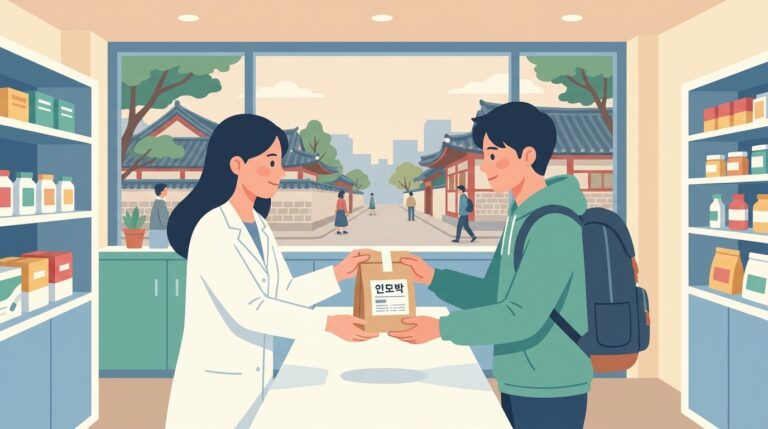
When you hand over your prescription (처방전) or receive your medication from the pharmacist, always use two hands. This is a fundamental sign of respect in Korean culture. Using one hand can sometimes look dismissive, even if you don’t mean it that way.
4-2. The Magic of “Individual Pill Pouches” (약포지)
In many Western countries, you receive your pills in plastic bottles. In Korea, pharmacies use a specialized machine to seal your exact dose for each meal into small, individual plastic pouches called 약포지 (yakpoji).
* If you see three pills for morning, three for afternoon, and three for night, they will be beautifully grouped into separate, tear-off pouches labeled 아침 (morning), 점심 (lunch), and 저녁 (dinner). It makes taking your medicine incredibly easy and satisfyingly organized!
Phase 5: The Hongdae Pharmacy Roleplay
The Setting: A warm, brightly lit pharmacy near Hongdae Station on a rainy Friday evening. You have a slight cold, and you just came from a clinic nearby.
The Characters:
* You (A tired traveler with a prescription)
* Pharmacist (A kind, middle-aged pharmacist wearing a white coat and glasses)
[Scene Start]

Pharmacist: 어서 오세요! 어떻게 오셨어요?
(Eoseo oseyo! Eotteoke osyeosseoyo?)
🎭 (Greets you warmly with a slight bow behind the counter)
"Welcome! How can I help you today?"

You: 안녕하세요. 처방전 접수해 주세요.
(Annyeonghaseyo. Cheobangjeon jeopsuhae juseyo.)
🎭 (Politely handing over the slip of paper using both hands)
"Hello. Please process this prescription."

Pharmacist: 네, 잠시만 기다려 주세요. 조제해 드릴게요.
(Ne, jamsiman gidaryeo juseyo. Jojehae deurilgetgo.)
🎭 (Takes the prescription with both hands and walks to the medicine preparation area)
"Sure, please wait a moment. I will prepare it for you."

(A few minutes pass... the pharmacist returns with a labeled paper bag of individual dose pouches)

Pharmacist: 김민지 님! 약 나왔습니다.
(Kim Min-ji nim! Yak nawasseumnida.)
🎭 (Calls your name and places the medicine bag on the counter)
"Min-ji Kim! Your medicine is ready."

You: 네! 이거 어떻게 먹어야 해요?
(Ne! Igeo eotteoke meogeoya haeyo?)
🎭 (Stepping closer, looking attentively at the medicine packet)
"Yes! How should I take this?"

Pharmacist: 하루에 세 번, 식후 30분에 드세요. 아침, 점심, 저녁 봉투에 적혀 있어요.
(Harue se beon, sikhu samsipbune deuseyo. Achim, jeomsim, jeonyeok bongtue jeok hyeo isseoyo.)
🎭 (Points to the symbols on the plastic pouches)
"Take it three times a day, 30 minutes after meals. It is written on the morning, lunch, and dinner pouches."

You: 아, 그렇군요. 혹시 이거 먹으면 졸려요?
(Ah, geureokgunyo. Hoksi igeo meogeumeon jollyeoyo?)
🎭 (Showing a slightly worried expression, as you have plans later)
"Ah, I see. By any chance, will I get sleepy if I take this?"

Pharmacist: 네, 감기약이라 조금 졸릴 수 있어요. 운전은 피하셔야 해요.
(Ne, gamgiyagira jogeum jollil su isseoyo. Unjeoneun pihasyeoya haeyo.)
🎭 (Nods understandingly and speaks in a warm, warning tone)
"Yes, since it's cold medicine, you might feel a bit drowsy. You must avoid driving."

You: 알겠습니다. 감사합니다!
(Algetseumnida. Gamsahamnida!)
🎭 (Accepts the medicine bag with both hands and bows politely)
"Understood. Thank you!"

Pharmacist: 네, 몸조리 잘하세요! 안녕히 가세요.
(Ne, momjori jalhaseyo! Annyeonghi gaseyo.)
🎭 (Waving slightly with a kind smile)
"Yes, take good care of yourself! Goodbye."

[Scene End]
🔀 Decision Point: If the Pharmacist asks you “알레르기 있으세요?” (Do you have allergies?)
- Best Choice (A): “아니요, 없어요.” (Aniyo, eopseoyo. / No, I don’t.) -> Highly clear and helpful.
- Risk Choice (B): “괜찮아요.” (Gwenchanayo. / It’s okay.) -> This can be ambiguous. It might mean “No allergies” or “I don’t mind having allergies.”
- Silent Choice (C): (Just shaking your head) -> It works, but saying “없어요” shows much better communication!
Phase 6: 10-Second Shadowing Drill
Let’s practice the rhythm of Korean speech. Use the emotion guides and pause markers (/) to speak naturally!
- [🥺 Exhausted but Polite]
처방전 / 접수해 주세요.
(Cheobangjeon / jeopsuhae juseyo.)
Pause briefly after “처방전” to make it sound incredibly natural! -
[🧐 Curious and Careful]
이거 먹으면 / 졸려요?
(Igeo meogeumeon / jollyeoyo?)
Raise your tone slightly at “졸려요?” like a gentle question.
Phase 7: K-Culture Mini Dictionary
| Word (Korean + Romanization) | English Translation | Real-world Context |
|---|---|---|
| 처방전 (Cheobangjeon) | Prescription | The official paper slip given by doctors that you must hand to the pharmacist to get prescription-strength medication. |
| 조제 (Joje) | Preparation of medicine | The pharmacist’s process of compounding and packaging your specific medicine pouches. |
| 식후 30분 (Sikhu 30-bun) | 30 minutes after meals | The standard timing rule for taking medication in Korea to protect your stomach lining. |
| 약포지 (Yakpoji) | Individual medicine pouches | The small plastic pouches containing your custom-dosed pills, sorted by mealtime. |
Phase 8: Traveler’s Survival Kit
Top 3 Survival Phrases for Your Pharmacy Visit
- 종합 감기약 주세요. (Jonghap gamgiyak juseyo.)
- “Please give me multi-symptom cold medicine.” (For when you don’t have a prescription but need over-the-counter medicine!)
- 대역이 있어요? (Daeyeogi isseoyo?) -> Correction: 대체약이 있어요? (Daecheyagi isseoyo?)
- “Do you have an alternative medicine?” (Useful if they don’t have the exact brand you want.)
- 물 좀 주실 수 있나요? (Mul jom jusil su innayo?)
- “Can I have some water, please?” (Most pharmacies have a water purifier near the counter so you can take your medicine immediately!)
📌 Editor’s Travel Note
- Finding open pharmacies: Use the Naver Map App to search for “약국” (yakguk). It will show you real-time operating hours.
- Emergency Medicine: If pharmacies are closed late at night, major convenience stores (CU, GS25, 7-Eleven) sell basic cold medicine, pain relievers, and digestive aids under the label 안전상비의약품 (Safe Medicines).
Phase 9: Deep Thoughts — “One Step Deeper”
In many Western cultures, medicine is treated with high privacy; patients take bottles home and read long leaflets in private. In Korea, health is highly communicative and community-supported. Pharmacists will carefully walk you through your dose times, circle things on your bag, and even tell you what foods to avoid. It highlights the Korean value of 정 (Jeong / warm attachment and affection) and active caregiving.
💬 Your Turn: How does your home country handle prescription medicine? Is it as personalized as Korea’s individual pouches? Let us know in the comments below!
Phase 10: FAQ & Common Mistakes
Q: Can I buy birth control or strong pain relievers without a prescription in Korea?
A: Depends. Many birth control pills are available over-the-counter (일반의약품) without a prescription. However, strong painkillers, antibiotics, and specific hormones absolutely require a doctor’s 처방전.
Q: Do Korean pharmacists speak English?
A: Often, yes! Especially in popular tourist hubs like Myeongdong, Hongdae, and Gangnam, pharmacists speak enough English to explain your dosages clearly.
Q: What if I lose my prescription paper?
A: You must go back to the clinic. Korean law strictly prohibits pharmacies from dispensing prescription drugs without physical or official digital prescriptions.
🚨 Common Mistakes Warning!
- Mistake: Handing over the prescription with one hand while looking at your phone.
- Correct Action: Put down your phone, make eye contact, and hand it over with both hands.
- Mistake: Eating the plastic pouch itself!
- Correct Action: Always tear open the plastic 약포지 and take only the pills inside.
Phase 11: Action Missions
- 🥉 Bronze (At-Home Challenge): Practice saying “처방전 접수해 주세요” in front of your mirror with a polite bow.
- 🥈 Silver (Social Challenge): Share a picture of a Korean “약포지” (medicine pouch) or a Korean pharmacy sign on your Instagram/X and tag us with the word #약국!
- 🥇 Gold (Real-world Challenge): Next time you are feeling slightly under the weather in Korea, walk into a pharmacy and politely ask for “종합 감기약 주세요”!
Phase 12: Interactive Quiz Challenge
Test your knowledge to see if you are ready to conquer the Korean pharmacy!
Q1. What is the polite way to ask, “Do I take this 30 minutes after meals?” (Click to reveal)
Answer: 식후 30분에 먹는 건가요? (Sikhu samsipbune meongneun geongayo?)
Tip: “식후” means after meals, and “식전” means before meals!
Q2. True or False: You should always give and receive items in a Korean pharmacy using one hand. (Click to reveal)
Answer: False! Always use two hands (양손) as a sign of polite manners and respect.
Q3. Fill in the blank: The physical prescription slip given by a doctor is called a ________. (Click to reveal)
Answer: 처방전 (Cheobangjeon)
Thank you for learning with Daily Hangul! Keep shining, stay healthy, and we will see you in the next lesson! 아프지 마세요! (Don’t get sick!)







