

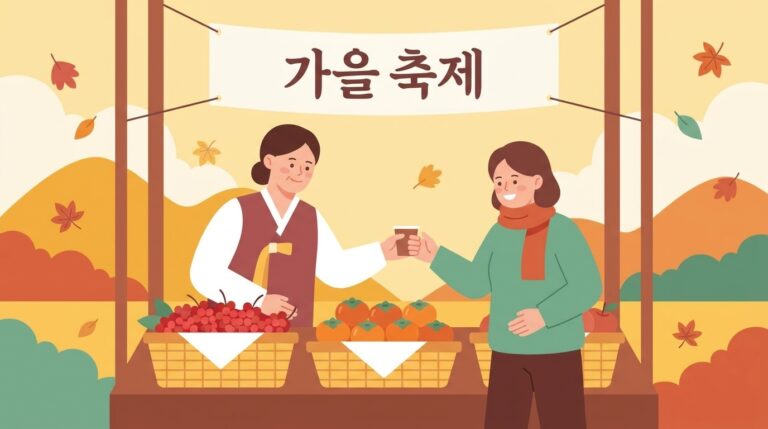
Beyond Seoul: How to Speak Like a Local at Korea’s Regional Harvest Festivals
안녕하세요! Welcome back to another cozy corner of Daily Hangul. I’m your senior editor and your trusted nunchi navigator. Have you ever wanted to break free from the neon lights of Seoul and dive into the true heart of Korea?
Imagine walking through a bustling market in Mungyeong during the vibrant Omija (Five-Flavor Berry) Festival, surrounded by mountains painted in autumn colors, or breathing in the rich, sweet aroma of roasted chestnuts in Gongju. Suddenly, a warm, smiling grandmother (imo or ajumma) hands you a fresh sample. Your heart races. You want to match her warmth, but the stuffy, formal sentences from your textbook feel incredibly awkward in this lively, rural crowd.
Don’t worry! Today, we’re stepping out of the classroom and onto the festival grounds. By the end of this guide, you won’t just know how to order—you’ll know how to charm the local vendors, secure some legendary deom (free extras), and experience the beautiful concept of Jeong (정, deep emotional bonding) like a true local.
Phase 2: Deep Dive into 3 Core Festival Expressions
To navigate any regional specialty festival (지역 특산물 축제), you only need to master these three golden keys. Let’s break down their hidden nuances.
1. 이 지역에서 제일 유명한 게 뭐예요? (I ji-yeok-eseo je-il yu-myeong-han ge mwo-yeo-yo?)
- Pronunciation: ee jee-yuck-eh-suh jay-il yoo-myung-han geh mwo-yah-yo?
- Meaning: “What is the most famous thing in this region?”
- K-Culture Moment: Think of those healing travel variety shows like 2 Days & 1 Night (1박 2일), where the cast arrives in a remote village and immediately asks the locals what they should eat first.
- Editor’s Insight: While you might already know you’re at an apple or garlic festival, asking this open-ended question shows respect for local pride. It invites the vendor to boast about their specific harvest or recipe, opening the door to a warm conversation.
- Situation Spectrum:
- Friends & Casual settings: ✅
- Semi-formal / Market vendors: ✅
- Formal / Business settings: ⚠️ (Slightly too casual for a corporate boardroom, but perfect for travel!)
🤔 Think About It: In many Western cultures, we tend to search Google reviews first. In Korea, asking a local directly is seen as a sign of respect and trust. Why do you think relational communication is so highly valued in Korean public spaces?
2. 맛보기로 조금만 시식해 볼 수 있을까요? (Mat-bo-gi-ro jo-geum-man si-sik-hae bol su is-seul-kka-yo?)
- Pronunciation: mat-bo-ghee-ro jo-geum-man shee-sheek-hae bol soo ee-seul-kka-yo?
- Meaning: “Could I try a little sample to taste?”
- K-Culture Moment: The bustling street-food scenes in K-Dramas like Welcome to Samdal-ri, where characters happily munch on free street samples while chatting with local market owners.
- Editor’s Insight: Sishik (시식) means “food tasting.” Adding Mat-bogi (맛보기 – tasting showcase) makes you sound incredibly natural and polite. It tells the vendor, “I am genuinely interested in your craft, not just looking for free food!”
- Situation Spectrum:
- Friends & Casual settings: ✅
- Semi-formal / Market vendors: ✅
- Formal / Elderly speakers: ✅ (Very polite and respectful!)
3. 이거 혹시 택배로 보낼 수 있어요? (I-geo hok-si taek-bae-ro bo-nael su is-seo-yo?)
- Pronunciation: ee-guh hok-shee taek-bae-ro bo-nel soo ee-suh-yo?
- Meaning: “Is it possible to ship this by courier?”
- K-Culture Moment: K-Dramas showing the miraculous speed of Korea’s logistics network, where fresh seafood from the southern coast arrives at a Seoul doorstep the very next morning.
- Editor’s Insight: Regional festivals can be far from your hotel. Carrying 5kg of fresh peaches or honey jars on an intercity bus is a nightmare. Almost every festival booth in Korea has a Taekbae (택배 – courier) partnership. Asking this shows you are a savvy traveler!
- Situation Spectrum:
- Friends & Casual settings: ✅
- Semi-formal / Market vendors: ✅
- Formal settings: ✅
Phase 3: Textbook Korean vs. Real Korean
When you are at a crowded, energetic local festival, using rigid textbook sentences can make you sound like an automated GPS. Let’s look at how real Koreans talk!
Situation 1: Praising the Food to the Vendor
- 📖 Textbook: “이 과일은 매우 맛있습니다.” (This fruit is very delicious.) – Too robotic and cold!
- 🗣️ Real Korean: “우와, 사장님! 이거 진짜 꿀맛이에요!” (Wow, boss! This is literally sweet as honey!)
- 💡 Why it works: Calling the vendor Sajangnim (boss) or Imo (auntie) instantly builds intimacy, and Kkul-mat (꿀맛 – honey taste) is a beloved, vivid slang word that brings a bright smile to any farmer’s face.
Situation 2: Asking for a Generous Bonus
- 📖 Textbook: “할인해 주십시오.” (Please give me a discount.) – Can sound demanding or cheap.
- 🗣️ Real Korean: “사장님~ 너무 맛있는데 덤으로 조금만 더 주시면 안 돼요?” (Boss~ this is so delicious, could you slip in a little ‘deom’ for me?)
- 💡 Why it works: Instead of asking to lower the price, asking for Deom (덤 – free extra food/items) appeals to the Korean sense of Jeong. You are celebrating their generosity rather than haggling over pennies.
Phase 4: K-Culture Deep Dive & Non-Verbal Manners
To truly connect with locals at a festival, your body language must match your words.
4-1. The Body Language of ‘Jeong’ (정)
When a vendor hands you a sample (like a freshly peeled pear or a piece of warm rice cake):
1. The Two-Handed Rule: Always receive the sample with both hands. Cup your hands together or support your right wrist/forearm with your left hand. This minor gesture speaks volumes about your character.
2. The Appreciative Nod: Take a bite, make eye contact, widen your eyes slightly, and nod while saying, “음~! 진짜 최고예요!” (Mmm~! Jin-ja choe-go-yeo-yo! – Mmm~! It’s truly the best!).
4-2. The Seasonal Food Craze (제철 음식)
Koreans are deeply obsessed with Jecheol-eumsik (제철 음식 – food in its peak season). Eating food out of season is considered a missed spiritual connection with nature. When you visit a local festival—be it the Gijang Anchovy Festival in spring or the Muan Onion Festival in summer—you are participating in a sacred annual ritual. Acknowledging this seasonality will instantly bond you with the locals.
Phase 5: The Interactive Festival Roleplay
Setting: You are visiting the scenic autumn Mungyeong Omija Festival. The air smells of sweet berries and fallen pine needles. You stop in front of a rustic wooden stall decorated with bright red berries. An energetic elder vendor (Imo) is actively beckoning you over.
Cast:
- Imo (이모): A warm, passionate local vendor with a thick regional accent.
- You (나): A curious traveler eager to try local delicacies.
1. 이모: (With a wide smile, waving her hands)
       "어서 와요! 우리 문경 오미자 한 번 맛보고 가세요!"
       (Eoseo wayo! Uri Mungyeong Omija han beon mat-bogo gaseyo!)
       "Welcome! Come taste our Mungyeong Omija before you go!"

2. 나: (Approaching gently, nodding)
       "안녕하세요! 오미자가 색깔이 정말 곱고 예쁘네요."
       (Annyeonghaseyo! Omijaga saekkkari jeongmal gopgo yeppuneyo.)
       "Hello! The color of the Omija is truly beautiful and vibrant."

3. 이모: (Proudly holding up a small cup of bright red tea)
       "그쵸? 올해 농사가 아주 풍년이에요. 시원하게 한 모금 마셔봐요!"
       (Geuchyo? Olhae nongsaga aju pungnyeonieyo. Siwonhage han mogeum masyeobwayo!)
       "Right? This year's harvest is incredibly abundant. Take a refreshing sip!"

4. 나: (Receiving the cup with both hands, taking a sip)
       "우와... 진짜 새콤달콤하고 맛있어요! 요즘이 딱 제철인가요?"
       (Uwa... jinja saekom-dalcomhago masisseoyo! Yojeumi ttak jecheoringayo?)
       "Wow... it's genuinely sweet and sour and so delicious! Is right now the peak season?"

5. 이모: (Slapping her knee in delight)
       "아유, 잘 아네! 9월 지금이 오미자가 가장 약효도 좋고 맛있을 때지!"
       (Ayu, jal ane! Gu-wol jigeumi omijaga gajang yakhyodo joko masisseul ttaeji!)
       "Ah, you know your stuff! September right now is when Omija has the best health benefits and taste!"

6. 나: (Looking at the bottled Omija syrup)
       "서울에 계신 부모님께 선물하고 싶은데, 혹시 이거 택배로 보낼 수 있어요?"
       (Seoure gyesin bumonimkke seonmulhago sipeunde, hoksi igeo taekbaero bonael su isseoyo?)
       "I want to send this as a gift to my parents in Seoul. Is it possible to ship this by courier?"

7. 이모: (Nodding vigorously)
       "당연하지! 전국 어디든 안전하게 우체국 택배로 하루 만에 쏴 드려요!"
       (Dangyeonhaji! Jeonguk eodideun anjeonhage ucheguk taekbaero haru mane sswa deuryeoyo!)
       "Of course! We ship safely anywhere in the country via Post Office courier in just one day!"

8. 나: (Smiling warmly)
       "그럼 두 박스 주문할게요! 사장님, 혹시... 덤으로 좀 더 챙겨주실 수 있나요?"
       (Georeom du bakseu jumunhalgeyo! Sajangnim, hoksi... deomeoro jom deo chaenggyeojusil su innayo?)
       "Then I will order two boxes! Boss, by any chance... could you squeeze in a little 'deom' for me?"

9. 이모: (Laughing loudly, packing an extra small bottle of syrup)
       "외국인 손님이 한국말을 어쩜 이렇게 예쁘게 해! 자, 요건 내 특별 서비스!"
       (Oegugin sonnimi hangungmareul eojeom ireoke yeppuge hae! Ja, yogeon nae teukbyeol seobiseu!)
       "How can a foreign guest speak Korean so beautifully! Here, this extra bottle is my special service!"

10. 나: (Bowing slightly with absolute delight)
       "우와! 이모, 진짜 감동이에요! 너무 감사합니다. 대박 나세요!"
       (Uwa! Imo, jinja gamdongieyo! Neomu gamsahamnida. Daebak naseyo!)
       "Wow! Imo, I'm truly touched! Thank you so much. I hope your business hits the jackpot!"
🔀 Decision Point: Choose Your Strategy!
At Turn 8, how would you ask for that extra bit of kindness?
- Choice A: “너무 비싸요. 깎아주세요!” (It’s too expensive. Give me a discount!)
- 🚨 Risk: At a local festival where farmers display their hard yearly labor, demanding a direct discount can feel dismissive of their hard work. Use with caution.
- Choice B: “이모, 혹시 덤으로 조금만 더 주실 수 있나요?” (Imo, could you perhaps give me a little ‘deom’?)
- 🏆 Best Choice: You respect their pricing, call them “Imo” (Auntie), and playfully ask for Deom. This warms their heart and almost always secures you extra treats and local stories.
- Choice C: “할인 안 해주면 안 살래요.” (If you don’t discount it, I won’t buy it.)
- 🚫 Worst Choice: Highly confrontational and breaks the atmosphere of mutual Jeong.
Phase 6: 10-Second Emotional Shadowing Drill
Korean is a highly melodic language. To sound natural, you need to practice where to pause and how to inject emotion. Try speaking these lines aloud using the emotion guides!
- [😊 Excited & Bright]
- “와! / 이거 진짜 / 꿀맛이에요!”
- Wa! / ee-guh jin-ja / kkul-mat-ee-eh-yo!
- (Wow! / This is / incredibly sweet as honey!)
- [🥺 Playful & Cute Pleading]
- “이모~/ 혹시 덤으로/ 조금만/ 더 주시면 안 돼요?”
- I-mo~/ hok-si deom-eu-ro/ jo-geum-man/ deo ju-si-myeon an dwae-yo?
- (Auntie~/ Could you perhaps/ give me just/ a little bit of ‘deom’?)
- [💖 Touched & Warm]
- “우와! / 진짜 / 감동이에요! / 감사합니다!”
- U-wa! / jin-ja / gam-dong-ee-eh-yo! / gam-sa-ham-ni-da!
- (Wow! / I’m truly / touched! / Thank you!)
Phase 7: K-Culture Mini-Dictionary
| Word (Hangul) | Romanization | English Translation | Real-World Cultural Nuance |
|---|---|---|---|
| 특산물 | Teuk-san-mul | Local Specialty | Agricultural or seafood products that a specific city is nationwide famous for (e.g., Naju Pears, Boseong Green Tea). |
| 제철 | Je-cheol | In-season | The absolute peak season for a food. Finding jecheol food is a major Korean lifestyle and travel priority. |
| 덤 | Deom | Free extra / Bonus | The extra scoop of food or free item added out of pure affection, representing the physical manifestation of Jeong. |
| 대박 | Dae-bak | Jackpot / Big hit | Commonly used in “대박 나세요!” (May your business hit the jackpot!) to wish vendors success. |
Phase 8: Traveler’s Survival Kit
Visiting a rural festival can occasionally test your navigation skills. Keep these three phrases in your back pocket!
Survival Phrases
- “카카오페이나 카드 되나요?” (Kakao-pei-na ka-deu doe-na-yo?)
- Tip: “Do you accept Kakao Pay or credit cards?” While card systems are highly integrated, small local booths might prefer bank transfers (계좌이체 – Gye-jwa-i-che) or cash.
- “여기 주차장 어디에 있어요?” (Yeo-gi ju-cha-jang eo-di-e is-seo-yo?)
- Tip: “Where is the parking lot?” Festival grounds get intensely crowded.
- “화장실이 어디예요?” (Hwa-jang-sil-i eo-di-yeo-yo?)
- Tip: “Where is the restroom?” Crucial for open-field festivals!
📌 Editor’s Travel Note
When venturing outside of Seoul, Google Maps will not work well. Make sure to download the Naver Map App or the KakaoMap App for precise walking and driving directions. Additionally, secure the Kakao T App to easily hail local taxis in remote regions.
Phase 9: Deep Reflection — “One Step Deeper”
In Western countries, local farmer’s markets are often seen as high-end, artisanal shopping venues. In Korea, regional specialty festivals are vital lifelines that preserve national heritage and support aging rural populations.
When you visit a festival in places like Yeongdeok (famous for crab) or Geumsan (famous for ginseng), you aren’t just shopping—you are actively participating in communal healing. The exchange of Deom is not a transaction; it’s an acknowledgment of shared humanity. As rural areas face demographic declines, your respectful presence and attempts to speak their language act as a warm bridge of global connection.
💬 Your Turn: Does your hometown have a local food or harvest festival? How do people negotiate or show appreciation to local farmers there? Share your stories with us in the comments below!
Phase 10: FAQ & Avoiding Misunderstandings
Q: Can I haggle for a lower price at these festivals?
A: Generally, no. Unlike antique markets, farmers set fair, regulated prices during public festivals. Asking for a steep cash discount can seem slightly rude. Instead, always ask for 덤 (Deom)! You get more value, and the vendor gets to showcase their generosity.
Q: Can international tourists easily ship items home?
A: Domestic shipping is easy, international shipping is not. Most festival booths only offer domestic shipping (국내 택배). If you want to send items back to your hotel in Seoul, that is perfectly fine! Just have your hotel address and room number written clearly in Korean.
Q: What if I don’t carry any physical cash?
A: Don’t panic! Even grandma vendors in remote villages are highly tech-savvy. They will have a sign showing their bank name and account number (계좌번호). If you have a local Korean banking app, you can easily transfer the money on the spot. If not, keeping 20,000–30,000 KRW in cash is highly recommended.
🚨 Common Mistakes Alert!
- Mistake 1: Grabbing food samples without asking.
- Correct Action: Always wait for the vendor to invite you or ask politely: “맛보기로 조금만 먹어봐도 돼요?”
- Mistake 2: Speaking to elderly sellers in informal banmal (반말).
- Correct Action: Never say “이거 맛있다” to a vendor. Always use the respectful polite form: “정말 맛있어요!”
- Mistake 3: Not verifying the shipping timeline.
- Correct Action: If you are leaving Korea in two days, make sure the domestic shipping won’t take longer. Ask: “서울까지 내일 바로 도착하나요?” (Will it arrive in Seoul tomorrow?)
Phase 11: Action Mission!
Ready to put your knowledge into practice? Here is your 3-step challenge:
- 🥉 Bronze (At-Home Challenge): Record yourself saying “이 지역에서 제일 유명한 게 뭐예요?” with a bright, welcoming tone. Listen for the natural rhythm.
- 🥈 Silver (Social Challenge): Post a picture of your favorite Korean food on Instagram or thread, tag #DailyHangul, and write “이거 진짜 제철이라 꿀맛이에요!” in the caption.
- 🥇 Gold (Real-Life Challenge): The next time you visit a Korean mart, local market, or even a restaurant in your city, politely ask the staff: “오늘 제일 맛있는 게 뭐예요?” and watch their eyes light up.
Phase 12: Interactive Quiz Challenge
Test your festival vocabulary and etiquette survival skills!
1. Situational Judgment
You are at the Yecheon Honey Festival and want to buy wild honey. You want to ask for extra. What is the most culturally charming phrase?
* A) 깎아주세요, 너무 비쌉니다. (Kkak-a-ju-se-yo, neo-mu bi-ssab-ni-da.)
* B) 사장님, 혹시 덤으로 조금 더 주실 수 있나요? (Sajangnim, hoksi deomeoro jogeum deo jusil su innayo?)
* C) 그냥 공짜로 하나 더 주세요. (Geunyang gongjja-ro hana deo ju-se-yo.)
🔍 Reveal Answer & Explanation
Correct Answer: B
Using “Sajangnim” and asking for “Deom” builds a beautiful emotional connection. Choice A is too dry, and Choice C sounds demanding!
2. Fill-in-the-Blank
“우와! 이 과일 진짜 _______이에요!” (Wow! This fruit is literally sweet as honey!)
* Hint: Think of the sweet combination of bees and flavor!
🔍 Reveal Answer & Explanation
Correct Answer: 꿀맛 (Kkul-mat)
Kkul means honey, and Mat means taste. Combine them, and you have the absolute favorite Korean expression for incredibly delicious food!
3. True or False
True or False: When a local vendor hands you a delicious food sample with one hand, it is perfectly polite to grab it casually with only your left hand.
🔍 Reveal Answer & Explanation
Correct Answer: False
Always use both hands to receive items from others in Korea, especially from those older than you. It is a fundamental non-verbal sign of respect!







