

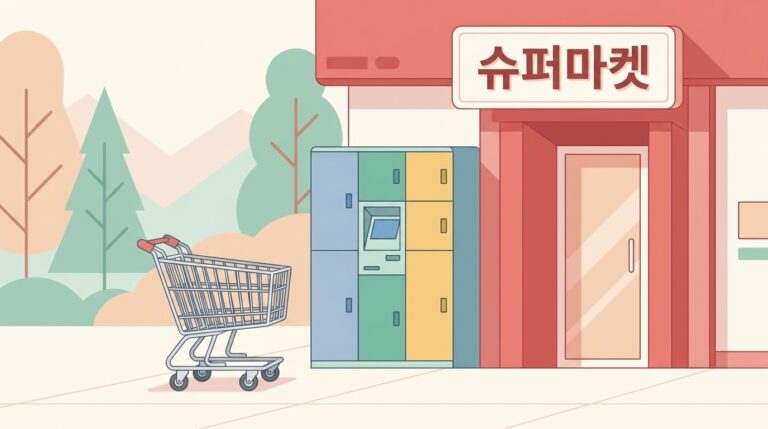
Unlock the K-Supermarket: How to Get and Push a Shopping Cart in Korea Like a Local
Phase 1: Welcome to the Bustling World of Korean Marts!
안녕하세요! (An-nyeong-ha-se-yo!) Hello! It’s your favorite premium K-culture tutor and local navigator from Daily Hangul.
Imagine this: You’re walking into a massive, shiny E-Mart or Homeplus in Seoul. The delicious aroma of freshly cooked Mandu (dumplings) fills the air. You see towers of colorful K-snacks and aesthetic strawberry milk cartons. You feel like you’ve stepped straight into a classic K-Drama scene—like when the main characters cutely bicker while grocery shopping together.
But as you head toward the rows of shopping carts, you freeze. Every single cart is locked together with a thick metal chain! There is a small slot on the handle, and local Koreans are effortlessly sliding a silver coin in, clicking a button, and pulling a cart out like magic.
Suddenly, you realize you don’t know how to ask for a coin, how to ask where the carts are, or how to politely navigate through the crowds of grandmas (Ajummis) hovering around the free sample booths.
Don’t panic! By the end of this guide, you will master the exact phrases and unspoken cultural manners needed to navigate a Korean supermarket with absolute confidence. This guide is built on real-world feedback from hundreds of beginner students who went from “lost in the supermarket” to “shopping like a true Seoulite.”
Phase 2: The Big 3 Supermarket Cart Phrases
Let’s learn the three most important phrases you’ll need when grabbing and pushing a cart (Kateu) in Korea.
1. 카트 어디에 있어요? (Ka-teu eo-di-e is-seo-yo?)
- Pronunciation Guide: Kah-teu uh-dee-eh ees-suh-yo? (Sounds like: “Car-two” + “uh-dee-eh” + “ees-suh-yo?”)
- Meaning: Where are the shopping carts?
- K-Culture Moment: Think of those sweet scenes in lifestyle K-Dramas where a couple meets up at the entrance of a grocery store after work. One of them always asks this while looking around holding their reusable bags.
- Editor’s Insight: The word “카트” (Ka-teu) is simply the English word “Cart” adapted to Korean pronunciation. If you are lost in a huge multi-level department store, just say this to any staff member with a gentle head bow.
- Situation Spectrum:
- Casual (Friends): 카트 어디 있어? (Ka-teu eo-di is-seo?)
- Semi-formal (Staff/Strangers): ✅ 카트 어디에 있어요? (Ka-teu eo-di-e is-seo-yo?)
- Formal (Polite/Elderly): 카트가 어디에 있습니까? (Ka-teu-ga eo-di-e is-seub-ni-ka?)
- 🤔 Think About It: Why does Korean use “어디에 있어요?” (literally: “Where does it exist?”) instead of a direct “Where is…?” structure? It reflects how Korean focuses heavily on the existence and presence of items in a physical space!
2. 100원짜리 동전 있어요? (Baek-won-cha-ri dong-jeon is-seo-yo?)
- Pronunciation Guide: Baek-won-chah-ree dong-jun ees-suh-yo? (Sounds like: “Beck-one” + “chah-ree” + “dong-jun” + “ees-suh-yo?”)
- Meaning: Do you have a 100-won coin?
- K-Culture Moment: In Korea, shopping carts require a 100-won coin (about 10 cents) to unlock them from the rack. When you return the cart and plug the chain back in, you get your coin back! If you only have paper cash, you will need to ask a friend or the customer service desk for a coin.
- Editor’s Insight: Don’t worry! This system isn’t trying to steal your money; it’s a brilliant Korean system to make sure people return their carts to the proper station instead of leaving them scattered in the parking lot!
- Situation Spectrum:
- Casual (Friends): ✅ 100원짜리 동전 있어? (Baek-won-cha-ri dong-jeon is-seo?)
- Semi-formal (Staff/Strangers): ✅ 100원짜리 동전 있어요? (Baek-won-cha-ri dong-jeon is-seo-yo?)
- Formal (Polite/Elderly): 100원짜리 동전 있으십니까? (Baek-won-cha-ri dong-jeon is-seu-sib-ni-ka?)
- 🤔 Think About It: “짜리” (cha-ri) is a cool Korean helper word that means “worth” or “value of.” It helps specify exact values! What is your country’s equivalent coin-lock system?
3. 잠시만요, 지나갈게요. (Jam-si-man-yo, ji-na-gal-ge-yo.)
- Pronunciation Guide: Jahm-shee-mahn-yo, jee-nah-gahl-geh-yo.
- Meaning: Just a moment, I will pass through.
- K-Culture Moment: Korean supermarkets get incredibly crowded, especially around the Sisik Koneo (free food tasting corners). If someone’s cart is blocking your path, saying this politely will instantly clear the way with a smile.
- Editor’s Insight: Foreigners often use “실례합니다” (Sil-rye-hab-ni-da / Excuse me), which sounds a bit too heavy and dramatic for a grocery aisle. “잠시만요, 지나갈게요” is much more natural and friendly.
- Situation Spectrum:
- Casual (Friends): 잠깐만, 나 지나갈게. (Jam-kan-man, na ji-na-gal-ke.)
- Semi-formal (Staff/Strangers): ✅ 잠시만요, 지나갈게요. (Jam-si-man-yo, ji-na-gal-ge-yo.)
- Formal (Polite/Elderly): 죄송합니다, 잠시 지나가겠습니다. (Joe-song-hab-ni-da, jam-si ji-na-ga-ges-seub-ni-da.)
Phase 3: Textbook Korean vs. Real-World Korean
When you study with standard textbooks, you learn stiff, formal phrases that native Koreans rarely use in real life. Let’s look at how to sound like a local!
Scenario 1: Returning your cart
- 📖 Textbook Korean: “카트를 어디에 반납합니까?” (Where do I return the cart? – Too formal, sounds like a military manual!)
- 🗣️ Real-World Korean: “카트 어디에 둬요?” (Where do I put the cart? – Super natural, polite, and quick!)
- 💡 Why it’s different: Koreans value efficiency and speed (Pali-Pali culture). Instead of using the heavy Sino-Korean word “반납” (ban-nap / formal return), locals prefer the simple verb “두다” (du-da / to put/leave).
Scenario 2: Asking someone to move their cart
- 📖 Textbook Korean: “당신의 카트를 치워 주십시오.” (Please move your cart. – Sounds very demanding and cold!)
- 🗣️ Real-World Korean: “죄송한데 카트 조금만 옆으로 부탁드립니다~” (I’m sorry, but could you please move the cart slightly to the side? – Soft, incredibly polite, and uses the magic word ‘부탁드립니다’ (please do this favor).)
- 💡 Why it’s different: In Korean culture, direct commands are avoided. Softening the request with “죄송한데” (I’m sorry but…) and “조금만” (just a little bit) makes the interaction incredibly smooth and friendly.
Phase 4: K-Culture Deep Dive & Non-Verbal Manners
4-1. Nunchi (눈치) and Cart Etiquette
Nunchi is the Korean art of sensing other people’s feelings and reading the room. In a busy Korean mart, Nunchi is everything!
* The Cart Dance: If you bump into someone’s cart or block someone’s way, do not make intense eye contact. Instead, give a quick, gentle head bow (about 15 degrees) and say “아, 죄송합니다” (Ah, joe-song-hab-ni-da / Oh, sorry) in a soft tone.
* Escalator Safety: Korean mart escalators are special! They are flat, tooth-locked travelators designed to lock your cart’s wheels magnetically so it doesn’t slide down. When stepping onto the escalator, push your cart firmly until you feel the wheels ‘click’ and lock into the track. Keep your hands on the handle just in case!
4-2. The K-Supermarket Lifestyle Code
- The Legend of the 100-Won Coin: Why 100 won? It keeps parking lots clean! If you don’t have a 100-won coin, you can walk up to the customer service desk (Gogaek Manjok Senteo) and ask “동전 교환기 어디 있어요?” (Where is the coin changer?) or simply ask them to exchange a 1,000-won bill for coins.
- The Sisik Koneo (Free Samples): Pushing your cart around the food tasting corners is a sport in Korea! The ladies cooking the samples (Imo / Aunties) love it when you show enthusiasm. Always say “잘 먹겠습니다!” (I will eat well!) before taking a sample.
Phase 5: Live Roleplay at E-Mart
Let’s put your skills to the test! You are shopping at E-Mart with your Korean friend, Min-ji, on a busy Sunday afternoon.
- Setting: The entrance of a bright, busy E-Mart. K-pop music plays softly in the background. The sound of rolling wheels and chatter fills the space.
- Cast:
- You (Excited A2 Learner)
- Min-ji (Your supportive Korean friend)
- Mart Staff (A helpful E-mart employee nearby)
- Min-ji: (🎭 Points to the rows of locked carts) 우리 카트 하나 가지고 갈까요?
(U-ri ka-teu ha-na ga-ji-go gal-ka-yo? / Shall we grab a cart?) -
You: 좋아요! 근데 카트 열쇠가 필요해요?
(Jo-a-yo! Geun-de ka-teu yeol-soe-ga pil-yo-hae-yo? / Great! But do we need a key for the cart?) -
Min-ji: (🎭 Laughs softly) 열쇠는 아니고, 100원짜리 동전이 필요해요. 혹시 동전 있어요?
(Yeol-soe-nun a-ni-go, baek-won-cha-ri dong-jeon-i pil-yo-hae-yo. Hok-si dong-jeon is-seo-yo? / Not a key, we need a 100-won coin. By any chance, do you have a coin?) -
You: 아, 저 지금 지갑에 지폐만 있어요. 어떡하죠?
(Ah, jeo ji-geum ji-gap-e ji-pye-man is-seo-yo. Eo-tteok-ha-jyo? / Oh, I only have paper cash in my wallet right now. What should we do?) -
Min-ji: 저기 직원분 계시네요. 저분한테 물어봐요!
(Jeo-gi ji-gwon-bun gye-si-ne-yo. Jeo-bun-han-te mul-eo-bwa-yo! / There’s a staff member over there. Let’s ask them!) -
You: (🎭 Walks up to the Mart Staff and bows politely) 저기요, 죄송한데 동전 교환기 어디에 있어요?
(Jeo-gi-yo, joe-song-han-de dong-jeon gyo-hwan-gi eo-di-e is-seo-yo? / Excuse me, I’m sorry, but where is the coin changer?) -
Mart Staff: (🎭 Points toward the customer service desk) 아, 저기 고객센터 옆에 있습니다.
(Ah, jeo-gi go-gaek-sen-teo yeop-e is-seub-ni-da. / Oh, it is right next to the customer service center over there.) -
You: 감사합니다! (🎭 Runs over, exchanges a bill, and comes back with a coin) 민지 씨, 저 동전 찾았어요! 이제 카트 꺼낼게요.
(Gam-sa-hab-ni-da! … Min-ji ssi, jeo dong-jeon cha-jas-seo-yo! I-je ka-teu kkeo-nael-ge-yo. / Thank you! … Min-ji, I got the coin! Now I’ll pull out the cart.) -
Min-ji: 와, 최고예요! 자, 동전을 여기에 넣고… 체인을 당겨보세요!
(Wa, choe-go-yeo-yo! Ja, dong-jeon-eul yeo-gi-e neo-go… che-in-eul dang-gyeo-bo-se-yo! / Wow, you are the best! Now, put the coin in here… and try pulling the chain!) -
You: (🎭 Clicks the coin in, pulls the chain, and the cart pops free!) 우와, 진짜 신기해요! 가 가요!
(U-wa, jin-짜 sin-gi-hae-yo! Ga-ga-yo! / Wow, this is so cool! Let’s go!)
🔀 Decision Point!
As you are pushing the cart near the fresh fruit section, a sweet grandma (Halmeoni) suddenly stops her cart right in front of the sweet potatoes, blocking the aisle completely. What do you do?
- Option A: Push past her cart silently with a stern face.
- Option B: Say loudly: “실례합니다! 비켜주세요!” (Excuse me! Move please!)
- Option C: Bow slightly, smile warmly, and say: “죄송한데 잠시만 지나갈게요~” (Excuse me, I’m sorry, but I’ll pass through quickly~)
🏆 Best Choice: Option C!
Why? Option C is incredibly respectful. Using “죄송한데” (I’m sorry but) and ending your phrase with a friendly tone shows that you respect her space. The grandma will likely smile, apologize, and happily move her cart for you!
⚠️ Risky Choice: Option B
Saying “비켜주세요” (Move please) is grammatically correct, but in Korean culture, it sounds extremely commanding, cold, and a bit rude when addressed to an elder. It can ruin the cozy neighborhood vibe instantly!
Phase 6: 10-Second Emotion Shadowing Drill
Let’s practice speaking with real Korean emotion! Use the slashes / as pause points and match your voice to the emotion markers.
- [😊 Bright & Friendly]
저기요~ / 카트 어디에 / 있어요?
(Jeo-gi-yo~ / ka-teu eo-di-e / is-seo-yo?)
“Excuse me~ Where are the carts?” -
[🥺 Soft & Apologetic]
죄송한데 / 잠시만 / 지나갈게요~
(Joe-song-han-de / jam-si-man / ji-na-gal-ge-yo~)
“I’m sorry, but could I just pass through~” -
[🎉 Excited & Proud]
나 / 100원짜리 동전 / 찾았어!
(Na / baek-won-cha-ri dong-jeon / cha-jas-seo!)
“I found a 100-won coin!”
Phase 7: K-Culture Mini-Dictionary
| Word (Korean + Romanization) | English Meaning | Local Context & Cultural Insights |
|---|---|---|
| 시식 코너 (Si-sik ko-neo) | Free Sample Corner | Supermarkets compete with incredible free food! You can taste everything from high-quality Hanwoo beef to hot dumplings while pushing your cart around. |
| 장바구니 (Jang-ba-gu-ni) | Shopping Basket / Reusable Bag | If you only have a few items, grab a green plastic Jang-ba-gu-ni at the entrance instead of a heavy cart. |
| 쓰레기 종량제 봉투 (Sseu-re-gi jong-ryang-je bong-tu) | Government-regulated trash bag | When checking out, if you ask for a bag, the cashier will ask if you want this trash bag. You can use it as a shopping bag, then use it for your trash at home! |
| 의무 휴업일 (Ui-mu hyu-eop-il) | Mandatory Mart Closing Days | To protect local traditional markets, major Korean supermarkets (like E-Mart, Lotte Mart) close on the 2nd and 4th Sundays of every month. Check before you go! |
Phase 8: Traveler’s Survival Kit
Top 3 Instant Survival Phrases
- 이거 어디에 있어요? (I-geo eo-di-e is-seo-yo?)
- Meaning: Where is this? (Show a picture of a K-food ingredient on your phone to the staff!)
- 봉투 필요해요? (Bong-tu pil-yo-hae-yo?)
- Meaning: Do you need a bag? (The cashier will ask you this. Answer with “네, 주세요” [Yes, please] or “아니요, 괜찮아요” [No, thank you]).
- 계산 어디서 해요? (Gye-san eo-di-seo hae-yo?)
- Meaning: Where do I pay / check out?
📌 Editor’s Travel Note
Before heading out, make sure to download the Naver Map App Download Page to check the operating hours of your nearest E-Mart, Lotte Mart, or Homeplus. Note: Store schedules may vary based on local government regulations.
Keep a spare 100-won coin in your phone case or card wallet—it will save you so much time when grabbing a cart!
Phase 9: A Deeper Thought — The Supermarket as a Community Hub
In many Western countries, grocery shopping is just a chore. But in Korea, visiting a massive “Hypermart” on the weekend is a beloved family activity. Parents push their children in large carts, couples try samples together, and friends stock up on cheap draft beers and late-night discounted fried chicken (Tark-gang-jeong).
This community-centric view shapes the language. When shopping, you aren’t just an individual consumer; you are sharing a tight physical space with grandmas, babies, and hard-working staff. This is why phrases like “지나갈게요” (I will pass through) are said so softly and politely. It’s an ongoing, subtle negotiation of space and respect.
💬 Your Turn: How do people in your country handle shopping carts? Do you have a coin system, or do you just grab one freely? Let us know in the comments below!
Phase 10: FAQ & Common Mistakes
Q: Can I pay with credit cards or Apple Pay at the food tasting corners?
A: No! The Sisik Koneo (sample corners) are completely free! You do not pay anything to taste. However, if you decide to buy the product, you simply put the packaged item in your cart and pay at the main checkout counters at the exit.
Q: I don’t have a 100-won coin. Can I use a 500-won coin instead to unlock the cart?
A: No. The coin slots are precisely measured for 100-won coins only. A 500-won coin is too large and will get stuck!
Q: Can I take the cart out to my taxi or bus stop?
A: Generally, carts are only allowed within the supermarket building and the designated parking lot. You cannot push the cart onto the public streets or bus stops.
🚨 The Top 3 Common Mistakes for Beginners
- Leaving the cart in the middle of the aisle: This blocks the busy Pali-Pali flow of traffic. Always park your cart close to the shelf, parallel to the aisle.
- Forgetting to take your coin back: When you return the cart, plug the chain of the cart in front of you into your handle slot, and your 100-won coin will pop right out!
- Saying “Excuse me” too aggressively: Avoid saying “여기요!” (Yeo-gi-yo!) loudly to clear a path. It sounds like you are angry. Stick to a gentle “잠시만요~” (Jam-si-man-yo~).
Phase 11: Your K-Shopping Missions!
Ready to put your knowledge into action? Try these three levels of challenges:
- 🥉 Bronze Mission: Stand in front of your mirror at home and practice saying “잠시만요, 지나갈게요~” three times with a gentle head bow and a friendly smile.
- 🥈 Silver Mission: When watching your next K-Drama, look closely at any grocery store scenes. Can you spot the shopping carts, and do you see anyone putting a coin in?
- 🥇 Gold Mission: Go to a Korean supermarket in Korea (or your local H-Mart), grab a cart using a coin, navigate the aisles politely, and say “감사합니다” to the cashier!
Phase 12: Interactive Quiz Challenge
Test your K-Mart knowledge below!
1. Which coin do you need to unlock a shopping cart in Korea?
a) 10 won
b) 100 won
c) 500 won
d) 1,000 won
👉 Click to see the answer!
Correct Answer: b) 100 won
Keep a 100-won coin handy whenever you visit a major Korean supermarket!
2. Complete the dialogue: “Excuse me, where is the cart?”
“카트 ______ 있어용?”
👉 Click to see the answer!
Correct Answer: 어디에 (eo-di-e)
The full polite phrase is: “카트 어디에 있어요?”
3. True or False: Major Korean supermarkets are open 24/7 every single day of the year.
👉 Click to see the answer!
Correct Answer: False
Most major marts have mandatory closing days (usually the 2nd and 4th Sundays of the month) to support local, traditional markets!
Keep practicing your Korean with joy, and we will see you in the next guide! 다음에 또 만나요! (Dae-eum-e tto man-na-yo! – See you again next time!)






