

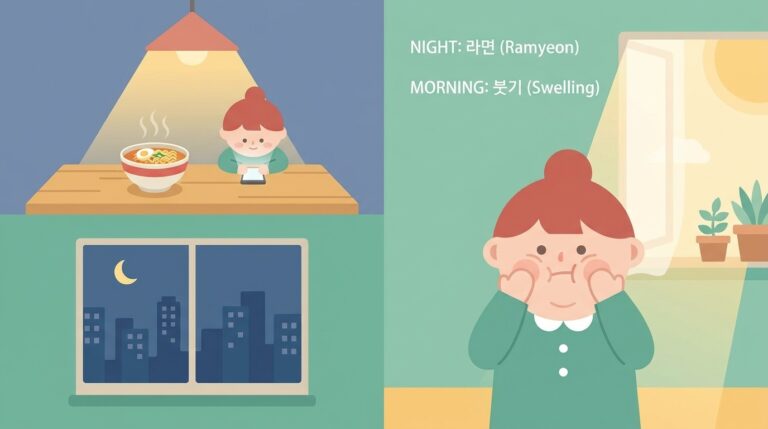
The Midnight Ramen Dilemma: How to Talk About Late-Night Snacks and Cure the Dreaded Morning “Puffy Face” like a True Korean
안녕하세요! Welcome back to another cozy session with Daily Hangul. I’m your head editor and your local Seoul guide, here to walk you through the delicious, slightly salty, yet absolutely essential world of Korean midnight snacks—and, more importantly, how to deal with the morning after!
Imagine this: It’s 11:30 PM. You’re in your cozy Seoul Airbnb, binge-watching your favorite K-Drama. On screen, the characters are slurping down a steaming pot of ramyeon. Your stomach growls. You look at your phone. Should you order that legendary Korean fried chicken?
In Korea, this is a sacred hour. But while late-night snacking is a beloved national pastime, waking up with a bloated face (얼굴이 붓다) the next morning is every Korean’s aesthetic nightmare. Even K-Pop idols have secret recipes to fight this!
Today, we’re going to learn the natural, real-world Korean expressions used to describe this delicious struggle, so you can sound incredibly fluent and relate to your Korean friends on a whole new level.
Phase 2: Core Expressions Deep Dive
Here are the three most essential expressions you need to master the art of midnight cravings and morning recovery.
1. 얼굴이 붓다 (eolguri butda)
- Pronunciation: eol-guri but-da / Sounds like: “earl-gool-ee boot-da”
- Meaning: Lit. “Face swells” / Real-world Nuance: To wake up with a puffy, bloated face (usually from too much sodium or crying the night before).
- K-Culture Moment: You’ll often see K-Pop idols on variety shows wearing sunglasses indoors first thing in the morning, sheepishly saying, “얼굴이 너무 부어서…” (Because my face is too puffy…).
- Editor’s Insight: 붓다 (to swell) is an irregular verb. When followed by a vowel, the ‘ㅅ’ disappears (e.g., 부었어요 / bueosseoyo).
- Situation Spectrum:
- Friends & Casual: ✅
- Co-workers & Semi-formal: ✅
- Bosses & Formal: ✅ (Just use the polite form: “오늘 얼굴이 많이 부었습니다.”)
- 🤔 Think About It: Why is a small, defined face so highly valued in Korean aesthetics? How does this influence the way Koreans talk about morning bloating compared to your culture?
2. 붓기를 빼다 (butgireul ppaeda)
- Pronunciation: but-gi-reul ppae-da / Sounds like: “boot-ghee-reul ppeh-da”
- Meaning: Lit. “To pull out the puffiness” / Real-world Nuance: To depuff your face, usually through massage, drinking cold water, or taking natural remedies.
- K-Culture Moment: Beauty vloggers sharing their morning routine, demonstrating jawline contouring massages or drinking specific teas to “붓기 빼기” (depuffing).
- Editor’s Insight: 붓기 (puffiness) is the noun form of 붓다. 빼다 means to remove or extract. Together, they form the ultimate daily self-care verb.
- Situation Spectrum:
- Friends & Casual: ✅
- Co-workers & Semi-formal: ✅
- Bosses & Formal: ✅
- 🤔 Think About It: What are the quick remedies you use when you feel bloated? Is there a specific food or drink in your hometown used to “depuff”?
3. 야식이 당기다 (yasik danggida)
- Pronunciation: ya-sik dang-gi-da / Sounds like: “ya-sheek dang-ghee-da”
- Meaning: Lit. “Late-night snack pulls me” / Real-world Nuance: To intensely crave a late-night snack.
- K-Culture Moment: Friends texting in a group chat at 11:00 PM: “아, 진짜 치킨 당긴다…” (Ah, I really crave chicken right now…).
- Editor’s Insight: 당기다 literally means “to pull.” Saying a food is “pulling you” is a much more natural, native way to express a strong craving than simply using “먹고 싶다” (I want to eat).
- Situation Spectrum:
- Friends & Casual: ✅
- Co-workers & Semi-formal: ⚠️ (A bit too casual for a strict business lunch, but great for office small talk!)
- Bosses & Formal: 🚫
- 🤔 Think About It: Why does late-night delivery culture feel so community-driven in Korea? Think about how easy it is to order food in Korea at 2 AM!
Phase 3: Textbook Korean vs. Real Korean
Let’s look at how textbooks teach these situations versus how native Koreans actually speak.
Situation 1: Explaining your bloated face in the morning
- 📖 Textbook Korean: “어제 저녁에 음식을 많이 먹어서 제 얼굴이 커졌습니다.” (Yesterday evening I ate a lot of food, so my face became big.)
- 🗣️ Real Korean: “어제 야식 먹고 잤더니 얼굴이 완전 부었어.” (I ate a late-night snack before sleeping yesterday, so my face is completely bloated.)
- 💡 Why is it different? The grammar pattern -었/았더니 perfectly links the past action (eating late) to the current result (puffy face). Using 완전 (completely/totally) adds native flavor.
Situation 2: Asking a friend for a depuffing remedy
- 📖 Textbook Korean: “붓기를 제거하는 약이 있습니까?” (Is there a medicine that removes swelling?)
- 🗣️ Real Korean: “붓기 빼는 데 뭐가 좋아? 녹차 마실까?” (What’s good for depuffing? Should I drink green tea?)
- 💡 Why is it different? Instead of the clinical and cold word 제거 (removal), natives use the active, conversational form -는 데 (when it comes to / for doing something) with 붓기 빼다.
Phase 4: K-Culture Deep Dive & Non-verbal Manners
4-1. Nunchi (눈치) & Body Language
When Koreans complain about their puffy faces, they often perform a light, circular massage motion along their jawline with their knuckles or gently tap their cheeks with both hands while making a cute, apologetic face. This non-verbal gesture signals, “I know I look a bit different today, please understand!”
4-2. The “Idol Water” Legend (아이돌 물)
In the fast-paced K-Pop industry, idols must look sharp even after 3 hours of sleep. This gave rise to the famous 아이돌 물 (Idol Mul). It’s a simple mixture of green tea (녹차), lemon juice, and a pinch of sugar. The combination of caffeine and Vitamin C acts as a natural diuretic, helping to “붓기를 빼다” in under 20 minutes! Try it next time you wake up feeling bloated.
Phase 5: Interactive Roleplay Scenario
Setting: It’s 11:45 PM in your Seoul apartment. Your Korean roommate, Minho (민호), is staring intensely at his phone, debating whether to order Jokbal (pig’s trotters).
- 민호: “아… 이 시간에 족발 진짜 당긴다. 주문할까?”
(Ah… I really crave Jokbal at this hour. Should I order?) - You: “(🎭 Smiling playfully) 족발? 지금 먹으면 내일 얼굴 많이 부을 텐데 괜찮아?”
(Jokbal? If you eat it now, your face will be really puffy tomorrow. Will you be okay?) - 민호: “(🎭 Sifting through the app) 어차피 내일 주말이잖아! 너도 같이 먹을래? 반반 세트 있어!”
(It’s the weekend tomorrow anyway! Do you want to eat with me? They have a half-and-half set!) - You: “(🎭 Gulping) 반반 세트? 매운 맛이랑 그냥 맛?”
(Half-and-half? Spicy and regular?) - 민호: “(🎭 Nodding enthusiastically) 응! 진짜 맛있겠다. 주문한다?”
(Yeah! It looks so good. Ordering now?)
🔀 Decision Point!
What is your response the next morning when you both wake up looking like round, cute goldfishes?
- A: “민호야, 우리 얼굴 완전 부었어! 붓기 빼는 데 뭐가 좋아?”
- B: “우리 얼굴이 커졌습니다. 약이 있습니까?”
- C: “나 붓기 안 빼도 돼. 그냥 라면 먹을래.”
Best Choice: A
Perfect! It uses the natural conversational phrase 얼굴이 완전 부었어 and asks for a depuffing tip using the authentic 붓기 빼는 데 뭐가 좋아? pattern. This will make Minho laugh and instantly look for some pumpkin juice in the fridge!
Bad Choice: B
This sounds too robotic and clinical. Asking for “medicine” (약) makes it sound like a medical emergency rather than a casual aesthetic concern.
Phase 6: 10-Second Shadowing Drill
Practice saying these out loud with real emotion! The slashes / indicate natural breathing pauses.
- [🥺 Whiny & Relatable]
“어제 야식 먹었더니 / 얼굴이 완전 부었어~”
(eot-je ya-shig meo-geot-deo-ni / eol-gu-ri wan-jeon bueos-seo~) -
[💡 Helpful & Bright]
“붓기 빼는 데는 / 따뜻한 녹차가 / 최고야!”
(but-gi ppae-neun-de-neun / tta-tteut-han nok-cha-ga / choi-go-ya!)
Phase 7: K-Culture Mini Dictionary
- 야식 (Yasik / Late-night Snack)
- Late-night dining culture is a pillar of Korean social life, fueled by 24/7 delivery services.
- 치맥 (Chimaek / Chicken & Beer)
- The ultimate late-night combination. Be warned: the sodium-alcohol combo is the absolute master of “얼굴이 붓다”!
- 호박즙 (Hobakjeup / Pumpkin Juice)
- A highly popular concentrated drink in Korea believed to be the absolute best natural remedy for reducing swelling.
- 해장 (Haejang / Hangover Cure)
- The act of eating warm, spicy soup the day after drinking to relieve hangovers and restore energy.
Phase 8: Traveler’s Survival Kit
Survival Expressions
- “배달되나요?” (bae-dal-doe-na-yo?) – “Do you deliver?”
- “붓기 빼는 차 있어요?” (but-gi ppae-neun cha is-seo-yo?) – “Do you have tea for depuffing?” (Ask this at a local pharmacy or Olive Young!)
- “내일 중요한 촬영이 있어요.” (nae-il jung-yo-han chwa-ryeong-i is-seo-yo.) – “I have an important shoot tomorrow.” (Great excuse to skip the late-night salty soup!)
📌 Editor’s Travel Note:
If you find yourself in Seoul with a bloated face, run to the nearest Olive Young Store and look for 호박차 (Pumpkin Tea) or 붓기 패치 (Depuffing Patches). They work like magic!
Phase 9: “One Step Deeper” — Cultural Reflection
In many Western cultures, having a puffy face in the morning is barely noticed or talked about. However, in Korea, the obsession with avoiding a “puffy face” (붓기) reflects a deeper societal focus on self-management and presentation. It highlights how Koreans value being perceived as neat, disciplined, and prepared at all times. Yet, ironically, the love for late-night delivery brings people together in shared, delicious guilt.
💬 Your Turn: Does your culture have a concept similar to “puffy face”? What do you usually do to recover after eating salty food late at night? Let us know in the comments below!
Phase 10: FAQ & Common Mistakes
Q: Can I use “얼굴이 부풀었어요” instead of “부었어요”?
A: No. 부풀다 means “to inflate” (like a balloon). For biological swelling or bloating of the face or body, you must use 붓다 (부었어요).
Q: Is pumpkin juice really effective for depuffing?
A: Yes! Pumpkin is naturally rich in potassium, which helps flush out sodium. It is incredibly popular among Koreans after late-night meals or even cosmetic surgeries.
Q: How do I pronounce “붓기” naturally?
A: Even though it is written as 붓기 (but-gi), it is pronounced as 붇끼 (but-kki) due to Korean pronunciation rules. Keep that double ‘ㄲ’ sound sharp!
Phase 11: Action Missions
- 🥉 Bronze: Record yourself saying “어제 라면 먹고 잤더니 얼굴이 부었어” on your phone and check your pronunciation.
- 🥈 Silver: Next time you crave a midnight snack, post a picture of it on social media with the caption: “오늘 야식 당긴다!”
- 🥇 Gold: Walk into a Korean convenience store or Olive Young and ask the clerk: “붓기 빼는 데 뭐가 제일 잘 나가요?” (What is the best seller for depuffing?)
Phase 12: Interactive Quiz Challenge
Q1. Which word means “late-night snacks” in Korean?
- 야채 (Yachae)
- 야식 (Yasik)
- 양념 (Yangnyeom)
Click to see Answer
Answer: 2. 야식 (Yasik)
Explanation: ‘야식’ literally translates to ‘night food’. ‘야채’ means vegetables and ‘양념’ means seasoning.
Q2. True or False: “붓기” is pronounced exactly as it is written (but-gi).
Click to see Answer
Answer: False
Explanation: It is pronounced as ‘붇끼’ (but-kki) due to tense consonant rules!







