

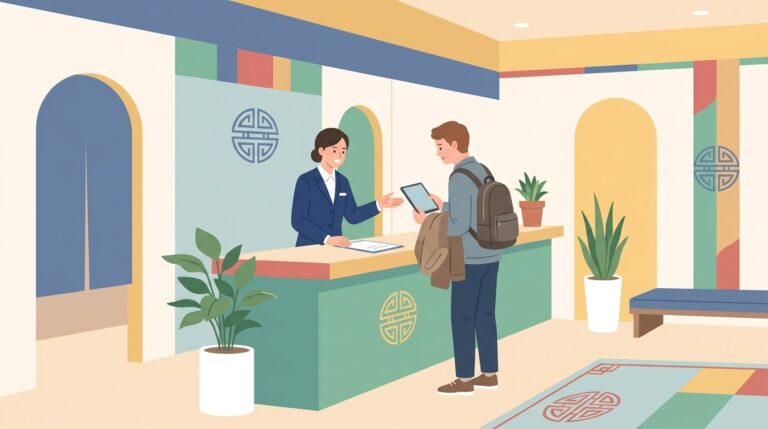
How to Open a Korean Bank Account Without Breaking a Sweat
안녕하세요! (An-nyeong-ha-se-yo!) Hello there, my dear friend! I am your Senior Editor at Daily Hangul, your personal premium tutor and local Seoul guide.
If you have ever watched a modern K-Drama, you have probably seen characters checking their phones to see a deposit, or rushing to a sparkling clean bank in Seoul to pay rent. Maybe you are planning to move to Korea, study abroad, or just stay long enough to need a local card.
But let’s be honest: walking into a foreign bank can feel like walking onto a stage without a script. Your heart beats fast, you sweat a little, and you worry, “What if I don’t understand their questions?”
Don’t worry! Today, we are going to learn the exact, friendly phrases you need to walk into any Korean bank and walk out with your brand-new bankbook and debit card. You’ll sound natural, polite, and confident!
Phase 2: 3 Key Expressions Deep Dive
Here are the three most important phrases you will need at the bank. Let’s break them down easily!
1. 통장 만들려고 왔어요. (Tong-jang man-deul-ryeo-go wat-eo-yo.)
- Pronunciation: Tong-jang mahn-deul-ryeo-go waht-uh-yo.
- Meaning: “I came here to make a bankbook/account.”
- K-Culture Moment: In K-Dramas like Our Beloved Summer, young professionals go to the bank to start their savings accounts. The “tongjang” (physical paper bankbook) is still a big symbol of financial independence in Korea!
- Editor’s Insight: Even though everything is digital now, Korean banks still issue beautiful little paper books called 통장 (tong-jang). Saying this phrase tells the teller exactly what your main goal is.
- Situation Spectrum:
- Friends/Casual: 🚫 Too formal for close friends, but perfect for public spaces.
- Business/Polite: ✅ Absolutely perfect, polite, and natural.
- Formal/High Respect: ✅ Polite enough for any professional bank setting.
- 🤔 Think About It: Why does Korean use the past tense “왔어요” (I came) here? In Korean culture, stating the physical action of arriving to do something shows clear, polite intent.
2. 체크카드도 같이 발급해 주세요. (Che-keu-ka-deu-do gat-i bal-geup-hae ju-se-yo.)
- Pronunciation: Cheh-keu-kah-deu-doh gaht-ee bahl-geup-hae joo-seh-yo.
- Meaning: “Please issue a debit card together with it, too.”
- K-Culture Moment: From buying street food in Hongdae to tapping onto the Seoul subway, Korea is almost 100% cashless. A “Check Card” (debit card) is your ultimate survival key!
- Editor’s Insight: In English, we call it a “debit card.” In Korea, it is always called a 체크카드 (check card). The word “발급” (bal-geup) means “to issue.”
- Situation Spectrum:
- Friends/Casual: 🚫 Too structured for casual chat.
- Business/Polite: ✅ The golden standard phrase for bank clerks.
- Formal/High Respect: ✅ Respectful and clear.
- 🤔 Think About It: Notice the particle 도 (do) which means “also.” This small syllable helps you bundle your requests politely without repeating yourself.
3. 인터넷 뱅킹 신청하고 싶어요. (In-teo-net baeng-king sin-cheong-ha-go sip-eo-yo.)
- Pronunciation: Een-tuh-net baeng-keeng sheen-chung-hah-goh sheep-uh-yo.
- Meaning: “I want to sign up for internet banking.”
- K-Culture Moment: Korea runs on high-speed internet. To buy K-Pop concert tickets on Interpark or order late-night Korean Fried Chicken on Coupang Eats, you need internet banking active!
- Editor’s Insight: 신청하다 (sin-cheong-ha-da) means “to apply/sign up.” Adding -고 싶어요 (-go sip-eo-yo) soft-pedals the request to sound sweet and humble.
- Situation Spectrum:
- Friends/Casual: ⚠️ Use only when asking a friend how to do it.
- Business/Polite: ✅ The ideal way to ask a clerk.
- Formal/High Respect: ✅ Highly respectful.
- 🤔 Think About It: Korean borrows many English words like “Internet Banking,” but they are pronounced with Korean phonetics. Knowing these makes learning feel like a fun game of matching words!
Phase 3: Textbook Korean vs. Real Korean
Let’s compare what textbooks show you versus what real Koreans say at the service counter!
Scenario 1: Telling the teller your goal
- 📖 Textbook Korean: “은행 계좌를 개설하기를 원합니다.” (Eun-haeng gye-jwa-reul gae-seol-ha-gi-reul won-ham-ni-da.)
- Why it’s stiff: This sounds like a legal document! Real humans do not say “I desire to open a banking account” in casual daily life.
- 🗣️ Real Korean: “통장 만들러 왔어요.” (Tong-jang man-deul-reo wat-eo-yo.)
- Why it works: It’s warm, direct, and uses “만들러” (to make), which is much friendlier than “개설” (open/establish).
Scenario 2: Leaving the desk
- 📖 Textbook Korean: “안녕히 계십시오.” (An-nyeong-hi gye-sip-si-o.)
- Why it’s stiff: While grammatically correct, it is extremely rigid and cold.
- 🗣️ Real Korean: “감사합니다. 수고하세요!” (Gam-sa-ham-ni-da. Su-go-hae-se-yo!)
- Why it works: Saying “수고하세요” (Keep up the great work!) is the ultimate way to show warm appreciation to hard-working Korean staff.
Phase 4: K-Culture Deep Dive & Mannerisms
4-1. The Art of the Kiosk and Hand Manners
When you first enter a Korean bank, do not go straight to the counter!
1. Look for a small machine near the entrance called 대기표 (dae-gi-pyo) (waiting ticket machine).
2. Press 개인 뱅킹 (gae-in baeng-king) (Personal Banking) to get your ticket number.
3. When handing your ID or card to the bank clerk, always use both hands with a slight bow of your head. This physical gesture shows wonderful Nunchi (social wisdom) and instant respect!
4-2. The Speed of “Ppalli-Ppalli” (빨리빨리)
In Korean dramas, bank visits are smooth and instant. In reality, security in Korean banking is very tight. You will need to sign your name on a digital tablet at least 10 times! Be patient, smile, and follow the clerk’s finger as they point to where you need to sign.
Phase 5: Interactive RPG — Opening Day!
Setting: A bright, busy branch of Hana Bank in Hongdae, Seoul. Upbeat K-Pop plays softly in the background.
Cast: You (an excited international resident) and Min-ji (a kind, speedy bank teller wearing a neat uniform).
Min-ji (Teller): (🎭 Smiling warmly, bowing slightly)
안녕하세요! 고객님, 무슨 일로 오셨어요?
(An-nyeong-ha-se-yo! Go-gaek-nim, mu-seun il-lo o-syeot-eo-yo?)
"Hello! Valued customer, how can I help you today?"

You: (🎭 Bowing your head back politely)
안녕하세요. 통장 만들려고 왔어요.
(An-nyeong-ha-se-yo. Tong-jang man-deul-ryeo-go wat-eo-yo.)
"Hello. I came here to open a bankbook."

Min-ji (Teller): (🎭 Nodding and tapping the keyboard)
네, 알겠습니다. 한국에서 사용할 신분증 있으세요?
(Ne, al-get-seum-ni-da. Han-guk-eseo sa-yong-hal sin-bun-jeung is-seu-se-yo?)
"Understood. Do you have an ID card to use in Korea?"

You: (🎭 Reaching into your bag)
네, 여기 외국인 등록증 있어요.
(Ne, yeo-gi oe-guk-in deung-rok-jeung is-seo-yo.)
"Yes, here is my Alien Registration Card."

Min-ji (Teller): (🎭 Receiving the card with both hands)
감사합니다. 체크카드도 같이 필요하세요?
(Gam-sa-ham-ni-da. Che-keu-ka-deu-do gat-i pil-yo-ha-se-yo?)
"Thank you. Do you also need a debit card together with it?"

You: (🎭 Nodding enthusiastically)
네, 체크카드도 같이 발급해 주세요.
(Ne, che-keu-ka-deu-do gat-i bal-geup-hae ju-se-yo.)
"Yes, please issue a debit card together with it, too."

Min-ji (Teller): (🎭 Pointing to a glowing digital screen on the desk)
여기에 주소랑 전화번호 적어 주세요.
(Yeo-gi-e ju-so-rang jeon-hwa-beon-ho jeok-eo ju-se-yo.)
"Please write your address and phone number here."

You: (🎭 Carefully writing in English and Korean)
네, 다 적었어요.
(Ne, da jeok-eot-eo-yo.)
"Yes, I wrote it all."

Min-ji (Teller): (🎭 Checking the screen)
인터넷 뱅킹도 신청해 드릴까요?
(In-teo-net baeng-king-do sin-cheong-hae deu-ril-kka-yo?)
"Shall I sign you up for internet banking too?"

You: (🎭 Smiling with relief)
네, 인터넷 뱅킹 신청하고 싶어요. 감사합니다!
(Ne, in-teo-net baeng-king sin-cheong-ha-go sip-eo-yo. Gam-sa-ham-ni-da!)
"Yes, I want to sign up for internet banking. Thank you!"
🔀 Decision Point!
Min-ji asks you to create a 4-digit PIN code for your new debit card:
“비밀번호 네 자리 눌러 주세요.” (Bi-mil-beon-ho ne ja-ri nul-ler ju-se-yo.)
Which option do you choose?
* Choice A: You type your birthday on the keypad.
* Choice B: You ask her loudly, “Is ‘1234’ okay?”
* Choice C: You quietly cover the keypad with your hand and press four unique numbers.
💡 Decision Analysis:
- Best Choice: Choice C! Korean banks prioritize security. Covering your hands is considered standard safety etiquette, and the clerk will appreciate your carefulness.
- Bad/Risk Choice: Choice B. Saying your passcode out loud in a public bank lobby is a major security risk, and the clerk will politely ask you not to say it out loud!
Phase 6: 10-Second Emotion Shadowing Drill
Let’s practice speaking with real Korean emotion! Match the vibe of the emojis below.
- [😊 Super Polite and Happy]
“통장 / 만들려고 / 왔어요!”
(Tong-jang / man-deul-ryeo-go / wat-eo-yo!) -
[🥺 Softly Requesting]
“체크카드도 / 같이 / 주세요~”
(Che-keu-ka-deu-do / gat-i / ju-se-yo~) -
[😤 Confident and Friendly]
“감사합니다! / 수고하세요!”
(Gam-sa-ham-ni-da! / Su-go-hae-se-yo!)
Phase 7: K-Culture Mini Dictionary
- 통장 (Tong-jang): A small physical paper booklet that records every single deposit and withdrawal. Many young Koreans love keeping them as physical memories of their savings!
- 대기표 (Dae-gi-pyo): A waiting ticket. Essential for any bank, post office, or government agency in Korea.
- 체크카드 (Check-card): A debit card linked directly to your account. Unlike credit cards, this only spends what you have.
- 서명 (Seo-myeong): Your official signature. Often written with a special electronic stylus on the desk pad.
Phase 8: Traveler’s Survival Kit
Survival Cards (Quick Reference)
| Korean | Romanization | English / Pro Tip |
|---|---|---|
| 외국인 등록증 | Oe-guk-in deung-rok-jeung | Alien Registration Card (ARC). Your golden ticket to opening any real bank account in Korea. |
| 비밀번호 | Bi-mil-beon-ho | Password/PIN. Always 4 digits for debit cards in Korea. |
| 여권 | Yeo-gwon | Passport. Can be used for temporary tourist accounts, though features may be limited. |
| 서명해 주세요 | Seo-myeong-hae ju-se-yo | Please sign here. Pointed out by the clerk on the screen. |
📌 Editor’s Travel Note
Before visiting a branch, make sure to check out the Official Korean Government Portal for Foreigners to confirm what type of visa allows local bank accounts. Additionally, once your account is open, check out the Hana Bank Global App Download Guide for a smooth English-friendly mobile banking experience!
Phase 9: Deep Reflection — “One Step Deeper”
In many Western countries, physical bankbooks went extinct decades ago. But in Korea, the 통장 (tong-jang) is still alive and well. Why?
Historically, watching the mechanical printer stamp transactions on a physical paper page represented absolute security and progress. It is a tangible proof of hard work. Even today, when Korean parents want to give a meaningful financial gift to their children, they hand over a physical tongjang.
It shows how Korea beautifully blends futuristic high-tech apps with warm, nostalgic traditions.
💬 Your Turn: Does your country still use physical paper documents for banking, or is everything digital? Let us know in the comments below!
Phase 10: FAQ & Common Mistakes
Q: Can I open a Korean bank account with just a tourist visa?
A: Depends. While some banks allow you to open a highly restricted account using your passport, most major banks now require an Alien Registration Card (ARC) with at least 3 months left on your visa to prevent fraud.
Q: What is the bank fee for keeping an account open?
A: Yes, it’s free! Unlike many Western banks, Korean banks do not charge monthly account maintenance fees.
Q: Do bank clerks in Seoul speak English?
A: Depends. In major foreign-friendly hubs like Hongdae, Itaewon, or Gangnam, many banks have dedicated English-speaking desks. In smaller neighborhoods, having these phrases written down is a lifesaver!
🚨 Common Mistakes Warning Board
- Forgetting your physical ID: You cannot use a photo of your passport or ARC on your phone. You must bring the physical card.
- Saying “디스 카드” (This card) instead of “체크카드” (Check card): Tellers might think you are trying to pay for something instead of issuing a debit card!
- Signing different names: Make sure your signature matches the name spelling on your ARC exactly.
Phase 11: Action Missions
- 🥉 Bronze (At-Home Challenge): Record yourself saying, “통장 만들러 왔어요” three times with a confident smile!
- 🥈 Silver (Network Challenge): Share your favorite Korean banking word on social media and tag #DailyHangul!
- 🥇 Gold (Real-Life Challenge): Walk into a local bank in Korea, pull a 대기표 (waiting ticket), and politely say hello using 수고하세요 to the guard!
- 🎮 K-Culture Mission: Watch a modern business K-Drama (like Start-Up) and count how many times they mention checking their tongjang!
Phase 12: Interactive Quiz
Test your knowledge below! Click on the toggle to check the answers.
1. What does “체크카드” mean in Korea?
- A) Credit Card
- B) Check Book
- C) Debit Card
Reveal Answer
Answer: C! A 체크카드 (check-card) is a debit card that subtracts money directly from your bank account instantly.
2. Complete the blank: “통장 ________ 왔어요.”
- A) 가러 (ga-reo)
- B) 만들려고 (man-deul-ryeo-go)
- C) 먹으러 (meog-eu-reo)
Reveal Answer
Answer: B! “만들려고 왔어요” means “I came here to make/create.”
3. True or False: You should always give your ID card to the bank clerk with only one hand to show confidence.
Reveal Answer
Answer: False! Always use two hands to offer or receive things from staff to show wonderful Korean manners!







