

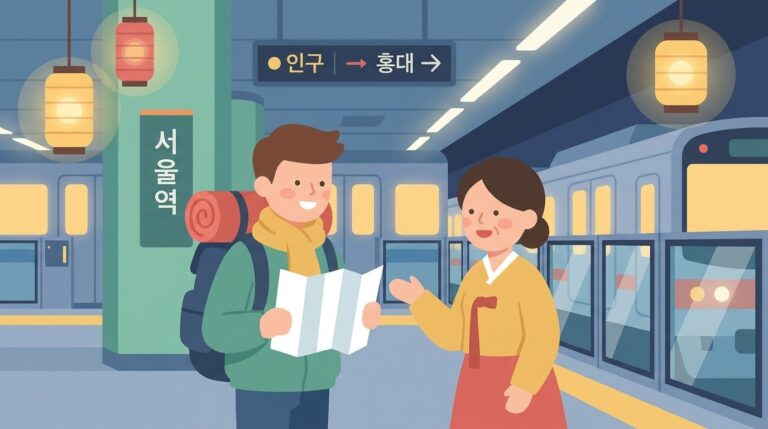
Don’t Miss the Last Train! Ask Like a Local in Seoul
안녕하세요! Hello! I am your warm, friendly Korean tutor from Daily Hangul. Imagine this: you’ve had an amazing day in Seoul. You enjoyed delicious Korean fried chicken and beer (치맥 chimaek) in Hongdae, sang your heart out at a singing room (노래방 noraebang), and suddenly you look at your phone. It’s 11:45 PM!
You rush into the underground station. The crowd is moving fast, and you’re not sure if the train is still running. You feel a pinch of panic. We’ve all been there! Even as an experienced traveler, missing the last train in a foreign city can be scary.
But don’t worry! Today, we are going to learn how to ask for the last train time in simple, A1-level Korean. Armed with these friendly phrases, you will feel like a confident local navigates the beautiful Seoul subway system.
Phase 2: Three Essential Expressions for the Last Train
1. 막차 시간은 몇 시예요? (What time is the last train?)
- Pronunciation: Mak-cha si-gan-eun myeot si-yeo-yo? (Sound-alike: “Mock-cha she-gahn-oon myut she-yo-yo?”)
- Meaning: What time is the last train? (Literal: Last train time is what hour?)
- K-Culture Moment: You often hear this in K-dramas when the main characters are having a romantic dinner, and one secretly hopes the last train has already left so they can walk together longer!
- Editor’s Insight: This is the most polite and natural way to ask any station staff or a friendly stranger near the ticket gates.
- Situation Spectrum:
- Casual (Friends): ✅ (With a slightly softer ending: 막차 시간 몇 시야?)
- Semi-formal (Colleagues): ✅
- Formal (Elderly/Staff): ✅
- 🤔 Think About It: In Korean, the word for “last train” is 막차 (mak-cha). Mak (막) means “last” or “end,” and cha (차) means “car” or “vehicle.” Can you see how Korean combines simple blocks to make new words? What is the word for train in your language?
2. 막차 끊겼어요? (Did the last train leave?)
- Pronunciation: Mak-cha kkeun-gyeot-seo-yo? (Sound-alike: “Mock-cha kkoon-gyut-suh-yo?”)
- Meaning: Is the last train gone? (Literal: Is the last train cut off?)
- K-Culture Moment: Picture a character running down the subway stairs, out of breath, asking a station worker with a worried face.
- Editor’s Insight: The verb 끊기다 (kkeun-gi-da) means “to be cut off” or “disconnected.” Koreans view public transport lines as continuous threads. When service stops, the thread is “cut!”
- Situation Spectrum:
- Casual (Friends): ✅
- Semi-formal (Colleagues): ✅
- Formal (Elderly/Staff): ⚠️ (Better to say: 막차 끊겼나요?)
3. 이거 막차예요? (Is this the last train?)
- Pronunciation: I-geo mak-cha-yeo-yo? (Sound-alike: “Ee-guh mock-cha-yeh-yo?”)
- Meaning: Is this the last train?
- K-Culture Moment: You are standing on a crowded platform, a train arrives, and everyone is rushing in. You quickly ask the person next to you before boarding.
- Editor’s Insight: Simple, fast, and highly effective when you are in a rush. “I-geo” means “this.”
- Situation Spectrum:
- Casual (Friends): ✅
- Semi-formal (Colleagues): ✅
- Formal (Elderly/Staff): ✅
Phase 3: Textbook Korean vs. Real Korean
When you study with traditional textbooks, you might learn sentences that sound too robotic. Let’s compare them to how real Koreans speak on the streets of Seoul!
Situation: Asking if there is still a train
- 📖 Textbook Korean: 마지막 열차가 아직 존재합니까? (Ma-ji-mak yeol-cha-ga a-jik jon-jae-hap-ni-ka? – “Does the final train still exist?”)
- 🗣️ Real Korean: 막차 아직 있어요? (Mak-cha a-jik is-seo-yo? – “Is the last train still here?”)
- 💡 Why is it different? Koreans prefer short, active verbs like “있다 (to be/exist)” over formal, academic terms. It sounds warmer and much more natural!
Situation: Urging a friend to hurry
- 📖 Textbook Korean: 신속하게 이동하십시오. (Sin-sok-ha-ge i-dong-ha-sip-si-o. – “Please move rapidly.”)
- 🗣️ Real Korean: 빨리 가야 돼요! (Ppal-li ga-ya dwae-yo! – “We have to go fast!”)
- 💡 Why is it different? The fast-paced lifestyle of Korea (known as the Pali-Pali culture) shines through everyday speech. Simple and urgent wins every time!
Phase 4: K-Culture Deep Dive & Non-verbal Manners
4-1. Subway Etiquette and Body Language
When asking for help in a busy Seoul station, your body language speaks volumes.
* The Gentle Bow: Before asking a question, slightly bow your head. This shows instant respect.
* Eye Contact: Avoid staring too intensely. A polite, brief eye contact followed by looking at the transit screen together is perfect.
* Pointing Manners: If you want to point at a digital train schedule, use your whole hand with palm facing up, rather than pointing with a single index finger, which can sometimes look aggressive.
4-2. The Realities of Seoul’s Nightlife Transit
Did you know that Seoul’s subway system is incredibly clean and safe, but it does not run 24 hours a day? On weekdays, most last trains run until about 12:00 AM to 1:00 AM. On weekends, they actually finish earlier (often around midnight). Keep this in mind when planning your epic night outs!
Phase 5: Roleplay Scenario: The Race Against Time in Hongdae
Setting: Hongdae Station, Line 2 platform. It’s 11:50 PM. Neon lights from street buskers are still glowing upstairs, but down here, everyone is walking fast. You see a friendly local holding a warm cup of coffee.
Cast:
* You (A traveler trying to get back to the hotel)
* Minho (A kind local wearing a stylish trench coat)
- Dialogue:
- You: 🎭 (Bowing slightly, looking a bit lost) 저기요… 죄송한데 질문이 있어요. (Jeo-gi-yo… joe-song-han-de jil-mun-i is-seo-yo. / Excuse me… I’m sorry, but I have a question.)
- Minho: 🎭 (Smiling warmly) 아, 네! 괜찮아요. 말씀하세요. (Ah, ne! Gwan-chan-a-yo. Mal-sseum-ha-se-yo. / Oh, yes! It’s okay. Please tell me.)
- You: 🎭 (Pointing to the track screen) 신촌 방향… 막차 아직 있어요? (Sin-chon bang-hyang… mak-cha a-jik is-seo-yo? / Toward Sinchon… is the last train still here?)
- Minho: 🎭 (Checking his phone app) 음, 신촌행이요? 잠시만요… (Eum, Sin-chon-haeng-i-yo? Jam-si-man-yo… / Um, bound for Sinchon? Just a moment…)
- You: 🎭 (Looking anxious) 막차 끊겼어요? (Mak-cha kkeun-gyeot-seo-yo? / Did the last train leave?)
- Minho: 🎭 (Pointing down the track as a train headlight appears) 아니요! 안 끊겼어요. 저기 오네요! (An-i-yo! An kkeun-gyeot-suh-yo. Jeo-gi o-nae-yo! / No! It’s not gone. Look, it’s coming over there!)
- You: 🎭 (Relieved, pointing to the arriving train) 이거 막차예요? (I-geo mak-cha-yeo-yo? / Is this the last train?)
- Minho: 🎭 (Nodding quickly) 네, 맞아요! 이거 타셔야 돼요. (Ne, ma-ja-yo! I-geo ta-syeo-ya dwae-yo. / Yes, that’s right! You must catch this one.)
- You: 🎭 (Stepping onto the train, bowing deeply) 정말 감사합니다! (Jeong-mal gam-sa-hap-ni-da! / Thank you so much!)
- Minho: 🎭 (Waving safely) 네, 잘 가세요! (Ne, jal ga-se-yo! / Yes, go safely!)
🔀 Decision Point
What would you do if Minho told you the train was gone?
* A) Cry on the platform. (Not recommended!)
* B) Ask: “택시 어디서 타요?” (Taek-si eo-di-seo ta-yo? / Where do I catch a taxi?)
* C) Sleep on the subway bench. (A bit too cold!)
- Best Choice Analysis: B is the absolute best! If you miss the last train, knowing how to ask for a taxi stand will save your night.
Phase 6: 10-Second Shadowing Drill
Let’s practice saying these out loud with feeling! Speak along with the emotional guides:
- [🥺 Worried & Urgent]
막차 / 아직 / 있어요?
(Mak-cha / a-jik / is-seo-yo?) -
[😱 Oh No! Panicking]
막차 / 끊겼어요?
(Mak-cha / kkeun-gyeot-seo-yo?) -
[😊 Relieved & Checking]
이거 / 막차예요?
(I-geo / mak-cha-yeo-yo?)
Phase 7: K-Culture Mini Dictionary
- 막차 (Mak-cha): The last train or bus of the night. A word filled with both relief and urgency!
- 지옥철 (Ji-ok-cheol): Meaning “Hell Subway.” A humorous blend of Jiok (Hell) and Subway (Subway) used to describe extremely packed trains during rush hours.
- 교통카드 (Gyo-tong-ka-deu): Transit card (like T-Money). Absolutely essential for smooth traveling in Korea!
- 야근 (Ya-geun): Overtime work. Many office workers miss the last train due to late-night work culture.
Phase 8: Traveler’s Survival Kit
Here are three instant phrases to keep in your pocket:
- 역무원 어디 있어요? (Yeok-mu-won eo-di is-seo-yo?) – Where is the station staff?
- 몇 번 출구예요? (Myeot beon chul-gu-yeo-yo?) – Which exit number is this?
- 티머니 충전 어디서 해요? (T-money chung-jeon eo-di-seo hae-yo?) – Where can I recharge my T-money card?
📌 Editor’s Travel Note: Always download the Naver Map App before arriving in Korea. Google Maps does not always show the most accurate walking paths or subway timetables in Korea, but Naver Map updates the exact last train times in real-time!
Phase 9: Going Deeper — Cultural Reflection
Korea is famous for its lively “night culture” (밤문화 bam-mun-hwa). Streets remain bright, safe, and active even past midnight. Because of this, public transit plays an important role. When people scream and run for the “makcha,” it is a shared community experience. Even strangers will hold the subway doors open for you if they see you sprinting!
💬 Your Turn: How late does the subway run in your hometown? Is it easy to find a ride home after midnight? Let us know in the comments below!
Phase 10: FAQ & Mistakes
Q: Do subways run 24 hours in Seoul?
A: No. Unlike some major global cities, Seoul subways close for safety maintenance overnight, usually closing around midnight to 1 AM.
Q: Can I buy a ticket with a foreign credit card?
A: It depends. Some machines accept them, but it is always safer to carry some cash to buy or recharge a physical T-Money card.
Q: What should I do if the subway is closed?
A: Look for “Owl Buses” (밤올빼미 버스) which run late at night, or use a taxi-hailing app like Kakao T.
🚨 Common Mistake Alert!
Do not say “마지막 기차” (ma-ji-mak gi-cha). While grammatically correct, gicha refers to long-distance trains (like the KTX bullet train). For city subways, always use 막차 (mak-cha)!
Phase 11: Action Missions
- 🥉 Bronze: Record yourself saying “막차 시간은 몇 시예요?” on your phone and listen to the flow.
- 🥈 Silver: Next time you watch a K-drama, try to spot the word 막차 during a nighttime scene.
- 🥇 Gold: When you visit Korea, ask a station worker “이거 막차예요?” instead of looking at your phone!
Phase 12: Interactive Quiz Challenge
Try to solve these fun questions to test your knowledge!
📝 Question 1: What is the most natural way to ask “Did the last train leave?”
Answer: 막차 끊겼어요? (Mak-cha kkeun-gyeot-seo-yo?)
Explanation: This is the perfect, natural 구어체 (spoken Korean) phrase used by locals.
📝 Question 2: True or False – Seoul Subways run 24/7 on weekends.
Answer: False!
Explanation: Seoul subways close overnight for maintenance. They actually close slightly earlier on weekends than weekdays!
“,







