

Why Seoul is Obsessed with Mid-Century Modern: Your Premium Korean Interior Design Guide
Phase 1: Empathy (공감 — The Seoul Aesthetic Obsession)
안녕하세요! (An-nyeong-ha-se-yo! / “Hello!”) It’s your favorite local navigator and senior editor at Daily Hangul.
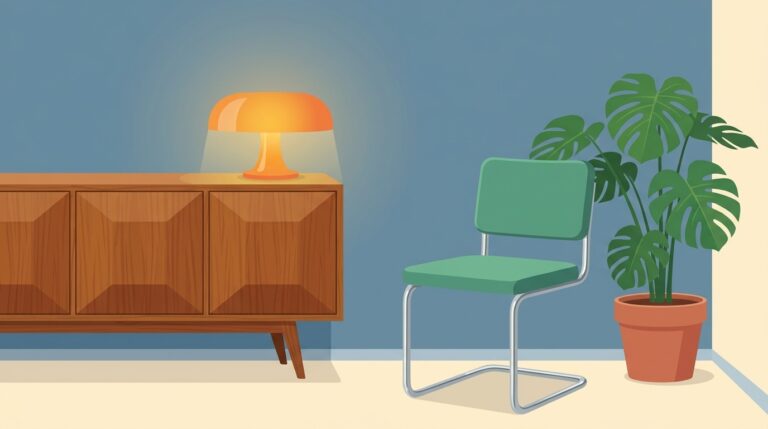
If you have stepped into a chic cafe in Seongsu-dong (성수동) recently, or scrolled through the curated lifestyle feeds of young Seoulites on Instagram, you have probably noticed a distinct aesthetic pattern. Sleek chrome-legged chairs, warm teak wood credenzas, vibrantly colored acrylic lamps (usually in striking orange or mustard yellow), and clean, geometric lines. Yes, the global Mid-Century Modern (미드 센추리 모던) style has taken Korea by storm.
But here is the catch: when talking to Korean friends about their homes, simply translating “I like retro furniture” doesn’t quite capture the sophisticated vibe. You might find yourself stuck using basic words like 예뻐요 (ye-ppeo-yo / “It is pretty”) or 좋아해요 (jo-a-hae-yo / “I like it”), missing out on the rich, nuanced design vocabulary that native Koreans use to express their aesthetic tastes.
In this premium guide, we are going to dive deep into the cultural phenomenon behind Korea’s mid-century modern obsession. By the end of this lesson, you won’t just understand why this trend exploded in Korea’s unique urban landscape; you will also master the high-level (C2) vocabulary needed to dissect spatial design, express subtle aesthetic feelings, and hold your own in a trendy design talk over a specialty flat white in Seoul. Let’s elevate your Korean to the next level!
Phase 2: Core Expressions Deep Dive (핵심 표현 3선)
To talk about interior design like a true connoisseur, you need expressions that capture both the structural element and the emotional vibe of the space. Here are three crucial expressions.
1. 미드센추리 모던 감성 (Mideu-senchuri Modeon Gamseong)
- Pronunciation: [mideu-sen-churi mo-deon gam-seong] / Sound-alike: “Mid-century modern gahm-seong”
- Meaning: Mid-Century Modern Vibe / Aesthetic.
- K-Culture Moment: Think of the trendy “officetels” (오피스텔) featured in high-end slice-of-life K-Dramas like Our Beloved Summer. The characters’ rooms are carefully curated with modular shelving and steel-framed desks, reflecting an intellectual yet artistic persona.
- Editor’s Insight: While “감성” (gamseong) literally translates to “sensitivity” or “emotion,” in modern Korean lifestyle discourse, it represents a highly coveted aesthetic currency. Saying a place has “미드센추리 모던 감성” means it successfully channels that specific, effortlessly cool, curated mid-century atmosphere.
- Situation Spectrum:
- Friends & Casual: ✅
- Semi-formal (Co-workers): ✅
- Formal (Business/Seniors): ✅
- 🤔 Think About It: Why do you think Koreans appended the word “감성” (vibe/sensitivity) to a Western architectural term? How does this highlight the Korean focus on subjective, shared emotional spaces over mere functional descriptions?
2. 철제와 원목의 조화 (Cheolje-wa Wonmok-ui Johwa)
- Pronunciation: [cheol-je-wa won-mok-ui jo-hwa] / Sound-alike: “Chul-jeh-wa won-mok-ee jo-hwa”
- Meaning: The harmony of metal/steel and natural solid wood.
- K-Culture Moment: Walk into any premium showroom in Hannam-dong, and you will hear designers using this phrase to describe how the cold, industrial feel of steel tubes balances the organic warmth of teak or walnut wood.
- Editor’s Insight: “원목” (wonmok) refers specifically to high-quality solid wood, distinct from cheap laminate (합판). The juxtaposition of metal and wood is the structural heart of the mid-century modern movement, and expressing this “조화” (harmony) showcases a very refined linguistic taste.
- Situation Spectrum:
- Friends & Casual: ✅
- Semi-formal (Co-workers): ✅
- Formal (Business/Seniors): ✅
- 🤔 Think About It: The concept of balance and harmony (조화) is deeply rooted in traditional Korean philosophy (like Um-Yang / Yin-Yang). How does this traditional value effortlessly find its way into modern interior appreciation?
3. 미니멀리즘과 실용성의 극대화 (Minimeolleijeum-gwa Silyongseong-ui Geukdaehwa)
- Pronunciation: [mi-ni-meol-li-jeum-gwa shi-ryong-seong-ui geuk-dae-hwa] / Sound-alike: “Minimal-ism-gwa sheel-yong-sung-ee geuk-deh-hwa”
- Meaning: Maximizing minimalism and practicality/functionality.
- K-Culture Moment: This is the ultimate design philosophy for modern Korean “one-room” (원룸 – studio apartment) dwellers who want their small spaces to look spacious, functional, yet incredibly stylish.
- Editor’s Insight: “실용성” (practicality) is a highly valued trait in fast-paced Korean society. Mid-century modern furniture is loved not just because it looks artistic, but because its modular and lightweight nature maximizes utility in compact urban living spaces.
- Situation Spectrum:
- Friends & Casual: ⚠️ (Slightly academic for casual chatter)
- Semi-formal (Co-workers): ✅
- Formal (Business/Seniors): ✅
- 🤔 Think About It: In your culture, do you prioritize aesthetic form or practical function when choosing furniture? How do you express that balance in your own language?
Phase 3: Textbook Korean vs. Real Korean Showcase
When you study with standard textbooks, the vocabulary can often feel sterile and outdated. Let’s look at how a textbook phrase transforms in the mouth of a real, trend-conscious Seoulite.
Situation 1: Expressing the desire to completely redecorate your room
- 📖 Textbook Korean: “제 방의 가구를 바꾸고 싶습니다.” (I want to change my room’s furniture.)
- 🗣️ Real Korean: “이번 기회에 방을 ‘미드센추리 감성’으로 싹 갈아엎으려고요.” (I’m planning to completely gut and re-do my room with that ‘mid-century vibe’ this time.)
- 💡 Why the difference? “싹 갈아엎다” (ssak garaeopda) is a highly expressive idiomatic verb meaning “to completely overturn/renovate.” It conveys a passionate, dramatic transformation rather than a simple exchange of furniture.
Situation 2: Complimenting a friend’s beautifully styled living room
- 📖 Textbook Korean: “당신의 거실 인테리어가 매우 아름답습니다.” (Your living room interior is very beautiful.)
- 🗣️ Real Korean: “와, 거실 대박이다! 완전 인스타 감성 뿜뿜이네요. 가구 매칭이 완전 찰떡이에요!” (Wow, your living room is incredible! It’s totally overflowing with Instagram vibes. Your furniture matching is absolutely spot-on!)
- 💡 Why the difference? “뿜뿜” (ppum-ppum) is a playful onomatopoeia for “overflowing/gushing with a certain energy,” and “찰떡” (chal-tteok – sticky rice cake) is used metaphorically to describe a perfect, seamless match or chemistry between items.
⚠️ Bottom Note: While these slangs are incredibly natural and will immediately make you sound like an insider, reserve “싹 갈아엎다” and “뿜뿜” for peers and close colleagues. In professional interior consultations, stick to “조화롭다” (harmonious) and “재구성하다” (reconstruct).
Phase 4: K-Culture Deep-Dive & Non-Verbal Manners
4-1. “Nunchi” (눈치) and Spatial Etiquette
In Korea, space is a premium luxury. Because the majority of urban Koreans live in apartments (아파트) or officetels (오피스텔), showing off a cluttered house is seen as a lack of spatial mindfulness or 눈치 (Nunchi – situational awareness/tact).
When visiting a Korean friend’s home, do not immediately touch or sit on expensive designer furniture (like a original USM Haller system shelf or a Fritz Hansen chair) without permission. Instead, take a step back, gently clasp your hands, scan the room, and offer a verbal compliment first. Expressing appreciation for the “여백의 미” (yeobaek-ui mi / “the beauty of empty space”) shows that you understand both design and Korean cultural sensitivity.
4-2. The Pandemic “Zip-kok” (집콕) Phenomenon
Why did Mid-Century Modern explode specifically in the 2020s in Korea? The answer lies in the word 집콕 (Zip-kok / staying cocooned at home) during the pandemic.
With cafes closed and international travel blocked, young Koreans redirected their disposable income toward personal spaces. The style’s bold primary colors (orange, green, blue) offered a psychological escape from the monotonous gray concrete architecture of Seoul. It became a form of self-expression—a curated backdrop for the booming trend of 랜선 집들이 (Laenseon Jipdeuri / online virtual housewarmings) on YouTube and Instagram.
Phase 5: Interactive Roleplay Scenario
The Setting: You are visiting a vintage design furniture showroom in the trendy backalleys of Seongsu-dong with Ji-won (지원), a local interior stylist who is helping you source pieces for your new apartment. The room smells of polished teak oil and beeswax, with smooth lofi-jazz playing in the background.
Dialogue
- Ji-won: (🎭 Points to an authentic 1960s Danish teak sideboard with sleek chrome handles) “여기 보세요! 이 사이드보드 진짜 대박이지 않아요?”
(Look at this! Isn’t this sideboard absolutely amazing?) - You: “와, 대박… 철제와 원목의 조화가 진짜 예술이네요.”
(Wow, incredible… The harmony of steel and solid wood is truly art.) - Ji-won: (🎭 Nods enthusiastically, adjusting her glasses) “맞아요! 이게 바로 미드센추리 모던의 핵심이거든요. 따뜻한 원목 느낌에 차가운 스틸이 들어가니까 전혀 지루하지 않죠?”
(Exactly! That’s the core of mid-century modern. Adding cold steel to warm solid wood makes it not boring at all, right?) - You: “진짜 그래요. 이 가구 하나로 방 전체에 감성 인테리어가 완성될 것 같아요.”
(Indeed. I feel like this single piece of furniture would complete the ‘emotional interior’ of the whole room.) - Ji-won: “안 그래도 요즘 한국에서 1인 가구들 사이에서 이 감성이 완전 대세예요. 좁은 공간도 넓어 보이게 만드는 마법이 있거든요.”
(Actually, these days, this vibe is a massive trend among single-person households in Korea. It has a magic that makes tight spaces look wider.) - You: “공간의 실용성을 극대화하는 구조라서 그런가 봐요.”
(Maybe that’s because the structure maximizes the practicality of the space.) - Ji-won: “오, 정답이에요! 역시 가구를 보는 안목이 있으시네요. 혹시 이 오렌지색 아크릴 조명은 어때요? 같이 매칭하면 어울릴까요?”
(Oh, correct! You really have an eye for furniture. What do you think about this orange acrylic lamp? Would it match well if we paired them together?)
🔀 Decision Point: How do you respond to Ji-won’s styling suggestion?
- Option A: “조명이 너무 화려해서 사이드보드랑 잘 안 맞을 것 같아요.”
(The lamp is too flashy, so I don’t think it fits well with the sideboard.) - Option B: “완전 찰떡일 것 같아요! 밋밋한 원목에 오렌지 컬러로 포인트를 주면 감성이 더 살겠네요.”
(I think they’d be a perfect match! Giving a point with orange color on plain solid wood would elevate the vibe even more.) - Option C: “그냥 다른 거 보여주세요.”
(Just show me something else.)
💡 Choices Analysis:
- Best Choice (Option B): Excellent! You used the highly natural idiomatic word “찰떡” (chal-tteok) and the design term “포인트” (point/accent color). This shows deep appreciation for styling nuances and immediately makes Ji-won feel respected as a curator.
- Mediocre Choice (Option A): grammatically correct, but a bit too direct and dismissive. In Korean design discussions, offering soft counter-proposals (e.g., “조금 더 차분한 톤도 어울릴 것 같은데, 어떻게 생각하세요?” / “I think a slightly calmer tone might also fit, what do you think?”) keeps the conversation harmonious.
- Risky/Bad Choice (Option C): Extremely blunt and borderline rude. It lacks “눈치” (Nunchi) and breaks the creative synergy of the styling session.
Phase 6: 10-Second Emotion Shadowing Drill
Let’s practice speaking with real Korean emotion! Focus on the pauses (/) and try to mimic the native flow.
Drill 1: [😍 Overwhelmed with Aesthetic Joy]
- Sentence: “완전 / 인스타 감성 / 뿜뿜이네요! / 가구 배치가 / 완전 찰떡이에요!”
- Pronunciation Guide: [Wan-jeon / in-seu-ta gam-seong / ppum-ppum-i-neyo! / ga-gu bae-chi-ga / wan-jeon chal-tteok-i-e-yo!]
- Intonation Tip: Elevate your pitch on “뿜뿜” (ppum-ppum) and make “찰떡” (chal-tteok) sound punchy and tight to emphasize the perfect match.
Drill 2: [🤔 Reflecting and Impressed]
- Sentence: “철제와 원목의 / 조화가 / 진짜 예술이네요. / 공간이 / 확 살아나요.”
- Pronunciation Guide: [Cheol-je-wa won-mok-ui / jo-hwa-ga / jin-jja ye-sul-i-neyo. / Gong-gan-i / hwak sal-ah-na-yo.]
- Intonation Tip: Drag the “진짜~” (jin-jja~) slightly to show deep contemplation, and drop your voice slightly on “예술이네요” (ye-sul-i-neyo) to sound like a genuine design critic.
Phase 7: K-Culture Mini Dictionary (4 Key Terms)
- 오늘의집 (Oneul-ui Zip / “Today’s House”)
- The absolute holy grail app for interior design in Korea. It is a mix of social media, styling guides, and e-commerce. If you want to study real-life Korean interior trends, downloading this app is your first step.
- 미드센추리 (Mideu-senchuri / “Mid-Century”)
- Though imported from the US/Europe, Koreans use this shorthand to refer to a specific lifestyle lifestyle that values modern, bright accents, steel modular shelving, and vintage posters.
- 1인 가구 (Ilin Gagu / “Single-Person Household”)
- The demographic driver behind Korea’s modern design trends. With solo living rising dramatically in Seoul, furniture has become smaller, more modular, and highly aesthetic.
- 플랜테리어 (Planterior)
- A portmanteau of “Plant” and “Interior”. Mid-century modern in Korea is almost always paired with unique houseplants like Monsteras or Olive trees to soften the metallic industrial elements.
Phase 8: Traveler’s Survival Kit
Even if you are not buying furniture, you will use these when cafe-hopping in Seoul!
| Expression (한글) | Romanization | English & Pro Tip |
|---|---|---|
| 여기 인테리어 진짜 예쁘다. | Yeo-gi in-te-ri-eo jin-jja ye-ppeu-da. | “The interior here is so pretty.” Use this casually the moment you walk into a beautifully decorated cafe. |
| 혹시 가구 브랜드가 어디 건가요? | Hok-shi ga-gu beu-raen-deu-ga eo-di geon-ga-yo? | “Excuse me, what brand is this furniture?” A highly sophisticated question to ask a cafe owner or host. |
| 사진 찍기 딱 좋은 조명이네요. | Sa-jin jjik-gi ttak jo-eun jo-myeong-i-ne-yo. | “This lighting is perfect for taking photos.” Great to say when you find a warm, aesthetic corner. |
📌 Editor’s Travel Note: To find the absolute best mid-century modern cafes and vintage showrooms in Seoul, do not search on Google Maps (which has limited local updates). Instead, download Naver Map and search using the keywords “미드센추리 카페” (Mid-century cafe) or “빈티지 가구 쇼룸” (Vintage furniture showroom) for hyper-local results.
Phase 9: Deep Thought — “Going One Step Deeper” (한 발 더 깊이)
Historically, Korean interior design was dominated by traditional apartment layouts designed for uniform, collective family living. However, the meteoric rise of Mid-Century Modernism reflects a profound shift in the psychological makeup of the younger generation. In a society that historically emphasized communal harmony and uniformity, personal spaces have become the ultimate sanctuary for individual identity.
By curating a space with bold, unconventional steel shapes and vibrant colors, young Koreans are quietly protesting against the monotonous, grey apartment complexes that dominate the Seoul skyline. It is not just about furniture; it is a visual statement of who they are.
💬 Your Turn: How does interior design reflect the social changes in your home country? Do people prioritize collective comfort or individual aesthetic expression? Let us know in the comments below!
Phase 10: FAQ & Common Mistakes
Q: Can I use “인테리어” (Interior) to refer to the actual furniture itself?
A: No. In English, “interior” is a broad term, but in Korean, “인테리어” usually refers to the overall spatial layout, wallpaper, and lighting vibes. For physical items, always use 가구 (ga-gu / “furniture”) or 소품 (so-pum / “props/decor accessories”).
Q: Is there a difference between “빈티지” (Vintage) and “레트로” (Retro) in Korean?
A: Yes, subtly. “빈티지” (bin-ti-ji) implies high-end, authentic historical items (like original 60s chairs). “레트로” (re-teu-ro) or “뉴트로” (new-tro) refers to newly manufactured items designed to look old-school, often with a playful, nostalgic pop culture vibe.
Q: How do I ask if a piece of furniture is an original or a replica politely?
A: You can ask: “이거 오리지널 제품인가요, 아니면 복각(레플리카) 제품인가요?” (Is this an original product, or a re-edition/replica product?).
🚨 Common Mistakes Warning Board
- Mistake: Calling every old thing “고가구” (Go-gagu).
- Why: “고가구” refers specifically to traditional traditional Korean antique wooden furniture (Chosun dynasty chests, etc.). For Western mid-century items, use 빈티지 가구 (vintage furniture).
- Mistake: Pronouncing “Modern” as English “Mah-dern”.
- Why: It should be pronounced phonetically using Korean vowels as 모던 (mo-deon).
- Mistake: Using “아주” (a-ju / very) in casual conversations.
- Why: While grammatically correct, it sounds like a textbook. Use 진짜 (jin-jja) or 완전 (wan-jeon) to sound naturally fluent.
Phase 11: Action Missions
- 🥉 Bronze Mission (The Solo Mirror Challenge): Look at your own room. Record a voice memo saying: “내 방도 미드센추리 감성으로 싹 갈아엎고 싶다!” (I want to completely renovate my room with a mid-century vibe!) with passionate energy.
- 🥈 Silver Mission (The Digital Explorer): Open Instagram, search the hashtag
#오늘의집or#미드센추리모던. Find a picture you like, and leave a comment in Korean: “철제와 원목의 조화가 진짜 예술이네요!” (The harmony of steel and wood is truly art!) - 🥇 Gold Mission (The Seoul Cafe Hunt): Go to a trendy cafe in your city (or Seoul). Order your drink, point to an interesting piece of furniture, and ask the barista or owner: “이 가구 진짜 예쁜데, 혹시 어디 브랜드 제품인가요?”
- 🎮 K-Culture Mission: Watch a modern lifestyle K-drama (like Lovestruck in the City). Spot one piece of mid-century furniture (a modular shelf, a plastic dining chair) and sketch it in your language journal with its Korean name!
Phase 12: Interactive Quiz Challenge
Test your new interior design and cultural knowledge!
1. Situational Judgment
Which response is the most culturally savvy and linguistically natural when someone invites you to their newly decorated studio apartment?
– A) “방이 참 좁은데 가구가 크네요.” (The room is quite small but the furniture is big.)
– B) “완전 인스타 감성 뿜뿜이네요! 가구 조화가 완전 찰떡이에요.”
– C) “이 가구들 다 가짜 레플리카죠?”
View Answer & Explanation
- Correct Answer: B
- Why: Option B uses great slang (“뿜뿜”, “찰떡”) and compliments the aesthetic, which is highly appreciated in Korea’s prideful “housewarming” (집들이) culture. Option A and C are highly offensive and lack Nunchi!
2. Fill in the Blanks
Complete the sentence:
“이 사이드보드는 차가운 ( )와 따뜻한 ( )의 조화가 정말 매력적이에요.”
(This sideboard is really charming due to the harmony of cold steel and warm solid wood.)
View Answer & Explanation
- Correct Answer: 철제 (cheolje / steel) / 원목 (wonmok / solid wood)
3. True or False?
In Korea, “오늘의집” (Today’s House) is merely an apartment renting app.
View Answer & Explanation
- Correct Answer: False
- Why: 오늘의집 is Korea’s largest lifestyle and interior platform where people share styling tips, buy furniture, and show off their home makeovers.







