

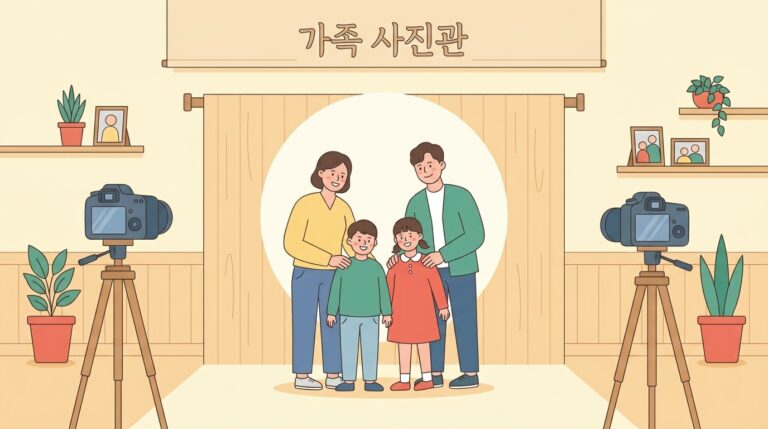
Capture Your Perfect Family Memories: A Beginner’s Guide to Korean Photo Studios
안녕하세요! (Annyeonghaseyo!) Warmest greetings from your favorite Korean tutor and local culture navigator at Daily Hangul!
Have you ever watched a K-Drama where the main characters walk into a cozy neighborhood photo studio (사진관 – sa-jin-gwan) and come out with a stunning, perfectly lit family portrait hanging in their living room? Taking a formal family photo is a huge milestone and a beautiful tradition in Korea.
But if you walk into a Korean photo studio as a beginner, you might freeze up. How do you tell the photographer what you want? How do you ask for those famous, natural-looking retouches without sounding like a robot?
Don’t worry! Today, we are going to learn the exact survival phrases and cultural secrets you need to make your family photo session in Korea stress-free, fun, and absolutely picture-perfect.
Phase 2: Core Expressions Deep-Dive
Let’s master the three most important phrases you will need at a Korean photo studio.
1. 가족사진 찍으러 왔어요. (Ga-jok-sa-jin jji-geu-reo wa-sseo-yo.)
- Pronunciation Guide: gah-jok-sah-jin jjee-gheu-ruh wah-ssuh-yo
- Sound-alike: Think of “gajeok” like “gah-jok” (family) and “wasseoyo” like “wah-so-yo” (came to do).
- Meaning: “We came to take a family photo.”
- K-Culture Moment: In many warm family dramas, family members secretively wear matching white shirts and jeans, open the studio door, and proudly declare this phrase to surprise their parents.
- Editor’s Insight: This is your perfect icebreaker! As soon as you walk in, say this with a smile. It instantly tells the staff what service you are looking for.
- Situation Spectrum:
- Casual (Friends): ⚠️ (Too formal for friends, use “우리 사진 찍으러 왔어” instead)
- Semi-formal (Staff/Photographer): ✅ (Perfect and highly polite!)
- Formal (Elderly/Business): ✅
- 🤔 Think About It: In Korean, we often omit the subject “We” (우리 – u-ri) because the context makes it obvious. Why do you think Korean culture values this group-context over stating “I” or “We” every time?
2. 자연스럽게 보정해 주세요. (Ja-yeon-seu-reop-ge bo-jeong-hae ju-se-yo.)
- Pronunciation Guide: jah-yuhn-seu-ruh-pgae bo-juhng-hae joo-seh-yo
- Sound-alike: “Bojeong” sounds like “bo-jung” (retouching/editing).
- Meaning: “Please retouch/edit the photo naturally.”
- K-Culture Moment: Korea is world-famous for high-tech photo editing (보정). However, if you don’t specify, you might end up looking like a completely different person! This phrase ensures you keep your natural charm while looking flawless.
- Editor’s Insight: The word “보정” (bo-jeong) is key here. It doesn’t mean drastic plastic-surgery style editing; it means cleaning up the skin tone, lighting, and flyaway hairs.
- Situation Spectrum:
- Casual (Friends): ⚠️
- Semi-formal (Staff/Photographer): ✅
- Formal (Elderly/Business): ✅
3. 액자로 만들고 싶어요. (Aek-ja-ro man-deul-go si-peo-yo.)
- Pronunciation Guide: aek-jah-roh mahn-deul-goh shi-puh-yo
- Sound-alike: “Aekja” sounds like “eck-jah” (picture frame).
- Meaning: “I want to make it into a framed photo.”
- K-Culture Moment: If you visit a Korean home, you will almost always see a giant, beautifully framed family portrait hanging in the center of the living room. It’s a symbol of family unity and warmth.
- Editor’s Insight: After choosing your best shot, use this phrase to order a physical frame to hang in your home or gift to your parents.
- Situation Spectrum:
- Casual (Friends): ⚠️
- Semi-formal (Staff/Photographer): ✅
- Formal (Elderly/Business): ✅
Phase 3: Textbook Korean vs. Real Korean
Let’s compare what textbooks teach you versus what Koreans actually say in the studio!
Situation 1: Asking the photographer to make you look good
- 📖 Textbook: “저를 아름답게 수정해 주십시오.” (Jeo-reul a-reum-dap-ge su-jeong-hae ju-sip-si-o. / Please modify me beautifully.)
- 🗣️ Real Korean: “사장님, 포토샵 예쁘게 잘 부탁드려요~!” (Sa-jang-nim, po-to-syap ye-ppeu-ge jal bu-tak-deu-ryeo-yo! / Boss, please do some nice Photoshop magic for me!)
- 💡 Why is it different? Koreans friendly call small business owners “사장님” (sa-jang-nim / boss). Using the word “포토샵” (Photoshop) is much more natural and conversational than the stiff textbook word “수정” (modification).
Situation 2: Ready to strike a pose
- 📖 Textbook: “미소를 지으십시오.” (Mi-so-reul ji-eu-sip-si-o. / Please wear a smile.)
- 🗣️ Real Korean: “하나, 둘, 셋, 김치~! 손가락 하트 해볼까요?” (Ha-na, dul, set, gim-chi~! Son-ga-rak ha-teu hae-bol-kka-yo? / One, two, three, Kimchi~! Shall we do finger hearts?)
- 💡 Why is it different? Real photographers use energetic cues to make you laugh. “김치” (Kimchi) or “치즈” (Cheese) is standard, often combined with the famous “손가락 하트” (finger heart) to ease the tension.
Phase 4: K-Culture Deep-Dive & Non-verbal Manners
4-1. The Art of
Frequently Asked Questions (FAQ)
Q: What does "가족사진 찍으러 왔어요. (Ga-jok-sa-jin jji-geu-reo wa-sseo-yo.)" mean in Korean and how do you pronounce it?
A: In Korean, "가족사진 찍으러 왔어요. (Ga-jok-sa-jin jji-geu-reo wa-sseo-yo.)" is pronounced [Guide: gah-jok-sah-jin jjee-gheu-ruh wah-ssuh-yo] and means: "We came to take a family photo."
Q: What does "자연스럽게 보정해 주세요. (Ja-yeon-seu-reop-ge bo-jeong-hae ju-se-yo.)" mean in Korean and how do you pronounce it?
A: In Korean, "자연스럽게 보정해 주세요. (Ja-yeon-seu-reop-ge bo-jeong-hae ju-se-yo.)" is pronounced [Guide: jah-yuhn-seu-ruh-pgae bo-juhng-hae joo-seh-yo] and means: "Please retouch/edit the photo naturally."
Q: What does "액자로 만들고 싶어요. (Aek-ja-ro man-deul-go si-peo-yo.)" mean in Korean and how do you pronounce it?
A: In Korean, "액자로 만들고 싶어요. (Aek-ja-ro man-deul-go si-peo-yo.)" is pronounced [Guide: aek-jah-roh mahn-deul-goh shi-puh-yo] and means: "I want to make it into a framed photo."






